
◆ Health & Education
BIOL 155 UBC: how do you do well in Human Biology?
BIOL 155 Human Biology: Physiology and Introductory Anatomy is a 6-credit, year-long course at the University of British Columbia (UBC) in Vancouver, running from September to April. It is the lecture-only version of a human biology sequence, and it covers ten major organ systems in 47 numbered lectures. This guide explains how MAAS mentors read its structure and how students can spend their study time where the marks are.
Note on the code: this guide describes the UBC Vancouver course. Other universities, mostly outside Canada, use BIOL 155 for different subjects, so forum advice filed under the same code may not apply. MAAS is an independent academic support provider with no affiliation to the University of British Columbia.
◆ Question 1 / 8 · What is BIOL 155,
What is BIOL 155, and who takes it?
Direct answer: BIOL 155 is a foundational human physiology and anatomy course for students in General Sciences, Biology, and those preparing for health professional degrees. It counts as science elective credit, but it does not satisfy prerequisites for upper-level life sciences courses, and it is not itself a prerequisite for Medicine or Dentistry.
Evidence: The UBC Vancouver Academic Calendar for 2025/26 lists BIOL_V 155 at 6 credits, in a [3-0-0; 3-0-0] format, meaning three lecture hours a week in each of two terms. The prerequisite is one of CHEM 12, CHEM 100, CHEM 110 or CHEM 111, plus one of BIOL 11, BIOL 12 or BIOL 111. The Biology Program's general syllabus, dated February 2023, sets five learning objectives. They cover physiology across systems, the link between structure and function, applying that knowledge and explaining it to a non-expert, thinking critically about its place in health care practice, and professional conduct expected of future health care workers.
Example: A Nursing-track student and a General Science student can share the same Monday lecture. The first needs the course to move toward a clinical programme, while the second needs a 6-credit science elective with a lighter laboratory load. BIOL 155 suits both because it asks for the same skill: explain how a structure works and what changes when something goes wrong.
◆ Question 2 / 8 · Is BIOL 155 the
Is BIOL 155 the same as BIOL 153?
Direct answer: No. They were the lab and lecture-only versions of the same human biology teaching. BIOL 153 carried 8 credits and a weekly laboratory; BIOL 155 carries 6 credits and no laboratory. The UBC Biology Program course listing now marks BIOL 153 as no longer offered.
Evidence: A 2019 Biology Program syllabus describes BIOL 155 as "the lecture-only version" of the program, with 3 hours of lecture a week, while BIOL 153 added a 3-hour laboratory and a 1-hour tutorial. Under that older syllabus BIOL 155 marks came solely from the lecture exams, at 15% for each of two midterms, 35% for the winter exam and 35% for the final. The later syllabus is different, as the next section shows.
Example: A student who finds a 2019 study guide for BIOL 155 and a 2023 outline for the same course can read two different grading schemes. Treat any older guide as a description of the content only, and confirm the weights against your own section's outline.
◆ Question 3 / 8 · How is BIOL 155
How is BIOL 155 graded?
Direct answer: In the February 2023 syllabus, 70% of the grade comes from four lecture exams and 30% from tutorial work. That is the last published scheme MAAS could read directly. The syllabus calls itself a general representation of the course as previously offered and subject to change, so your own section's outline decides.
How the BIOL 155 grade is weighted
February 2023 UBC Biology Program syllabus, which says it may change.
Two midterms
20
% of the grade
Winter-term final
20
% of the grade
End-of-year final
30
% of the grade
Tutorial work
30
% of the grade
Save this figure
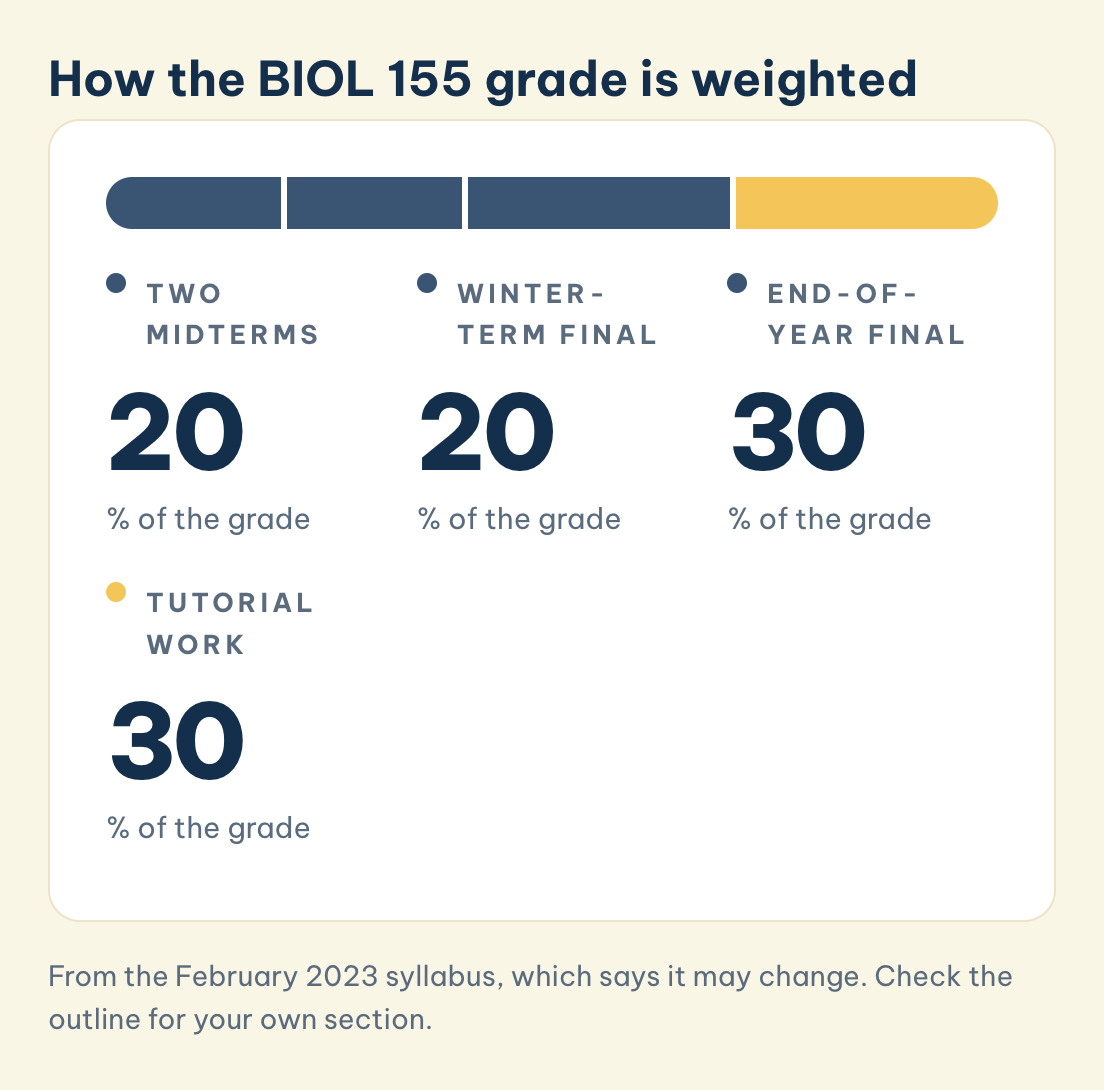
Evidence: The 2023 syllabus lists two in-class midterms (one in November, one in March) at 10% each, a winter-term final in the December exam period at 20%, and an end-of-year final in the April exam period at 30%. Tutorial work adds 30%: a weekly pre-tutorial assignment (5% in total across 21 tutorials), weekly tutorial attendance (5%), weekly tutorial quizzes (10%) and two tutorial term finals at 5% each. Searching the web returns other splits, including one with a 25% year-end final, so the table below shows only the scheme MAAS read in the Biology Program's own document.
| Component | Weight | Notes |
|---|---|---|
| Two in-class midterms | 20% | 10% each, November and March |
| Winter-term final | 20% | December exam period |
| End-of-year final | 30% | April exam period |
| Weekly pre-tutorial assignments | 5% | 0.25% each across 21 tutorials |
| Weekly tutorial attendance | 5% | 0.25% each |
| Weekly tutorial quizzes | 10% | 0.5% each |
| Tutorial term finals | 10% | 5% each, end of each term |
Example: Suppose a student collects 28 of the 30 tutorial points through steady preparation and attendance. To finish the year at 70%, that student needs 42 more points from the 70 available in the lecture exams, which is 60% on the exams. Tutorial work is not a side activity, because 30 of the 100 points are available before any exam is sat.
◆ Question 4 / 8 · What do the midterms
What do the midterms and finals actually cover?
Direct answer: The exams follow the lecture schedule, and the syllabus gives the scope of the two midterms: lectures 1 to 14 in Term 1 and lectures 25 to 35 in Term 2. The syllabus does not state the question format, so ask your instructor or check the course site rather than rely on a forum post.
Evidence: The 2023 syllabus numbers the lectures L1 to L47. Term 1 runs from the introduction and tissue basics through the skeletomuscular, nervous and endocrine systems to reproduction and pregnancy. Term 2 moves from the cardiovascular system to the respiratory, immune, digestive and urinary systems, ending with the regulation of urine and the medullary osmotic gradient. The required materials are the textbook Visual Anatomy & Physiology (3rd edition) by Martini and colleagues and a Visible Body Courseware subscription for the anatomy atlas.
Example: A student counting weeks can see that the November midterm falls in Week 10 of Term 1 and covers L1 to L14, while the Term 1 final in December covers the full term. Planning review blocks backwards from those dates is more reliable than studying chapters in textbook order.
◆ Question 5 / 8 · How do you build
How do you build a weekly review routine?
Direct answer: Review each lecture within a few days, again at the end of each system, and again before each exam, with retrieval at every pass. Reading notes again feels productive but rates poorly in the research. Practice testing and spacing your reviews over weeks rate highly.
Evidence: Dunlosky et al. (2013) compared 10 learning techniques and wrote in their abstract that "practice testing and distributed practice received high utility assessments" (Dunlosky et al., 2013, p. 4). Highlighting and rereading, which students report relying on heavily, rated low. Cepeda et al. (2006) reviewed distributed practice in verbal recall tasks and showed that spacing study across sessions beats packing it into one. Both findings point to the same plan for a course with 47 lectures: short, repeated sessions with a quiz at the end of each.
Example: For the cardiac cycle (L28), a student could sketch the pressure-volume sequence from memory on the evening of the lecture, then again at the weekend, then again two weeks later. Each attempt takes about 10 minutes. Checking the sketch against Martini's figure after the attempt shows exactly which valve event was forgotten.
◆ Question 6 / 8 · How do you study
How do you study for the BIOL 155 exams?
Direct answer: Practise retrieval instead of rereading. Close the notes, write or draw what you remember, then check. Karpicke and Blunt (2011) found that retrieval practice produced more learning from science texts than elaborative studying with concept mapping, a technique many biology students use heavily.
Evidence: The abstract of that study states: "Here, we show that practicing retrieval produces greater gains in meaningful learning than elaborative studying with concept mapping" (Karpicke & Blunt, 2011, p. 772). The authors add that the advantage held for texts like those found in science education, and for questions that required inference as well as recall. For BIOL 155, where exams add up to 70% of the grade across four sittings, the practical translation is to spend most of a study session answering questions, not recopying material.
Example: For the nervous system block (L9 to L15), a student writes five questions per lecture, such as "Why does the action potential not travel backwards?", answers them without notes the next day, and marks each answer correct, partly correct or missing. The missing items become the next session's list.
◆ Question 7 / 8 · How do you learn
How do you learn long physiological sequences?
Direct answer: Learn a sequence as a chain of causes. Write the trigger, the sensor, the response and the effect on the next step. Then redraw the chain without notes and explain it aloud. Blood pressure control, ventilation and nephron filtration all reward this method.
Evidence: The Term 2 lecture list gives the structure. Blood flow and pressure (L29 to L32) rest on the relationship between cardiac output and resistance, where cardiac output is heart rate multiplied by stroke volume. Ventilation (L34) turns on Boyle's law, which links the volume of the chest to the pressure of the air in it. The urinary lectures (L44 to L47) move from glomerular filtration through tubular reabsorption and secretion to the medullary osmotic gradient. Each topic is a sequence in which a change at one step shifts the next.
Example: For "What happens to blood pressure when a person stands up quickly?", a strong answer names the pooling of blood in the legs, the drop in venous return, the lower stroke volume and cardiac output, the reflex that raises heart rate and vessel tone, and the return of pressure. A weaker answer says "the body adjusts". The first answer can be marked line by line.
◆ Question 8 / 8 · Can you get help
Can you get help with BIOL 155?
Direct answer: You can get help understanding the physiology and checking your own explanations, but the work you submit must be yours. UBC's academic misconduct rules list paying a tutor to do your work as cheating, and the same rules apply to the weekly pre-tutorial assignments and quizzes.
Evidence: Section 3.1 of the UBC Vancouver Academic Calendar's discipline provisions includes "retaining or paying a tutor or another person to do your work" among examples of cheating, and also lists accessing websites or online resources not permitted by the instructor. The disciplinary measures in section 9 range from a zero on the work to a failing grade in the course, a notation on the transcript, suspension and expulsion.
Example: A legitimate tutoring session looks like this. A student brings a pressure-control diagram they drew, explains it aloud, and is asked where each arrow comes from. The tutor corrects the physiology, but the diagram, the explanation and every submitted answer stay the student's own.
Frequently asked questions
Is BIOL 155 the same as BIOL 153 at UBC?
No. BIOL 153 was the 8-credit version with a laboratory and is listed by the Biology Program as no longer offered. BIOL 155 is the 6-credit, lecture-only course.
What are the prerequisites for BIOL 155?
The UBC Vancouver calendar for 2025/26 lists one of CHEM 12, CHEM 100, CHEM 110 or CHEM 111, plus one of BIOL 11, BIOL 12 or BIOL 111.
How much is the final exam worth?
In the February 2023 syllabus the end-of-year final is worth 30% and the winter-term final 20%. Older and newer outlines can differ, so check your own section.
Which textbook does BIOL 155 use?
The 2023 syllabus lists Visual Anatomy & Physiology (3rd edition) by Martini and colleagues and a Visible Body Courseware subscription. Confirm the current edition with your instructor.
Does MAAS write BIOL 155 assignments?
No. MAAS tutors explain physiology and question the reasoning in notes and diagrams you have prepared yourself. Every submitted task must be your own work under UBC's academic integrity rules.
Related reading
- BIOL234 Nutritional Physiology: another health and life sciences guide, where mechanism detail matters more than listing facts
- How to write a critical review: a step-by-step method for judging a source rather than summarising it
- How to design a systematic review in the health sciences: how reviews rank and combine evidence
Where MAAS fits
- Subject tutoring, one to one: 60 or 90 minute sessions with a tutor matched to health and life sciences, working through mechanisms and reasoning you have already attempted. Tutoring is advisory, so it carries no grade target; if the tutor is not the right fit, you can ask to change expert
- Course-code assignment coaching: how MAAS mentors approach any unit assignment
References
- Cepeda, N. J., Pashler, H., Vul, E., Wixted, J. T., & Rohrer, D. (2006). Distributed practice in verbal recall tasks: A review and quantitative synthesis. Psychological Bulletin, 132(3), 354–380. https://doi.org/10.1037/0033-2909.132.3.354
- Dunlosky, J., Rawson, K. A., Marsh, E. J., Nathan, M. J., & Willingham, D. T. (2013). Improving students' learning with effective learning techniques: Promising directions from cognitive and educational psychology. Psychological Science in the Public Interest, 14(1), 4–58. https://doi.org/10.1177/1529100612453266
- Karpicke, J. D., & Blunt, J. R. (2011). Retrieval practice produces more learning than elaborative studying with concept mapping. Science, 331(6018), 772–775. https://doi.org/10.1126/science.1199327
Tools & resources
- University of British Columbia Biology Program. (2023). BIOL 155 – Human Biology: Physiology and Introductory Anatomy: General course syllabus [Syllabus, as of February 2023]. Retrieved October 12, 2026, from https://biologyprogram.sites.olt.ubc.ca/files/2023/02/Syllabus_BIOL155_2023-v2.pdf
- University of British Columbia Biology Program. (2019). BIOL 153 and BIOL 155 general course syllabus [Syllabus]. Retrieved October 12, 2026, from https://biologyprogram.sites.olt.ubc.ca/files/2019/10/Syllabus_BIOL153-155_2019.pdf
- University of British Columbia. (2025). BIOL_V 155 Human biology: Physiology and introductory anatomy [Academic Calendar 2025/26 entry]. Retrieved October 12, 2026, from https://vancouver.calendar.ubc.ca/course-descriptions/courses/biolv-155
- University of British Columbia. (n.d.). Academic misconduct by UBC students [Academic Calendar, section 3]. Retrieved October 12, 2026, from https://vancouver.calendar.ubc.ca/campus-wide-policies-and-regulations/student-conduct-and-discipline/discipline-academic-misconduct/3-academic-misconduct-ubc-students
This article is part of the MAAS Journal series for Vietnamese international students. MAAS is an independent academic support provider. For health and life sciences units, we offer one-to-one tutoring on concepts and methods only; we do not write, complete or submit any assessed work.
Have a mentor check your draft against this guide as you write.
Book a free consultation ▸