
Three years of accounting rewards getting to the correct figure. Auditing rewards something the earlier units never asked for: a defensible position built on evidence that is incomplete by design. Students arrive at ACCT3600 fluent in producing answers and find themselves marked on how they reasoned toward a conclusion that could still turn out wrong. That shift is the whole unit, and missing it is the single most common reason strong accounting students underperform in their final year.
Author: MAAS Editorial Team
Last updated: 2026-08-12
Category: accounting-finance
What is the unit, and why does capstone status matter?
Direct answer: At the University of Sydney Business School, ACCT3600 is Accounting and Auditing in Practice, a 6 credit point undergraduate unit taught in both semesters by the Accounting, Governance and Regulation academic unit. It requires at least 112 credit points including ACCT2012 or ACCT2019, plus ACCT3011 Reporting on Business Groups, and is prohibited against ACCT3014.
Evidence: The handbook describes it as the capstone unit for the accounting major, stating that it bridges the gap between theory and practice by integrating knowledge and consolidating key skills developed across the major. It also requires that all other requirements for the major be completed before this unit or concurrently with it. That sequencing is not administrative housekeeping. Once the 112 credit point threshold is cleared, the unit assumes you have everything else and tests whether you can put it together.
Example: A student prepared for ACCT3600 by reading auditing material intensively and reviewing nothing else. She knew the AUASB standards well and still struggled with the case work, because the cases assumed she would bring financial reporting knowledge from earlier units and use it without being prompted.
What does the unit actually assess?
Direct answer: Your ability to apply auditing concepts to case studies drawn from practice, within the framework of Australian Auditing Standards issued by the Auditing and Assurance Standards Board (AUASB), which itself follows the International Standards on Auditing set by the International Auditing and Assurance Standards Board (IAASB), and the audit of corporate financial reports under the Corporations Act 2001 (Cth). Other forms of audit and assurance work are covered too, and the stated approach is both practical and theoretical.
Evidence: The unit description says students are expected to apply their knowledge to case studies developed from practice, and that the unit aims to provide practical experience in identifying, analysing and solving contemporary business problems. Every verb there is an application verb. None of them is a recall verb. The assumed knowledge statement reinforces this: you are expected to understand the key principles and rules of specified auditing standards and be able to apply them in the context of business scenarios.
Example: Asked what the auditor should do about an unusual revenue fluctuation under ASA 315, a weaker answer named the relevant standard and quoted its requirement. A stronger answer named the same standard, said what the fluctuation could plausibly indicate, identified which of those possibilities the available evidence could distinguish, and specified the procedure that would distinguish them.
Why does professional skepticism carry so many marks?
Direct answer: Because it is the thing the standards require and the thing students find hardest to demonstrate in writing. It is not suspicion, and it is not a phrase you insert to signal awareness. It is a way of handling evidence that shows up in what you do with a management explanation.
Evidence: The research literature is precise here in a way that helps your writing. Nelson (2009), writing in Auditing: A Journal of Practice & Theory, reviews the field and builds a model treating skepticism as indicated by judgments and decisions, shaped by an auditor's knowledge, traits and incentives, rather than as a personality label. Hurtt et al. (2013) synthesise the subsequent work, writing that "both researchers (e.g., Nelson 2009) and regulators (e.g., the PCAOB) have emphasized the importance of exercising the appropriate level of professional skepticism when conducting an audit" (Hurtt et al., 2013). Hurtt (2010) went further and developed a measurement scale for it, and DeFond and Zhang (2014), reviewing the broader audit quality literature, treat the exercise of skepticism as one of the observable inputs to audit quality rather than an unmeasurable trait. Together these tell you something important: the profession treats skepticism as a construct with observable components, not as a mood.
Example: A submission wrote that the auditor should maintain professional skepticism, as required under ASA 200, toward management's explanation of the inventory variance. That sentence is a label. The version that earned marks said what the explanation would predict if true, named the independent evidence that would confirm or contradict that prediction, and said what the auditor should conclude if the evidence came back neither way.
How should you structure a case study answer?
Direct answer: A strong case study answer moves through five components: risk identification, risk assessment, response, evidence evaluation, and conclusion, each explicitly tied to the one before it, as with confirming receivables under ASA 505. ASIC's own inspection findings criticise audit files where a response is disconnected from a named risk, so that link is what marking rewards.
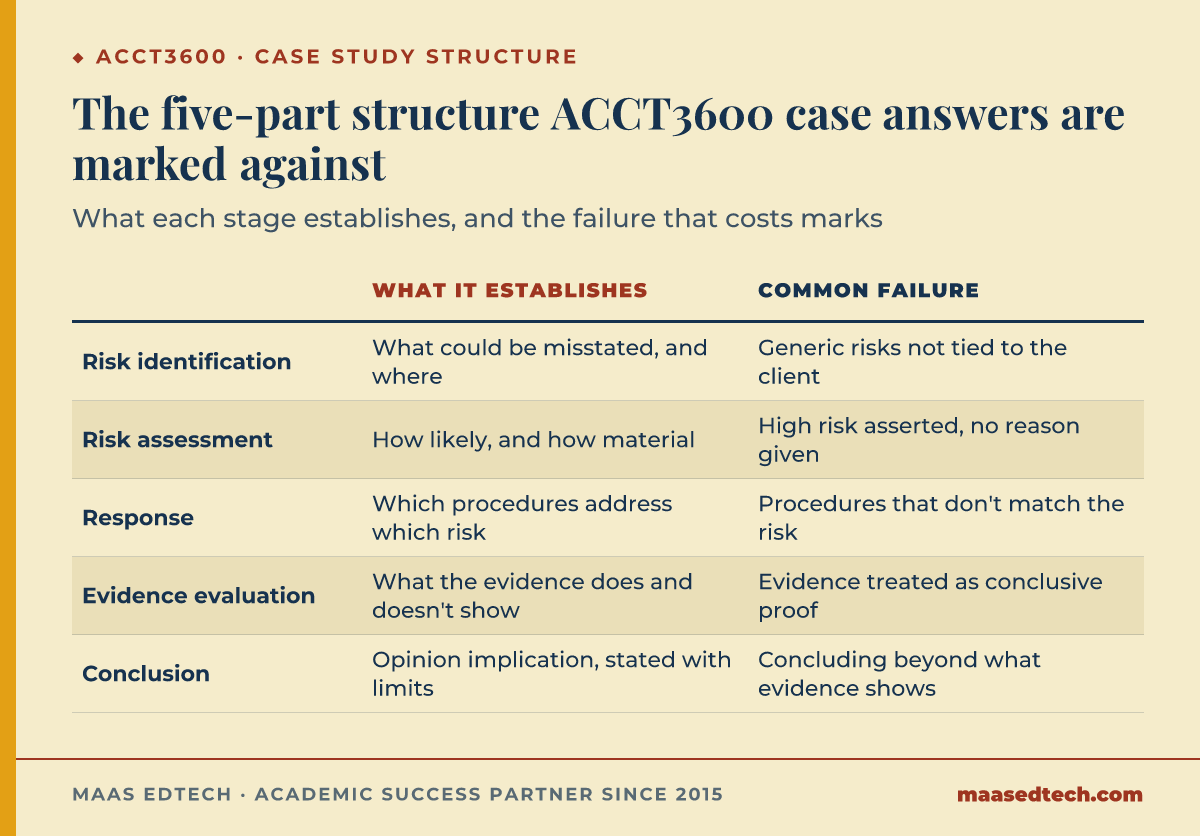
| Component | What it establishes | Common failure |
|---|---|---|
| Risk identification | What could be materially misstated, and at which assertion | Listing generic risks not tied to this client |
| Risk assessment | How likely, and how material | Asserting high risk without saying why here |
| Response | Which procedures address which risk | Listing procedures that do not match the risk named |
| Evidence evaluation | What the evidence obtained does and does not establish | Treating evidence as conclusive when it is corroborative |
| Conclusion | The opinion implication, stated with its limits | Concluding beyond what the evidence supports |
Evidence: This structure mirrors the audit process the unit is built around, and the marking follows the same logic. A response disconnected from a named risk is a procedure performed for no reason, which is precisely the criticism the Australian Securities and Investments Commission (ASIC) levels at deficient audit files in its own inspection findings.
Example: Two students both recommended confirming receivables under ASA 505. The first listed it among several procedures. The second tied it to a specific risk of overstated revenue near year end, noted that confirmations address existence but not valuation, and added the procedure that would address valuation. The second answer covered less ground and scored higher.
How do you write about materiality without turning it into arithmetic?
Direct answer: By treating it as a judgement about users rather than a percentage applied to a benchmark. The threshold calculation is the visible part, and it is the part carrying the fewest marks.
Evidence: Materiality exists because financial statements, prepared under the AASB's framework, are meant for people making decisions, so what matters is whether a misstatement could change one of those decisions. That question depends on who the users are and what they are deciding, which is why the same dollar amount can be material in one engagement and trivial in another. A submission that computes a threshold and never revisits it has answered the mechanical half.
Example: Two students set the same planning materiality. The first applied it uniformly and moved on. The second noted that the client was negotiating a debt covenant tied to a specific ratio, observed that misstatements affecting that ratio could influence a lender's decision at amounts well below the overall threshold, and set a lower level for the accounts feeding it. The second answer explained why, and that explanation is the assessable part.
What does integration actually require here?
Direct answer: Bringing financial reporting judgement into an audit answer without being asked. The capstone framing means the assessor expects your ACCT3011 and second-year knowledge to appear when the case calls for it.
Evidence: The handbook states that students are expected to comprehend the form and content of published financial statements prepared under the Australian Accounting Standards issued by the Australian Accounting Standards Board (AASB), and be able to explain their function. You cannot assess whether a balance is materially misstated without a view on how that balance should have been measured and disclosed in the first place. The auditing knowledge tells you how to test it; the reporting knowledge tells you what correct would look like.
Example: Faced with a case involving an impairment indicator under AASB 136, a weaker answer discussed audit procedures for verifying management's calculation. A stronger one first said what the applicable measurement basis required, identified which input in management's model carried the most judgement, and directed the audit effort there.
A practical order of work
Direct answer: Work through six checks in order: read the business before the audit issues, write the assertion each risk threatens, match every procedure to one named risk, note what evidence still leaves open, evidence skepticism rather than asserting it, and check whether the case is testing reporting judgement disguised as an audit question.
- Read the case for the client's business before reading it for audit issues. Risk is a property of the business, not of the account names.
- For every risk, write the assertion it threatens. A risk without an assertion cannot be linked to a procedure.
- Match each procedure to one named risk. Delete procedures that do not have one.
- After stating what evidence you would obtain, write one line on what it would still leave open.
- Handle skepticism through the evidence, not through the adjective. Never write that skepticism should be maintained without showing it operating.
- Check whether the case is testing reporting judgement disguised as an audit question. In a capstone it often is.
Frequently asked questions
Is ACCT3600 mainly memorising auditing standards?
No. You need to know the AUASB standards well enough to apply them, but the assessment is built on case application. Quoting a requirement without applying it to the facts in front of you is where most marks are lost.
How do I show professional skepticism in writing without sounding cynical?
Show it through evidence handling rather than through tone, in line with how Hurtt (2010) operationalises the construct through observable behaviours. Say what an explanation predicts, what would test that prediction, and what you would conclude in each outcome. That reads as rigour; suspicion of management as a stance reads as bias.
Do I need work experience to do well?
No. The cases are developed from practice, but they supply the context you need. What helps more than experience is reading the case as a business first rather than as a set of accounts.
How much of my earlier accounting knowledge will I need?
More than students expect. The unit is a capstone, so the case material assumes the financial reporting knowledge tested in ACCT2012 or ACCT2019 and rarely signals when you should use it.
Should my conclusion always be definitive?
It should be defensible, which is not the same thing, echoing Nelson's (2009) point that skepticism shows up in judgments and decisions rather than in certainty of tone. Where evidence is insufficient, saying so and specifying what further evidence would resolve the question is a stronger answer than an overconfident conclusion.
Where MAAS fits
MAAS mentors work alongside students at the University of Sydney and other Australian universities on units like this rather than in place of them. On an audit case, the most useful work is usually the least glamorous: checking that every procedure in your answer traces back to a risk you actually named, testing whether your skepticism is doing something or just being asserted, and asking what your conclusion would look like if one piece of your evidence fell away. The analysis stays yours. If that is useful, our academic support service and our tutoring service are the two places to start.
References
DeFond, M., & Zhang, J. (2014). A review of archival auditing research. Journal of Accounting and Economics, 58(2–3), 275–326. https://doi.org/10.1016/j.jacceco.2014.09.002
Hurtt, R. K. (2010). Development of a scale to measure professional skepticism. Auditing: A Journal of Practice & Theory, 29(1), 149–171. https://doi.org/10.2308/aud.2010.29.1.149
Hurtt, R. K., Brown-Liburd, H. L., Earley, C. E., & Krishnamoorthy, G. (2013). Research on auditor professional skepticism: Literature synthesis and opportunities for future research. Auditing: A Journal of Practice & Theory, 32(Supplement 1), 45–97. https://doi.org/10.2308/ajpt-50361
Nelson, M. W. (2009). A model and literature review of professional skepticism in auditing. Auditing: A Journal of Practice & Theory, 28(2), 1–34. https://doi.org/10.2308/aud.2009.28.2.1
Tools & resources
The University of Sydney. (n.d.). ACCT3600: Accounting and Auditing in Practice. https://www.sydney.edu.au/units/ACCT3600