
◆ Accounting & Finance
ACC501 Business Accounting and Finance: you are not being trained to become an accountant
The single most useful fact about this subject is buried in its enrolment rules. ACC501 is incompatible with MBA504, which tells you what it is: the accounting core of a postgraduate management degree, built for people who will read financial statements and authorise budgets, not prepare the accounts. Students who study it as a bookkeeping subject work hard at the wrong thing, drilling journal entries while losing marks on what a set of numbers means for a decision.

◆ Section 1 / 7 · The subject
What the subject is, and which institution this describes
Direct answer: ACC501 Business Accounting and Finance is an 8 credit point postgraduate subject in the Charles Sturt University School of Business, introducing financial accounting, management accounting and finance to people working in a business environment. It covers the generally accepted accounting principles (GAAP) underlying the accounting process, has no prerequisites, and is incompatible with MBA504.
Evidence: Charles Sturt's handbook entry carries ACC501 at 8 credit points under the School of Business. The published description states ACC501 is designed as an introduction to financial accounting, management accounting and finance for those working in a business environment, and covers the generally accepted accounting principles (GAAP) underlying the accounting process together with the uses and limitations of published financial statements. It records no prerequisites and lists MBA504 as incompatible.
A warning about study material: ACC501 is a heavily reused code. Introductory accounting courses carrying it also appear at a number of North American providers, each with different content, different credit weightings and different assessment. Nothing you find under the bare code is guaranteed to belong to your degree. Search the subject name together with the institution, and treat any study material that does not name Charles Sturt as belonging to somebody else's subject until you have checked.
Two facts on that page shape how you should prepare. No prerequisites means the cohort contains people who have never seen a balance sheet alongside people who manage departmental budgets for a living, all assessed against the same criteria. The MBA504 incompatibility means ACC501 occupies the accounting slot in a management qualification, so the standard it holds you to is managerial usefulness rather than technical completeness.
◆ Section 2 / 7 · Outcomes
What the outcomes actually ask for
Direct answer: They ask you to critique and interpret, not to reproduce. Four of the six published outcomes use verbs of judgment.
The outcome list is worth reading slowly, because the verbs carry the marking standard. Students completing ACC501 should be able to discuss and apply the basic accounting ideas that underlie and limit the usefulness of accounting information; explain and analyse the nature and measurement of assets, equities, revenues, expenses and income; apply computer software to quantitative business decisions; implement and critique the analytic and interpretative techniques used in accounting and finance; discuss and critique the concepts behind decision making associated with the efficient allocation of business resources; and explain and implement financial analysis and management accounting procedures.
Notice what the first outcome says. It is not about the usefulness of accounting information. It is about the ideas that underlie and limit that usefulness. A subject that puts limitation into its first learning outcome is telling you in advance that its harder questions are about what the numbers fail to capture.
| How a beginner reads the task | What the outcome verbs require |
|---|---|
| Calculate the ratio | Say what the ratio can and cannot tell you here |
| Prepare the statement | Explain what a reader of it would still not know |
| Apply the technique | Implement it, then critique where it breaks down |
| Report the result | Recommend an action and carry the uncertainty into it |
| Learn the rule | Explain the measurement problem the rule is solving |
Evidence: Chi et al. (1981), writing in Cognitive Science, demonstrated that novices sort problems by surface features while experts sort them by the underlying principle. Their subjects were physics students, and the pattern they describe is one of the more durable findings in the study of expertise. It describes the exact failure pattern in introductory accounting: a student who has categorised problems as inventory questions and cash flow questions has organised knowledge by chapter heading, and will not recognise the same underlying issue when it arrives in unfamiliar packaging, which is what an integrative assessment is designed to do.
◆ Section 3 / 7 · Measurement
Why is measurement the hardest idea in the subject?
Direct answer: Because accounting numbers look like observations and are actually estimates produced by rules, and everything ACC501 asks you to critique flows from that gap.
An inventory figure, a depreciation charge, an allowance for doubtful debts and a provision are not measured in the way a length is measured. Each is the output of a policy choice applied to an uncertain future, which is the same observation Watts and Zimmerman (1978), writing in Accounting Review, built into a whole research programme asking why particular accounting rules get chosen in the first place. Once you have internalised that, the critique outcomes stop being vague. You are not being asked for a general opinion. You are being asked which estimate a conclusion depends on, and how much the conclusion would move if a defensible alternative estimate had been used.
Evidence: Ball (2006), in Accounting and Business Research, set out the trade-offs in International Financial Reporting Standards (IFRS) with unusual directness, arguing that a move toward fair value increases relevance while importing estimation error and management discretion into the accounts, and warning that "there inevitably will be substantial differences among countries in implementation of IFRS, which now risk being concealed by a veneer of uniformity" (Ball, 2006). His analysis is useful here precisely because it refuses to treat the choice as settled. That is the register your critique answers should sit in: a stated trade-off with named costs, rather than a verdict that one method is correct.
Evidence: Jensen and Meckling (1976), in the Journal of Financial Economics, supply the agency framing that sits underneath financial reporting. Their subject is what it costs when the people running a business are not the people who own it, and the monitoring that gap creates. Reporting is a downstream application of that argument rather than the argument itself, but it is the reason financial statements are shaped by who has to be answerable to whom. This is the reason "the uses and limitations" phrasing sits in the ACC501 subject description. A statement prepared to discharge accountability is not the same object as a statement prepared to inform your particular decision, and the difference is examinable.
Example: Asked to assess whether a company's profitability had improved, a weak answer computed the margins for two years, noted the increase and concluded that performance had improved. A stronger answer reached the same figures, then observed that the improvement was concentrated in a period when the depreciation policy changed, quantified how much of the movement that accounted for, and stated what remained after adjusting. Both answers did the same arithmetic. Only one of them noticed that a policy change had done part of the work the numbers were being credited with.
◆ Section 4 / 7 · Spreadsheet outcome
The spreadsheet outcome students underestimate
Direct answer: One published outcome requires applying computer software to quantitative business decisions, and it is assessed as reasoning made visible rather than as software proficiency.
Students read that outcome as a formatting requirement and lose marks in two predictable ways. The first is hard-coding: typing a computed number into a cell instead of a formula, which destroys the audit trail and makes it impossible for a marker to see whether you understood the relationship or copied a result. The second is building a model with no separated assumptions, so nobody, including you, can test what happens if the growth rate is wrong.
The professional habit worth building now is simple. Put every assumption in its own clearly labelled block, refer to those cells everywhere else, and never let a raw number appear inside a formula. That structure makes sensitivity analysis a matter of changing one cell, and sensitivity analysis is where the interpretive marks live. A model that produces one answer answers a smaller question than a model that shows which assumption the answer depends on.
Evidence: Sweller (1988), also in Cognitive Science, showed that working memory is the binding constraint when people learn to solve problems, and that poorly structured tasks consume capacity on bookkeeping rather than on understanding. The applied lesson is not motivational. A disorganised spreadsheet spends your attention on locating your own numbers, which is capacity you no longer have available for the analysis you are actually being marked on.
◆ Section 5 / 7 · Assessment structure
Reading the assessment structure
Direct answer: The subject has historically escalated its weightings across the session, which means the early tasks are diagnostic and the late tasks decide the grade.
How four ACC501 assessment items were weighted, online offering, Session 2 2021
Online offering in Session 2 2021, from the archived 2023 handbook record. The yellow item carries the most weight.
Introductory financial accounting
10
% weighting
Recording and presenting financial reports
20
% weighting
Inventory, cash, cost-volume-profit and economic order quantity
30
% weighting
Budgeting, relevant information and capital budgeting
40
% weighting
Save this figure
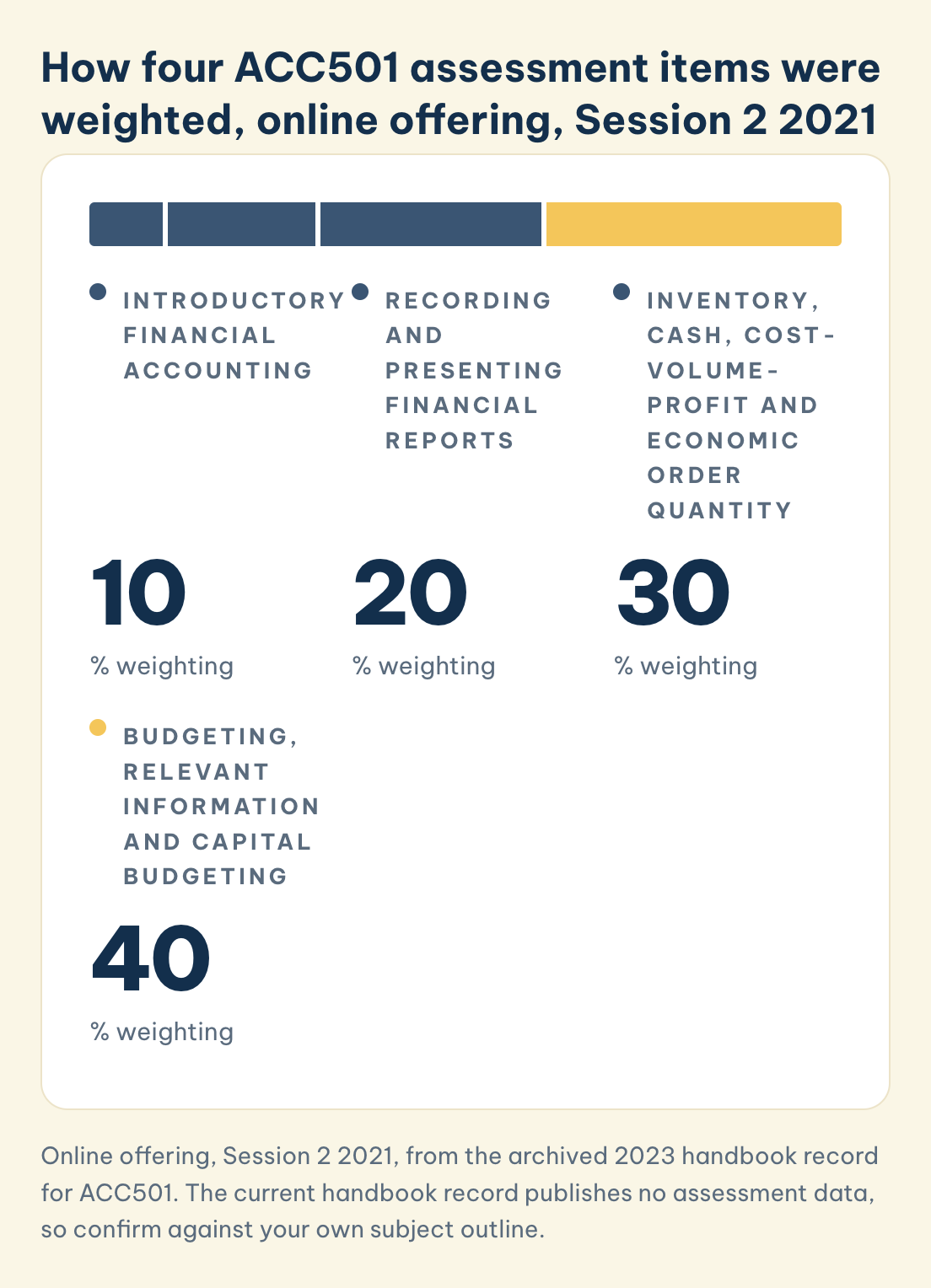
The archived 2023 handbook record publishes the pattern for the online offering in Session 2 2021: four assessment items at 10% for introductory financial accounting, 20% for recording and presenting financial reports, 30% for inventory management, cash management, cost-volume-profit and economic order quantity, and 40% for budgeting, relevant information and capital budgeting. That is one mode in one session four years ago, and the current handbook record publishes no assessment data at all. Treat the shape as an indication rather than a schedule, and confirm against your own subject outline.
The shape still tells you something durable. A back-weighted subject rewards students who use the low-stakes early tasks as instrumentation. If you lost marks in the first item, the useful question is not how many marks but which kind: an arithmetic slip is cheap to fix, whereas a misread of what the question was asking will repeat in every later item and cost far more at 40% than it did at 10.
It also warns against a common misjudgment. Students who find the first weeks manageable often reduce their effort at exactly the point where the material turns from recording toward decision making, which is where the marks are concentrated and where the interpretive outcomes are assessed.
Evidence: Kaplan and Norton (1992), published in Harvard Business Review, is worth reading before the final block rather than after it. Their argument that financial measures report the consequences of decisions already taken, and therefore need to be paired with measures of what drives future performance, is exactly the reasoning the budgeting and capital budgeting material calls for. A capital budgeting answer that computes a net present value and stops has produced a number; one that names the assumption the number is most sensitive to, and what the firm would monitor to find out early whether it was wrong, has produced a recommendation. Even the discount rate feeding that net present value carries an assumption Franco Modigliani and Merton Miller (1958), writing in the American Economic Review, forced the field to make explicit: how a firm is financed changes who bears the risk in a cash flow, which is part of why two reasonable analysts can price the same project differently.
◆ Section 6 / 7 · Uneven cohort
Preparing when the cohort is this uneven
Direct answer: ACC501 mixes business novices with working professionals under one no-prerequisite enrolment, so both groups misjudge the material differently. The fix is writing one sentence per technique naming the decision it informs and a situation where it misleads. Ten such sentences by session's end build a principle-organised summary, the structure Chi et al. found separates experts from novices.
With no prerequisites and a cohort of working professionals, the room contains two groups with opposite problems. Students without a business background underestimate the vocabulary load and try to reason before they can read the statements fluently. Students with years of practical exposure often assume ACC501 will formalise what they already do, and then lose marks by answering from workplace practice rather than from the framework being taught.
Both are fixable with the same habit. Every time ACC501 introduces a technique, write down in one sentence what decision it is meant to inform and one situation in which it would mislead. Ten of those sentences by the end of the session gives you a portable summary that is organised by the underlying principle rather than by chapter, which is the organisation Chi et al. found separates expert from novice performance.
One practical caution before you plan a session around this subject. The 2025 handbook record lists no offerings, and the archived 2023 record states that none were identified for that year either, so availability is something to confirm through the Subject Availability Listing rather than assume. The incompatible subject listed is MBA504, and credit in it blocks enrolment here.
◆ Section 7 / 7 · A mentor
Where a mentor is worth having on this subject
Direct answer: A MAAS mentor checks two things: whether your spreadsheet's assumptions sit in a labelled, testable block or are buried inside formulas, visible within about thirty seconds, and whether your conclusion's uncertainty survived from the working to the final sentence. You still run the numbers and reach the conclusions; the mentor confirms your evidence actually supports what you claim.
Almost nobody needs help with the arithmetic. The place students lose marks is one step later, at the point where a correct number has to become a defensible statement about a business, and that step is very hard to audit alone.
A MAAS mentor works on two surfaces. The first is your spreadsheet, opened and read rather than described: assumptions either sit in a labelled block where they can be tested, or they are buried inside formulas where nobody can find them, and that difference is visible in about thirty seconds. The second is the sentence your numbers are supposed to support. Which estimate is that sentence resting on? How far does it move if a reasonable person chose the other treatment? And did any of that uncertainty survive into the recommendation, or did it quietly disappear between the working and the conclusion?
You run the numbers and you reach the conclusions. A mentor only makes sure the conclusion says what your evidence can actually carry.
Frequently asked questions
Whose subject is this, exactly?
Charles Sturt University, where ACC501 Business Accounting and Finance is an 8 credit point postgraduate subject in the School of Business. A number of North American providers use the same code for unrelated introductory accounting courses, so verify the institution before trusting any study material you find.
Do I need an accounting background to enrol?
The handbook entry records no prerequisites. The subject is written for people working in a business environment rather than for trainee accountants, so the assumed starting point is managerial rather than technical.
Can I take this alongside MBA504?
No. MBA504 is listed as incompatible, which means credit in one blocks the other. Confirm on the handbook page for your own year, since these lists are reviewed between years.
Is this subject just bookkeeping?
No, and treating it that way is the most common preparation error. Four of the six published outcomes use verbs of judgment such as critique, analyse and discuss, and the ACC501 subject description names the limitations of financial statements alongside their uses.
How much weight sits on the later assessments?
In the one published pattern available, the online offering in Session 2 2021, four items escalated from 10% to 40% with the heaviest covering budgeting and capital budgeting. The current handbook record publishes no assessment data, so check your own subject outline rather than planning around a four-year-old shape.
Do I need to be good at Excel?
You need to be structured rather than advanced. One outcome requires applying computer software to quantitative business decisions, and marks follow from separating your assumptions, using formulas instead of typed results, and being able to show how the answer moves when an assumption changes.
Related reading
References
Ball, R. (2006). International Financial Reporting Standards (IFRS): Pros and cons for investors. Accounting and Business Research, 36(sup1), 5–27. https://doi.org/10.1080/00014788.2006.9730040
Chi, M. T. H., Feltovich, P. J., & Glaser, R. (1981). Categorization and representation of physics problems by experts and novices. Cognitive Science, 5(2), 121–152. https://doi.org/10.1207/s15516709cog0502_2
Jensen, M. C., & Meckling, W. H. (1976). Theory of the firm: Managerial behavior, agency costs and ownership structure. Journal of Financial Economics, 3(4), 305–360. https://doi.org/10.1016/0304-405X(76)90026-X
Kaplan, R. S., & Norton, D. P. (1992). The balanced scorecard: Measures that drive performance. Harvard Business Review, 70(1), 71–79.
Sweller, J. (1988). Cognitive load during problem solving: Effects on learning. Cognitive Science, 12(2), 257–285. https://doi.org/10.1207/s15516709cog1202_4
Watts, R. L., & Zimmerman, J. L. (1978). Towards a positive theory of the determination of accounting standards. The Accounting Review, 53(1), 112–134.
Modigliani, F., & Miller, M. H. (1958). The cost of capital, corporation finance and the theory of investment. American Economic Review, 48(3), 261–297.
A free 20-minute consultation is a conversation about your ACC501 brief and the uncertainty in your conclusions.
Book a free consultation ▸