
◆ Research Methods
What are the main types of questionnaire questions?
The main types of questionnaire questions are open, closed, rating, ranking and matrix questions. Closed questions come in several forms, such as yes/no and multiple choice. A handbook from the Food and Agriculture Organization of the United Nations (FAO) groups the formats into closed, open and table questions (FAO, 2020), while Arundel (2023) lists five formats plus a sixth, the open question. Which you choose depends on the data you need.
◆ Question 1 / 9 · Four types?
What are the four types of questionnaire?
Direct answer: The sources do not agree on a standard "four". FAO (2020) names three formats: closed, open and table or matrix questions. Arundel (2023) names five common formats and a sixth, the open question. A practical working set for students is open, closed, scaled (rating or ranking) and matrix questions.
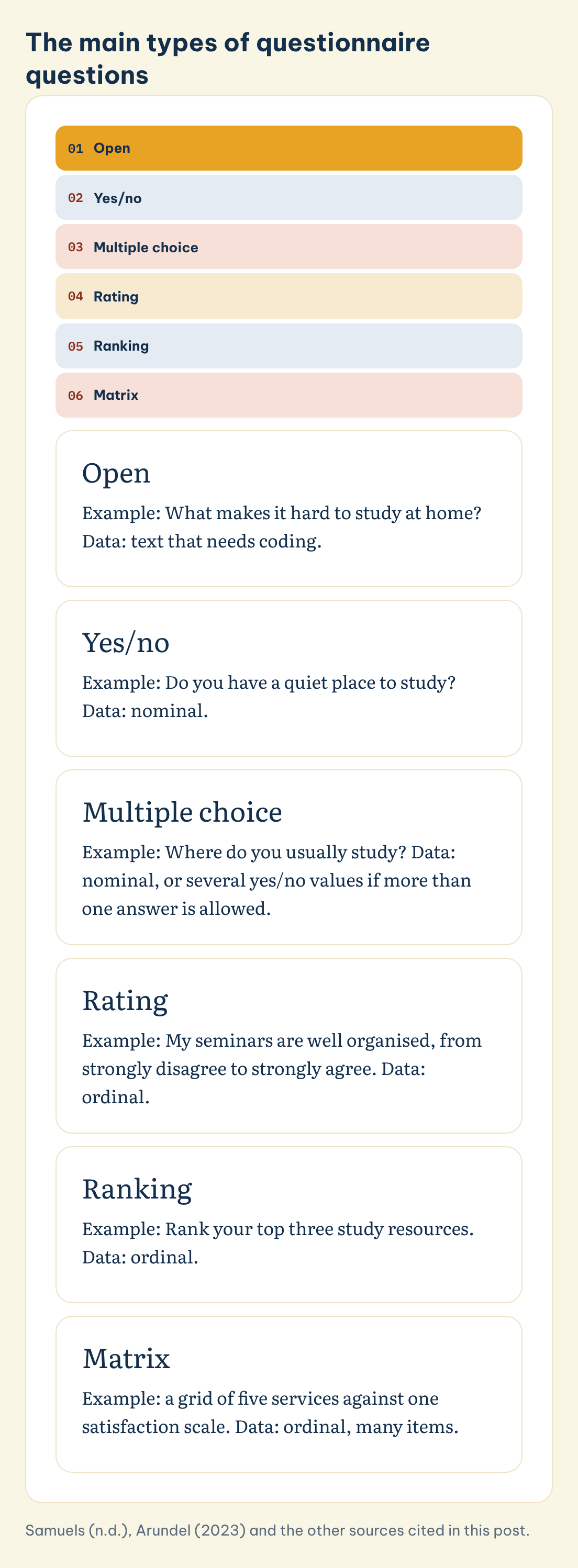
The main types of questionnaire questions
Tap a type to see an example item and the data it produces.
Open
Example: What makes it hard to study at home? Data: text that needs coding.
Yes/no
Example: Do you have a quiet place to study? Data: nominal.
Multiple choice
Example: Where do you usually study? Data: nominal, or several yes/no values if more than one answer is allowed.
Rating
Example: My seminars are well organised, from strongly disagree to strongly agree. Data: ordinal.
Ranking
Example: Rank your top three study resources. Data: ordinal.
Matrix
Example: a grid of five services against one satisfaction scale. Data: ordinal, many items.
Save this figure
Search results for this question often give different lists, and that is not an error on your part. The count changes because authors draw the boundaries in different places. Some treat rating and ranking as special cases of closed questions, which is how FAO (2020) handles them, while others give them their own category. A table of contents from a textbook will therefore not match a lecture slide, and neither is wrong.
What matters for a dissertation is that you name your categories and stay consistent. If you describe your instrument in the methodology chapter as having closed, open and matrix items, define each term once and then use it the same way throughout. Examiners tend to check that the labels in the text match the items printed in the appendix. For the wider choice between numbers and words as data, see our guide on how to choose between qualitative, quantitative and mixed methods, because the question types you pick follow from that choice.
◆ Question 2 / 9 · Formats
What are the various formats of questionnaires?
Direct answer: Questionnaires vary by who completes them and how structured they are. Sheffield Hallam University (n.d.) describes self-administered and interviewer-administered methods. Arundel (2023) separates semi-structured questionnaires, mostly open questions, from structured ones, mostly closed questions with a few open ones.
The first split is about delivery. A self-administered questionnaire is a paper form, a mailed form or an online form, and the interviewer-administered version is read out in person or over the phone, with the interviewer recording the answers (Sheffield Hallam University, n.d.). The same source notes that self-administration reduces the chance of interviewer bias but removes someone who can explain a confusing question. For a student working alone, that trade-off often decides the matter, since you cannot be present when a respondent reads your wording.
The second split is about structure. According to Arundel (2023), semi-structured questionnaires mostly contain open questions and are often used in face-to-face or telephone interviews, rarely involving more than 100 respondents because interviews are costly. Structured questionnaires mostly contain closed questions with a few open ones, and they can be sent to tens or thousands of people. A student survey with 150 responses therefore sits firmly in the structured camp, even if it ends with one free-text box.
◆ Question 3 / 9 · Types with examples
Types of questionnaire in research with examples
Direct answer: The table below gives each question type with one example item that a student might use in a survey about first-year study habits. It is a quick reference. The sections that follow explain when each type works, what data it produces and which mistakes to avoid with it.
| Question type | Example item | Data it produces |
|---|---|---|
| Open | "What makes it hard to study at home?" | Text, needs coding |
| Dichotomous (yes/no) | "Do you have a quiet place to study? Yes / No" | Nominal |
| Multiple choice, single answer | "Where do you usually study? Library / Home / Café / Other" | Nominal |
| Multiple choice, multiple answers | "Tick all that apply: laptop, tablet, phone" | Several yes/no values |
| Rating | "My seminars are well organised: Strongly disagree to Strongly agree" | Ordinal |
| Ranking | "Rank your top three study resources" | Ordinal |
| Matrix | A grid listing five services against one satisfaction scale | Ordinal, many items |
| Filter | "Do you work part-time? If yes, go to question 8" | Routing, changes the base |
Samuels (n.d.) offers a similar map in statistics terms: multiple choice gives nominal or ordinal data, a number field gives scale data, ranking gives ordinal data and a text field gives qualitative data. Arundel (2023) adds that check lists and yes/no questions collect nominal data, ordinal and matrix questions collect ordinal data, and numeric level questions collect interval, count or percentage data. Matching each item to the analysis you plan to run is the main reason to choose one type over another.
◆ Question 4 / 9 · Open questions
What are open-ended questions and when should you use them?
Direct answer: An open-ended question gives no response options, so respondents answer in their own words. Blackstone (2012) states that an open-ended question does not include response options. Use them when you do not know the likely answers, or when you need an exact number rather than a category.
An example for a student project is "What, if anything, would make your lectures more useful?" with a blank box below. FAO (2020) says open questions are less common in quantitative research because they are harder to answer and to process, and that they suit situations where the topic is poorly known, where an instrument is being tested, or where an exact figure is wanted. Krosnick and Presser make a related point about quantities: "Thus, open questions are usually preferable to closed items for measuring quantities" (Krosnick & Presser, 2010, p. 267).
The cost appears at analysis. Krosnick and Presser (2010) state that analysing open questions needs a coding scheme applied by more than one person, with a high level of agreement between coders. CASRAI (2026) puts it in practical terms: build a codebook before you report any percentage from open answers. If you have 200 responses and no time to code them twice, limit yourself to one or two open questions at the end of the survey, after the respondent has warmed up on easier items.
◆ Question 5 / 9 · Closed questions
What are closed-ended questions and their main forms?
Direct answer: A closed question offers a fixed set of answers. Blackstone (2012) notes that offering response options assumes closed-ended questions. The main forms are dichotomous (two options), single-answer multiple choice and multiple-answer multiple choice. They are quick to answer and easy to code.
Dichotomous items are, in CASRAI's (2026) words, the fastest item type to answer and the easiest to code, but they fail when the true answer is conditional. The example given is "Are you satisfied with the training program?" forced into Yes or No, when the real answer may be "it depends". A student version would be "Did your seminar tutor give useful feedback? Yes / No", which hides the difference between "sometimes" and "never".
For multiple choice, FAO (2020) separates single choice from multiple choice where more than one answer can be selected. The instruction "Tick all that apply" must come just after the question text and before the list of answer categories (FAO, 2020). The same handbook says categories should be self-explanatory, mutually exclusive and exhaustive, and it warns against overlapping bands such as 15-30 and 30-44 for age. Krosnick and Presser (2010) add that tacking on an "other" option is generally not effective, as respondents tend to restrict their answers to the substantive choices that are explicitly offered, so list the real options carefully before relying on "Other, please specify".
◆ Question 6 / 9 · Rating and ranking
How do rating, ranking and semantic differential questions work?
Direct answer: A rating question asks respondents to place their view on a scale, a ranking question asks them to order items, and a semantic differential uses opposite adjectives at each end. Scale length differs by format: Krosnick and Presser (2010) report five points as the usual Likert choice and seven for the semantic differential.
Rating items are the most common choice in student surveys. Samuels (n.d.) says rating scales typically have 5 or 7 values, with fewer values reducing data quality and more being hard to process mentally. A semantic differential item could ask "Rate your online learning platform" with "confusing" at one end and "clear" at the other, across seven points. The sources opened for this post define the semantic differential only briefly, so check a methods textbook if your marker expects a full definition.
Ranking needs more caution. FAO (2020) states that ranking all possible answers is very burdensome and advises asking for the top three or five. Samuels (n.d.) goes further and marks ranking as hard to analyse, suggesting you ask about each item individually and then rank the mean scores. CASRAI (2026) puts the point where ranking becomes unreliable at roughly seven to eight items. A safe student rule is to rank no more than five items, and to prefer a rating for each item when you need to compare strength of opinion.
◆ Question 7 / 9 · Matrix and filter
What are matrix, demographic and filter questions?
Direct answer: A matrix lists several items that share one answer scale. A demographic question records respondent characteristics such as age or year of study. A filter question routes respondents past items that do not apply. Blackstone (2012) calls a matrix a question type that lists a set of questions with the same answer categories.
Matrix questions save space and help respondents progress, as Blackstone (2012) notes, but they have a known weakness. FAO (2020) warns that grids can cause satisficing, where people tick the same column throughout, and that in paper questionnaires they save space without saving the respondent's time. CASRAI (2026) names the mobile-screen risk and the same straightlining problem. A grid of eight items about university services is therefore acceptable, but a grid of thirty is not.
Filter questions change who answers what. Arundel (2023) describes them as directing respondents to later questions using skip instructions, often called branch logic, such as "If yes to any of the above, please go to question 6, otherwise go to question 11". CASRAI (2026) gives the consequence for your results: if 400 of 1,000 respondents say yes, downstream percentages have a base of 400, not 1,000. State that base in every table. For demographic items, Samuels (n.d.) advises putting easy questions such as demographics first and open or complex ones last, and CASRAI (2026) lists a missing "prefer not to say" option as a pitfall.
◆ Question 8 / 9 · Wording faults
What wording mistakes spoil any type of question?
Direct answer: Four faults recur in the sources: double-barrelled questions, leading questions, double negatives and overlapping options. Each can make an otherwise sound question type produce unusable data. Fixing them costs little at the drafting stage and a great deal after you have collected responses.
A double-barrelled question asks two things at once. Sheffield Hallam University (n.d.) gives the example "Are you happy with the amount and timeliness of feedback you receive from your tutors?", where you cannot tell which part the respondent answered. Schweinberger (2026) makes the same point with "Do you find this course useful and enjoyable?": a "No" could mean neither, or only one of the two. The remedy is to split the item into two separate questions.
A leading question pushes toward an answer. Schweinberger (2026) offers "Don't you think that public transport is underfunded?" as an example and advises avoiding value-laden language. Sheffield Hallam University (n.d.) contrasts "What is your opinion of the price of cinema admission?" with the loaded "Cinema tickets are too expensive", and says leading questions will bias the results. The same source suggests keeping questions under twenty-five words where possible and avoiding double negatives. Response options should also be exhaustive and mutually exclusive, as the age-band example above shows.
◆ Question 9 / 9 · Choosing a mix
How do you choose the right mix of question types?
Direct answer: Start from the analysis you plan to run, then work backwards to the question type. Use closed items for what you can list in advance, a few open items for what you cannot, and keep the whole instrument short. Arundel (2023) puts the ceiling for a well-designed form at about a quarter of an hour.
A useful method is to write one line per research question that says what kind of answer would settle it. If the answer is a count or a percentage, you need closed items. If it is a reason, you need an open item or a follow-up interview, and then the survey may belong in a mixed design, which we cover in the main mixed methods research designs. Schweinberger (2026) also suggests grouping items in thematic blocks and moving from general to specific, and keeping completion under 15 minutes for general-population surveys.
Before launch, link each item to a research question. Our guide on writing research questions and objectives shows how to keep that chain visible. Any item that links to nothing is a candidate for deletion. If you want a person who has done fieldwork to look over your instrument or your collection plan, support with data collection from MAAS is there for that: you design the questionnaire and run the study, and a researcher in your field advises you along the way.
Frequently asked questions
What are the main types of questionnaire questions?
Open, closed, rating, ranking and matrix questions, with closed questions taking forms such as yes/no and multiple choice. FAO (2020) groups formats into closed, open and table questions.
What is the difference between open and closed questions?
Open questions have no response options and need coding, while closed questions offer fixed answers. Blackstone (2012) states that offering response options assumes closed-ended questions.
How many points should a rating scale have?
Samuels (n.d.) says rating scales typically have 5 or 7 values. Krosnick and Presser (2010) give five as the usual Likert length and seven for the semantic differential.
Should I ask respondents to rank items?
Only a few. FAO (2020) advises asking for the top three or five, and CASRAI (2026) says ranking becomes unreliable past roughly seven to eight items.
What is a double-barrelled question?
One that asks two things at once, such as "useful and enjoyable". Schweinberger (2026) advises splitting it into two items, because a "No" could mean either part.
How long should my questionnaire be?
Arundel (2023) suggests a well-designed questionnaire can be completed within 15 minutes or less. Schweinberger (2026) gives the same limit for general-population surveys.
References
Arundel, A. (2023). Survey fundamentals. In How to design, implement, and analyse a survey (Chap. 2). Edward Elgar Publishing. https://doi.org/10.4337/9781800376175.00006
Blackstone, A. (2012). Principles of sociological inquiry: Qualitative and quantitative methods (Chap. 8.4, Designing effective questions and questionnaires). Saylor Foundation. https://socialsci.libretexts.org/Bookshelves/Sociology/Introduction_to_Research_Methods/Book:_Principles_of_Sociological_Inquiry__Qualitative_and_Quantitative_Methods_(Blackstone)/08:_Survey_Research-_A_Quantitative_Technique/8.04:_Designing_Effective_Questions_and_Questionnaires
CASRAI. (2026). Survey question types: A practical guide with examples. https://casrai.org/guides/survey-question-types
Food and Agriculture Organization of the United Nations. (2020). Handbook for questionnaire design (Statistical Standard Series). Food and Agriculture Organization of the United Nations. https://openknowledge.fao.org/server/api/core/bitstreams/298a1aa1-e17f-47e5-a7b5-354bc2ac7134/content
Krosnick, J. A., & Presser, S. (2010). Question and questionnaire design. In P. V. Marsden & J. D. Wright (Eds.), Handbook of survey research (2nd ed., pp. 263-313). Emerald Group Publishing. https://web.stanford.edu/dept/communication/faculty/krosnick/docs/2010/2010%20Handbook%20of%20Survey%20Research.pdf
Samuels, P. (n.d.). Questionnaire design [Slides]. statstutor. https://www.statstutor.ac.uk/resources/uploaded/2questionnairedesign2.pdf
Schweinberger, M. (2026). Designing and analyzing survey and questionnaire data with R. Language Technology and Data Analysis Laboratory (LADAL). https://ladal.edu.au/tutorials/surveys/surveys.html
Sheffield Hallam University. (n.d.). Questionnaire design [Teaching resource, PDF]. https://teaching.shu.ac.uk/hwb/ag/resources/material/questionnaireanalysisusingspss.pdf
Not sure how this guide applies to your own case? Talk it through with MAAS in a free 20-minute consultation.
Book a free consultation ▸