
◆ Research Methods
What thesis statistics help is a student allowed to get?
Direct answer: Thesis statistics help is allowed when it advises on method and leaves the analysis and the writing with you. The evidence shows why advice matters: Debusho et al. (2025) found at least one clear methodological error in 41.0% of 139 theses. University services draw the line at advice, so check your own handbook first.
Which thesis statistics help is worth asking for?
Direct answer: Ask for thesis statistics help at the points where theses most often go wrong: the study design, the assumptions behind a test, the sample size and the reporting of results. Three published audits, summarised below, show these are the weak points.
Debusho et al. (2025) read 139 theses and dissertations in agricultural and environmental sciences from an open, distance and e-learning university, 86 master's and 53 doctoral. They found at least one blatant methodological error in 57 of them (41.0%), and 90 (64.7%) either did not use an appropriate study design or did not use the collected data efficiently. They wrote that "A lack of knowledge could be the cause of these errors" (Debusho et al., 2025, Conclusion).
Olsen et al. (2019) checked 250 economic psychology master's theses. Of 174 focal p-values that the software statcheck could recompute, 32 (18%) did not match their test statistic and 4 (2%) changed the conclusion of the test. Nuijten et al. (2016) ran the same check on 258,105 p-values from the 16,695 of 30,717 articles that reported significance tests and wrote that they "found that half of all published psychology papers that use NHST contained at least one p-value that was inconsistent with its test statistic and degrees of freedom" (Nuijten et al., 2016, p. 1205).
| Study | What was checked | Result as reported |
|---|---|---|
| Debusho et al. (2025) | 139 theses, 86 master's and 53 doctoral | 57 theses (41.0%) with at least one clear error |
| Olsen et al. (2019) | 250 master's theses, 174 focal p-values | 32 inconsistent (18%), 4 changed the conclusion |
| Nuijten et al. (2016) | 16,695 articles with significance tests | 49.6% had at least one inconsistent p-value, 12.9% a gross one |
What can a statistics helper legitimately do with you?
Direct answer: A helper can talk through the choice of test, show you how to check its assumptions, teach the software, sit beside you while you run the analysis and explain the output. The helper should not decide your research question, produce results you cannot reproduce or write your discussion.
Hoekstra et al. (2012) gave 30 Ph.D. students in psychology (41 were approached) six data sets each and watched how they analysed them. Normality was correctly checked in 12% of the analysed data sets and homogeneity of variance in 23%. The authors also report that when checks happened, they were "regularly by means of a statistical test". Part of the reason, they suggest, is that SPSS prints Levene's test by default, and they note the argument that preliminary tests of this kind compound the chance of a Type I error. Good thesis statistics help fills exactly that gap: a plot-based check, plus an explanation of what a violation means for your choice of method.
In Debusho et al. (2025), ANOVA or MANOVA appeared in 45 theses (32.4%) and regression in 34 (24.5%), so the tests most students run are the ones most worth a second pair of eyes. Think of the work as six jobs. Choosing the test, checking assumptions, learning the software and understanding the output are all fine to share. Running the analysis is the grey zone: running a test together, with you at the keyboard, is advice, while receiving a table you cannot reproduce is not. Reporting is yours. Our guide on how to choose the right statistical test shows the questions to settle first, and the explainer on the null and alternative hypothesis covers what the test is judging.
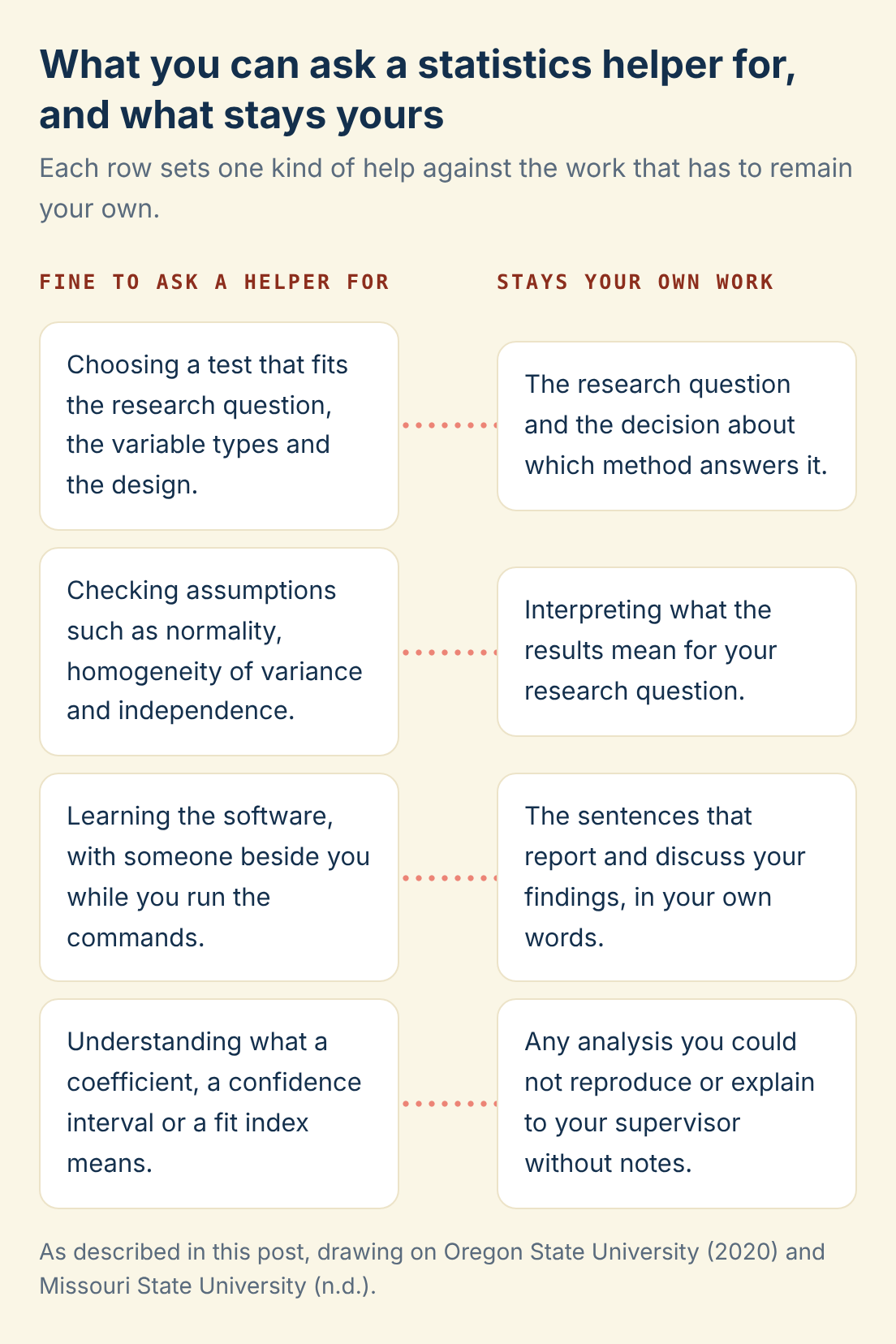
What you can ask a statistics helper for, and what stays yours
Each row sets one kind of help against the work that has to remain your own.
Fine to ask a helper for
Stays your own work
Choosing a test that fits the research question, the variable types and the design.
The research question and the decision about which method answers it.
Checking assumptions such as normality, homogeneity of variance and independence.
Interpreting what the results mean for your research question.
Learning the software, with someone beside you while you run the commands.
The sentences that report and discuss your findings, in your own words.
Understanding what a coefficient, a confidence interval or a fit index means.
Any analysis you could not reproduce or explain to your supervisor without notes.
Save this figure
Which statistics can you check yourself before anyone reviews them?
Direct answer: Free thesis statistics help starts with you. You can recompute each reported p-value from its test statistic and degrees of freedom, confirm that you justified the sample size, report an effect size and show evidence that you checked assumptions. These four checks match the gaps found in real theses.
Each row is a question a marker could ask, with the published rate at which theses fail it.
| Check | Question to ask your own draft | What the audits found |
|---|---|---|
| Reporting | Does every p-value match its test statistic and degrees of freedom? | 18% of focal p-values in 250 theses did not (Olsen et al., 2019) |
| Sample size | Did you give a power analysis or a stated reason for n? | One formal power analysis in 250 theses; mean n of 222, median 157 |
| Effect size | Did you report a standardised effect size for the main test? | 90 of 250 theses (36%) did |
| Assumptions | Is there evidence of the checks behind each ANOVA or t-test? | None of 45 ANOVA works showed a variance check; 2 treated the response as normal (Debusho et al., 2025) |
Source: Olsen et al. (2019) and Debusho et al. (2025), read in open full text on 2026-10-31.
Recomputing a p-value takes a minute in any statistics package once you have the test statistic and degrees of freedom. The tool used in the audits is open: the R package statcheck is described by Nuijten et al. (2016, doi.org/10.3758/s13428-015-0664-2). For the second row, the page on statistical power is a plain starting point, the p-value page covers what that number does and does not say, and analysis of variance lists the assumptions behind the fourth.
◆ Question 3 / 5 · What has to stay your own
What has to stay your own work?
Direct answer: The research question, the choice of method, the interpretation and the writing stay yours. Both the Oregon State University (2020) and Missouri State University (n.d.) pages describe advice: Oregon State says its consultants will not do data entry or analyses, and Missouri State says they do not design or analyse a student's thesis data.
Oregon State University (2020) describes its free service in a few short sentences, among them "The assistance given is primarily advice" and "Consultants will not do data entry or statistical analyses for you". Missouri State University (n.d.) goes further in its approval form: consultants intend to provide advice and guidance, and students who meet a consultant independently should have the committee's permission and tell the committee the general content of the meeting.
A thesis is evidence that you can pose a question, choose a method and judge what the answer means, so an examiner may ask why you chose this test and what you did about an outlier. Reproducibility is a practical test. If you can reopen the data file and syntax, rerun the analysis, get the same tables and explain the choices in two sentences, the help built your capability. If not, it replaced it. These are two American examples of a pattern, not your university's rule, so read your own handbook and ask your supervisor before you start. Our comparison of dissertation coaching and going it alone applies the same distinction to the whole thesis.
How do you choose a thesis statistics helper?
Direct answer: When you buy thesis statistics help, choose someone who teaches, hands over the files you need to reproduce the work, matches your software and type of study, and agrees that interpretation and writing remain yours. Walk away from anyone who promises a particular result, because then the analysis is following a wish and not the data.
Ask these questions and notice how clearly they are answered.
- Can I rerun the analysis myself? A good answer includes the cleaned data, the syntax or script and a short log of decisions.
- Do you work in my software and my type of study? Survey work in SPSS is not the same skill as structural equation modelling in AMOS or partial least squares in SmartPLS.
- Who writes the results and discussion? It should be you. A helper may comment on your draft but should not draft it.
- What if the data do not support my hypothesis? A trustworthy helper says the finding is the finding.
- Does my supervisor know? A helper who suggests keeping it quiet is asking you to carry the risk.
Ask to see a sample of the explanation as well as a sample of the output, since how someone teaches is the best evidence of whether you will leave more capable.
How does MAAS review a statistics plan with you?
Direct answer: A MAAS mentor in your discipline offers to review your analysis plan with you before you run anything, then goes through each step as you carry it out. You keep the cleaned data, the syntax and the tables, and you write the results and discussion yourself.
MAAS's data analysis support for SPSS, R and Python is built around that boundary, and it is thesis statistics help in the advisory sense used throughout this guide. The mentor acts as advisor and tutor, you remain the author, and nothing is submitted on your behalf.
In practice the plan review covers the four self-checks above: the design and the test you intend to use, the assumptions you will need to show, how you will justify the sample size, and which effect size and tables you will report. You then run the analysis yourself with the mentor beside you and keep every file. If you are unsure which of the six jobs you need, a free 20-minute consultation is a conversation about where you are with your analysis, with no obligation. You can book one here.
Frequently asked questions
Is it cheating to get help with the statistics in my thesis?
Not when the help is advice that you act on yourself. It becomes a problem when someone else produces the analysis or interpretation and you present it as your own work.
Can a statistician run the analysis for my dissertation?
Rules differ by university. Two American services state that their consultants do not run or design the student's analysis, so ask your supervisor and read your handbook before you hire anyone.
Do I need my supervisor's permission to get statistics help?
Some universities require it, and Missouri State University (n.d.) is one of them. Even where it is optional, telling your supervisor first protects you if anyone later asks how the analysis was produced.
How common are statistics mistakes in student theses?
Debusho et al. (2025) found a clear error in 57 of 139 theses, so they are common. Most were design, assumption and reporting problems that a plan review would have caught.
What should I check before hiring someone for thesis statistics help?
Check that you will receive the data, syntax and decision log, that they work in your software, and that the writing stays with you. Treat any promised result as a reason to decline.
References
Debusho, L. K., Mashabela, M. R., Sebatjane, P. N., Sithole, S., Tabo, B., & Rapoo, E. M. (2025). Evaluation of statistical methods applied in theses and dissertations in an Open, Distance and e-Learning University. PLOS ONE, 20(3), Article e0319654. https://doi.org/10.1371/journal.pone.0319654
Hoekstra, R., Kiers, H. A. L., & Johnson, A. (2012). Are assumptions of well-known statistical techniques checked, and why (not)? Frontiers in Psychology, 3, Article 137. https://doi.org/10.3389/fpsyg.2012.00137
Missouri State University. (n.d.). RStats thesis and research project approval form [Form]. https://www.missouristate.edu/RStats/_Files/Approval-form.docx
Nuijten, M. B., Hartgerink, C. H. J., van Assen, M. A. L. M., Epskamp, S., & Wicherts, J. M. (2016). The prevalence of statistical reporting errors in psychology (1985-2013). Behavior Research Methods, 48(4), 1205-1226. https://doi.org/10.3758/s13428-015-0664-2
Olsen, J., Mosen, J., Voracek, M., & Kirchler, E. (2019). Research practices and statistical reporting quality in 250 economic psychology master's theses: A meta-research investigation. Royal Society Open Science, 6(12), Article 190738. https://doi.org/10.1098/rsos.190738
Oregon State University. (2020). How does a student get help with statistics for their proposal? https://health.oregonstate.edu/faq/28471
This article is part of the MAAS Journal series for students. MAAS is an academic support partner: experts guide students through each stage of their own work, and we do not complete assessed work on a student's behalf.
Not sure how this guide applies to your own case? Talk it through with MAAS in a free 20-minute consultation.
Book a free consultation ▸