
◆ Student Success
When does failing a course at RMIT put your place at risk?
Category: student-success
Last updated: 2026-09-03

A student fails one course, pays to repeat it, and treats the matter as closed. The next results release brings an email carrying a phrase they have not seen before: first stage at risk. Nothing in it concerns the course they failed. It concerns a rule that has been counting in the background.
Direct answer: One failed course costs money and time. What puts your enrolment at risk is a separate rule about academic progress. At RMIT, failing 50% or more of your enrolled course load in a compulsory semester, or failing a course a second time, is what moves you into first stage at risk.
The progression at a glance. First stage at risk begins when you fail 50% or more of an enrolled course load in a compulsory semester, or fail a course a second time. Final stage at risk requires a show cause submission to the Program Assessment Board within 10 working days. The Board may exclude a student for three semesters, with re-admission possible after two.
Re-enrolment and fees settle the failed course, while the progress rule is applied by an academic body that can end your program. Most of what circulates online about failing at RMIT covers the first, and this article covers the second.
◆ Question 1 / 7 · What does the fail itself
What does the fail itself change, before any at-risk rule applies?
This section draws on RMIT's Australian guidance on failing a course. The at-risk sections that follow draw on RMIT Vietnam's own pages.
Direct answer: A fail does not return your fees. A failed core course must be repeated, while a failed elective can be replaced with a different one. A failed prerequisite can force you to rearrange later enrolments, and the completion date of the program can move.
RMIT states the fee position plainly: "A fail does not mean your fees will be refunded"; verified on 3 September 2026. RMIT also separates two cases students often merge. "If you fail a core course, you will need to repeat it in order to meet your program requirements", while "if you fail an elective course, you will not need to repeat this, you will be able to select another elective in its place". A third line covers the knock-on effect: "if you fail a pre-requisite course, you may need to adjust your enrolment if you now don't meet the pre-requisites for future enrolments".
RMIT adds that failing "may extend the time it takes you to complete your program", and that remission or removal of debt may be available in special circumstances subject to eligibility.
One consequence is often reported without its condition attached. Students holding an Australian student visa and studying onshore face visa reporting duties, and Schedule 1 lists progress requirements under the ESOS Act 2000 as at-risk conditions for that group. A student enrolled at RMIT Vietnam is not in that group, and the Confirmation of Enrolment issued there is an enrolment statement used for purposes such as visa or job applications rather than an eCoE issued under the Australian scheme.
None of that is the progress rule, and none of it decides whether you keep your place.
◆ Question 2 / 7 · What counts as
What counts as unsatisfactory academic progress at RMIT?
Direct answer: RMIT identifies a student as at risk when they have failed 50% or more of an enrolled course load in a compulsory semester, or failed a course for a second time. The trigger is the proportion of your load and the repetition, not the individual grade on any one assessment.
RMIT's Academic Success Advising page describes at risk students as those who have "Failed 50% or more of an enrolled course load in a compulsory semester or teaching period; and/or Failed a course a second time"; verified on 3 September 2026. Those four words "or teaching period" matter at RMIT Vietnam, which runs short teaching periods outside the main semesters. A student on a light load can cross the 50% threshold on a single failure while a student on a full load may not, and a second failure in a course counts on its own. The rule is proportional and historical rather than absolute, which is why two students with similar grades receive different emails.
Those two are not the whole rule. RMIT sets out the full definition in Schedule 1, a downloadable document listing nine conditions, and the second one reads "Has failed to comply with conditions prescribed in an academic performance improvement plan"; verified on 3 September 2026. The plan described in the next section is therefore something you can fall foul of in its own right.
◆ Question 3 / 7 · What happens at first stage
What happens at first stage at risk?
Direct answer: An email arrives after results are released, or after a grade changes, telling you that you are first stage at risk. You are invited to speak with an Academic Success Advisor and build an Academic Performance Improvement Plan, which sets out what you must achieve next teaching period to stay in your program.
What follows a first stage at risk email
Tap an item to see what happens.
Item 1 of 4
An email arrives after results are released, or after a grade changes, telling you that you are first stage at risk.
Item 2 of 4
Advisor
You are invited to speak with an Academic Success Advisor.
Item 3 of 4
Plan
You build an Academic Performance Improvement Plan, which sets out what you must achieve next teaching period to stay in your program.
Item 4 of 4
Module
Alongside the plan, RMIT asks at risk students to complete the Understanding RMIT Academic Progress Policy module.
Save this figure
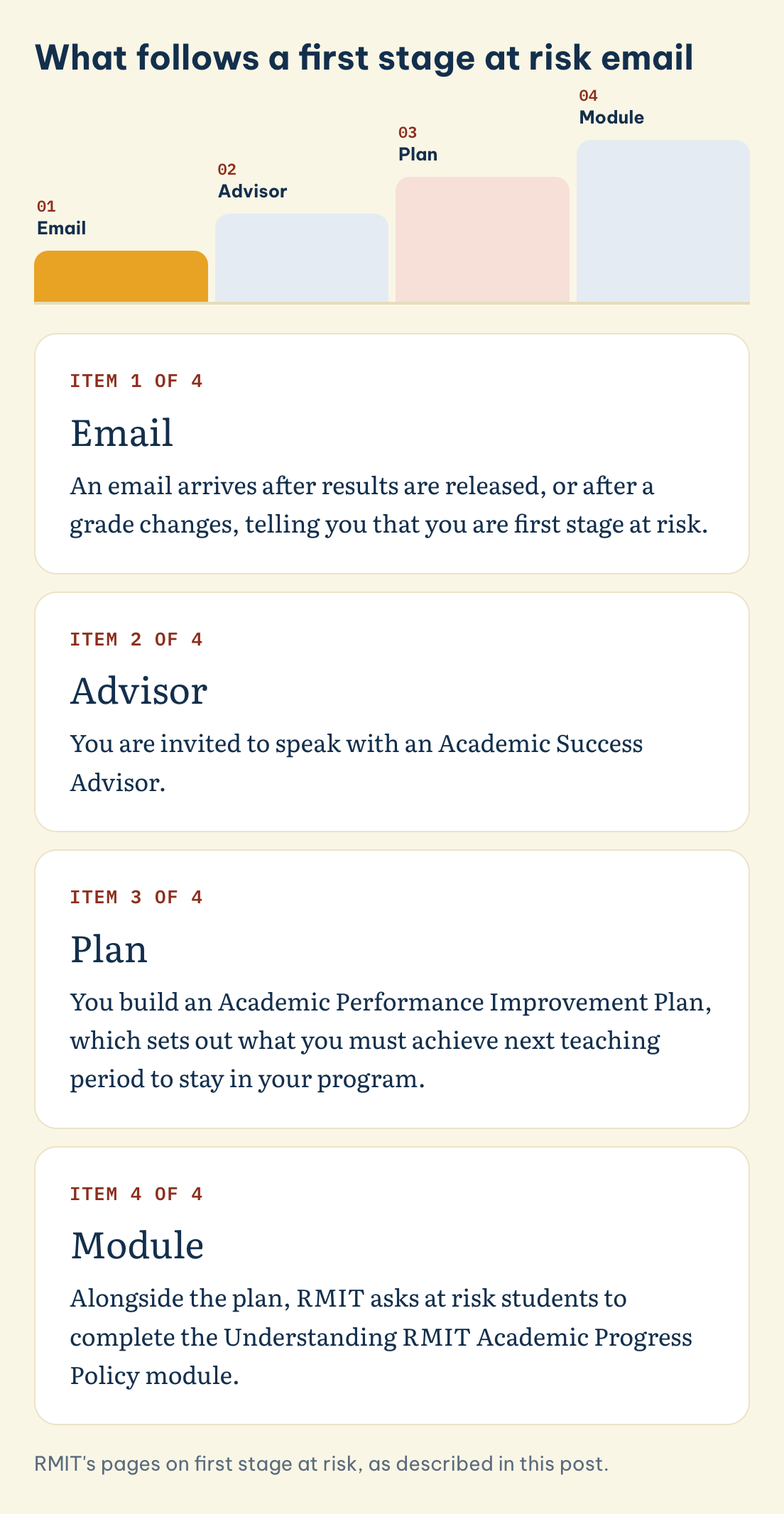
RMIT describes the plan's function in one line worth reading closely: the plan "sets out the requirements you need to meet in the next teaching period to continue in your program"; verified on 3 September 2026. That converts a warning into conditions with a deadline, and the requirements are specific to each student, so until the plan exists nobody has written down what a successful next semester looks like for you.
Alongside the plan, RMIT asks at risk students to complete an Understanding RMIT Academic Progress Policy module. Booking runs through the Student Connect Online Portal, the Student Academic Success team operates Monday to Friday from 9am to 5pm, and the team can be reached at sas@rmit.edu.vn. RMIT describes the advisors as "experts in getting at risk students back on track"; verified on 3 September 2026.
◆ Question 4 / 7 · What is a show cause
What is a show cause, and how long do you have?
Direct answer: If unsatisfactory progress continues, you reach final stage at risk and must send a written submission called a show cause to the Program Assessment Board. RMIT gives you 10 working days from the date of the notification email, counting Monday to Friday only.
The submission must explain the academic underperformance, demonstrate how you will improve, and provide independent supporting documentation of circumstances outside your control. Students most often misread the third element, since independent means a source other than their own account.
RMIT attaches a warning to that requirement: "Creating, submitting or using fraudulent documents constitutes a breach of the RMIT Student Charter and may be deemed misconduct under the Student Conduct Policy", with consequences running from failing an assessment task through to permanent expulsion or revocation of a qualification; verified on 3 September 2026. MAAS does not help students prepare show cause submissions, and this section is here to explain the process rather than to assist with it.
Ten working days is a fortnight in practice, and it runs from when the email arrives rather than when you open it. RMIT states that "Late submissions will not be accepted by the PAB and taking a Leave of Absence will not prevent the PAB from considering your case for possible exclusion". If a decision to exclude is made, an appeal must be submitted within 20 working days of the notification, and RMIT says the outcome usually reaches students within 21 days of the submission deadline. At this stage the Academic Success Advisor is the person to ask what your circumstances require, because the Board sets the standard of evidence.
◆ Question 5 / 7 · What can the Program
What can the Program Assessment Board decide?
Direct answer: The Board can allow you to continue in your program, or it can recommend that you be excluded from the program for a full academic year, which RMIT states is equivalent to three semesters. A student who is excluded may apply for re-admission to the program after the first two semesters of that exclusion.
This moves a graduation date rather than a semester. Three semesters of exclusion with re-admission possible after two puts the earliest realistic return a year later, and re-admission is an application rather than an entitlement. For an international student a change of that size reaches beyond the academic calendar, so raise it with student services before the Board meets.
◆ Question 6 / 7 · Does being flagged actually
Does being flagged actually help you recover?
Direct answer: Not by itself. Research on early warning systems and on academic probation points the same way, that identifying at risk students is the part universities do well, while improving outcomes depends on what happens after the flag. One randomised field experiment measured accurate prediction and no benefit from the counselling that followed.
In a randomised field experiment on an early warning system at a large Dutch university, according to Plak and colleagues (2022), "the results show that the EWS accurately predicts at-risk students. Yet, EWS-assisted counselling did not reduce dropout, nor improved academic performance."
Two earlier studies frame the same tension. Examining a Canadian probation policy, Lindo et al. (2010) write that "being placed on probation at the end of the first year discourages some students from returning to school while improving the GPAs of those who do", with negative effects on graduation rates concentrated among students who had arrived with the highest school grades. Albert and Wozny (2024), studying an intensive probation policy at the United States Air Force Academy that included mandatory study time, found that placement on probation increased performance without increasing attrition and increased completion of STEM degrees.
Read together the three point one way: the flag is not the intervention. An intensive, specific, time structured response is associated with recovery, while notification on its own carried measurable harm in the Canadian case. Treat the Academic Performance Improvement Plan as the work rather than the paperwork, and make its requirements concrete enough that you can tell by week six whether you are meeting them.
◆ Question 7 / 7 · What should you do
What should you do in the teaching period after a fail?
Direct answer: Treat the next teaching period as the one being measured, because under the plan it is. Fix the diagnosis before the schedule, since a plan built on the wrong cause will meet its deadlines and still produce the same result.
Separate causes that look alike on a transcript, since misreading a rubric is a different problem from submitting late and both appear identically in the grade column. A third pattern MAAS mentors see regularly among students writing in English as an additional language is an argument that was sound while the marker could not follow it, which surfaces as feedback about structure rather than content.
The test for your plan is whether it names a checkpoint before results are final, because a plan whose first measurable moment is the end of semester leaves no room to correct. That gap between being identified and being helped is the practical lesson MAAS draws from the studies above.
To see where a draft stands against the marking criteria before you submit, MAAS mentors work through that with you on your own writing. The work stays yours, which is the only version that helps in a teaching period you are being assessed on.
References
Albert, A., & Wozny, N. (2024). The impact of academic probation. Journal of Human Resources, 59(3), 852-878. https://doi.org/10.3368/jhr.0520-10877r2
Lindo, J. M., Sanders, N. J., & Oreopoulos, P. (2010). Ability, gender, and performance standards: Evidence from academic probation. American Economic Journal: Applied Economics, 2(2), 95-117. https://doi.org/10.1257/app.2.2.95
Plak, S., Cornelisz, I., Meeter, M., & van Klaveren, C. (2022). Early warning systems for more effective student counselling in higher education: Evidence from a Dutch field experiment. Higher Education Quarterly, 76(1), 131-152. https://doi.org/10.1111/hequ.12298
Tools & resources
- RMIT University Vietnam, Academic progress: https://www.rmit.edu.vn/students/my-studies/assessment-and-results/academic-progress
- RMIT University Vietnam, Academic Success Advising: https://www.rmit.edu.vn/students/support/student-academic-success/academic-success-advising
- RMIT University Vietnam, Student Academic Success: https://www.rmit.edu.vn/students/support/student-academic-success
- RMIT University, Failing a course: https://www.rmit.edu.au/students/my-course/assessment-results/results-grades/failing-a-course
A free 20-minute consultation is a conversation about your situation. MAAS does not help students prepare show cause submissions.
Book a free consultation ▸