
◆ Marketing
MKTG1529 Interactive Marketing: how do you approach the assignment?
The fastest way to lose marks in MKTG1529 is to submit a campaign plan that lists interactive channels and calls the job done. Social media, email, chatbots and personalised recommendations all appear, each described only as a way to push a message outward. Nothing in the design lets what the consumer says change what happens next, so the plan is broadcast wearing interactive clothing. This guide answers the seven questions students taking MKTG1529 ask MAAS mentors most often.

◆ Question 1 / 7 · What MKTG1529 is
What is MKTG1529, and what level is it pitched at?
Direct answer: MKTG1529 is the RMIT course code for Interactive Marketing, a 12-credit-point postgraduate course at RMIT Vietnam Saigon South; MKTG1530 is the same course at the Hanoi campus. The postgraduate bar is not describing interactive tools but building a consumer-centred strategy where the exchange runs both ways, the reciprocity test Grönroos (1994) treats as central to relationship marketing.
Evidence: RMIT's handbook record 014932 describes the course as developing a deep understanding of what interactive marketing entails: what the defining elements of interactive marketing are, how those elements facilitate a mutual exchange of information between marketer and consumer, how they are used to identify consumer needs and to foster relationships, and how they can inform strategies to fulfil those needs. The course asks you to apply that understanding by identifying and creating a successful consumer-centred interactive marketing strategy. It contributes to the Australian Marketing Institute competency in integrated marketing communications, and develops the digital and content creation competencies.
Read the phrase "mutual exchange of information" slowly. It is the load-bearing part of the whole course description, and it is the part most drafts quietly skip, the same mutuality Grönroos (1994) and Hoffman and Novak (1996) both treat as the definitional core of a real exchange.
Example: A student opened her draft with a well-researched section on Vietnam social platform penetration. Two questions came back: what would the brand learn about a customer that it did not already know, and what would the customer get in return, the reciprocal exchange Grönroos (1994) treats as the core of relationship marketing. Neither question had an answer anywhere in the document. The research was solid. The exchange was missing.
◆ Question 2 / 7 · What is interactive
What actually makes something interactive?
Direct answer: Interactivity is a property of the mechanism, not of the channel, as Rafaeli (1988) argued when he first separated interactivity from the medium carrying it. A channel makes interaction possible; a mechanism makes it happen and makes it consequential. The test is whether consumer input changes the next thing the consumer sees.
What makes each element of an MKTG1529 plan genuinely interactive
Each row sets one element of your plan beside the version that is genuinely interactive.
Element in your plan
Genuinely interactive version
Social post
A prompt whose answers are read and visibly change the next post
Sequence branches on what the person did or told you
Chatbot
Captures the unresolved question and routes it to someone who acts on it
Personalised recommendation
Customer can see why, and can correct it
Community or UGC
Community input feeds a decision the brand then reports back on
Save this figure
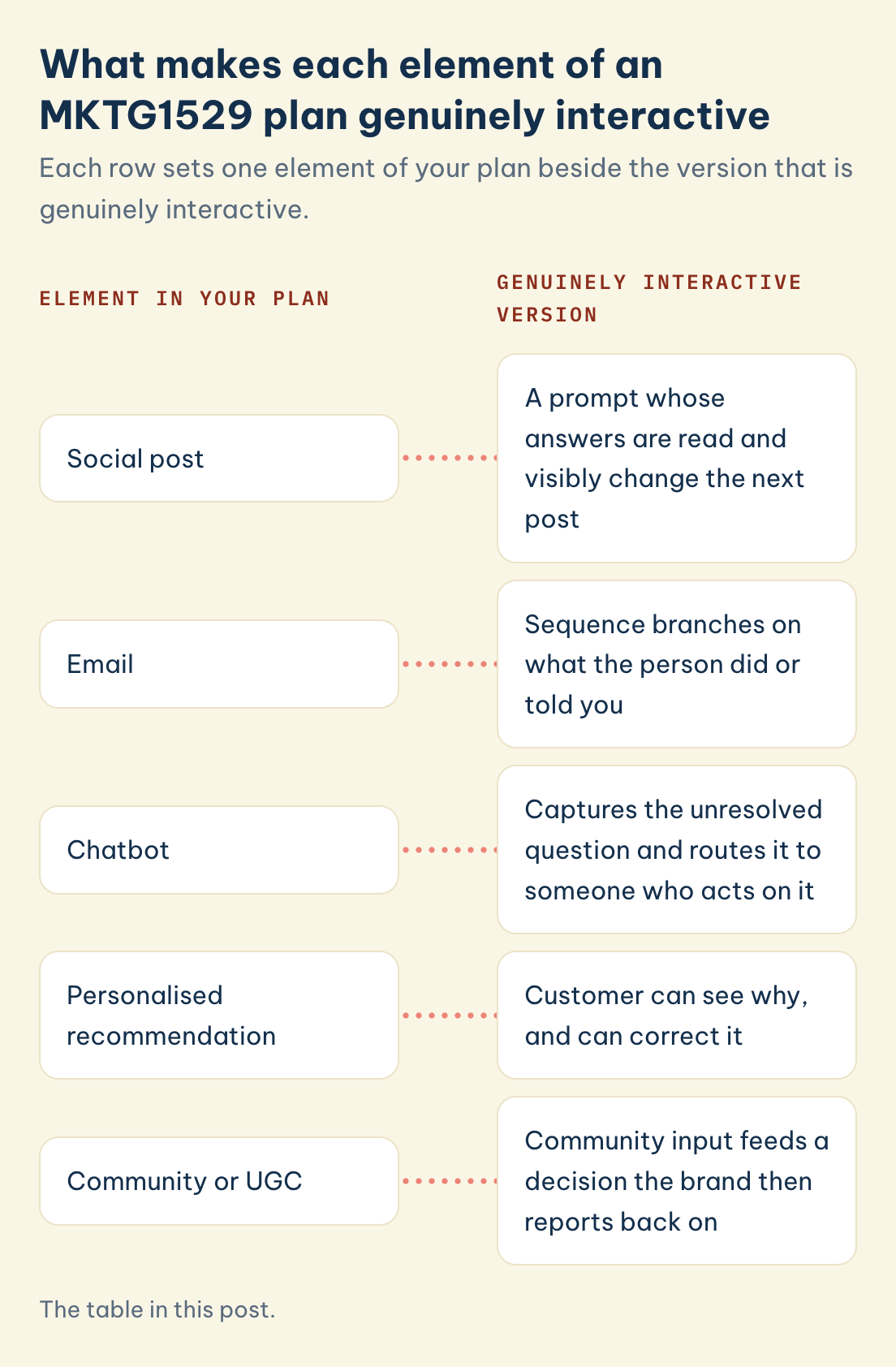
The idea is older than the 2000s literature most drafts cite. Rafaeli (1988) defined interactivity as an extent to which later messages in a sequence relate to earlier ones, and Steuer (1992) treated it as a dimension of mediated experience that can be measured independently of the technology carrying it. The marketing literature has been precise about this for over two decades, and the precision is worth borrowing. Liu and Shrum (2002) argue that inconsistent findings about interactivity across studies come largely from researchers measuring different dimensions of it while using the same word. They separate the construct into distinct dimensions including active control, two-way communication and synchronicity. Those are separable. A page can give a user a great deal of active control while communicating in one direction only. An email sequence can be technically two-way while nobody reads the replies.
Applying the distinction is what earns marks:
| Element in your plan | One-way version | Genuinely interactive version |
|---|---|---|
| Social post | Brand publishes, counts likes | A prompt whose answers are read and visibly change the next post |
| Same sequence to everyone on the list | Sequence branches on what the person did or told you | |
| Chatbot | Scripted FAQ tree | Captures the unresolved question and routes it to someone who acts on it |
| Personalised recommendation | Output of a model the customer cannot see or correct | Customer can see why, and can correct it |
| Community or UGC | Brand reposts flattering content | Community input feeds a decision the brand then reports back on |
The right-hand column all share one feature: there is a return path, and something downstream depends on it, the sustained-conversation quality Deighton (1996) said interactive media makes possible.
Example: A group proposed an Instagram poll as their headline interactive tactic. The question put to the group was what the brand would do differently depending on which option won. The honest answer was nothing; the poll existed to generate engagement, not to create the response-to-earlier-message loop Rafaeli (1988) defines as interactivity itself. They kept the poll but tied the result to which product variant the brand would feature the following month, and reported that back to the audience. Same tactic, now a mechanism.
◆ Question 3 / 7 · More is not better
Why is "more interactivity is better" the wrong assumption?
Direct answer: Because it is empirically false, precisely the point Liu and Shrum (2002) make in their title, and a postgraduate marker will expect you to know that. Treating interactivity as an unqualified good is the single most common way an otherwise capable MKTG1529 assignment reads as undergraduate.
Liu and Shrum's (2002) title puts the question directly: what is interactivity and is it always such a good thing? Their argument is that although interactivity has obvious and intuitive advantages, it can be a disadvantage under some conditions, and its effect on advertising effectiveness depends on both the person and the situation. Interactivity imposes a cost on the consumer. It asks for attention, effort, or information. Whether that cost is worth paying is not constant across people or moments.
That variability in whether the cost is worth paying is the point at which your assignment can become genuinely critical rather than descriptive. A strong submission does not just design an interactive mechanism. It states the conditions under which that mechanism would backfire, and says which segment and which moment it is designed for, the segment-and-moment sensitivity Bol et al. (2018) found mattered even for something as simple as personalised messaging.
Example: A student designed an elaborate product configurator for a first-touch awareness campaign. Her mentor wanted to know how much effort the mechanism demanded from someone who had never heard of the brand, the situational cost Liu and Shrum (2002) describe. She moved the configurator later in the journey and put a far lighter mechanism at first touch. The critical reasoning about who and when was what the feedback praised.
◆ Question 4 / 7 · Data and personalisation
How do you handle data and personalisation without being naive about it?
Direct answer: Treat the consumer's information as something they are choosing to give, at a price they are calculating, the privacy calculus Bol et al. (2018) describe. A plan that assumes people will hand over data because the offer is relevant has skipped the part the evidence is clearest about.
Bol et al. (2018), in an online experiment with a representative Dutch sample of 1,131 participants, found that privacy risk perception was the strongest cost predictor of willingness to self-disclose, and, notably, that "personalization decreased trust slightly and benefits marginally" (Bol et al., 2018, p. 370). That result cuts against the intuition most campaign plans are built on. Personalisation is not free goodwill; it can itself be the thing that makes people warier. That resistance echoes an older finding: Davis (1989) showed adoption of a new system depends on perceived usefulness and perceived ease of use, and a personalisation mechanism that feels invasive fails on both counts even when it is technically well built.
How you collect matters as much as what you collect. Xu et al. (2011) distinguish covert personalisation, where content is pushed based on quietly observing behaviour, from overt personalisation, where the person requests it, and found that the influence of personalisation on perceived risk and benefit differs by which approach is used. A plan that says "we will personalise" without saying which of these it means has not made the decision the course is asking you to make.
And the exchange is social, not merely transactional. Degutis et al. (2023), using social exchange theory with a representative survey analysed by structural equation modelling, found that consumer-perceived provider reciprocity outweighed the perceived benefit of disclosure in driving willingness to share personal data. In plain terms, people care about whether the relationship gives back, not only about whether the immediate offer is worth it.
Example: A team planned a data capture form offering a discount code. The review kept returning to one gap: what the customer received in the relationship beyond the one-off code. The revised mechanism told customers what the brand had learned from them in aggregate and what it changed as a result, the reciprocity signal Degutis et al. (2023) found mattered more than the offer itself. The discount stayed. The reciprocity was what made the section defensible.
◆ Question 5 / 7 · Critical analysis
What separates a critical analysis from a descriptive one here?
Direct answer: Description says what the mechanism is. Critical analysis says what it costs the consumer, under what conditions it fails, and how you would know, echoing Steuer's (1992) point that interactivity is a dimension you can actually measure, not just claim.
A serviceable habit is to write every mechanism up in four moves rather than one:
- What it is. The mechanism, in one sentence.
- What the consumer gives, and gets. Attention, effort, data on one side; what returns on the other.
- When it fails. The person or situation in which this becomes a cost without a benefit, the segment-by-moment interaction Liu and Shrum (2002) modelled.
- How you would detect that. The signal that would tell you it is failing, early.
Most drafts contain move 1 only, four or five times over. Moves 2 to 4 are where postgraduate marks live, and they are also short. Adding them usually lengthens a section by a paragraph, not a page.
Example: A student's draft described six tactics in six competent paragraphs and scored in the middle band. He was asked to cut to three tactics and give each one the four moves, the kind of measurable depth Steuer (1992) argued interactivity requires. The document got shorter, the mark went up, and the feedback used the word analytical for the first time.
◆ Question 6 / 7 · Consumer-centred
How do you keep the strategy consumer-centred rather than brand-centred?
Direct answer: Check whose problem each section is solving. If every mechanism solves a brand problem such as reach, awareness or data capture, the plan is brand-centred no matter how often it uses the word customer.
The course description is explicit that the elements of interactive marketing are used to identify consumer needs, foster relationships, and inform strategies that fulfil those needs. That is a chain with the consumer's need at the front, not the brand's objective. A practical way to audit your own draft is to underline the beneficiary of each mechanism. A plan in which the brand is the beneficiary every time has answered a different question from the one asked. Hoffman and Novak (1996) made the underlying case for why this matters online specifically: computer-mediated environments let consumers become active participants who can shape the content itself, not just passive recipients of it, which is precisely the shift a brand-centred plan fails to make.
This beneficiary audit is also where the relationship framing earns its place. Fostering a relationship implies duration and memory: the brand should behave differently towards someone on their fifth interaction than on their first, the shift from transaction to relationship that Grönroos (1994) framed as central to modern marketing thought. Plans that treat every contact as a first contact have described a campaign, not a relationship.
Example: A group's plan had a strong acquisition mechanism and nothing after purchase. Their mentor wanted to know what the brand would say to the same person three months later, and what it would already know about them. The addition of a short post-purchase section, using information the customer had already given, changed the plan from a funnel into the sustained conversation Deighton (1996) described.
◆ Question 7 / 7 · Assignment structure
What structure works for the assignment?
Direct answer: Structure the report so the consumer's need drives every later section:
- Consumer need and context. What the target consumer is trying to accomplish, evidenced rather than assumed.
- Where interaction can create value. The specific points where a two-way exchange helps the consumer, not just the brand.
- Mechanism design. Each mechanism written in the four moves above.
- Information exchange and privacy. What you collect, covert or overt, what the consumer gets back, and why the reciprocity is credible.
- Relationship over time. How behaviour changes across repeat interactions, in the spirit of what Deighton (1996) called treating a customer relationship as a sustained conversation rather than a single transaction.
- Measurement. Signals such as reply rate, opt-out rate or Net Promoter Score, the metric Reichheld (2003) proposed as a proxy for relationship health, that would show the exchange is working, including early warning that it is not.
- Limitations and conditions. Where this strategy would not hold under a regulation such as GDPR or under a segment that Liu and Shrum (2002) would predict finds the mechanism costly rather than helpful.
Confirm your own assessment tasks, weightings and course learning outcomes in Canvas. Class guides are specific to a teaching period, and the outcomes listed there are what you will be marked against.
Example: A student kept all her content and simply moved her consumer research section from an appendix to the front, then made each later section refer back to it. She changed almost no words. The report stopped reading as a set of tactics and started reading as a strategy, the shift from passive recipient to active participant Hoffman and Novak (1996) describe.
Frequently asked questions
Is MKTG1529 the same as MKTG1530?
Yes, the same course at different RMIT Vietnam campuses. MKTG1529 runs at Saigon South and MKTG1530 at the Hanoi campus. Check the code on your own Canvas shell before quoting it.
Is this course undergraduate or postgraduate?
Postgraduate. That changes what is expected: not a description of interactive tools, but a defensible consumer-centred strategy with stated conditions and limitations, the critical standard Liu and Shrum (2002) apply throughout their own analysis.
Do I need to use a specific interactivity framework?
Only if your class guide requires one. What matters is that you distinguish the dimensions rather than using interactivity as a single undifferentiated word, since that conflation is exactly what Liu and Shrum (2002) identify as the source of confusion.
Can I write about AI-driven personalisation?
Yes, and it fits the course well, provided you treat it as an exchange rather than a capability. The questions stay the same: what is collected, whether it is covert or overt in the sense Xu et al. (2011) define, what returns to the consumer, and when it would backfire in the way Bol et al. (2018) documented.
My case brand is small and has little data. Is that a problem?
No, and it can be an advantage. A small brand forces you to design mechanisms that earn information rather than assume access to it, which is closer to the perceived-usefulness test Davis (1989) describes than to a data-volume contest.
How much of the plan should be tactics?
Fewer tactics, each properly analysed, beats a long list. Three mechanisms with costs, failure conditions and detection signals will outscore eight described at surface level, the measurable-dimension standard Steuer (1992) set for what counts as interactivity at all.
How MAAS mentors support MKTG1529 students
MAAS works with RMIT Vietnam students as academic mentors and advisors. For this course that usually means testing whether your mechanisms are genuinely two-way before you build a full draft around them, checking that your data and personalisation reasoning reflects what the evidence actually shows rather than the optimistic version, and reviewing your own writing against the course learning outcomes so you can see where a marker would ask for more critical depth. You do the analysis and you write the report. Our role is to ask the questions your marker will ask, early enough that you can still answer them.
If you want a second read, bring your brief and your current draft. We match you with a discipline-matched expert within 48 hours when our network already covers that field, or in about two weeks if MAAS has to recruit for it, and the first 20-minute consultation is free. Around 23 percent of our expert network holds a PhD. Start at our MAAS Assignment & Essay Support, or see our guide to MKTG1416 Digital Marketing Strategy and Planning for the related problem of keeping a strategy coherent from objective to metric. For the underlying skill of reading what a task is actually asking, see assignment command words explained.
References
Bol, N., Dienlin, T., Kruikemeier, S., Sax, M., Boerman, S. C., Strycharz, J., Helberger, N., & de Vreese, C. H. (2018). Understanding the effects of personalization as a privacy calculus: Analyzing self-disclosure across health, news, and commerce contexts. Journal of Computer-Mediated Communication, 23(6), 370–388. https://doi.org/10.1093/jcmc/zmy020
Davis, F. D. (1989). Perceived usefulness, perceived ease of use, and user acceptance of information technology. MIS Quarterly, 13(3), 319–340. https://doi.org/10.2307/249008
Degutis, M., Urbonavičius, S., Hollebeek, L. D., & Anselmsson, J. (2023). Consumers' willingness to disclose their personal data in e-commerce: A reciprocity-based social exchange perspective. Journal of Retailing and Consumer Services, 74, 103385. https://doi.org/10.1016/j.jretconser.2023.103385
Deighton, J. (1996). The future of interactive marketing. Harvard Business Review, 74(6), 151–162.
Grönroos, C. (1994). From marketing mix to relationship marketing: Towards a paradigm shift in marketing. Management Decision, 32(2), 4–20. https://doi.org/10.1108/00251749410054774
Hoffman, D. L., & Novak, T. P. (1996). Marketing in hypermedia computer-mediated environments: Conceptual foundations. Journal of Marketing, 60(3), 50–68. https://doi.org/10.1177/002224299606000304
Liu, Y., & Shrum, L. J. (2002). What is interactivity and is it always such a good thing? Implications of definition, person, and situation for the influence of interactivity on advertising effectiveness. Journal of Advertising, 31(4), 53–64. https://doi.org/10.1080/00913367.2002.10673685
Rafaeli, S. (1988). Interactivity: From new media to communication. In R. P. Hawkins, J. M. Wiemann, & S. Pingree (Eds.), Advancing communication science: Merging mass and interpersonal processes (pp. 110–134). Sage Publications.
Reichheld, F. F. (2003). The one number you need to grow. Harvard Business Review, 81(12), 46–54.
Steuer, J. (1992). Defining virtual reality: Dimensions determining telepresence. Journal of Communication, 42(4), 73–93. https://doi.org/10.1111/j.1460-2466.1992.tb00812.x
Xu, H., Luo, X., Carroll, J. M., & Rosson, M. B. (2011). The personalization privacy paradox: An exploratory study of decision making process for location-aware marketing. Decision Support Systems, 51(1), 42–52. https://doi.org/10.1016/j.dss.2010.11.017
Tools & resources
- RMIT Handbook, course record for Interactive Marketing: https://handbook.rmit.edu.au/ords/r/rmit/catalogue/course?p6_code=014932
- RMIT course guide 014932: https://www.rmit.edu.au/study-with-us/levels-of-study/course-guides/014/014932
- RMIT Vietnam course and class guides: https://www.rmit.edu.vn/students/my-studies/program-course-information/course-guides
A free 20-minute consultation is a conversation about where you are with MKTG1529.
Book a free consultation ▸