
◆ Marketing
MKTG1416 Digital Marketing Strategy and Planning: how do you approach the capstone?
Most MKTG1416 submissions are not marked down for a weak section; they are marked down because the sections do not hold together. An objective, a channel plan aimed at a different audience, and a measurement table that cannot confirm or disconfirm that objective can each read competently alone, yet the chain between them is broken, and a capstone is the assessment built to detect exactly that. This guide answers the seven questions RMIT Vietnam students ask MAAS mentors.

◆ Question 1 / 7 · What MKTG1416 is
What is MKTG1416, and why does being a capstone change how it is marked?
Direct answer: MKTG1416 is the RMIT course code for Digital Marketing Strategy and Planning, taught to undergraduate students at RMIT Vietnam Saigon South, Ho Chi Minh City, as the culminating course of the Bachelor of Digital Marketing (BP318). It must be taken after all other courses, because a capstone assesses integration, rewarding the joins between competencies rather than the competencies themselves.
Evidence: RMIT's handbook record 052664 describes this course as the culminating project in the Digital Marketing program, giving students the opportunity to integrate, critically reflect on and consolidate what they have learnt across the program, so that they emerge with the strategic mind, frameworks and tools to create and manage a company's digital strategy. The program record for BP318 names MKTG1416 as the final-year capstone and groups it with the work-integrated learning courses in which students work on industry-based projects identified by the school. The Hanoi campus equivalent is MKTG1471.
Example: A student arrived at her first mentoring session with a draft she described as "five strong chapters". The session turned on a single question: which chapter would have to change if the client's objective turned out to be retention rather than acquisition? Only the first chapter mentioned the objective at all. The other four would have stayed word for word identical. That is the diagnostic for a broken chain.
◆ Question 2 / 7 · Learning outcomes
What are the course learning outcomes actually asking for?
Direct answer: Five outcomes, and most of them are about linkage rather than knowledge. Read them as a chain rather than a checklist.
Evidence: The RMIT course learning outcomes for MKTG1416 require five linked outcomes. CLO1 is to understand the marketing objectives of a firm in order to develop strategic recommendations that will help achieve them. CLO2 is to manage and optimise key channels and content within the company's strategic plan. CLO3 is to integrate your strategic approach with hands-on experience using platforms and tools. CLO4 is to recommend a viable solution that will address the client brief or issue. CLO5 is to work on projects in collaboration with others with minimal supervision and communicate effectively to achieve the project objectives.
Notice the grammar. CLO1 does not say "understand marketing objectives"; it says understand them in order to develop recommendations that achieve them. CLO2 does not say "manage channels"; it says manage them within the strategic plan. The verbs are relational. A submission can demonstrate every individual skill and still miss most of the outcomes.
Example: A group produced an excellent paid social plan built in Meta Ads Manager, with real platform screenshots and a competent budget split. Their mark was mid-range. The feedback said the channel work was not connected to the stated objective. They had satisfied the noun in CLO2 and missed the preposition.
◆ Question 3 / 7 · Where marks concentrate
Where do marks concentrate, and what breaks the chain?
Direct answer: In a client-facing capstone, marks concentrate at the joins: objective to segment, segment to channel, channel to content, and content to metric. The most common failure is at the final join, where the measurement plan reports what is easy to count instead of what would answer the objective.
Reporting what is easy to count instead of what answers the objective is a documented failure mode in professional practice, not just in student work. Vollrath and Villegas (2022), in the Journal of Marketing Analytics, name it digital marketing analytics myopia: fixating on a single convenient indicator such as click-through rate regardless of which segment is being addressed or where that segment sits in its decision journey. Their argument is that strategy, tactics and measurement must each be aligned to the same stage of the customer decision journey, and that optimising a campaign on one metric can actively undermine the broader goal. Click-through rate is near absent at an early awareness stage, so choosing it there ignores the needs of that segment entirely.
The evidence on which metrics work is more uncomfortable than most students expect. Mintz et al. (2021), writing in the International Journal of Research in Marketing, analysed 439 managers making 1,287 marketing-mix decisions and found that customer-mindset metrics such as awareness, satisfaction and willingness to recommend were consistently associated with better decision outcomes, while headline financial metrics such as target volume, net present value and return on marketing investment were consistently associated with worse ones. Managers were also more uncertain about the effective metrics and more confident about the ineffective ones, which is why the weaker measures get overused.
In practice, the platform matters less than the discipline. A dashboard built in Google Analytics 4, Meta Ads Manager, TikTok Ads Manager or Google Search Console will all report awareness-stage numbers such as reach and video-completion rate alongside conversion-stage numbers such as cost per acquisition. The tool does not decide which number belongs in your report; the journey stage does. Pulling the wrong number into a Google Sheets summary because it looks more impressive than the number your objective actually calls for is the same analytics myopia Vollrath and Villegas describe, just committed with better software.
Example: A team set the objective as building consideration among a segment that had never heard of the client, then proposed to measure success by conversion rate and ROMI. Their mentor wanted to know what number would appear in month one if the campaign worked perfectly. They could not answer, because a segment at the awareness stage does not convert in month one whether the work is good or bad. The metric could not distinguish success from failure, which is the definition of a metric that is not doing any work.
◆ Question 4 / 7 · A coherent chain
What does a coherent chain look like in practice?
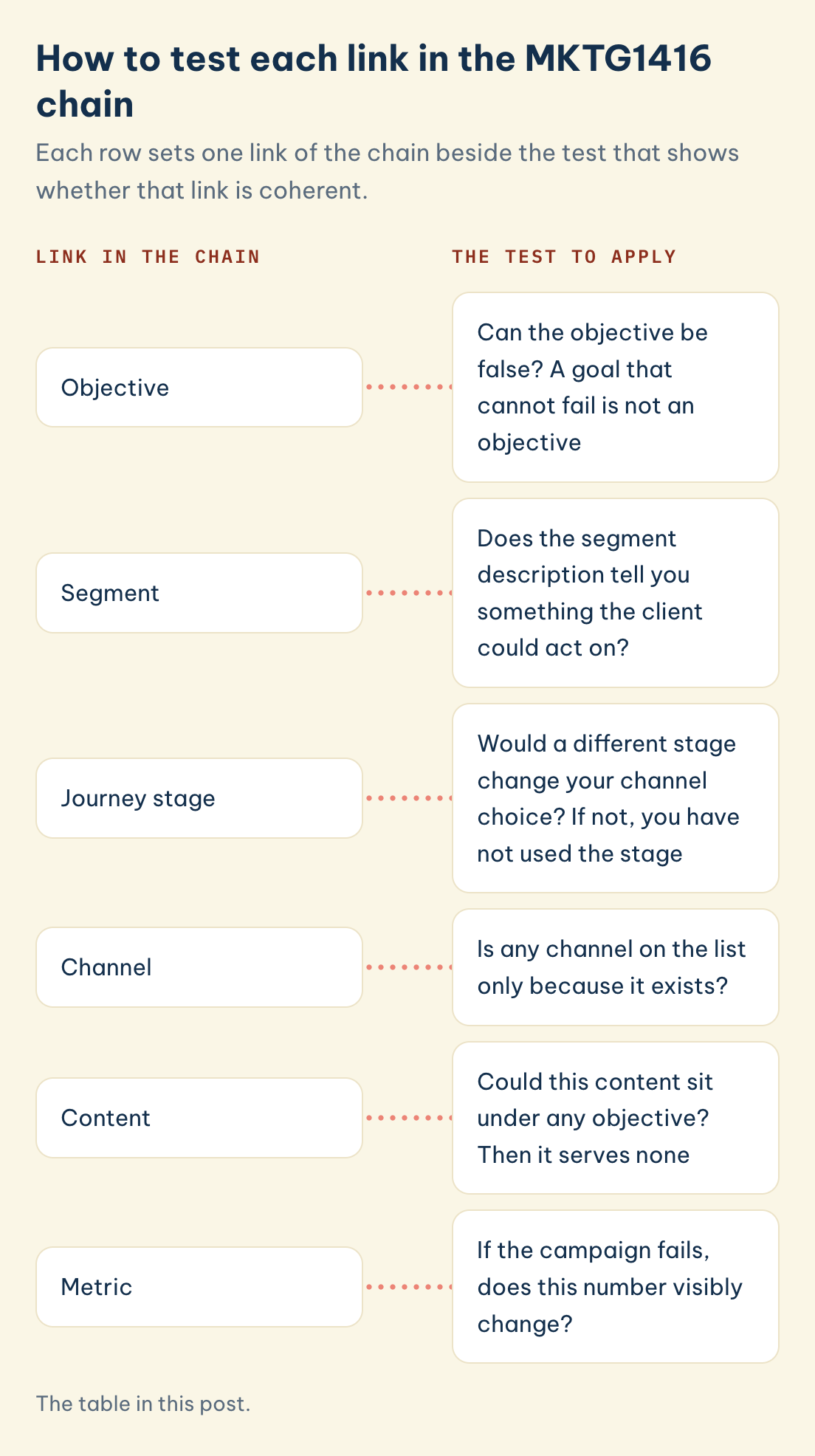
Direct answer: Every row should be readable left to right without a leap. If you cannot say because between two adjacent cells, the join is where you will lose marks.
How to test each link in the MKTG1416 chain
Each row sets one link of the chain beside the test that shows whether that link is coherent.
Link in the chain
The test to apply
Objective
Can the objective be false? A goal that cannot fail is not an objective
Segment
Does the segment description tell you something the client could act on?
Journey stage
Would a different stage change your channel choice? If not, you have not used the stage
Channel
Is any channel on the list only because it exists?
Content
Could this content sit under any objective? Then it serves none
Metric
If the campaign fails, does this number visibly change?
Save this figure
| Link in the chain | Weak version (each fine alone) | Coherent version | The test to apply |
|---|---|---|---|
| Objective | "Increase brand awareness and drive sales" | "Move first-time buyers of category X from unaware to actively considering, within one semester" | Can the objective be false? A goal that cannot fail is not an objective |
| Segment | "Gen Z in Vietnam, 18 to 25" | "Students in HCMC who already buy the category but from a substitute brand" | Does the segment description tell you something the client could act on? |
| Journey stage | Not stated | Early consideration, not purchase | Would a different stage change your channel choice? If not, you have not used the stage |
| Channel | "Facebook, TikTok, Instagram, email" | One channel where that segment is already active at that stage, with the reason | Is any channel on the list only because it exists? |
| Content | "Engaging content" | The specific job the content does at that stage | Could this content sit under any objective? Then it serves none |
| Metric | Click-through rate, ROMI | A customer-mindset measure that moves if and only if the objective is being met | If the campaign fails, does this number visibly change? |
The right-hand column is the part worth memorising. Coherence is not something you assert in a linking sentence; it is something a marker verifies by testing whether a change upstream would force a change downstream. Named planning frameworks such as RACE (Reach, Act, Convert, Engage) exist precisely to force that left-to-right test onto paper before you start writing the report.
Example: One group listed four channels, including a TikTok Ads Manager plan, because the brief mentioned an integrated campaign and they read "integrated" as "several". They were asked to delete the two channels they could not defend. The plan got shorter, the Meta Ads Manager screenshots were cut to the two that mattered, and the mark went up, because the two survivors could each be traced to the segment and the stage.
◆ Question 5 / 7 · The client brief
How do you handle the client brief without either ignoring it or obeying it?
Direct answer: Treat the brief as evidence about the client's situation, not as an instruction you must satisfy. The strongest capstone work interrogates the brief and says so explicitly, with reasons.
Interrogating the brief instead of just satisfying it is where students are most often too deferential. In a study of postgraduate marketing consultancy projects, Hiller and Rosborough (2015) found that clients valued precisely the moments when student teams did not deliver what the client expected to hear. In their own account, "the students did not necessarily deliver what the client wanted to hear, thus further giving weight to the notion that these types of projects develop students’ critical skills" (Hiller & Rosborough, 2015, p. 3). One not-for-profit client expected recommendations aimed at changing individual behaviour; the team argued instead for community-level awards and a tailored approach for vulnerable groups. The same study notes, honestly, that such reframing is not the norm, and that students more typically recommend action the organisation is already taking.
There is a limit worth naming. Disagreeing with the brief only earns credit when the disagreement is evidenced. "The client asked for X but we think Y" is an opinion. "The brief assumes the barrier is awareness; our segment data indicates the barrier is at consideration, so an awareness campaign would spend against a problem the client does not have" is an argument.
Example: A student's brief asked for a follower-growth campaign. She was uncomfortable but wrote the campaign anyway. The question back to her was which evidence in her own research supported follower count as the constraint. There was none. Her rewrite kept the client's underlying goal, showed why follower growth would not deliver it, and proposed an alternative. She did not refuse the brief. She re-specified the problem inside it.
The Hiller and Rosborough study drew its cases from consultancy projects presented to the Academy of Marketing, the professional body that also publishes teaching guidance for exactly this kind of client-facing assessment.
◆ Question 6 / 7 · Group work
Why does group work sink otherwise good capstone submissions?
Direct answer: Because a divided workload produces divided logic. When each member owns a section, the sections optimise independently and the chain breaks at exactly the joins the capstone is marking.
Ishida et al. (2025), publishing in the Journal of Marketing Education, observed this directly when comparing project structures in marketing education. In the class where work was distributed across a larger collective unit, the creative executions and the selected media platforms were not aligned, described as efforts running in parallel yet uncoordinated, and the presentation suffered as a result. The smaller-team structure produced more cohesive and more convincing campaigns. The failure was not effort or ability; it was the absence of anyone holding the joins.
The practical implication is a role most student groups never assign. Someone has to own the chain rather than a section, reading the whole document as a single argument and challenging every join. That person writes less and improves the mark more.
Example: A group of four split the plan four ways and merged the parts into a shared Google Docs file the night before submission. The document contained three different definitions of the target segment. Nobody had the job of noticing.
◆ Question 7 / 7 · Report structure
What structure works for the strategy and planning report?
Direct answer: Structure the report so that each section is visibly caused by the one before it. A serviceable spine looks like this:
- Situation and problem definition. What the client believes the problem is, what your evidence indicates it is, and where those differ.
- Segment and journey stage. Who, and where in their decision journey. This section licenses everything after it.
- Strategic objective. Falsifiable, time-bound, and traceable to the segment.
- Channel and content plan. Each choice justified by segment and stage, not by popularity.
- Measurement plan. Metrics that move if and only if the objective moves, tracked through a named tool such as Google Analytics 4 or Meta Ads Manager, with the reasoning stated.
- Implementation and risk. Sequence, owners, dependencies, and what you would do if the leading indicator does not move.
- Reflection. What you would revise, and on what evidence.
Confirm your own task list and weightings in Canvas, since class guides are specific to a teaching period and this course runs across three Vietnam semesters each year. A situation-analysis section is also a natural place for a SWOT analysis, a PESTLE analysis of the category, or a review of category search interest in Google Trends, provided each point in it is then used somewhere later in the report rather than left to stand alone.
Example: A student reordered nothing and rewrote nothing except the first sentence of each section, making each one refer back to the decision made in the previous section. The content was unchanged. The report suddenly read as one argument, and the feedback shifted from "descriptive" to "well integrated".
Frequently asked questions
Is MKTG1416 the same as MKTG1471?
They are the same course delivered at different RMIT Vietnam campuses. MKTG1416 runs at the Saigon South campus in Ho Chi Minh City and MKTG1471 at the Hanoi campus. Always check your own course code in Canvas before quoting a code in your work.
Do I need to use a named framework such as See, Think, Do, Care?
No framework is compulsory unless your class guide requires one. Common named options in digital marketing planning include AIDA, STP (Segmentation, Targeting, Positioning), and RACE, alongside See, Think, Do, Care. A framework helps only if it forces you to state the journey stage explicitly, which is the thing markers check. Using a framework as decoration and then ignoring it in your channel section is worse than not using one.
How much theory belongs in a capstone report?
Enough to justify decisions, and no more. In consultancy-style projects, clients themselves reported that theory was valuable specifically because it gave a foundation for persuading their own boards (Hiller & Rosborough, 2015). Theory that does not change a recommendation is padding.
My data set is small. Does that lower my mark?
Small samples are normal in a semester-length project. What lowers marks is overclaiming from them, a pattern Mintz et al. (2021) also flag among working managers, not only students. State the limit, then reason within it. A modest finding handled honestly reads as more competent than a large claim that the data cannot support.
Can I recommend something the client is already doing?
You can, but say so and explain why it should continue or scale. Presenting existing practice as a new recommendation is a recognised weakness in student consultancy work, documented by Hiller and Rosborough (2015), and markers spot it quickly.
What is the single fastest improvement to a draft?
Read only the first and last sentence of every section, in order. If that sequence does not read as a connected argument, fix the joins before you touch anything else.
How MAAS mentors support MKTG1416 students
MAAS works with RMIT Vietnam students as academic mentors and advisors. For a capstone this usually means three things: helping you pressure-test the chain from objective to metric before you commit a full draft to it, reviewing your own writing against the course learning outcomes so you can see which joins a marker would question, and coaching the group-coordination problem described above so that one person genuinely owns coherence. You do the analysis and you write the report. Our role is to ask the questions your marker will ask, early enough that you can still answer them.
If you want a second read on your plan, bring your brief and your current draft. We match you with a discipline-matched expert within 48 hours when our network already covers that field, or in about two weeks if MAAS has to recruit for it, and the first 20-minute consultation is free. Around 23 percent of our expert network holds a PhD. Start at our MAAS Assignment & Essay Support, or read our guide to digital business development in MKTG1420 if you are taking that course in the same program. For the underlying skill of reading what an assessment task is actually asking, see assignment command words explained.
References
Hiller, A., & Rosborough, J. (2015). Brief encounter: The use of consultancy projects to enhance the learning experience of postgraduate marketing students [Conference presentation]. Academy of Marketing Conference: The Magic in Marketing, University of Limerick, Limerick, Ireland, July 7–9. https://irep.ntu.ac.uk/id/eprint/26033/
Ishida, C., Kaufman, P. B., Gibson, M., & Hunter, G. K. (2025). Fostering value cocreation using an agency-style client project in marketing education. Journal of Marketing Education. Advance online publication. https://doi.org/10.1177/02734753251318180
Mintz, O., Gilbride, T. J., Lenk, P., & Currim, I. S. (2021). The right metrics for marketing-mix decisions. International Journal of Research in Marketing, 38(1), 32–49. https://doi.org/10.1016/j.ijresmar.2020.08.003
Vollrath, M. D., & Villegas, S. G. (2022). Avoiding digital marketing analytics myopia: Revisiting the customer decision journey as a strategic marketing framework. Journal of Marketing Analytics, 10(2), 106–113. https://doi.org/10.1057/s41270-020-00098-0
Tools & resources
- RMIT Handbook, course record for Digital Marketing Strategy and Planning: https://handbook.rmit.edu.au/ords/r/rmit/catalogue/course?p6_code=052664
- RMIT Handbook, program record for the Bachelor of Digital Marketing (BP318): https://handbook.rmit.edu.au/ords/r/rmit/catalogue/program?p5_code=BP318VRI
- RMIT Vietnam course and class guides: https://www.rmit.edu.vn/students/my-studies/program-course-information/course-guides
A free 20-minute consultation is a conversation about where you are with MKTG1416.
Book a free consultation ▸