
MKTG1456 Applied Public Relations Research is where public relations stops being about writing and starts being about proof. Students who struggle usually produce a polished campaign idea with no research behind it, or an evaluation that counts press clippings and calls it success. The marks live in doing PR the way the profession now demands. This guide answers the seven questions Vietnamese students at RMIT ask MAAS mentors most often before they start MKTG1456.
Author: MAAS Editorial Team · Reviewed by a Senior Communications mentor (public relations research and evaluation)
Last updated: 2026-07-24
Category: marketing

What is MKTG1456 Applied Public Relations Research about?
Direct answer: MKTG1456 Applied Public Relations Research is an undergraduate course in RMIT's Bachelor of Professional Communication, within the Public Relations major, offered at RMIT Vietnam (also MKTG1510 in Melbourne). It teaches research as the engine of professional PR: defining a communication problem, choosing methods, gathering data, and measuring outcomes.
Evidence: Applied PR research courses are built around two research moments that frame the whole PR process: formative research, done before a campaign to understand the situation and the publics, and evaluative research, done after to judge whether objectives were met. Recognised planning models make this explicit, ROPES (Research, Objectives, Programming, Evaluation, Stewardship) opens and closes with research. The course's word "Applied" is the instruction: you are expected to conduct research on a real problem, not to describe research in the abstract.
Example: A Vietnamese student arrived at MAAS with a creative campaign concept and no research at all. Her mentor asked one question: how do you know your audience thinks what you assume they think? She did not. Once she treated research as the foundation of the campaign rather than a section to add at the end, the assignment reorganised itself around evidence, which is exactly what the course assesses.
What assessment does the MKTG1456 assignment usually involve?
Direct answer: Assessment in RMIT PR courses is by essays, reports, research proposals and presentations, individually and in groups, never exams. MKTG1456 typically involves a research proposal or plan (defining a problem, questions, method and sample) and an applied research report that presents findings and turns them into communication recommendations, sometimes with an evaluation framework for a campaign. The research report is usually where most of the marks sit. Always confirm the exact tasks, weightings and topic in your own Canvas shell, because assessment detail varies by semester.
Evidence: Because the course is method-driven, assessment rewards a defensible research design far more than a polished idea. A research proposal makes you justify your method and sample before you gather anything; a research report makes you show that your conclusions follow from your data. Both are marked on rigour, whether the research could actually answer the question you set, not on how attractive the eventual campaign looks.
Example: A student wrote a strong-sounding report claiming his campaign would "raise awareness", supported only by his own assumptions. His MAAS mentor did not rewrite the campaign; she asked what method would test the awareness claim, and what sample would make it credible. Adding a defensible survey design turned an opinion into research, and the mark followed.
How is MKTG1456 graded, what does the rubric actually reward?
Direct answer: MKTG1456 rewards four things, roughly in this order: (1) research design, whether your method actually answers the question and your sample supports the claim; (2) measurement of outcomes, whether you evaluate change in awareness, attitude or behaviour rather than counting outputs; (3) evidence-based recommendations, whether your PR advice follows from your findings; and (4) rigour and referencing, including ethics and validity. The move from a pass to a strong mark is almost always the shift from "we got lots of coverage" to "we measured whether the coverage changed what our public thought or did".
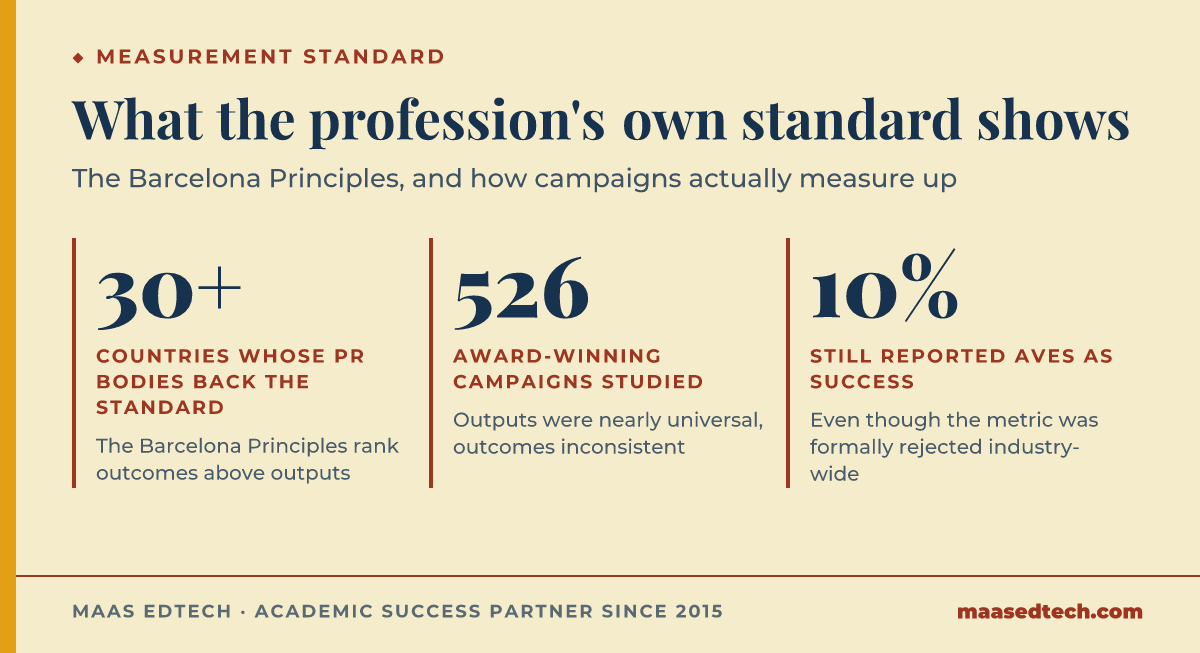
Evidence: The professional standard the course teaches, the Barcelona Principles agreed by PR bodies across 30-plus countries, states plainly that measuring outcomes is preferred to measuring outputs, and that Advertising Value Equivalents (AVEs) are not the value of communication. A content analysis of 526 award-winning campaigns (Schriner, Swenson, & Gilkerson, 2017) found outputs were nearly universal in evaluations while outcomes were inconsistent, and AVEs persisted in about 10% of cases despite being formally rejected. A report that stops at outputs is repeating the exact weakness the standard was written to fix.
| Rubric focus | Outputs / assertion (lower band) | Outcomes / evidence (higher band) |
|---|---|---|
| Research question | Vague aim ("raise awareness") | A specific, measurable question a method can answer |
| Method | Method named but not justified | Method and sample justified as fit for the question |
| Measurement | Counts coverage, reach, AVEs | Measures change in awareness, attitude or behaviour |
| Findings | Reports what happened | Interprets what the data mean for the public and the client |
| Recommendations | Generic PR advice | Advice that follows directly from the findings |
Example: A MAAS mentor marked a student's evaluation section against this table and found it full of reach and impression counts. The student added one outcome measure, a before-and-after attitude question, and reframed his recommendations around it. The evaluation moved two bands, because it finally measured effect rather than activity.
Which methods and concepts should you use in MKTG1456?
Direct answer: Use a small, well-justified set. For research design, the core choices are surveys (for measuring awareness and attitudes at scale), content analysis (for media and message analysis), and interviews or focus groups (for depth on why publics think as they do). For framing the PR process, use a recognised model such as ROPES or RACE. For measurement and evaluation, anchor in the Barcelona Principles and the outputs, outtakes, outcomes and impact distinction. Choose the method that fits your question and justify why, rather than listing methods you will not use.
Evidence: These methods and frameworks are examiner-recognised because they turn "we did some PR" into a research argument. The measurement literature is also a clear place to earn critical marks, because the field is genuinely divided. Macnamara (2014) writes that his review "presents a critical analysis that reveals continuing gaps and problematic issues to address in the latest efforts to measure the value of PR" (Macnamara, 2014, p. 7), which is exactly the gap a course built on the Barcelona Principles asks you to close. AVEs, which value coverage as if it were paid advertising, have been criticised in the academic literature for over sixty years and were formally rejected by the industry in 2010, yet Watson (2012) documented that they remained one of the most popular practitioner metrics. Noting that gap, and choosing outcome measures instead, demonstrates exactly the critical judgement the higher bands reward.
Example: A Vietnamese student planned to measure her campaign's success by media coverage value. Her mentor pointed her to the evidence that the profession rejects that metric and explained why coverage cost is not communication value. She switched to a small pre- and post-survey of attitude change, and her method went from discredited to defensible in one revision.
How do you design a defensible research study for the report?
Direct answer: Start from one clear, answerable question, then choose the method that fits it, define a sample you can justify, and plan how you will analyse the data before you collect it. Match the tool to the job: use a survey to measure how many people hold an attitude, interviews to understand why, content analysis to see how an issue is being framed in the media. Keep the scope small enough to do properly. A modest study done rigorously beats an ambitious one done loosely, and marks reward the rigour.
Evidence: Applied PR research is graded on whether the design could actually produce valid evidence, so specificity and justification are where the marks are, exactly the standard the discipline's own research-methods primer sets for a defensible study (Stacks, 2017). "I will survey people about the brand" is not a design; "I will survey 100 RMIT students with a five-item attitude scale before and after exposure to the campaign message, to measure attitude change" is a design a marker can assess. Naming your sample, your instrument and your analysis in advance is what separates the higher bands.
Example: A student proposed to "interview the public" with no number, no criteria and no questions. His mentor had him narrow it to eight purposively chosen participants, a short interview guide, and a plan to code the answers by theme. Nothing about the topic changed, but the study became credible, and the proposal mark rose accordingly.
How should you handle generative AI and academic integrity in MKTG1456?
Direct answer: Check your course's Canvas statement on AI before using any tool, because research courses often set specific limits, especially around data and analysis, and follow RMIT's rule to acknowledge and reference any permitted use. The safe approach is the one the research recommends: use tools for supportive work only if allowed, verify everything they produce, and declare the use plainly.
In a research course, an AI tool that invents statistics, sources or "findings" is not a shortcut; it is a fabrication risk that strikes at the core of what you are being assessed on.
Evidence: Non-disclosure is the documented failure mode, and it is usually driven by fear rather than intent to deceive. A study at King's Business School found that 74% of students did not declare their AI use on the mandatory coursework coversheet, with fear of penalties, ambiguous guidelines, inconsistent enforcement and peer influence all reported as barriers (Gonsalves, 2025). For a course marked on research rigour and evidence, presenting AI-generated or unverified data as real findings fails on the exact criterion the report is graded against, and raises a serious integrity concern.
Example: A student asked a MAAS mentor whether using a tool to help structure his survey questions was allowed. The mentor's answer was procedural: check the Canvas statement, and if supportive use is permitted, note it in one line, then make sure every question and any reported figure was genuinely his own and verifiable. He did, and the transparency read as professional rigour rather than as a risk.
What are the most common mistakes Vietnamese students make in MKTG1456?
Direct answer: The recurring mistakes are: leading with a campaign idea and bolting research on afterward; setting vague aims no method can measure; evaluating with outputs (reach, clippings, AVEs) instead of outcomes; choosing a method without justifying it; over-scoping the study so it cannot be done properly; and treating recommendations as separate from the findings. Each loses marks even when the writing and the campaign concept are strong.
Evidence: Because the course is research-led, a compelling idea with weak method sits in the lower bands by definition. Students trained to value creativity in earlier communication courses often carry that instinct into a research course that rewards defensible evidence instead, and the discipline to lead with the question rather than the idea is precisely the skill being assessed.
Example: A Vietnamese student's report opened with a full creative concept and reached research only on the last page. His mentor did not touch the concept; she had him move the research to the front and rebuild the campaign on what the data actually showed. The report inverted, and so did the mark, because the evidence was now driving the work.
How can a MAAS mentor help you approach MKTG1456 without crossing the line?
Direct answer: A MAAS mentor works alongside you, not instead of you. The mentor helps you decode the brief, turn a vague aim into a researchable question, choose and justify a method and sample, and design outcome measures instead of output counts. You keep authorship of every research decision and every word; the mentor raises the ceiling of what you can defend on your own.
Evidence: Because MKTG1456 is graded on research design and outcome measurement rather than creative polish, the durable gain is the habit of grounding communication decisions in evidence. That habit is the core of modern PR and communications practice, where you will be expected to justify strategy with research and prove effect with measurement. Coaching that builds that reasoning is what moves marks and, more importantly, what survives into your career.
Example: A Vietnamese RMIT student arrived able to pitch a campaign but unable to research or evaluate one. Over a few sessions her MAAS mentor did nothing but ask "what is your question, what method answers it, and how will you measure the outcome" until the sequence became automatic. She designed and wrote everything herself. The mark rose, and she now runs measurement for a communications agency in Ho Chi Minh City.
Frequently asked questions
Is MKTG1456 hard for international students?
The research is manageable; the difficulty is the mindset shift. The course rewards evidence over creativity, so students who excelled at campaign ideas often need to learn to lead with a research question and justify a method before the assignment feels right.
What is the difference between outputs and outcomes in PR?
Outputs are what you produced or how far it reached, articles, impressions, coverage. Outcomes are the effect on your public, changes in awareness, attitude or behaviour. The professional standard is to measure outcomes; outputs alone are not evidence of value.
Why can't I use Advertising Value Equivalents to measure success?
AVEs value coverage as if it were paid advertising, which is not what PR value is. The industry formally rejected AVEs in 2010, and the academic literature has criticised them for decades. Use outcome measures instead.
Does MAAS write the MKTG1456 assignment for me?
No. MAAS provides mentoring and review. A mentor helps you decode the brief, design a defensible study, and test your reasoning, but you remain the author of every research decision and every word you submit.
How big should my sample be?
Big enough to support your claim and small enough to do properly. What matters more than size is justification: explain who your participants are, why they fit the question, and how you chose them.
Can I use AI tools in MKTG1456?
Only if your Canvas statement permits it, and only with acknowledgement per RMIT's guidance. Never present AI-generated data or sources as real findings; verify everything, because a research course is exactly where fabricated evidence is caught.
How MAAS mentors support MKTG1456 students
If you are approaching the MKTG1456 Applied Public Relations Research assignment and want a clearer path, MAAS offers a free 20-minute consultation to review your brief and map your approach. Bring your assignment brief and we will match you with a subject mentor within 48 hours when our network already covers that field. If it does not, MAAS opens a dedicated recruitment round for your case, which usually takes about two weeks. Around 23% of MAAS experts hold a PhD, and our communication mentors are experienced practitioners who work with you to raise what you can defend on your own, never to write the work for you.
Related reading: see our guides to COMM2920 Advocacy, Voice and Public Relations and MKTG1492 Marketing Communication, and our academic support service for how mentoring works end to end.
References
Gonsalves, C. (2025). Addressing student non-compliance in AI use declarations: Implications for academic integrity and assessment in higher education. Assessment & Evaluation in Higher Education, 50(4), 592–606. https://doi.org/10.1080/02602938.2024.2415654
Macnamara, J. (2014). Emerging international standards for measurement and evaluation of public relations: A critical analysis. Public Relations Inquiry, 3(1), 7–29. https://doi.org/10.1177/2046147X14521199
Schriner, M., Swenson, R., & Gilkerson, N. (2017). Outputs or outcomes? Assessing public relations evaluation practices in award-winning PR campaigns. Public Relations Journal, 11(1), 1–15.
Stacks, D. W. (2017). Primer of public relations research (3rd ed.). Guilford Press.
Watson, T. (2012). The evolution of public relations measurement and evaluation. Public Relations Review, 38(3), 390–398. https://doi.org/10.1016/j.pubrev.2011.12.018
Tools & resources
Association for Measurement and Evaluation of Communication. (2015). Barcelona Principles 2.0. AMEC. https://amecorg.com
RMIT University. (2026). Applied Public Relations Research (055972), course guide. RMIT Handbook. https://handbook.rmit.edu.au