
MGT4020 Global Operations Management rewards students who name a supply chain trade off and choose a side with evidence, not those who recommend efficiency and resilience at once. Students who struggle with this course know lean, just in time, which Toyota formalised in 1954, and global sourcing, but recommend all of it together, which is impossible because operations decisions require giving something up. This guide answers the seven questions Vietnamese students ask MAAS mentors before starting MGT4020.
Author: MAAS Editorial Team
Last updated: 2026-07-20
Category: business-management

What is MGT4020 Global Operations Management about?
Direct answer: MGT4020 is an operations course about designing and running the systems that deliver goods and services across international networks. It covers operations strategy, process design and capacity, global sourcing, inventory and lead time management, lean and quality systems, supply chain coordination including the bullwhip effect, risk and resilience. The course wants a decision that acknowledges what it sacrifices.
Evidence: The teaching frame rests on established operations research. Skinner's argument that a factory cannot excel at everything established the trade off principle still taught today, Fisher's framework matches supply chain design to product type, Lee's work on the triple A supply chain sets out agility, adaptability, and alignment, and Hopp and Spearman formalise the relationship between inventory, throughput, and lead time. Liker (2004) codified the lean side of that tension into 14 management principles drawn from Toyota, and a case that borrows the vocabulary of lean without engaging any of those 14 principles reads as name-dropping rather than analysis.
Example: A Vietnamese student arrived at MAAS with a report recommending that a manufacturer cut inventory to lean levels and simultaneously build buffer stock for resilience. His mentor asked which one the firm should do first and what it would cost to be wrong. Once the report named the trade off and chose a position with evidence, his mark moved from a Pass level draft to a Distinction.
What assessment does the MGT4020 assignment usually involve?
Direct answer: Global operations courses at this level are commonly assessed through an individual case analysis of a firm's supply chain or operations problem, often with quantitative components such as inventory or capacity calculations, a group project, and sometimes a simulation. You are typically asked to diagnose the operational problem, apply operations frameworks and any relevant calculations, evaluate options against competitive priorities, and recommend a design with its risks. Confirm the exact task, word count, and weighting in your own course outline, because structure varies by provider and by teaching period.
Evidence: Australian higher education assessment in this field is criterion referenced, meaning marks are awarded against published rubric criteria rather than by ranking students against each other. That is why reading the rubric closely matters far more than how many operations concepts you name.
Example: A Vietnamese student spent half of a 2,000 word report describing the company's product range and factories. His MAAS mentor cut the description to a paragraph and reallocated the words to the lead time and inventory analysis that actually drove the recommendation. Same firm, same word count, and the analysis led version earned a clear Distinction.
How is the MGT4020 assignment graded, and what does the rubric reward?
Direct answer: Operations rubrics at this level reward four things, roughly in this order: a diagnosis that identifies the real operational constraint rather than the visible symptom, correct application of frameworks and calculations with the assumptions stated, explicit treatment of trade offs between cost, speed, quality, flexibility, and resilience, and a recommendation with implementation implications and risks, plus writing and referencing. A recommendation that promises improvement on every dimension at once signals that no trade off has been understood.
Evidence: Criterion bands typically run Pass, Credit, Distinction, and High Distinction, and the jump from Credit to Distinction is usually defined by the words critical and justified, meaning a justified design choice and a critical view of what it costs.
Example: A MAAS mentor marked one Vietnamese student's draft by asking of the recommendation what the firm gives up. There was no answer. After a rewrite that priced the sacrifice, more inventory holding cost in exchange for a shorter recovery time, the same case moved up two full rubric bands.
Which frameworks should you use in MGT4020?
Direct answer: Anchor the analysis in two or three frameworks that fit the problem. Competitive priorities and the trade off principle force you to say what the operation is optimising for. Fisher's matrix matches an efficient or responsive supply chain to a functional or innovative product.
Little's law states, in its simplest form, that average inventory equals throughput multiplied by average lead time (WIP = throughput x cycle time), and running that one equation on a case's own numbers often shows the constraint is not where the client thinks. The order-quantity trade-off behind most inventory calculations is even older: Ford Harris published the first economic order quantity formula in 1913, balancing ordering cost against holding cost, a trade-off every inventory recommendation in this module still makes, explicitly or not. The bullwhip effect explains demand amplification and information distortion along the chain. A risk and resilience lens, developed at length by Sheffi (2005), asks where the single points of failure are and what recovery would cost, treating high-impact, low-probability disruptions as a design problem rather than bad luck. Choose the frameworks your case evidence can support.
| Framework | What it explains | Use it to decide |
|---|---|---|
| Competitive priorities and trade offs | What the operation is optimising for and what it sacrifices | Which dimension to protect when they conflict |
| Fisher's product to supply chain matrix | Whether the product needs an efficient or a responsive chain | Whether cost or availability should drive the design |
| Little's law | The relationship between inventory, throughput, and lead time | Where the constraint actually sits in the flow |
| Bullwhip effect (Lee, Padmanabhan, & Whang, 1997) | Why demand variability amplifies upstream | Whether the fix is information sharing rather than more stock |
| Risk and resilience | Where single points of failure are and what recovery costs | Whether to dual source, hold buffer, or accept the risk |
Evidence: These frameworks are examiner recognised foundations. Skinner (1969) established the trade off principle, Fisher (1997) the product to supply chain match, Lee (2004) the triple A supply chain, Hopp and Spearman (2011) the factory physics relationships, and Christopher (2016) the standard supply chain management text. That trade-off logic is standard across the discipline, not just Skinner's original claim: an open operations-management text puts it plainly, noting that "by understanding these trade-offs, companies can determine what matters most to their customers and focus on excelling in those areas" (Abbas & Goosheh, 2024, p. 36), exactly the judgement a Distinction-level MGT4020 recommendation has to make explicit. Lee, Padmanabhan, and Whang (1997) traced the bullwhip effect to four specific causes, demand-signal processing, order batching, price fluctuations, and rationing or shortage gaming, and naming which of the four is driving your case is worth more marks than describing the effect in general terms. Note the standing caution that lean and resilience pull against each other, so a Distinction level answer prices the tension rather than pretending it does not exist.
Example: A Vietnamese student proposed cutting supplier count to reduce cost while also improving supply security. Her MAAS mentor applied the resilience lens and the numbers, showing that consolidation raised concentration risk. The revised design kept a single source for stable components and dual sourced the critical one, with the cost difference quantified, and that analysis earned the marks.
How should you structure the MGT4020 report?
Direct answer: Use a diagnosis led structure. Open with the operational problem and your position, keeping firm background under 10% of the word count. Diagnose the constraint with evidence, including calculations where the data allows. Apply the framework that fits. Evaluate two or three design options against the competitive priorities, naming the trade off each one forces.
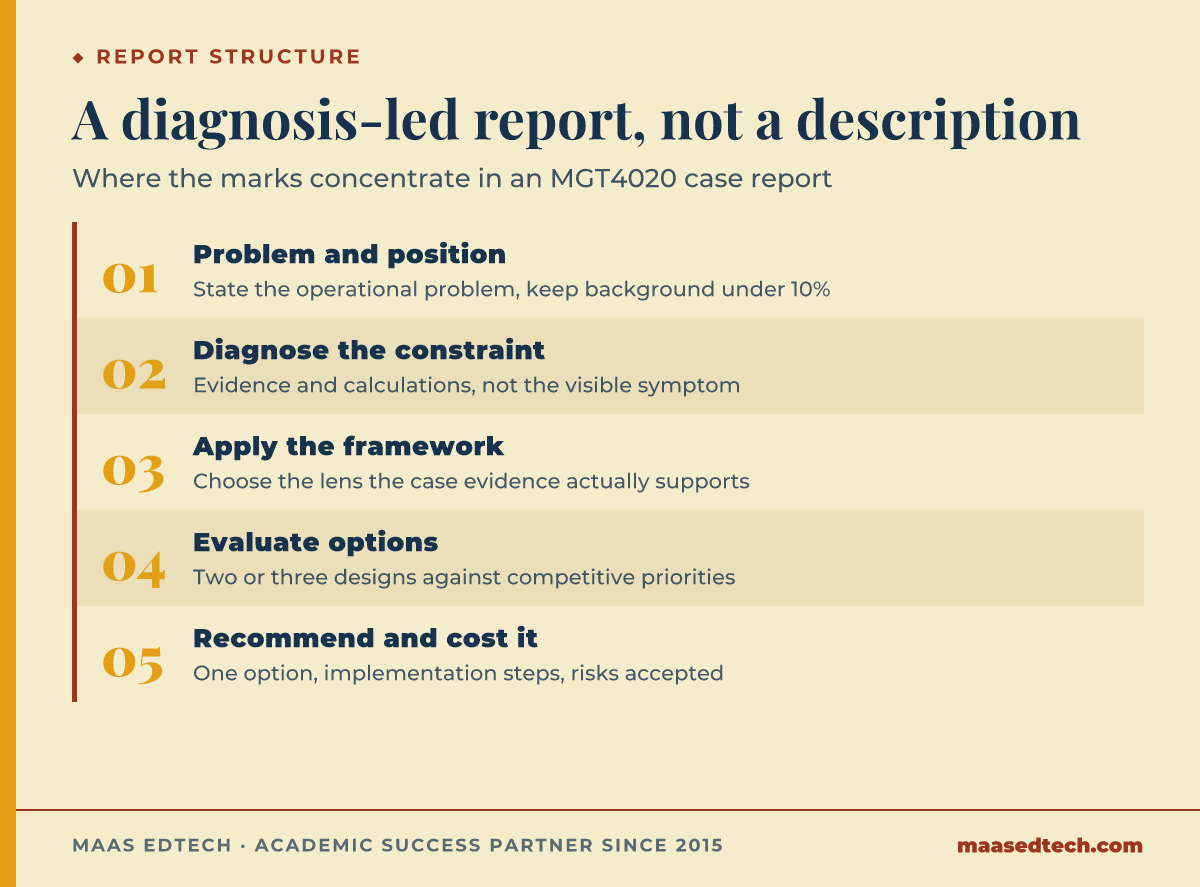
Recommend one, with implementation steps, cost implications, and the risks you accept. Show your calculations with stated assumptions in the body or a clearly referenced appendix, because unstated assumptions are the most common reason a correct number earns no marks.
Evidence: Criterion referenced rubrics weight diagnosis, application, and trade off evaluation far above description of the company or its products. Matching your word budget to the rubric weighting is the most reliable way to lift a grade without new data. A quick, standard-textbook example (Christopher, 2016): ABC analysis of a firm's inventory typically finds that roughly 20% of stock-keeping units drive about 80% of inventory value, the classic Pareto pattern, so a report that treats every line item as equally important is already conceding an easy diagnostic mark.
Example: A Vietnamese student submitted a report with a detailed process map and a one line recommendation to improve efficiency. His MAAS mentor used the freed words to compare three options on cost, lead time, and recovery time. Same case, and the report moved from a borderline Credit to a Distinction because a choice was finally being made and defended.
What are the most common mistakes that lose marks in MGT4020?
Direct answer: Three recurring mistakes show up across MAAS operations coaching. First, recommending improvement on every dimension at once, which shows the trade off principle has not landed. Second, calculations presented without assumptions or units, so a marker cannot tell whether the number is right or what it means. Third, treating a symptom rather than the constraint, most often adding inventory to hide a lead time or quality problem that will simply reappear. Fixing these three lifts most drafts by at least one rubric band.
Evidence: Across MAAS operations coaching, marker feedback before intervention clusters heavily on trade offs not considered and assumptions not stated, the two phrases that most often separate a Credit from a Distinction in operations rubrics.
Example: A Vietnamese student recommended raising safety stock to fix late deliveries. His MAAS mentor asked why deliveries were late, and the case evidence pointed to a supplier quality problem causing rework. The revised recommendation fixed the quality issue and reduced stock, which cost less and solved the actual constraint, earning full marks on the diagnosis criterion.
How long is the MGT4020 assignment and what referencing style does it use?
Direct answer: Confirm the exact word count and style in your course outline. Individual operations reports at this level commonly sit between 2,000 and 3,000 words, with calculations, appendices, and reference lists often excluded from the count. Referencing style varies by provider, and both APA 7th and Harvard are common in Australian business programs, so use whichever your outline specifies and apply it consistently. Reference every operational figure you rely on, state the units and the period for any calculation, and cite framework sources rather than consultancy summaries.
Evidence: Australian business programs typically nominate a single referencing style in the course outline and mark consistency as part of academic writing criteria. Markers routinely deduct marks for uncited company data, calculations without units or assumptions, or reference lists that do not match in text citations.
Example: A Vietnamese student lost marks because his lead time figures had no source and his inventory calculation gave a number with no unit. A MAAS pre submission audit fixed both in under 1 hour, with each figure sourced and every calculation labelled. On his next assessment, clean documentation recovered marks on a criterion that requires no extra analysis at all.
Frequently asked questions
Is MGT4020 a hard course?
It is more quantitative than most management courses but the maths is not advanced. The difficulty is judgement: knowing which constraint matters and what you are willing to sacrifice to relieve it.
Do I need strong maths?
You need to be comfortable with inventory formulas, lead time, and capacity arithmetic, and to state your assumptions clearly. Accuracy and clear assumptions matter far more than mathematical sophistication.
Can I use a Vietnamese manufacturer or exporter as my case?
Often yes, and it can work well because Vietnam sits in many global supply chains, which makes sourcing, lead time, and resilience questions concrete. Check you can source operational data before committing, since supply chain figures are often not public.
Should I recommend reshoring or nearshoring?
Only if the evidence supports it for this firm and product. The credible answer names the cost, the lead time effect, the capability gap, and the transition period rather than treating relocation as automatically safer.
What referencing style does MGT4020 use?
It depends on the provider, with APA 7th and Harvard both common. Use the style named in your course outline, applied consistently, including for company and industry data.
Can MAAS help me with MGT4020?
Yes. MAAS Assignment & Essay Support coaches you through the assessment with the Outline, Draft, Final model, covering constraint diagnosis, framework choice, presenting calculations with assumptions, and a pre submission referencing audit, all with PhD level mentors. Data and Coding Projects supports quantitative components. We coach your work and we do not write it for you.
Ready to approach MGT4020 with a clear strategy?
If you have the case but not the trade off, that is exactly where a discipline-matched expert helps most. MAAS Assignment & Essay Support is an academic support partner. We work alongside you through Outline, Draft, Final so the analysis stays yours and the structure earns the marks.
Bring your MGT4020 brief and we will match you to an operations and supply chain mentor, and 23% of our 100 plus experts hold a PhD, within 48 hours when our network already covers that field. If it does not, MAAS opens a dedicated recruitment round for your case, which usually takes about 2 weeks.
Book a free 15-minute MGT4020 consultation with MAAS Assignment & Essay Support
Related guides
- How to approach the MGMT302 Strategic Management assignment? covers evaluating options against explicit criteria
- How to approach the ISYS3453 Data Analytics assignment? covers interpreting operational data honestly
- How to approach the BUSM4699 Cross Cultural Management assignment? is useful when the network spans cultures
- Data and Coding Projects service supports data analysis and quantitative tasks
- Course-code assignment coaching is the pillar guide on tackling any unit assignment with a MAAS mentor
References
- Abbas, A., & Goosheh, S. (2024). Fundamentals of operations management. Fanshawe College Pressbooks (eCampusOntario). https://ecampusontario.pressbooks.pub/fundamentalsopsmgmt/chapter/2-2-competitiveness/
- Christopher, M. (2016). Logistics and supply chain management (5th ed.). Pearson.
- Fisher, M. L. (1997). What is the right supply chain for your product? Harvard Business Review, 75(2), 105-116.
- Hopp, W. J., & Spearman, M. L. (2011). Factory physics (3rd ed.). Waveland Press.
- Lee, H. L. (2004). The triple-A supply chain. Harvard Business Review, 82(10), 102-112.
- Liker, J. K. (2004). The Toyota way: 14 management principles from the world's greatest manufacturer. McGraw-Hill.
- Lee, H. L., Padmanabhan, V., & Whang, S. (1997). Information distortion in a supply chain: The bullwhip effect. Management Science, 43(4), 546-558. https://doi.org/10.1287/mnsc.43.4.546
- Sheffi, Y. (2005). The resilient enterprise: Overcoming vulnerability for competitive advantage. MIT Press.
- Skinner, W. (1969). Manufacturing: Missing link in corporate strategy. Harvard Business Review, 47(3), 136-145.
Tools and resources
- Tertiary Education Quality and Standards Agency. (n.d.). Higher education good practice hub. Retrieved July 20, 2026, from https://www.teqsa.gov.au/guides-resources/higher-education-good-practice-hub
This article is part of the MAAS Journal series for Vietnamese international students. MAAS Assignment & Essay Support is an academic support partner. We coach students through the Outline, Draft, Final delivery model with developmental feedback from discipline-matched experts. We do not write or submit work on a student's behalf.