
MGK3201 Big Data and Marketing Analytics rewards students who connect an analytical result to a marketing decision and its cost, not those who report model output. Students who struggle with this Monash marketing unit are rarely short on technical skill: they segment customers, fit the model, and report the metric, without saying which campaign, budget, or targeting choice the finding should change. This guide answers the seven questions Vietnamese students ask MAAS mentors before starting MGK3201.
Author: MAAS Editorial Team
Last updated: 2026-07-20
Category: marketing

What is MGK3201 Big Data and Marketing Analytics about?
Direct answer: MGK3201 is a Monash marketing unit about using customer and campaign data to make marketing decisions. It covers the marketing-analytics process, customer data sources, segmentation and clustering, customer lifetime value and RFM analysis, churn and response modelling, attribution, and A/B testing, alongside the privacy and ethics constraints on customer data use.
Evidence: The teaching frame follows the marketing-analytics literature: Wedel and Kannan's (2016) review of analytics in data-rich environments for the method landscape, Gupta and colleagues' (2006) work on customer lifetime value for the valuation logic, and Lambrecht and Tucker's (2013) experimental evidence on when personalised advertising does and does not work, a useful counterweight to the assumption that more targeting is always better. Gupta and colleagues frame the whole exercise this way: "As modern economies become predominantly service-based, companies increasingly derive revenue from the creation and sustenance of long-term relationships with their customers" (Gupta et al., 2006, p. 139).
Example: A Vietnamese student in Australia arrived at MAAS with a six-cluster segmentation and a conclusion that "the segments differ significantly". Her mentor asked which segment she would spend the next dollar on and why. Once the report answered that, two clusters were merged as commercially indistinguishable and her mark moved from a Pass-level draft to a Distinction.
What assessment does the MGK3201 assignment usually involve?
Direct answer: Marketing analytics units at this level are commonly assessed through an individual or group analytics project on a customer dataset, often staged as exploration, then modelling, then a management report or presentation, sometimes with a shorter technical task or quiz. You are typically asked to answer a marketing question with data, evaluate the result, and make a recommendation a marketing manager could act on. Confirm the exact task, tools, word count, and weighting in your own unit guide, because structure varies by teaching period and campus.
Evidence: Australian higher-education assessment in this field is criterion-referenced: marks are awarded against published rubric criteria rather than by ranking students against each other. That is why reading the rubric closely matters far more than how many techniques you demonstrate.
Example: A Vietnamese student spent most of a report describing the clustering algorithm and how it works. His MAAS mentor cut the method explanation to a short paragraph, moved the technical detail to an appendix, and reallocated the words to what each segment is worth and how to reach it. Same analysis, same word count, a clear Distinction.
How is the MGK3201 assignment graded, what does the rubric actually reward?
Direct answer: Marketing analytics rubrics at this level reward four things, roughly in this order: (1) a marketing question that the analysis genuinely answers, (2) defensible method and data choices with the reasoning stated, (3) interpretation in commercial terms, segment value, expected response, cost per acquisition, including uncertainty and the limits of the data, and (4) a recommendation with a measurement plan, plus communication and referencing. A statistically sound result with no commercial reading is the classic Credit-level submission.
Evidence: Criterion bands run Pass / Credit / Distinction / High Distinction, and the jump from Credit to Distinction is usually defined by "critical" and "justified", justified method choices and critically interpreted commercial implications, not by using a more sophisticated model.
Example: A MAAS mentor marked one Vietnamese student's draft by asking of each output: what would a marketing manager do differently because of this? Most outputs had no answer. After a rewrite that attached a decision to each finding, the same analysis moved up two full rubric bands.
Which frameworks and techniques should you use in MGK3201?
Direct answer: Match the technique to the marketing question rather than demonstrating range. Use RFM or clustering for segmentation when the question is who to treat differently; customer lifetime value when the question is how much a customer is worth and therefore what you may spend to acquire or retain them; churn or response modelling when the question is who to contact; attribution analysis when the question is which channel deserves credit; and controlled experimentation when the question is whether something actually works. Always state what the technique cannot tell you.
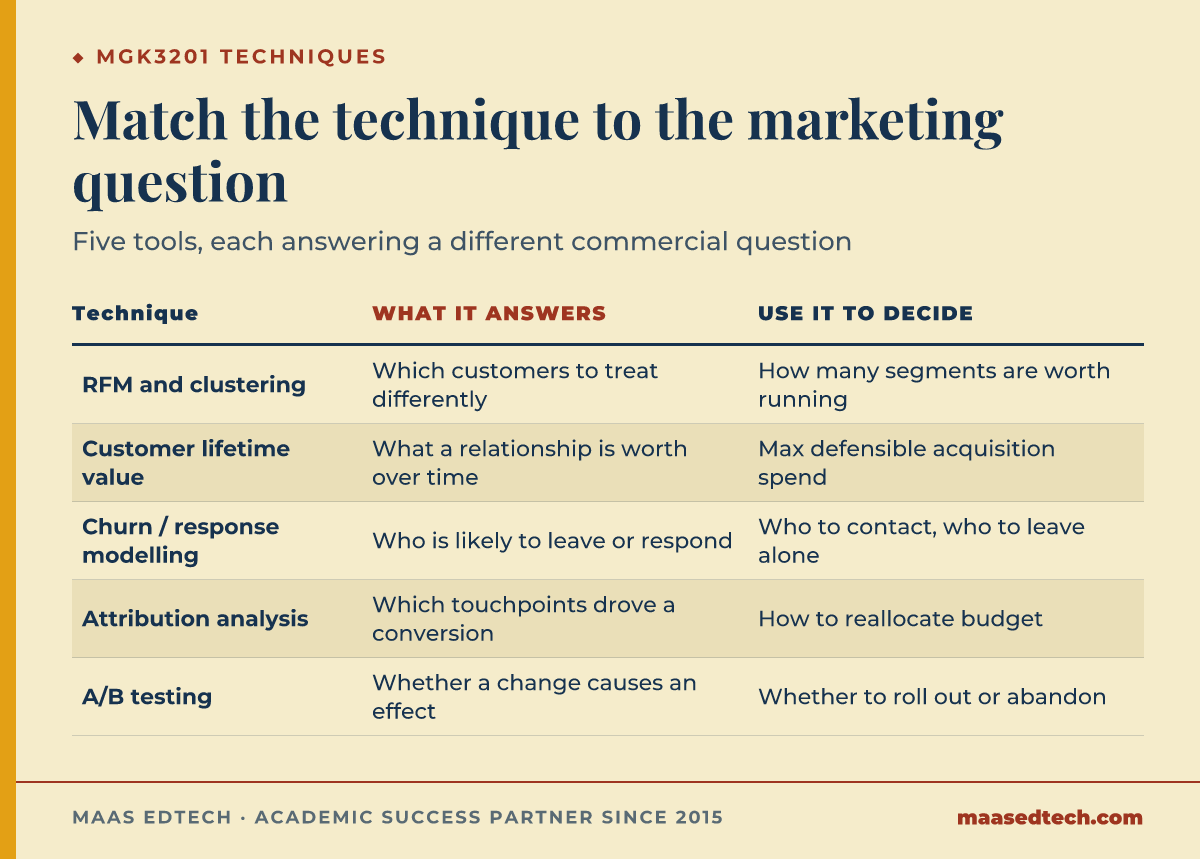
| Technique | What it answers | Use it to decide |
|---|---|---|
| RFM and clustering | Which customers behave differently enough to treat differently | How many segments are commercially worth running |
| Customer lifetime value | What a customer relationship is worth over time | The maximum defensible acquisition and retention spend |
| Churn / response modelling | Who is likely to leave, or to respond to an offer | Who to contact, and who to leave alone |
| Attribution analysis | Which touchpoints contributed to a conversion | How to reallocate budget across channels |
| A/B testing and experimentation | Whether a change causes an effect | Whether to roll out, iterate, or abandon |
Evidence: These techniques rest on examiner-recognised foundations: Wedel and Kannan (2016) for the analytics landscape, Gupta et al. (2006) for customer lifetime value, Lambrecht and Tucker (2013) for the experimental limits of personalisation, and Provost and Fawcett (2013) for the analytics-for-business framing. Note the standard caution, observational campaign data cannot separate the effect of a campaign from who was selected to receive it, which is exactly why the experimentation section exists.
Example: A Vietnamese student reported that customers who received the email campaign spent 40% more. His MAAS mentor pointed out that the list was built from past high spenders. The revised report named the selection effect and proposed a holdout group for the next round, earning full marks on the criterion the raw comparison had failed.
How should you structure the MGK3201 report?
Direct answer: Use a decision-led structure: (1) the marketing question and why it matters commercially, (2) the data and its preparation, with only result-changing decisions in the body, (3) the method and why it fits the question, (4) results interpreted in commercial terms, value, cost, expected response, with uncertainty stated, and (5) a recommendation with a budget implication and a measurement plan. Keep code, full outputs, and diagnostic tables in appendices; the body carries the argument. Every figure needs a caption and a sentence of interpretation.
Evidence: Criterion-referenced rubrics weight "commercial interpretation", "justification", and "recommendation" far above "volume of analysis". This mirrors the framing in Provost and Fawcett (2013), where the value of an analytic result is judged by the business decision it changes rather than by the technique used to produce it. Matching your word budget to the rubric weighting is the most reliable way to lift a grade without running more models.
Example: A Vietnamese student submitted a report ending with "the model achieved 0.82 AUC". His MAAS mentor asked what that means for the campaign: at what contact cost, targeting which decile, does the model beat contacting everyone. The revised close gave a break-even contact cost and the report moved from a borderline Credit to a Distinction.
What are the most common mistakes that lose marks in MGK3201?
Direct answer: Three recurring mistakes show up across MAAS analytics coaching. First, a technically correct result with no commercial reading, no value, no cost, no decision. Second, causal claims from campaign data that cannot support them, because the treated group was selected rather than randomised. Third, segments or models that are statistically distinct but commercially useless: eight clusters no marketing team could ever run separately, or a churn model with no plan for who to contact and at what cost. Fixing these three lifts most drafts by at least one rubric band.
Evidence: Verhoef et al. (2016) frame the whole discipline as making smarter marketing decisions from customer data, which is precisely the step these three mistakes skip. Across MAAS analytics coaching, marker feedback before intervention clusters heavily on "results not linked to marketing decisions" and "limitations not addressed", the two phrases that most often separate a Credit from a Distinction in marketing analytics rubrics.
Example: A Vietnamese student produced eight segments with distinct profiles. His MAAS mentor asked how many distinct creative treatments the team could realistically produce and fund. The revised report presented three actionable segments and explained what was lost by merging, the trade-off analysis itself earned the marks.
How long is the MGK3201 assignment and what referencing style does it use?
Direct answer: Confirm the exact word count, submission format, and style in your unit guide, the written component at this level commonly sits between 1,500 and 2,500 words, with appendices, code, and reference lists usually excluded. Referencing style varies by faculty; APA 7th and Harvard are both common in Australian business programs, so use whichever your unit guide specifies and apply it consistently. Cite the dataset, the tools and packages you used, and any industry benchmark you rely on, with dates.
Evidence: Australian business programs typically nominate a single referencing style in the unit guide and mark consistency as part of academic-writing criteria. Markers routinely deduct marks for unreferenced datasets, uncited methods, or a submitted notebook that cannot be run.
Example: A Vietnamese student lost marks because his benchmark conversion rate came from an undated agency blog and his workbook contained a broken data link. A MAAS pre-submission audit fixed both in under an hour. On his next task, clean documentation recovered marks on a criterion requiring no extra analysis.
Where this guidance comes from
The technique table above rests on four academic sources, Wedel and Kannan (2016) in the Journal of Marketing, Gupta et al. (2006) in the Journal of Service Research, Lambrecht and Tucker (2013) in the Journal of Marketing Research, and Provost and Fawcett (2013), plus one practitioner text aimed squarely at this unit's own framing: Verhoef, Kooge, and Walk's (2016) Creating Value with Big Data Analytics, which argues that an analytics project only creates value once it changes a specific marketing decision, the same standard this guide applies to every MGK3201 draft.
Frequently asked questions
Is MGK3201 a hard unit?
It is demanding in two directions: enough technical ability to handle customer data, and enough commercial judgement to say what the result is worth. Students who optimise the model and stop struggle; students who keep asking "what would the marketing team do differently" do well.
Do I need advanced statistics or machine learning?
Usually not beyond the unit's taught methods. A simple, well-interpreted segmentation or response model consistently outscores a complex one presented without commercial meaning. Depth of interpretation beats sophistication of technique in the rubric.
Can I use a Vietnamese company or market for the project?
Often yes, if the brief allows your own case and you can source usable data. The constraint is data access rather than relevance, check you have a dataset with enough records and variables before committing.
How do I handle privacy and ethics in the report?
Say explicitly what data you used, whether it is synthetic, public, or provided by the unit, and note any personal-data considerations. Many rubrics include a data-ethics criterion, and a short, specific paragraph earns those marks where a generic statement does not.
What referencing style does MGK3201 use?
It depends on the faculty, APA 7th and Harvard are both common in Australian business programs. Use the style named in your unit guide, applied consistently, including for datasets and tools.
Can MAAS help me with MGK3201?
Yes. MAAS Assignment & Essay Support coaches you through the assignment with the Outline, Draft, Final model, framing the marketing question, checking method choices, translating results into commercial terms, and a pre-submission audit, all with discipline-matched experts. Data & Coding Projects supports the quantitative side. We coach your work; we do not write it for you.
Ready to approach MGK3201 with a clear strategy?
If you have the model but not the marketing argument, that is exactly where a discipline-matched expert helps most. MAAS Assignment & Essay Support is an academic support partner; we work alongside you through Outline, Draft, Final so the analysis stays yours and the structure earns the marks.
Bring your MGK3201 brief and we will match you to a marketing analytics mentor, 23% of our 100+ experts hold a PhD, within 48 hours when our network already covers that field. If it does not, MAAS opens a dedicated recruitment round for your case, which usually takes about two weeks.
Book a free 15-minute MGK3201 consultation with MAAS Assignment & Essay Support →
Related guides
- How to approach the ISYS3453 Data Analytics assignment?: the information-systems companion on the analytics process
- How to approach the MRKT201 Advanced Marketing assignment?: for segmentation, targeting, and positioning decisions
- How to approach the MKTG1507 Digital Marketing assignment?: for the measurement and privacy debates
- Data & Coding Projects service: support with data analysis, charts, and quantitative tasks
- Course-code assignment coaching: pillar guide on tackling any unit assignment with a MAAS mentor
References
- Gupta, S., Hanssens, D., Hardie, B., Kahn, W., Kumar, V., Lin, N., Ravishanker, N., & Sriram, S. (2006). Modeling customer lifetime value. Journal of Service Research, 9(2), 139–155. https://doi.org/10.1177/1094670506293810
- Lambrecht, A., & Tucker, C. (2013). When does retargeting work? Information specificity in online advertising. Journal of Marketing Research, 50(5), 561–576. https://doi.org/10.1509/jmr.11.0503
- Provost, F., & Fawcett, T. (2013). Data science for business: What you need to know about data mining and data-analytic thinking. O'Reilly Media.
- Verhoef, P. C., Kooge, E., & Walk, N. (2016). Creating value with big data analytics: Making smarter marketing decisions. Routledge.
- Wedel, M., & Kannan, P. K. (2016). Marketing analytics for data-rich environments. Journal of Marketing, 80(6), 97–121. https://doi.org/10.1509/jm.15.0413
Tools & resources
- Tertiary Education Quality and Standards Agency. (n.d.). Higher education good practice hub. Retrieved July 20, 2026, from https://www.teqsa.gov.au/guides-resources/higher-education-good-practice-hub
This article is part of the MAAS Journal series for Vietnamese international students. MAAS Assignment & Essay Support is an academic support partner; we coach students through the Outline, Draft, Final delivery model with developmental feedback from discipline-matched experts. We do not write or submit work on a student's behalf.