
IBUS3104 Ethical International Business Decisions rewards students who reason to a defensible decision when two legitimate standards conflict across borders, not those who declare a practice wrong. Most students who struggle with this course are not short on moral conviction. They condemn a practice, cite one ethical theory, and stop, without engaging the local legal context, the competing obligation, or what a manager should do next. This guide answers the seven questions Vietnamese students ask MAAS mentors.
Author: MAAS Editorial Team
Last updated: 2026-07-20
Category: business-management

What is IBUS3104 Ethical International Business Decisions about?
Direct answer: IBUS3104 is an international business course about making and defending ethical decisions when a firm operates across legal systems, cultures, and standards. It covers normative ethical frameworks, cultural relativism, corruption, labour standards, human rights, and environmental obligations. The course assesses reasoning under conflict, not agreement with a preferred conclusion.
Evidence: The teaching frame draws on established sources. Donaldson's work on core human values and moral free space provides the standard way to reject both blanket relativism and blanket imposition of home country norms. The UN Guiding Principles on Business and Human Rights supply the protect, respect, and remedy structure that most current assessments reference, and the OECD Anti-Bribery Convention, signed in 1997 and in force since 1999, is the usual anchor for the corruption strand.
Example: A Vietnamese student in Australia arrived at MAAS with an essay arguing that a supplier's overtime practice was simply wrong. Her mentor asked what the local law permitted, what the workers themselves reported wanting, and what the buyer's realistic options were, including the effect of withdrawal. Once the essay reasoned through the conflict instead of announcing a verdict, her mark moved from a Pass level draft to a Distinction.
What assessment does the IBUS3104 assignment usually involve?
Direct answer: Courses of this type are commonly assessed through an individual case analysis of an ethical dilemma faced by a multinational firm, often with a group debate or presentation, and sometimes a reflective piece on your own ethical reasoning. You are typically asked to identify the ethical issue and the stakeholders, apply one or more ethical frameworks, weigh the conflicting obligations including legal and cultural context, and recommend a defensible course of action. Confirm the exact task, word count, and weighting in your own course outline, because structure varies by provider and by teaching period.
Evidence: Australian higher education assessment in this field is criterion referenced, meaning marks are awarded against published rubric criteria rather than by ranking students against each other. That is why reading the rubric closely matters far more than how strongly you state your position.
Example: A Vietnamese student spent half of a 2,000 word essay describing the company and the country before reaching the dilemma. His MAAS mentor cut the background to a paragraph and reallocated the words to the conflict between the home country standard and the host country practice. Same case, same word count, and the reasoning led version earned a clear Distinction.
How is the IBUS3104 assignment graded, and what does the rubric reward?
Direct answer: Rubrics for this course type reward four things, roughly in this order: precise identification of the ethical issue and whose interests are at stake, correct application of at least one normative framework to that specific issue rather than a definition of the theory, genuine engagement with the strongest opposing position including the legal and cultural context, and a practical recommendation a manager could implement, plus academic writing and correct referencing. Moral certainty without reasoning is the classic Credit level submission.
Evidence: Criterion bands typically run Pass, Credit, Distinction, and High Distinction, and the jump from Credit to Distinction is usually defined by the words critical and justified, meaning critical engagement with the counter position and a justified recommendation, not a stronger condemnation.
Example: A MAAS mentor marked one Vietnamese student's draft by asking of each paragraph whether it advanced the reasoning or repeated the verdict. Two thirds repeated the verdict. After a rewrite that built the opposing case properly before answering it, the same material moved up two full rubric bands.
Which frameworks should you use in IBUS3104?
Direct answer: Apply one or two frameworks properly rather than defining four. Utilitarian reasoning asks which option produces the best overall outcome and forces you to name who bears the cost. Deontological reasoning asks which duties and rights hold regardless of consequence, which is where human rights arguments sit.
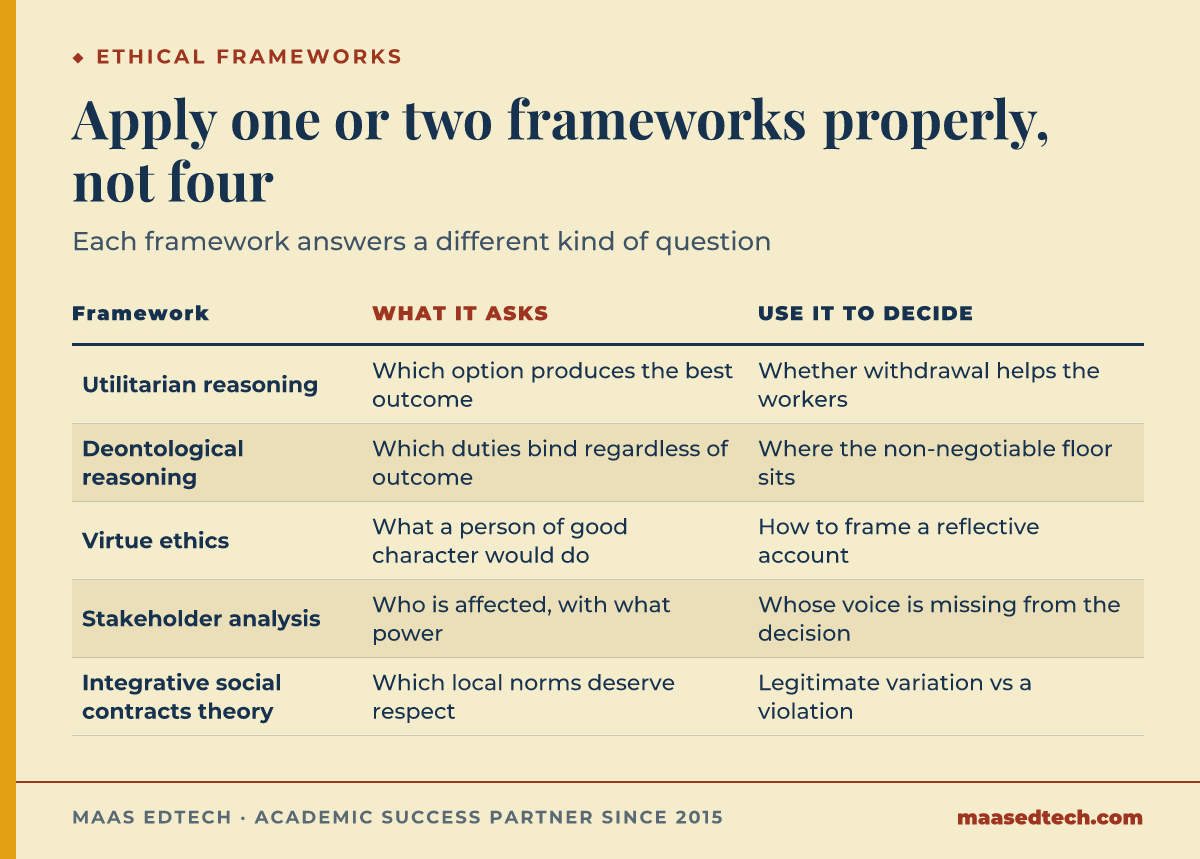
Virtue ethics asks what a person of good character would do and is useful for reflective components. Integrative social contracts theory gives you a disciplined way to respect local norms without abandoning universal minimums. A stakeholder analysis maps who is affected and with what power. Say why the framework you chose fits this dilemma better than the alternatives.
| Framework | What it asks | Use it to decide |
|---|---|---|
| Utilitarian reasoning | Which option produces the best overall outcome, and for whom | Whether withdrawal helps or harms the workers it aims to protect |
| Deontological reasoning | Which duties and rights bind regardless of consequences | Where the non negotiable floor sits, such as forced or child labour |
| Virtue ethics | What a person of good character would do here | How to frame a reflective account of your own judgement |
| Integrative social contracts theory | Which local norms deserve respect and which breach a universal minimum | Whether a practice is legitimate local variation or a genuine violation |
| Stakeholder analysis | Who is affected, with what interest and what power | Whose voice is missing from the decision as it stands |
Evidence: These five frameworks are examiner recognised foundations. Donaldson and Dunfee (1994) set out integrative social contracts theory in a paper still assigned three decades later; Donaldson (1996) provides the widely taught treatment of when to adapt to local norms and when not to; Freeman (1984) supplies the stakeholder frame, and Crane, Matten, Glozer and Spence (2019) is the textbook most Australian courses build the reading list around; and the United Nations (2011) Guiding Principles, 31 principles organised under 3 pillars, define the corporate responsibility to respect human rights, stating that "business enterprises should respect human rights. This means that they should avoid infringing on the human rights of others and should address adverse human rights impacts with which they are involved" (United Nations, 2011, p. 14). Note that relativism is not an acceptable stopping point in this course, because if every practice is defensible in its own context then there is nothing left to analyse.
Example: A Vietnamese student defended a facilitation payment on the ground that it was normal locally. Her MAAS mentor asked her to test that claim against the host country's own written law and against integrative social contracts theory. The practice was illegal locally as well as abroad, which changed the analysis entirely and earned the marks the relativist argument had lost.
How should you structure the IBUS3104 essay?
Direct answer: Use a reasoning led structure. State the dilemma precisely and why it is genuinely difficult, keeping company and country background under 10% of the word count. Map the stakeholders and the conflicting obligations. Apply your chosen framework to the specific facts. Build the strongest opposing position, including the local legal and cultural context, then answer it.
Close with a recommendation that names what the firm should do, what it should stop doing, and how it would be monitored. A dilemma with an obvious answer is usually a sign you have framed it too narrowly.
Evidence: Criterion referenced rubrics weight application of theory, engagement with the counter position, and practical recommendations far above description of the case. Matching your word budget to the rubric weighting is the most reliable way to lift a grade without finding new material.
Example: A Vietnamese student submitted an essay that condemned a labour practice in the first paragraph and spent the rest justifying that view. His MAAS mentor moved the recommendation to the end and inserted the opposing case in the middle. Same content in a different order, and the essay moved from a borderline Credit to a Distinction because the reasoning became visible.
What are the most common mistakes that lose marks in IBUS3104?
Direct answer: Three recurring mistakes show up across MAAS coaching. First, moral assertion in place of reasoning, where the conclusion arrives before the analysis and the counter position is never taken seriously. Second, a stranded theory section, where utilitarianism and deontology are defined at length and then never applied to a single fact of the case.
Third, recommendations that ignore feasibility, such as advising a firm to exit a market without considering what happens to the workers, the suppliers, or the local community after it leaves. Fixing these three lifts most drafts by at least one rubric band.
Evidence: Across MAAS coaching in this area, marker feedback before intervention clusters heavily on theory not applied and alternative view not considered, the two phrases that most often separate a Credit from a Distinction in business ethics rubrics.
Example: A Vietnamese student recommended that a buyer terminate a supplier contract over a safety breach. His MAAS mentor asked what happens to the 400 workers if the contract ends. The revised recommendation kept the relationship, imposed a remediation timeline with verification, and set an exit trigger if the timeline failed. That version earned full marks on the criterion the immediate exit had failed.
How long is the IBUS3104 assignment and what referencing style does it use?
Direct answer: Confirm the exact word count and style in your course outline. Individual essays at this level commonly sit between 1,500 and 2,500 words, with reference lists usually excluded from the count. Referencing style varies by provider, and both APA 7th and Harvard are common in Australian business programs, so use whichever your outline specifies and apply it consistently.
Cite ethical theorists from the source rather than a summary website, and reference international instruments such as the UN Guiding Principles or the OECD Convention directly, with the year and the relevant principle or article.
Evidence: Australian business programs typically nominate a single referencing style in the course outline and mark consistency as part of academic writing criteria. Markers routinely deduct marks for secondary citations of ethical theorists, unreferenced claims about a company's conduct, or reference lists that do not match in text citations.
Example: A Vietnamese student lost several marks because he cited the UN Guiding Principles through a consultancy blog and made claims about a supplier's conditions with no source. A MAAS pre submission audit closed the gaps in under an hour, with the instrument cited directly and each factual claim traced to a report or filing. On his next assessment, clean sourcing recovered marks on a criterion that requires no extra analysis at all.
Frequently asked questions
Is IBUS3104 a hard course?
It is judgement heavy rather than technically hard. The difficulty is holding two legitimate positions in view long enough to reason between them, when most people's instinct is to decide quickly and defend afterwards.
Does the marker want a particular ethical position?
No. These assessments mark the quality of reasoning rather than agreement with a preferred verdict. A well reasoned argument that a marker personally disagrees with scores highly, while a conclusion the marker shares but that arrives without reasoning does not.
Is cultural relativism an acceptable argument?
Only as a position to engage with, not as a resting point. The course expects you to distinguish legitimate local variation from a breach of a universal minimum, which is exactly what integrative social contracts theory is for.
Can I write about a Vietnamese company or a Vietnam based supply chain?
Often yes, and it can strengthen the essay because you understand the regulatory and cultural context. Source every factual claim about conditions or conduct carefully, and be precise about what the local law actually says rather than what is commonly assumed.
What referencing style does IBUS3104 use?
It depends on the provider, with APA 7th and Harvard both common. Use the style named in your course outline, applied consistently, including for international instruments and company reports.
Can MAAS help me with IBUS3104?
Yes. MAAS Assignment & Essay Support coaches you through the assessment with the Outline, Draft, Final model, covering how to frame the dilemma, apply a framework to specific facts, build the counter position properly, and a pre submission referencing audit, all with PhD level mentors. We coach your work and we do not write it for you.
Ready to approach IBUS3104 with a clear strategy?
If you have the case but not the reasoning on the page, that is exactly where a discipline-matched expert helps most. MAAS Assignment & Essay Support is an academic support partner. We work alongside you through Outline, Draft, Final so the thinking stays yours and the structure earns the marks.
Bring your IBUS3104 brief and we will match you to an international business mentor, and 23% of our 100-plus experts hold a PhD, within 48 hours when our network already covers that field. If it does not, MAAS opens a dedicated recruitment round for your case, which usually takes about 2 weeks.
Book a free consultation of 15 minutes on IBUS3104 with MAAS Assignment & Essay Support
Related guides
- BUSM4692 assignment: how do you approach Global Corporate Responsibility? is the closest sibling guide on CSR and corporate responsibility
- How to approach the BUSM4699 Cross Cultural Management assignment? covers cultural analysis without stereotyping
- How to approach the ACCT2105 Accounting in Organisations assignment? covers accountability and disclosure
- MAAS Academic Mentoring service offers 1:1 coaching with PhD level mentors in your discipline
- Course-code assignment coaching is the pillar guide on tackling any unit assignment with a MAAS mentor
References
- Crane, A., Matten, D., Glozer, S., & Spence, L. (2019). Business ethics: Managing corporate citizenship and sustainability in the age of globalization (5th ed.). Oxford University Press.
- Donaldson, T. (1996). Values in tension: Ethics away from home. Harvard Business Review, 74(5), 48-62.
- Donaldson, T., & Dunfee, T. W. (1994). Toward a unified conception of business ethics: Integrative social contracts theory. Academy of Management Review, 19(2), 252-284. https://doi.org/10.5465/amr.1994.9410210749
- Freeman, R. E. (1984). Strategic management: A stakeholder approach. Pitman.
- United Nations. (2011). Guiding principles on business and human rights. United Nations Human Rights Office of the High Commissioner. https://www.ohchr.org/en/publications/reference-publications/guiding-principles-business-and-human-rights
Tools and resources
- Tertiary Education Quality and Standards Agency. (n.d.). Higher education good practice hub. Retrieved July 20, 2026, from https://www.teqsa.gov.au/guides-resources/higher-education-good-practice-hub
This article is part of the MAAS Journal series for Vietnamese international students. MAAS Assignment & Essay Support is an academic support partner. We coach students through the Outline, Draft, Final delivery model with developmental feedback from discipline-matched experts. We do not write or submit work on a student's behalf.