
◆ Accounting & Finance
FNCE 371 Athabasca: how do you pass when both exams are invigilated?
FNCE 371 Applications in Corporate Finance is a 3-credit, self-paced Athabasca University course in which two invigilated exams carry 70% of the grade and the final must itself reach 50%. Three assignments carry the other 30%, spread across nine lessons that run from cash management to behavioural finance. This guide sets out how MAAS mentors read that structure and where marks tend to slip.
Note on the code: this guide describes the Athabasca University course written "FNCE 371" in its syllabus, which requires FNCE 370 first. Search results for the same code can point to other schools, so check the school before you rely on any weighting you find. MAAS is an independent academic support provider with no affiliation to Athabasca University.
◆ Question 1 / 8 · Course and who takes it
What is FNCE 371 Applications in Corporate Finance, and who takes it?
Direct answer: FNCE 371 is a 3-credit undergraduate course from the Faculty of Business at Athabasca University, delivered as individualized online study through Brightspace. It applies the tools of FNCE 370 to short-term finance, leasing, mergers, risk management, options and behavioural finance, and it is not available for challenge.
Evidence: The syllabus for Revision 8, opened and updated on 7 April 2026, lists FNCE 370 as the only prerequisite and states that "FNCE 371 is not available for challenge". Self-funded students start on the first of a month after registering by the 10th of the month before. The course text is the 12th Canadian edition of Fundamentals of Corporate Finance by Ross, Westerfield, Jordan, Pandes and Holloway, published by McGraw Hill in 2025. The syllabus adds that students transferring the course to a professional accounting designation such as CPA may need a grade above the minimum pass.
Example: A student who finished FNCE 370 in the summer often arrives expecting more of the same arithmetic. The first sign of a different course is the learning outcomes: they ask you to work out short-term financial plans, analyze leasing and mergers, evaluate derivative securities and discuss behavioural finance, so about half the verbs are "analyze", "evaluate" and "discuss" rather than "calculate".
◆ Question 2 / 8 · Assessment
How is FNCE 371 assessed in Revision 8?
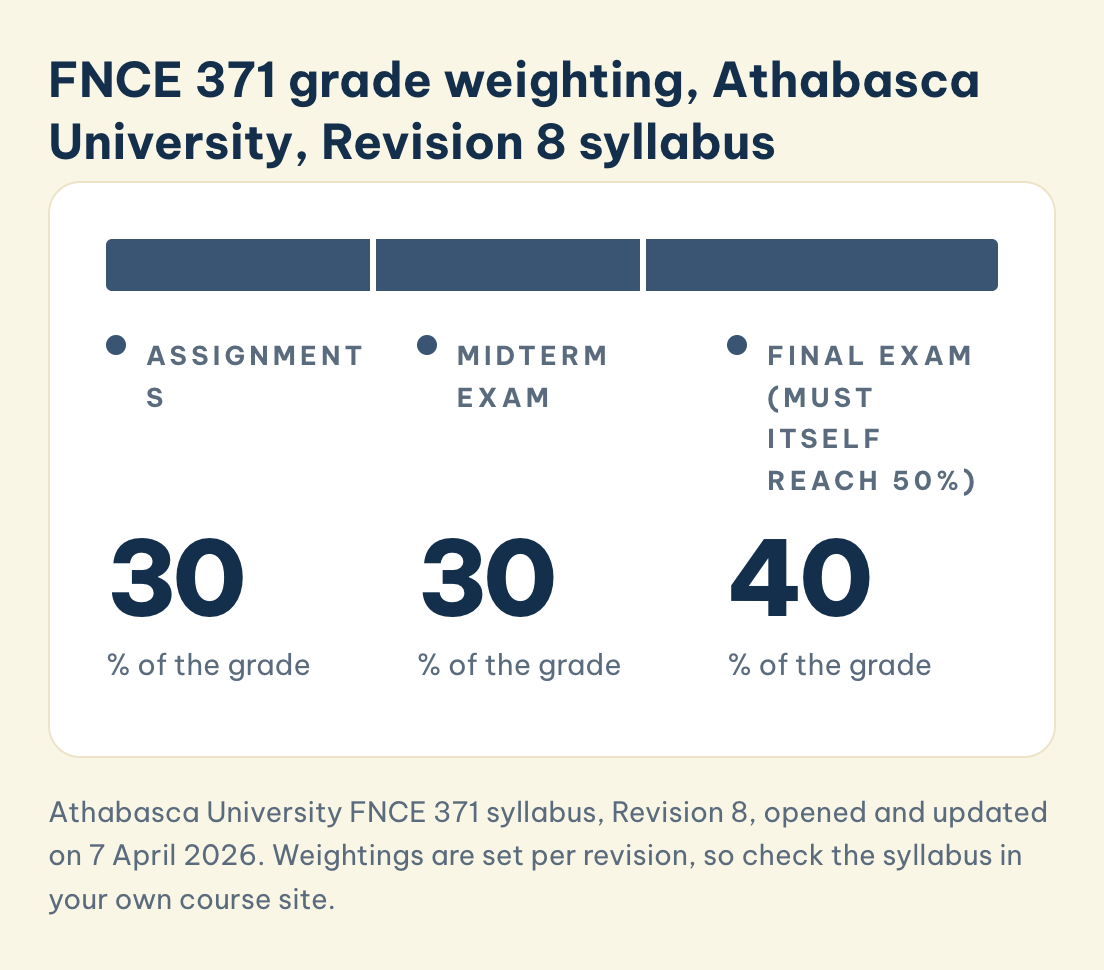
Direct answer: Three assignments carry 10% each, the midterm carries 30% and the final carries 40%. Both exams are written under supervision, through ProctorU or an approved in-person centre, and the student pays any invigilation fee. The final must reach 50% by itself, and the overall grade must reach at least D, which is 50%.
FNCE 371 grade weighting, Athabasca University, Revision 8 syllabus
The bars show the FNCE 371 grade weighting in the Athabasca University Revision 8 syllabus.
Assignments
30
% of the grade
Midterm exam
30
% of the grade
Final exam (must itself reach 50%)
40
% of the grade
Save this figure
Evidence: The weightings below come from the Revision 8 syllabus. On 16 October 2026 Perplexity quoted the same split, but Google's AI Overview for the course added exam details, such as the number of multiple-choice and written questions, that the official page does not publish. Treat any question count you find outside the syllabus as unverified, because Athabasca revises courses and older revisions carried different documents.
| Component | Weight | What it rewards |
|---|---|---|
| Assignment 1, 2 and 3 | 10% each, 30% in total | Worked case analysis with the reasoning written out |
| Midterm exam, invigilated | 30% | Applying lessons taught so far without a worked example beside you |
| Final exam, invigilated | 40% | Choosing the right tool across all nine lessons |
| Pass rule | At least 50% on the final and at least 50% overall | Both conditions, not one |
Example: The two exams together are worth more than twice the three assignments. A student who spends four weekends polishing Assignment 1 while leaving the midterm to the last week has put effort where the grade is thinnest. The syllabus names a 50% minimum for the final only, so a weak midterm does not fail you outright, but it removes the cushion you need if the final goes badly.
◆ Question 3 / 8 · Exam preparation
How do you prepare for the FNCE 371 midterm and final exams?
Direct answer: Prepare by retrieval, not rereading. Close the textbook and rework problems from a blank page, then check them, and repeat after a gap. Because both exams are invigilated and carry 70% of the grade, practice conditions should look like exam conditions: an approved calculator, no worked example, and a clock.
Evidence: Roediger and Karpicke (2006) had students either restudy prose passages or take recall tests on them. After one week, students in the repeated-testing condition recalled 61% of the material against 40% in the repeated-study condition, even though they had read the passage 3.4 times on average against 14.2 times. The authors conclude that "testing is a powerful means of improving learning, not just assessing it" (Roediger & Karpicke, 2006, p. 249). The syllabus pre-approves the Texas Instruments BA II Plus or BA II Plus Professional (recommended), the Sharp EL-738 family, the HP 10bII+ and the Casio FC-200V, so choose one early and learn its keystrokes.
Example: After Lesson 2 on cash and liquidity, a student closes the book and rebuilds a short cash budget from a blank sheet, three times over three weeks. The third attempt takes half the time of the first, and the gaps that remain are known rather than guessed. That is the habit that the invigilated midterm tests directly, and no assignment can rehearse it for you.
◆ Question 4 / 8 · Assignment 1 topics
What are the typical topics in FNCE 371 Assignment 1?
Direct answer: The public syllabus lists nine lessons but does not say which lesson feeds which assignment, so confirm the schedule in your own course site. The opening lessons cover short-term financial planning, cash and liquidity, and credit and inventory, which is where working-capital arithmetic first appears.
Evidence: The nine lessons in Revision 8 are Short-Term Finance and Planning, Cash and Liquidity Management, Credit and Inventory Management, International Corporate Finance, Leasing, Mergers and Acquisitions, Enterprise Risk Management, Options and Corporate Securities, and Introduction to Behavioural Finance. Deloof (2003) studied 1,009 large Belgian non-financial firms over 1992 to 1996 and found that managers can increase profitability by reducing the number of days accounts receivable and inventories are held, while less profitable firms wait longer to pay their bills.
Example: Suppose a firm holds inventory for 60 days, collects receivables in 40 days and pays suppliers in 30 days. Its operating cycle is 100 days and its cash cycle is 70 days. Collecting receivables five days sooner shortens the cash cycle to 65 days. A float question works the same way: cheques averaging $50,000 a day that spend 3 days in the system tie up $150,000, which costs $7,500 a year at a 5% opportunity cost.
◆ Question 5 / 8 · Excel skills
What Excel skills matter most in FNCE 371 cases?
Direct answer: The course expects data tables, functions, formulas, pivot tables and pivot charts. In practice, the functions that matter are present value, net present value, payment and goal-style what-if tables, and the most common error is applying a function to cash flows that start at the wrong period.
Evidence: The fifth learning outcome in the syllabus asks you to "use Excel data tables, functions, formulas, pivot tables, and pivot charts to organize and analyze data", and the syllabus lists spreadsheet software (Microsoft Excel or compatible) as a requirement. The exams, by contrast, use an approved non-programmable calculator, so the spreadsheet skill is demonstrated in assignments rather than under invigilation.
Example: Excel's NPV function treats the first value as occurring one period from now. For a project costing $100,000 today and returning $30,000 a year for five years at 10%, the function applied to the five inflows gives $113,724, and the outflow of $100,000 is then subtracted outside the function to reach an NPV of $13,724. Putting the $100,000 inside the range would discount it by a full year and understate the cost.
◆ Question 6 / 8 · Leasing and mergers
How do leasing and merger questions differ from textbook formulas?
Direct answer: They ask why a decision makes sense as well as what it is worth. A leasing answer needs the lease-versus-buy figure and the reason a firm might lease; a merger answer needs the value created and who captures it. A number without that reasoning usually earns partial marks at best.
Evidence: Sharpe and Nguyen (1995) found that firms facing high information-cost premiums for external funds finance a significantly greater share of their fixed assets with leases, that leasing propensity falls as firm size rises, and that firms with tax-loss carryforwards lease more. Andrade, Mitchell and Stafford (2001) examined 4,256 mergers over 1973 to 1998 and reported that announcement-period returns are positive for the combined parties, that the 1990s were mostly stock swaps, and that deregulation accounts for nearly half of merger activity since the late 1980s.
Example: A machine costs $90,000 to buy, or $20,000 a year for five years to lease. At a 4% after-tax cost of debt the lease payments are worth $20,000 multiplied by an annuity factor of 4.4518, or $89,036, so on these simplified figures leasing is cheaper by $964. For a merger, suppose a target is worth $100 million alone, synergies are worth $15 million and the bidder pays a $10 million premium. The bidder gains $5 million and the target's shareholders gain $10 million, which echoes the finding that most of the gains accrue to the target.
◆ Question 7 / 8 · Options and behavioural
What do the options and behavioural finance lessons ask you to explain?
Direct answer: Lessons 8 and 9 ask you to price and reason about options and then to question whether markets always price rationally. Good answers state the assumption before the result: put-call parity holds under no-arbitrage conditions, and the efficient market hypothesis is a claim about information, not a guarantee of sensible prices.
Evidence: Fama (1970) organised market efficiency into weak, semi-strong and strong forms, according to whether prices reflect past prices, public information or all information. Barberis and Thaler (2003) survey behavioural finance around two building blocks, limits to arbitrage and investor psychology, which together explain why rational traders cannot always correct prices pushed away by less rational ones.
Example: For a one-year European call and put on a stock priced at $50 with a $50 strike and a 4% interest rate, put-call parity says call plus present value of the strike equals put plus stock. The present value of the strike is $48.08. If the call trades at $6.00, the put should be $6.00 plus $48.08 minus $50, or $4.08. A strong written answer then adds that a persistent gap would signal an arbitrage opportunity only if trading costs and constraints allow it to be exploited.
◆ Question 8 / 8 · Getting help
Can you get help with FNCE 371 assignments?
Direct answer: You can get help understanding methods, but every assignment and exam answer must be your own work. Because the assignments are completed through individualized online study rather than in a supervised room, the line matters more here than in a campus course. Copying from a solution manual, a shared file or another student counts as plagiarism under Athabasca policy.
Evidence: Athabasca University's Student Academic Misconduct Policy defines plagiarism as submitting or presenting coursework as if it is the student's own when it is not. Its list includes work done in whole or in part by someone else, and coursework copied from "a textbook, a solution manual, the internet and/or any other source". The policy lists penalties that range from a reduction in grade for a course to revocation of an awarded credential, and it separately treats sharing examination content as cheating.
Example: Search results for this course include sites selling marked case answers and exam recollections. Using them to produce a submission falls inside the policy's definition, and it leaves the student unpractised for two invigilated exams that decide 70% of the grade. The legitimate use of a tutor looks different: a student brings a leasing problem they got wrong, reworks it aloud, and is asked why the after-tax cost of debt, not the coupon rate, was used to discount the payments.
Frequently asked questions
Is FNCE 371 harder than FNCE 370?
It is different rather than simply harder. FNCE 370 builds the core valuation tools, while FNCE 371 applies them to working capital, leasing, mergers, risk, options and behavioural finance, so more marks depend on explaining a decision and not only on calculating it.
What happens if I score below 50% on the FNCE 371 final?
You do not receive credit for the course, even if your overall grade is above 50%. The syllabus requires at least 50% on the final examination and an overall grade of at least D, which is 50%, so both conditions have to be met.
Are the FNCE 371 exams invigilated?
Yes. The midterm and final must be requested in advance and written under supervision, through ProctorU or an approved in-person invigilation centre that can accommodate online exams. Students pay any invigilation fees themselves.
Which calculator can I use for FNCE 371?
The syllabus pre-approves the Texas Instruments BA II Plus or BA II Plus Professional (recommended), the Sharp EL-738 family, the HP 10bII+ and the Casio FC-200V. Any other model needs approval from the course coordinator in advance through the AU Service Centre.
Can I challenge FNCE 371 instead of taking it?
No. The syllabus states that FNCE 371 is not available for challenge, unlike some other Athabasca courses.
Does MAAS complete FNCE 371 assignments or exams?
No. MAAS mentors explain methods and review practice problems you have already attempted. Every assignment and exam answer must be your own, in line with Athabasca University's academic misconduct policy.
Related reading
- FNCE 370 Overview of Corporate Finance: the prerequisite course, with its 50% final rule and capital budgeting toolkit
- COMM 305 Managerial Accounting: how a Canadian business school weights two paper exams against coursework
- How to revise for final exams effectively: a longer look at spaced and retrieval practice before a final that carries most of the grade
Where MAAS fits
- Subject tutoring, one to one: 60 or 90 minute sessions with a tutor matched to finance, working through practice problems you have already attempted. Tutoring is advisory, so it carries no grade target; if the tutor is not the right fit, you can ask to change expert
- Exam coaching resources: how MAAS mentors approach preparation for timed, invigilated exams
References
- Andrade, G., Mitchell, M., & Stafford, E. (2001). New evidence and perspectives on mergers. Journal of Economic Perspectives, 15(2), 103–120. https://doi.org/10.1257/jep.15.2.103
- Barberis, N., & Thaler, R. (2003). A survey of behavioral finance. In G. M. Constantinides, M. Harris, & R. M. Stulz (Eds.), Handbook of the economics of finance (Vol. 1, pp. 1053–1128). Elsevier. https://doi.org/10.1016/S1574-0102(03)01027-6
- Deloof, M. (2003). Does working capital management affect profitability of Belgian firms? Journal of Business Finance & Accounting, 30(3–4), 573–588. https://doi.org/10.1111/1468-5957.00008
- Fama, E. F. (1970). Efficient capital markets: A review of theory and empirical work. The Journal of Finance, 25(2), 383–417. https://doi.org/10.2307/2325486
- Roediger, H. L., & Karpicke, J. D. (2006). Test-enhanced learning: Taking memory tests improves long-term retention. Psychological Science, 17(3), 249–255. https://doi.org/10.1111/j.1467-9280.2006.01693.x
- Sharpe, S. A., & Nguyen, H. H. (1995). Capital market imperfections and the incentive to lease. Journal of Financial Economics, 39(2–3), 271–294. https://doi.org/10.1016/0304-405X(95)00830-8
Tools & resources
- Athabasca University. (2026). FNCE 371: Applications in corporate finance (Revision 8) [Course syllabus]. Retrieved October 16, 2026, from https://www.athabascau.ca/syllabi/fnce/fnce371.html
- Athabasca University. (n.d.). Student academic misconduct policy. Retrieved October 16, 2026, from https://www.athabascau.ca/university-secretariat/_documents/policy/student-academic-misconduct-policy.pdf
- Ross, S. A., Westerfield, R. W., Jordan, B. D., Pandes, J. A., & Holloway, T. A. (2025). Fundamentals of corporate finance (12th Canadian ed.). McGraw Hill.
This article is part of the MAAS Journal series for Vietnamese international students. MAAS is an independent academic support provider. For courses assessed by exams and individual online work, we offer one-to-one tutoring on methods only; we do not write, complete or submit any assessed work.
A free 20-minute consultation is a conversation about where you are with FNCE 371.
Book a free consultation ▸