
◆ Economics
How do you pass ECON 248 Macroeconomics at Athabasca?
ECON 248 Macroeconomics is a 3-credit, self-paced Athabasca University course with no prerequisites and four graded parts: six quizzes at 5% each, two assignments at 20% each, and an invigilated final at 30%. To pass, the final must reach 50% by itself. This guide shows how MAAS mentors read that structure and where students tend to lose marks.
Note on the code: this guide covers the Athabasca University course written "ECON 248" in its syllabus. The same code belongs to unrelated courses elsewhere: Singapore Management University uses ECON 248 for a course on income distribution, and Clark University in the United States uses it for a history course on Latin America and Asia. MAAS is an independent academic support provider with no affiliation to Athabasca University.
◆ Question 1 / 10 · What is ECON 248, and who
What is ECON 248, and who takes it?
Direct answer: ECON 248 is a 3-credit undergraduate macroeconomics course from the Faculty of Business at Athabasca University, delivered as individualized online study through Brightspace. It counts toward Arts or Social Science, needs no prerequisite, and pairs with ECON 247 Microeconomics as an introduction to the whole discipline.
Evidence: The syllabus for Revision 12, opened on 6 March 2026 and updated on 9 March 2026, describes the course as a study of economy-wide variables such as inflation, unemployment and the balance of international payments, and of how government policy affects them, and it positions the course as one half of an introduction to economics alongside ECON 247 Microeconomics. Self-funded students register by the 10th of a month to start on the 1st of the next, and a challenge for credit option exists. The Athabasca registrar's course availability list showed ECON 248 as open when checked on 13 October 2026.
Example: Two students sit in the same course without ever meeting. One is a full-time business student in Edmonton adding a requirement to a timetable, and the other is a working adult in Nova Scotia who wants three credits toward a degree. Neither has lectures that set the pace, so the weekly schedule has to be built by the student from the first day.
◆ Question 2 / 10 · How is ECON 248 assessed
How is ECON 248 assessed in Revision 12?
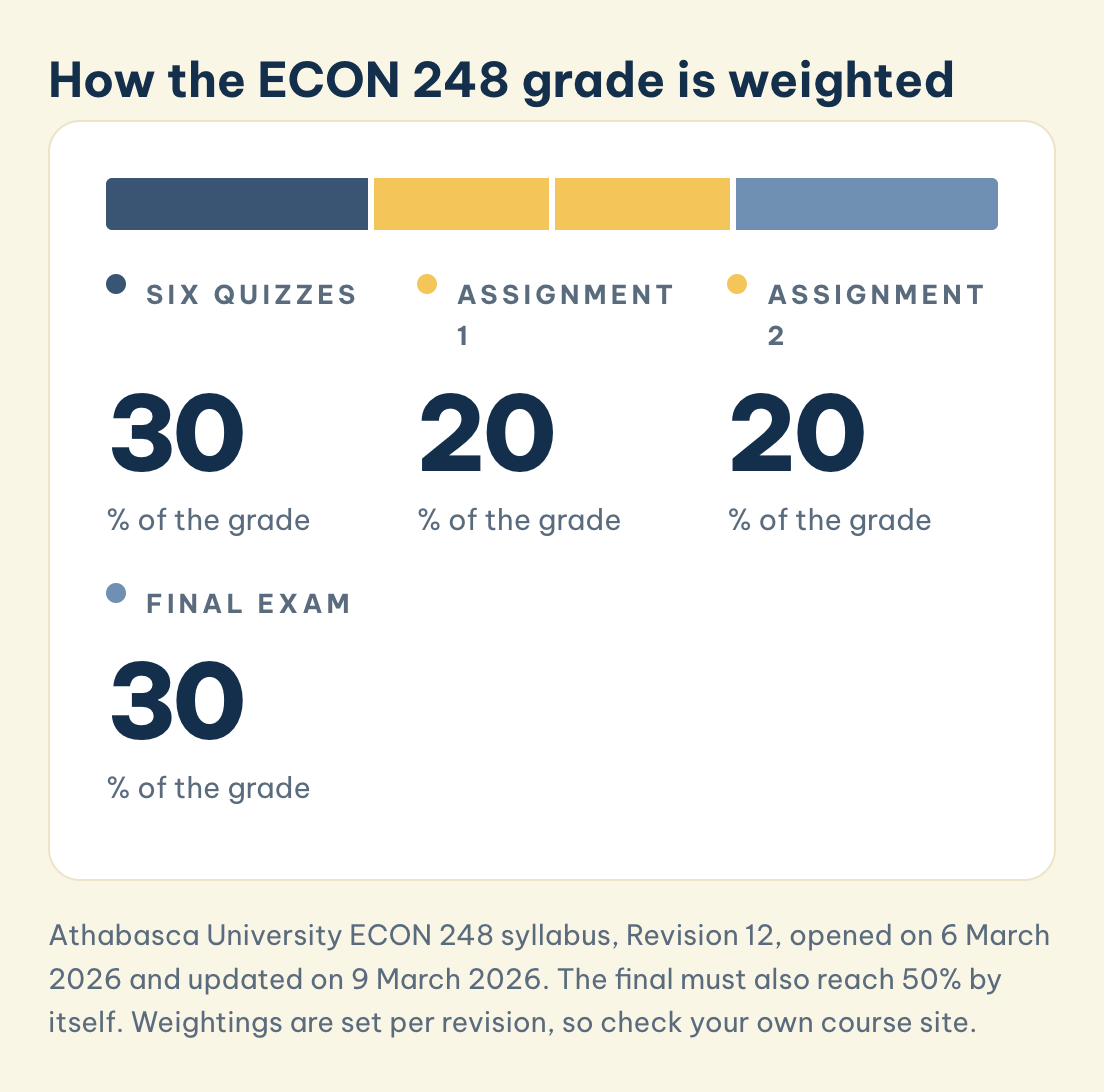
Direct answer: Coursework carries 70% of the grade and the final exam 30%. Six unit quizzes share 30%, Assignment 1 and Assignment 2 carry 20% each, and the final online exam carries 30%. The final is written under supervision through ProctorU or an approved in-person centre, and the student pays any invigilation fee.
How the ECON 248 grade is weighted
Athabasca University syllabus, Revision 12.
Six quizzes
30
% of the grade
Assignment 1
20
% of the grade
Assignment 2
20
% of the grade
Final exam
30
% of the grade
Save this figure
Evidence: The figures below come from the Revision 12 syllabus. Weightings are set per revision, and Athabasca states that it may amend course outlines without notice, so the syllabus inside your own course site is the final word.
| Component | Weight | What it rewards |
|---|---|---|
| 6 unit quizzes | 5% each, 30% in total | Steady recall of definitions and facts, one unit at a time |
| Assignment 1 | 20% | Applying the early units to written and numerical questions |
| Assignment 2 | 20% | Applying the later units, including money, open economies and policy |
| Final online exam, invigilated | 30% | Doing the same analysis without notes or a worked example beside you |
| Pass rule | At least 50% on the final and at least 50% overall | Both conditions, not one |
Example: The two assignments together are worth 40%, more than the final, and each is worth four times a single quiz. A student who skips the quizzes to polish Assignment 1 is putting hours where the grade is heavy, but is also dropping 30% of the course that exists mainly to check the vocabulary. The quizzes are the cheapest marks in the course, because they test whether the definitions are secure before the assignments ask you to use them.
◆ Question 3 / 10 · How do you prepare
How do you prepare for the ECON 248 final exam?
Direct answer: Plan the whole course around the exam from the first week. The final is only 30% of the grade, but the syllabus requires at least 50% on it, so strong coursework cannot rescue a weak exam. Practise closed-book problems on a schedule, because the exam is the first place no worked example sits next to the question.
Evidence: The syllabus states that credit requires a grade of 50 percent or higher on the final examination and an overall grade of at least D, which is 50 percent. The arithmetic shows how much the first condition matters. Coursework worth 70% of the grade, completed at 85%, contributes 59.5 points. A final worth 30% and written at 45% adds 13.5 points, for an overall grade of 73%, yet the course is not passed because the exam condition fails.
Example: A student who works through each unit with the eText open, checks answers against the worked examples and scores well on the quizzes may be learning to recognise a method rather than retrieve it. The first closed-book attempt at a question on the Fisher effect or the money multiplier may then be the exam itself. MAAS mentors suggest closing the book for one full problem set every fortnight, writing each answer from a blank page, and marking it afterwards against the text.
◆ Question 4 / 10 · What do Assignment 1
What do Assignment 1 and Assignment 2 involve?
Direct answer: The public syllabus does not list the questions or say exactly which units each assignment covers, so the reliable source is the assignment page inside your Brightspace course. What it does state is the weight: 20% each, 40% in total, and both are marked pieces of coursework.
Evidence: The course outline names three kinds of learning the assignments and exam draw on: economic concepts such as investment, inflation, exchange rates and multipliers; economic facts such as the powers and responsibilities of the Bank of Canada and how the Canadian economy performed in the recent past; and analytical tools such as the links between output and unemployment, inflation and unemployment, and inflation and interest rates. It also notes that economics is quantitative and requires some understanding of mathematics.
Example: A typical assignment question combines two of those strands. It might ask you to define real GDP, calculate it from nominal GDP and a price index, and then explain what the result implies for living standards. If nominal GDP is 2,000 and the GDP deflator is 125, real GDP is 2,000 divided by 1.25, or 1,600. A student who gets 1,600 but cannot say why nominal figures overstate growth has earned the arithmetic mark and probably lost the explanation mark.
◆ Question 5 / 10 · Which ECON 248 units carry
Which ECON 248 units carry the hardest ideas?
Direct answer: In MAAS mentors' experience, Units 3 to 6 carry most of the difficulty. They cover the long-run real economy, money and prices, open economies, and short-run fluctuations and policy. Each unit relies on identities and models from earlier ones, so an error in the loanable funds market or the quantity equation tends to reappear later.
Evidence: The syllabus lists six units: Introduction to Economics; The Data of Macroeconomics; The Real Economy in the Long Run; Money and Prices in the Long Run; The Macroeconomics of Open Economies; and Macroeconomic Fluctuations and Policy. The course text is Mankiw, Kneebone and McKenzie's Principles of Macroeconomics, 9th Canadian edition, published by Nelson Education in 2024 and supplied as an eText.
Example: Three small calculations cover much of Units 4 to 6. In the quantity equation, money supply M of 500, velocity V of 4 and real output Y of 1,000 give a price level P of 2, because MV equals PY. In the Fisher relationship, a real interest rate of 2% and inflation of 3% give a nominal rate of about 5%. In the simple spending multiplier, a marginal propensity to consume of 0.8 gives 1 divided by 0.2, a multiplier of 5. Students who see that each result is an identity rearranged learn fewer separate formulas.
◆ Question 6 / 10 · What do you need to know
What do you need to know about the Bank of Canada?
Direct answer: Know that the Bank aims for 2% inflation, the midpoint of a 1% to 3% control range, measured as the year-over-year change in total CPI. Know that it also tracks core measures, and that the framework behind this target is renewed every five years, with the next renewal due in 2026.
Evidence: The Bank of Canada's inflation page states that it aims for 2 per cent, the midpoint of a target range of 1 to 3 per cent, expressed as the year-over-year increase in total CPI. It adds that since January 2017 the preferred core measures are CPI-trim, CPI-median and CPI-common, which let the Bank look through temporary changes. The first agreement dates from 1991, the most recent renewal from 2021, and the page says the 2026 review is underway with renewal planned for a five-year period.
Example: A short-answer question might ask why a central bank watches core inflation when total CPI is the official target. A weak answer repeats the definition. A stronger one says that a one-off spike in gasoline prices moves total CPI but not the underlying trend, so policy that reacted to every spike would push interest rates up and down for no lasting reason. Check whether your eText edition describes the 2026 renewal, because a 2024 text may predate it.
◆ Question 7 / 10 · What resources help
What resources help with ECON 248 concepts?
Direct answer: Start with the material the course provides: the eText, the unit key-term lists and learning outcomes, and the quizzes. Add official explainers for the Canadian context, such as the Bank of Canada's short pieces on money and gross domestic product. Use shared exam files with caution, because they can breach academic rules.
Evidence: The Bank of Canada published explainers titled "What is money?" on 6 February 2026 and "What is gross domestic product?" on 19 January 2026, both written for general readers. Each unit of the course also opens with a list of key terms and learning outcomes, which doubles as a revision checklist. Athabasca's Student Academic Misconduct Policy separately treats sharing examination content as cheating.
Example: Search results for this course are crowded with shared sample exams and marked assignments from earlier revisions, on sites such as Studocu and CliffsNotes. Using them to prepare is tempting, but a past exam describes the old revision, not yours, and a copied answer teaches nothing about a question that has changed. A safer routine is to write your own question for each key term in a unit and answer it a week later.
◆ Question 8 / 10 · How can you practise
How can you practise multiple-choice and short-answer questions?
Direct answer: Write the questions yourself from each unit's key terms, answer them closed-book after a delay, and then check the eText. Alternate multiple-choice items that test a definition with short-answer items that ask you to explain a mechanism in three or four sentences. Spaced self-testing works better than rereading.
Evidence: Dunlosky, Rawson, Marsh, Nathan and Willingham (2013) reviewed ten learning techniques and rated practice testing and distributed practice as having high utility, while highlighting and rereading came out low. Roediger and Karpicke (2006) found that after one week students who had been tested on a passage recalled 61% of it, against 40% for students who had restudied it. They concluded that "testing is a powerful means of improving learning, not just assessing it" (Roediger & Karpicke, 2006, p. 249).
Example: After Unit 4, take the key-term list and turn "money multiplier" into a question: if banks hold 10% reserves and the central bank adds 1,000 of reserves, by how much can deposits grow? The simple answer is 1,000 times 10, or 10,000. Write the answer, then ask a second question that uses the same idea differently, such as what happens if banks choose to hold more reserves than required. The second question is the kind of short answer an exam can ask.
◆ Question 9 / 10 · How should you build an ECON
How should you build an ECON 248 study plan?
Direct answer: Divide the course into six unit blocks, finish each unit's quiz soon after the reading, and leave the last third of your time for closed-book revision. A fixed weekly routine matters more than long weekend sessions, because self-paced courses have no lecture timetable to enforce one.
Evidence: The Phillips (1958) paper, built on United Kingdom data from 1861 to 1957, is the classic example of how Unit 6's inflation and unemployment trade-off began as an empirical pattern before it became a model. Reading the model in this way helps the exam answer: you can say what the curve claims and what evidence it rests on. Dunlosky et al. (2013) support spreading practice over time rather than concentrating it.
Example: A student with six months might give each unit three weeks, with the quiz at the end of the first week, an assignment attempt in week two, and a closed-book problem set in week three. The final month is left for mixed revision across all six units. A student who instead reads all six units first and tests only at the end has no evidence of weak spots until the exam shows them.
◆ Question 10 / 10 · Can you get help with ECON
Can you get help with ECON 248 assignments?
Direct answer: You can get help understanding methods, but every assignment, quiz and exam answer must be your own work. Because ECON 248 coursework is completed through individualized online study rather than in a supervised room, the line matters more here than in a campus course. Copying from a solution manual or another student counts as plagiarism.
Evidence: Athabasca University's Student Academic Misconduct Policy defines plagiarism as presenting coursework as your own when it is not, and its list includes coursework copied from a textbook, a solution manual, the internet or any other source. The policy lists penalties from a reduced grade in a course to revocation of an awarded credential.
Example: A legitimate use of a tutor looks like this. A student brings an Assignment 1 practice question they answered incorrectly, reworks it aloud, and is asked why they used nominal rather than real figures. The tutor never sees a mark-bearing submission. Tutoring of this kind is advisory, so it carries no grade target, and if the tutor is not the right fit you can ask to change expert.
Frequently asked questions
Is ECON 248 hard?
The mathematics is light, but the course asks for definitions, models and policy reasoning across six units. The difficulty is breadth and precision, and the invigilated final must be passed on its own at 50%.
What happens if I score below 50% on the ECON 248 final?
You do not receive credit for the course, even if your overall grade is above 50%. The syllabus requires at least 50% on the final examination and at least 50% overall, so both conditions have to be met.
What textbook does ECON 248 use?
Revision 12 uses Mankiw, Kneebone and McKenzie, Principles of Macroeconomics, 9th Canadian edition, published by Nelson Education in 2024. It is supplied as an eText inside the course, and a print copy can be bought from the publisher.
Can I challenge ECON 248 instead of taking it?
Yes. The syllabus offers a challenge for credit option, assessed by an examination, and you need at least D (50 percent) on that examination to receive credit.
Is there a prerequisite for ECON 248?
No. The syllabus lists none, though it notes that economics is quantitative and that some understanding of mathematics helps.
Does MAAS complete ECON 248 assignments or exams?
No. MAAS mentors explain methods and review practice problems you have already attempted. Every assignment, quiz and exam answer must be your own, in line with Athabasca University's academic misconduct policy.
Related reading
- ECON1102 Macroeconomics 1: how UNSW frames the same macroeconomic variables for a Business School course
- ECON2102 Macroeconomics 2: where the models from an introductory course are taken further
- How to revise for final exams effectively: a longer look at spaced and retrieval practice before a final that decides a pass
Where MAAS fits
- Subject tutoring, one to one: 60 or 90 minute sessions with a tutor matched to economics, working through practice problems you have already attempted. Tutoring is advisory, so it carries no grade target; if the tutor is not the right fit, you can ask to change expert
- Exam coaching resources: how MAAS mentors approach preparation for timed, invigilated exams
References
- Dunlosky, J., Rawson, K. A., Marsh, E. J., Nathan, M. J., & Willingham, D. T. (2013). Improving students' learning with effective learning techniques: Promising directions from cognitive and educational psychology. Psychological Science in the Public Interest, 14(1), 4–58. https://doi.org/10.1177/1529100612453266
- Phillips, A. W. (1958). The relation between unemployment and the rate of change of money wage rates in the United Kingdom, 1861–1957. Economica, 25(100), 283–299. https://doi.org/10.1111/j.1468-0335.1958.tb00003.x
- Roediger, H. L., & Karpicke, J. D. (2006). Test-enhanced learning: Taking memory tests improves long-term retention. Psychological Science, 17(3), 249–255. https://doi.org/10.1111/j.1467-9280.2006.01693.x
Tools & resources
- Athabasca University. (2026). ECON 248: Macroeconomics (Revision 12) [Course syllabus]. Retrieved October 13, 2026, from https://www.athabascau.ca/syllabi/econ/econ248.html
- Athabasca University. (n.d.). Student academic misconduct policy. Retrieved October 13, 2026, from https://www.athabascau.ca/university-secretariat/_documents/policy/student-academic-misconduct-policy.pdf
- Bank of Canada. (n.d.). Inflation. Retrieved October 13, 2026, from https://www.bankofcanada.ca/core-functions/monetary-policy/inflation/
- Mankiw, N. G., Kneebone, R. D., & McKenzie, K. J. (2024). Principles of macroeconomics (9th Canadian ed.). Nelson Education.
This article is part of the MAAS Journal series for Vietnamese international students. MAAS is an independent academic support provider. For courses assessed by exams and individual online work, we offer one-to-one tutoring on methods only; we do not write, complete or submit any assessed work.
Not sure how this guide applies to your own case? Talk it through with MAAS in a free 20-minute consultation.
Book a free consultation ▸