
ECON1596 (and its companion code ECON1597) Business Challenges in the Digital Economy rewards students who use economic reasoning to explain why digital markets behave differently, not those who list technologies. Most who struggle with this RMIT course are not short on effort: they describe platforms, AI, and data as exciting phenomena, but never apply network effects or switching costs to a firm's actual case. This guide answers the seven questions Vietnamese RMIT students ask MAAS mentors most.
Author: MAAS Editorial Team
Last updated: 2026-07-20
Category: economics

What is ECON1596 / ECON1597 Business Challenges in the Digital Economy about?
Direct answer: ECON1596 is an RMIT business economics course (ECON1597 is the parallel code for a different cohort) that applies microeconomic reasoning to digital markets. It covers platform and two-sided markets, network effects, zero marginal cost, switching costs and lock-in, digital market power, and the labour-market effects of automation.
Evidence: The course sits on the standard digital and platform economics literature, Shapiro and Varian's Information Rules established the switching-cost and lock-in framing still used in teaching, Rochet and Tirole (2003) formalised two-sided platform pricing, and Parker, Van Alstyne and Choudary (2016) provide the platform business-model vocabulary that most digital-economy assessments expect.
Example: A Vietnamese student at RMIT Vietnam arrived at MAAS treating ECON1596 as "a course about tech companies". Her mentor reframed it: every topic is an economic property that changes how a market clears, when marginal cost is near zero, when value rises with users, when data creates a feedback loop. Once she wrote from that lens, her draft stopped profiling Grab and started explaining why the ride-hailing market tips towards one or two players, and her mark moved from a Pass-level draft to a Distinction.
What assessment does the ECON1596 assignment usually involve?
Direct answer: Business-economics courses at this level are commonly assessed through an individual report or case analysis built around a specific digital firm, platform, or policy question, sometimes with a group component and a short reflective or presentation element. You are typically asked to apply one or two digital-economics frameworks to a real case, for example, explaining why a platform tipped to dominance, evaluating a pricing or data strategy, or assessing whether a regulator should intervene and to reach a justified recommendation. Always confirm the exact task, word count, and weighting in your own Canvas shell, because assessment structure changes by semester, code (ECON1596 vs ECON1597), and campus.
Evidence: RMIT business assessments are criterion-referenced, meaning marks are awarded against published rubric criteria rather than ranked against classmates. This is set out in RMIT's Assessment policy, which is why decoding the rubric matters far more than the length of your report or the number of examples you cite.
Example: A Vietnamese RMIT student spent half of a 1,500-word report narrating the founding story of a platform before reaching his analysis. His MAAS mentor cut the company background to three sentences and reallocated the words to explaining the network-effect dynamic he had already identified. Same case, same word count, the analysis-led version earned a clear Distinction because the economics was finally doing the work.
How is the ECON1596 assignment graded, what does the rubric actually reward?
Direct answer: Digital-economy rubrics at this level reward four things, roughly in this order: (1) correct application of economic concepts to the specific digital case, (2) accurate use of evidence, market data, pricing, user numbers, to support the argument, (3) critical evaluation of trade-offs, risks, and alternatives, including who bears the cost, and (4) academic writing and Harvard referencing.
Describing a business model earns almost no marks on its own; marks live in why the economic property applies here, what the evidence shows, and whether the strategy or policy is justified once you weigh the costs.
Evidence: RMIT business rubrics use criterion bands (Pass / Credit / Distinction / High Distinction). The jump from Credit to Distinction is almost always defined by the words "critical" and "justified", critical evaluation of a strategy, justified interpretation of evidence, not by adding more company detail or more contemporary examples.
Example: A MAAS mentor marked one Vietnamese student's draft sentence by sentence, labelling each as "describe", "apply", or "evaluate". The draft was 70% describe: a tour of a platform's features with no economics attached. After one restructuring pass that named the economic mechanism under each claim and weighed the downside of the strategy, the same case moved up two full rubric bands.
Which economic frameworks should you use in ECON1596?
Direct answer: Anchor your analysis in two or three frameworks that fit your specific case rather than name-dropping the syllabus. The most useful for ECON1596 are: direct and indirect network effects (why digital markets tip), two-sided market pricing (why one side is subsidised), switching costs and lock-in (why users stay), zero marginal cost and versioning (why digital pricing differs from physical goods), and data feedback loops and market power (why scale compounds and when a regulator should care). Choose the frameworks your evidence can actually support.
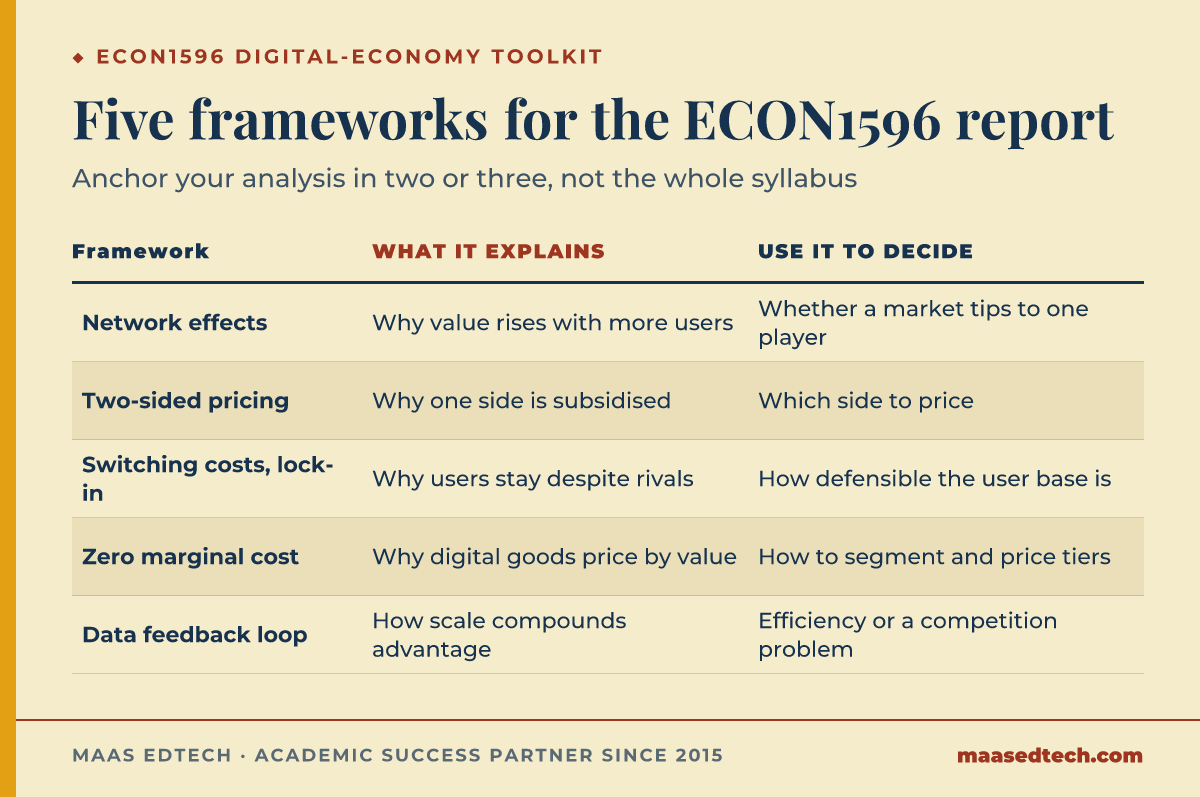
| Framework | What it explains | Use it to decide |
|---|---|---|
| Network effects (direct / indirect) | Why value rises with the number of users and markets tip to one player | Whether a market will concentrate and how a challenger could enter |
| Two-sided market pricing (Rochet & Tirole) | Why a platform subsidises one side and charges the other | Which side to price and what the platform's margin structure should be |
| Switching costs and lock-in (Shapiro & Varian) | Why customers stay even when a rival is better | How defensible a firm's user base actually is |
| Zero marginal cost and versioning | Why digital goods are priced by value, not by cost | How to segment customers and price tiers of the same product |
| Data feedback loop and digital market power | How scale in data compounds into durable advantage | Whether an advantage is efficiency or a competition problem |
Evidence: These frameworks are the examiner-recognised, textbook-level foundations of the field: Shapiro and Varian (1999) for information goods, switching costs, and versioning; Rochet and Tirole (2003) for two-sided platform pricing, opening their paper with the observation that "many if not most markets with network externalities are two-sided" (Rochet & Tirole, 2003); Parker, Van Alstyne and Choudary (2016) for platform strategy; Brynjolfsson and McAfee (2014) for the labour-market and automation strand many ECON1596 questions touch; and Varian (2014) for the standard microeconomic toolkit, demand, cost, and market structure, that the course assumes as background before any digital-specific framework is applied.
Example: A Vietnamese RMIT student analysing an e-commerce platform tried to apply five frameworks and explained each only shallowly. Her MAAS mentor cut it to two, indirect network effects to explain why sellers followed buyers, and switching costs to test how defensible that position was. Fewer frameworks, deeper application, higher mark.
How should you structure the ECON1596 report?
Direct answer: Use a question-led structure: (1) a brief introduction that states the business problem and your position, keeping company context under 10% of the word count, (2) the economic framework applied to your case, (3) evidence, market data, pricing, adoption figures, that you interpret rather than merely display, (4) a critical evaluation that weighs the trade-offs, risks, and who bears the cost, and (5) a justified recommendation. Any table or chart must be referred to and interpreted in the text; a figure that no sentence explains earns nothing. The single biggest structural fix is shrinking description and expanding application and evaluation, where the marks concentrate.
Evidence: Criterion-referenced rubrics weight "application of concepts", "use of evidence", and "critical evaluation" far above "background and description". Matching your word budget to the rubric weighting is the most reliable way to lift a grade without finding new material.
Example: A Vietnamese RMIT student submitted a report with a 400-word company profile and a two-line conclusion that restated his position. His MAAS mentor inverted the balance, giving the evaluation room to weigh the platform's data advantage against regulatory and reputational risk. Same case, same sources, the report moved from a borderline Credit to a Distinction because the trade-offs were finally argued.
What are the most common mistakes that lose marks in ECON1596?
Direct answer: Three recurring mistakes show up across MAAS economics coaching. First, students describe a technology or a company instead of analysing it with economic concepts, the report reads like a business news feature. Second, evidence is presented but not interpreted: user numbers or revenue figures are dropped in with no sentence saying what they mean for the argument. Third, recommendations are one-sided ("the platform should expand") rather than balanced evaluations that name the assumptions, the risks, and the losers. Fixing these three lifts most drafts by at least one rubric band.
Evidence: Across MAAS economics coaching, marker feedback before intervention clusters heavily on "needs more analysis" and "evidence not interpreted", the two phrases that most often separate a Credit from a Distinction in RMIT business rubrics.
Example: A Vietnamese student's conclusion read "AI will make the company more competitive." His MAAS mentor pushed him to specify: competitive against whom, through which mechanism (lower marginal cost, better matching, a data loop), at what cost (capital, displaced workers, regulatory exposure), and under what assumption about rival adoption. The specified version earned full marks on the evaluation criterion that the vague claim had failed.
How long is the ECON1596 assignment and what referencing style does it use?
Direct answer: Confirm the exact word count and style in your assessment brief, individual business-economics reports at this level commonly sit between 1,500 and 2,500 words, with tables and reference lists often excluded from the count, and use Harvard referencing, which is RMIT's default business style.
Stay within the 10% tolerance band, cite every statistic and every framework you invoke, and label every figure and table so it can be referred to from the text. In a course about fast-moving digital markets, date-stamping your market data matters: a 2019 user figure used as current evidence weakens an otherwise sound argument.
Evidence: RMIT's Business school uses RMIT Harvard as its standard referencing style, documented in RMIT's Easy Cite referencing tool. Markers routinely deduct marks for unreferenced statistics, uncited figures, or inconsistent Harvard formatting even when the economic analysis is strong.
Example: A Vietnamese RMIT student lost several marks because his platform-usage statistics cited no source and his in-text citations did not match his reference list. A MAAS pre-submission audit closed the gaps in under an hour, every figure sourced and dated, every Harvard entry aligned. On his next ECON1596 task, clean sourcing recovered marks on a criterion that requires no extra analysis at all.
Frequently asked questions
Is ECON1596 a hard course?
It is conceptually demanding rather than mathematically hard. There is little heavy calculation, but the course rewards economic reasoning applied to unfamiliar, fast-changing markets. Students who treat it as "write about tech" struggle; students who treat it as "apply microeconomics to digital markets" do well.
What is the difference between ECON1596 and ECON1597?
They are parallel course codes for substantially the same Business Challenges in the Digital Economy content, used across different cohorts, programs, or campus offerings. The economics you need is the same; the assessment brief, weighting, and due dates can differ, so always work from the brief in your own Canvas shell rather than a classmate's.
Can I use a Vietnamese company as my case?
Yes, and it often works well, platforms such as ride-hailing, e-wallet, and e-commerce operators in Vietnam give you a documented, locally relevant case. The risk is describing the company rather than using it to test an economic mechanism, so keep the case in service of the argument and source your figures carefully.
Do I need to cover AI and automation?
Only if your question calls for it. Automation and the future of work is a recognised strand of the course, but a focused report that applies two frameworks well beats a broad one that touches AI, blockchain, and platforms without depth in any of them.
What referencing style does ECON1596 use?
RMIT Harvard is the default for business courses, and it applies to your market data as well as your literature. Always confirm in your own brief and use RMIT's Easy Cite tool to format entries consistently.
Can MAAS help me with ECON1596?
Yes. MAAS Assignment & Essay Support coaches you through the assignment with the Outline, Draft, Final model, choosing the right framework, interpreting market evidence, structuring the evaluation, and a pre-submission referencing audit, all with discipline-matched experts. We coach your work; we do not write it for you.
Ready to approach ECON1596 with a clear strategy?
If you have the case but not the argument, that is exactly where a discipline-matched expert helps most. MAAS Assignment & Essay Support is an academic support partner; we work alongside you through Outline, Draft, Final so the analysis stays yours and the structure earns the marks.
Bring your ECON1596 or ECON1597 brief and we will match you to an economics mentor, 23% of our 100+ experts hold a PhD, within 48 hours when our network already covers that field. If it does not, MAAS opens a dedicated recruitment round for your case, which usually takes about two weeks.
Book a free 15-minute ECON1596 consultation with MAAS Assignment & Essay Support →
Related guides
- ECON1269 assignment: how to approach Business in a Globalised Economy?: sibling RMIT economics guide on trade theory and policy analysis
- BUSM2519 assignment: how do you approach Leading Digital Disruption?: the management-side companion to the digital economy question
- Assignment command words explained: what "evaluate", "analyse", and "justify" actually require
- MAAS Academic Mentoring service: 1:1 coaching with PhD-level mentors in your discipline
- Course-code assignment coaching: pillar guide on tackling any unit assignment with a MAAS mentor
References
- Brynjolfsson, E., & McAfee, A. (2014). The second machine age: Work, progress, and prosperity in a time of brilliant technologies. W. W. Norton.
- Parker, G. G., Van Alstyne, M. W., & Choudary, S. P. (2016). Platform revolution: How networked markets are transforming the economy and how to make them work for you. W. W. Norton.
- Rochet, J.-C., & Tirole, J. (2003). Platform competition in two-sided markets. Journal of the European Economic Association, 1(4), 990–1029. https://doi.org/10.1162/154247603322493212
- Shapiro, C., & Varian, H. R. (1999). Information rules: A strategic guide to the network economy. Harvard Business School Press.
- Varian, H. R. (2014). Intermediate microeconomics: A modern approach (9th ed.). W. W. Norton.
Tools & resources
- RMIT University. (n.d.). Assessment and exams. Retrieved July 20, 2026, from https://www.rmit.edu.au/students/student-essentials/assessment-and-exams
- RMIT University. (n.d.). Easy Cite referencing tool. Retrieved July 20, 2026, from https://www.rmit.edu.au/library/study/referencing
This article is part of the MAAS Journal series for Vietnamese international students. MAAS Assignment & Essay Support is an academic support partner; we coach students through the Outline, Draft, Final delivery model with developmental feedback from discipline-matched experts. We do not write or submit work on a student's behalf.