
◆ Communication & PR
COMM2975 PR Strategy and Planning: how do you plan it?
Open almost any student PR plan and you will find a SWOT table sitting between the background section and the objectives, connected to neither. It looks like analysis. It changes nothing. Researchers who examined how SWOT was actually used inside real organisations found the outputs were never carried into the next stage of planning, and argued the technique needed a product recall. This guide answers the seven questions Vietnamese COMM2975 students ask MAAS mentors most often.

◆ Question 1 / 7 · The course
What is COMM2975 and how does it differ from other planning courses?
Direct answer: COMM2975 is the RMIT course code for Public Relations Strategy and Planning, delivered to undergraduates at RMIT Vietnam Saigon South within the Public Relations major of the Bachelor of Professional Communication. It teaches strategic communication planning through a case study approach and situates it inside broader organisational planning. Two elements distinguish it: situation analysis and agile planning tools.
Evidence: RMIT's course guide for record 055968 states that the course uses a case study approach to analyse how strategic planning is applied across communication and public relations specialisations, examines how strategic communication planning sits within broader organisational and situational planning, and covers a variety of frameworks including situation analysis techniques and agile planning tools responsive to the current environment. The course carries different codes by campus: COMM2937 at Melbourne City Campus, COMM2976 at RMIT Vietnam Hanoi and COMM2998 at the Singapore Institute of Management.
Example: A student assumed this course would repeat the strategy content from earlier communication planning study and reused a structure that had earned him a Credit before. His mentor pointed at two words in his own course guide, agile and situational, that his linear plan did not address at all. The plan was competent and answered a question the course was not asking.
◆ Question 2 / 7 · Mid-band plans
Why does a well-formatted PR plan still land mid-band?
Direct answer: Because the sections do not talk to each other. A plan reads as mid-band when its research section could be deleted without changing its strategy, when its objectives could belong to any organisation, and when its evaluation measures activity rather than the objective it set. The test to run on your own draft is blunt: cover the strategy section and ask whether a reader could predict it from your situation analysis. If not, your analysis is decoration.
Evidence: Hill and Westbrook (1997) examined SWOT use in twenty organisations and found that in no case were the outputs actually used in the later steps of the strategy process, concluding the technique had become a ritual rather than an analytical tool. That failure pattern reproduces itself precisely in student plans.
Example: A student's SWOT listed "strong brand reputation" as a strength and "negative online sentiment" as a threat, in the same table, without noticing the contradiction. Her mentor asked which was true. Investigating that tension became her situation analysis, and it generated a strategy about closing the gap between reputation and sentiment, which no generic plan would have produced.
◆ Question 3 / 7 · Agile planning
What does the course mean by agile planning, and how do you write it?
Direct answer: Agile planning means designing a plan that can absorb change rather than one that assumes a stable environment for twelve months. In writing, that means three concrete things. State the assumptions your plan depends on, so a reader can see what would break it.
Build decision points into the timeline, not just milestones, specifying what you would do if a metric fails to move. Distinguish the strategic intent, which should be stable, from the tactics, which should be replaceable. A plan that cannot say what it would abandon is not agile, however often it uses the word.
Evidence: Mintzberg and Waters (1985) distinguished deliberate strategy, realised as intended, from emergent strategy, which forms through patterns in actions taken as conditions change, and argued that real strategy is almost always a blend. Mintzberg (1994) went further, arguing that formal planning processes often substitute procedure for strategic thinking. Both give you the vocabulary to write about adaptation as a designed feature rather than as failure.
Example: A student wrote a twelve-month campaign timeline with no contingency at all. His mentor asked what he would do if media pickup was zero in month two. He built three decision points into the timeline with named triggers and alternative tactics. The strategic objective never changed; the tactics became conditional. That single change moved the plan from descriptive to strategic.
◆ Question 4 / 7 · Objectives
How do you write objectives a marker cannot dismiss?
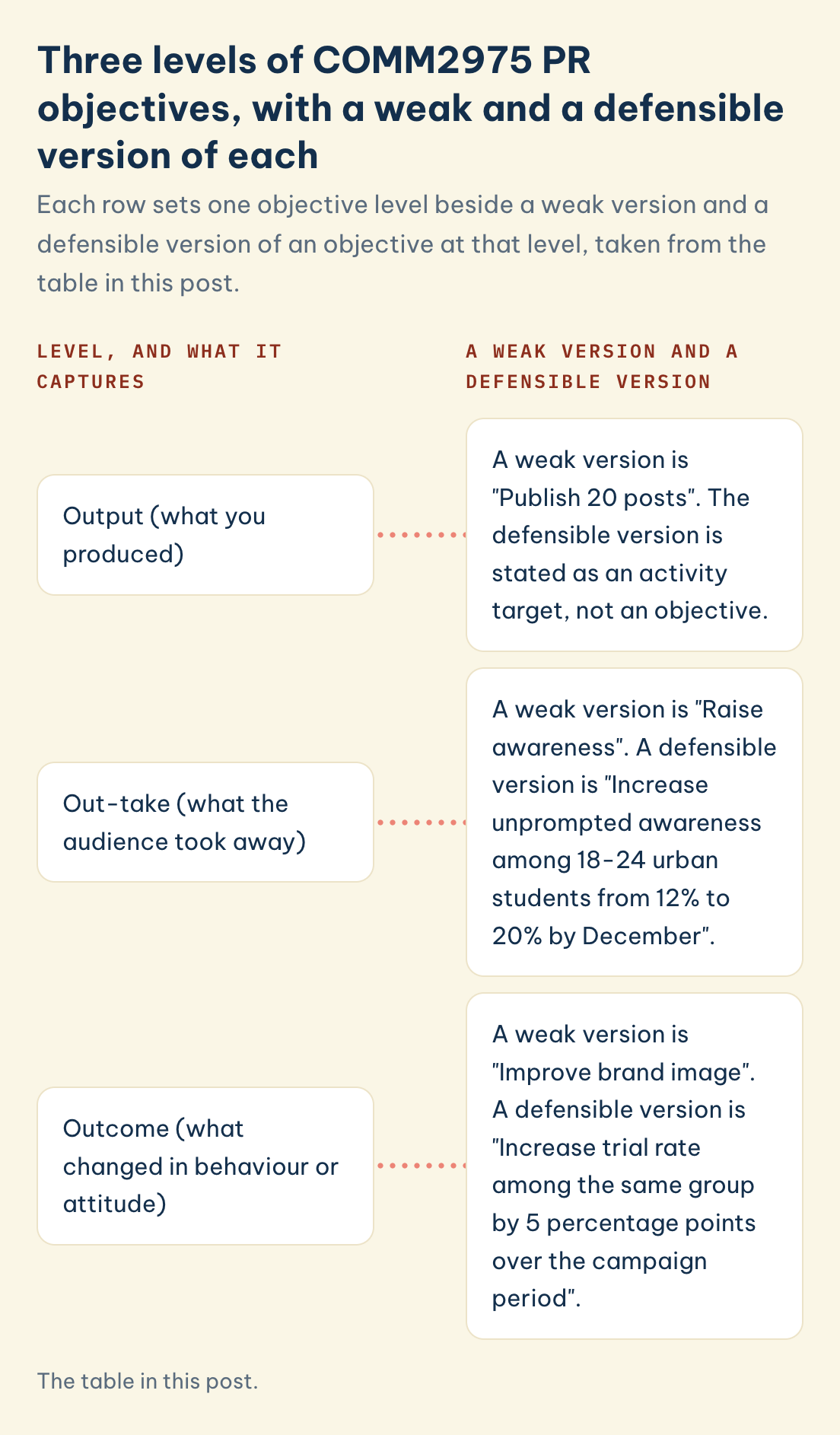
Direct answer: Separate the levels and stop at the level your plan can actually influence. Output objectives describe what you produce, such as media releases or events. Out-take objectives describe what audiences notice, understand or feel. Outcome objectives describe what changes in awareness, attitude or behaviour. Most student plans set output objectives and then evaluate them as if they were outcomes. Write objectives that name the audience, the change, the magnitude and the timeframe, and be honest when a communication plan can only realistically move an out-take.
Three levels of COMM2975 PR objectives, with a weak and a defensible version of each
Each row sets one objective level beside a weak version and a defensible version of an objective at that level, taken from the table in this post.
Level, and what it captures
A weak version and a defensible version
Output (what you produced)
A weak version is "Publish 20 posts". The defensible version is stated as an activity target, not an objective.
Out-take (what the audience took away)
A weak version is "Raise awareness". A defensible version is "Increase unprompted awareness among 18-24 urban students from 12% to 20% by December".
Outcome (what changed in behaviour or attitude)
A weak version is "Improve brand image". A defensible version is "Increase trial rate among the same group by 5 percentage points over the campaign period".
Save this figure
| Level | What it captures | A weak version | A defensible version |
|---|---|---|---|
| Output | What you produced | "Publish 20 posts" | Stated as an activity target, not an objective |
| Out-take | What the audience took away | "Raise awareness" | "Increase unprompted awareness among 18-24 urban students from 12% to 20% by December" |
| Outcome | What changed in behaviour or attitude | "Improve brand image" | "Increase trial rate among the same group by 5 percentage points over the campaign period" |
Evidence: Macnamara (2015) argued that communication evaluation has been stuck for decades precisely because outputs are counted as if they demonstrated effect, noting that "research-based measurement and evaluation of public relations and corporate communication are still not widely applied despite more than a century of discussion and intense focus since the 1970s" (Macnamara, 2015). He set out a model that separates outputs, out-takes and outcomes to break that deadlock. Writing objectives at the right level is what makes evaluation possible at all.
Example: A student's objective was "increase engagement on social media". Her mentor asked what the organisation would gain if engagement doubled. She could not answer, which revealed the objective was borrowed rather than derived. Rewritten as an out-take objective tied to a specific misunderstanding among her target public, both the strategy and the evaluation became measurable.
◆ Question 5 / 7 · Theories
Which theories belong in a strategy and planning assignment?
Direct answer: Use planning theory to justify your process, and public relations theory to justify your relationship with publics. Bringing only a step-by-step planning model produces a template exercise. The strongest plans explain why the chosen approach fits the situation, and acknowledge what the chosen model cannot see.
Evidence: Grunig and Hunt (1984) set out four models of public relations practice, press agentry, public information, two-way asymmetrical and two-way symmetrical, which lets you classify what your case organisation is actually doing rather than what it claims. Smith's (2020) strategic planning framework for public relations organises the process into formative research, strategy, tactics and evaluation, giving you a defensible structure. Mintzberg and Waters (1985) supply the critical counterweight, that plans rarely survive contact with conditions unchanged.
Example: A student described her client as practising two-way symmetrical communication because it replied to comments. Her mentor asked what the organisation had ever changed as a result of what publics said. Nothing. Reclassified as two-way asymmetrical, the analysis became honest, and it justified a strategy about building genuine feedback into the process.
◆ Question 6 / 7 · Situation analysis
How do you do a situation analysis that actually produces a strategy?
Direct answer: Work in three passes rather than filling in a matrix. First, gather evidence about the organisation, its publics and the environment, and record where each claim came from. Second, identify the central problem or opportunity in one sentence; if you cannot, you are not ready to plan.
Third, derive strategy from that sentence, and show the derivation explicitly in the text so the marker can follow it. Where you use a matrix such as SWOT or PEST, put it in an appendix and use the body of your plan to argue what follows from it.
Evidence: RMIT describes the course as covering situation analysis techniques alongside agile planning tools, positioning analysis as the engine of the plan rather than as a preliminary formality. Hill and Westbrook's (1997) finding shows what happens when that engine is disconnected.
Example: A student produced a thorough PEST analysis for a Vietnamese non-profit and then wrote a strategy about social media reach that had nothing to do with any factor she had identified. Her mentor asked which single environmental factor mattered most. It was a regulatory change affecting how the organisation could solicit donations. Her strategy was rebuilt around it and finally had a reason to exist.
◆ Question 7 / 7 · Structure
What structure works, and what gets cut?
Direct answer: Follow your brief, and where you have discretion use a shape that makes derivation visible: an executive summary that states the problem and the strategic response; a situation analysis ending with the problem statement; publics, defined by their relationship to the problem rather than by demographics alone; objectives at the correct level; strategy explaining the logic before tactics describe the execution; an implementation timeline with decision points; an evaluation section measuring the objectives you set. What gets cut is organisational background, tactic descriptions that read like a catalogue, and any framework that appears without consequence.
Evidence: RMIT assessment is criterion-referenced, so work is measured against published rubric criteria rather than ranked against classmates. A longer background section cannot lift a mark; making the analysis-to-strategy link explicit can.
Example: A student devoted 900 words of a 2,500-word plan to company history and awards. His mentor cut it to 200 and used the recovered words to show how each element of the analysis led to a strategic choice. Same research, same length, two bands higher.
Frequently asked questions
Is COMM2975 the same course as COMM2937 or COMM2976?
They are the same course record in the RMIT Handbook with different delivery codes by campus. COMM2975 is RMIT Vietnam Saigon South, COMM2937 is Melbourne City Campus, COMM2976 is RMIT Vietnam Hanoi and COMM2998 is the Singapore Institute of Management offering. Assessment detail can differ between offerings, so work from your own course guide and Canvas shell.
How is this different from a communication strategy course I have already taken?
The distinguishing emphases are situation analysis technique and agile planning. If your draft could have been submitted to an earlier planning course unchanged, it is probably missing the adaptive element this course is built around.
Can I invent a client, or must it be a real organisation?
Follow your brief. Where you have a choice, a real organisation is almost always better because it gives you verifiable evidence for the situation analysis, which is where the marks concentrate. An invented client tempts you to invent convenient facts.
Do I need a budget section?
If the brief asks for one, treat it as a constraint that shapes strategy rather than a table at the end. Naming what you cannot afford, and adjusting tactics accordingly, is evidence of strategic thinking rather than a limitation.
How many references does a PR plan need?
Your course guide is the authority. As a working guide, expect roughly eight to fifteen quality sources for an undergraduate plan of this type, with peer-reviewed work supporting your planning and PR theory, plus primary evidence about your client and its environment.
How MAAS mentors support COMM2975 students
MAAS works as an academic advisor, not a writing service. For COMM2975 that usually means helping you decode your own brief and rubric, pressure-testing whether your situation analysis actually leads to your strategy, checking that your objectives sit at a level your plan can influence, and giving feedback on where a tactic catalogue should become strategic reasoning. You write the plan; the mentor helps you see it the way a marker will.
If you are studying other courses in the Public Relations major, our guides to COMM2920 Advocacy and Voice in Public Relations and MKTG1456 Applied Public Relations Research cover neighbouring rubrics. You can also read how our academic support service works before you get in touch.
References
Grunig, J. E., & Hunt, T. (1984). Managing public relations. Holt, Rinehart and Winston.
Hill, T., & Westbrook, R. (1997). SWOT analysis: It's time for a product recall. Long Range Planning, 30(1), 46–52. https://doi.org/10.1016/S0024-6301(96)00095-7
Macnamara, J. (2015). Breaking the measurement and evaluation deadlock: A new approach and model. Journal of Communication Management, 19(4), 371–387. https://doi.org/10.1108/JCOM-04-2014-0020
Mintzberg, H. (1994). The rise and fall of strategic planning. Free Press.
Mintzberg, H., & Waters, J. A. (1985). Of strategies, deliberate and emergent. Strategic Management Journal, 6(3), 257–272. https://doi.org/10.1002/smj.4250060306
Smith, R. D. (2020). Strategic planning for public relations (6th ed.). Routledge.
Tools & resources
- RMIT course guide for Public Relations Strategy and Planning (course 055968), for the course description, learning outcomes and the delivery code attached to each campus.
- Your Canvas course shell and course guide, the only authoritative source for your assessment tasks, weightings and due dates.
- Primary evidence about your client: annual reports, published statements, regulatory information and dated media coverage, which is what turns a situation analysis into analysis.
A free 20-minute consultation is a conversation about where you are with COMM2975.
Book a free consultation ▸