
COMM2699 Issues, Risk and Crisis Communication at RMIT asks you to analyse how an organisation communicates through a threat, and the rubric rewards the theory behind your judgement, not a retelling of events. Most students who struggle can narrate a crisis in detail but never diagnose the crisis type or justify why a given response strategy fits it. This guide answers the seven questions Vietnamese students at RMIT ask MAAS mentors most often before they start COMM2699.
Author: MAAS Editorial Team · Reviewed by a Senior Communications mentor (public relations, crisis)
Last updated: 2026-07-23
Category: communication-pr

What is COMM2699 Issues, Risk and Crisis Communication about?
Direct answer: COMM2699 is an RMIT undergraduate course (offered at RMIT Vietnam, within the Bachelor of Professional Communication) examining how organisations identify issues, manage risk, and respond when a threat escalates into a crisis. It centres on trust, reputation, credibility and control, and the line between a contained issue and a full crisis.
Evidence: The course description is explicit that identification of issues and the appropriateness of response are what separate escalation from a public that understands. Because it teaches concepts through case studies, the marks live in your analysis of the case against theory, not in the vividness of your retelling.
Example: A Vietnamese RMIT student came to MAAS with a detailed timeline of a brand scandal and expected a strong mark. Her mentor reframed it: the timeline is context, the analysis is diagnosing the crisis type and evaluating whether the response protected reputation. Once she replaced narration with theory-led judgement, her draft moved from a Pass level to a Distinction.
What assessment does the COMM2699 assignment usually involve?
Direct answer: COMM2699 is typically assessed through case-study analysis and an applied communication task, often a written report analysing a real crisis and, in some semesters, a crisis communication plan or strategy for a given scenario. You are usually asked to identify the issue or crisis, analyse the organisation's response using crisis communication theory, and evaluate its effectiveness against reputation and stakeholder outcomes. Always confirm the exact brief and weighting in your own Canvas shell, because assessment detail changes by semester.
Evidence: RMIT assessment is criterion-referenced, meaning your work is marked against published rubric criteria rather than ranked against classmates. This is why a gripping account of a scandal with no theoretical framing still stalls in the middle bands: the criteria reward the diagnosis and evaluation, not the story.
Example: A student wrote a compelling six-page narrative of an airline crisis and earned a Credit. His MAAS mentor pointed to the rubric line rewarding "application of crisis communication theory", which he had barely touched. The events were never the problem; the missing analysis was.
How is the COMM2699 assignment graded, what does the rubric actually reward?
Direct answer: COMM2699 rubrics reward four things, in roughly this order: (1) correct diagnosis of the issue or crisis type, (2) explicit application of crisis and issues communication theory, (3) critical evaluation of the organisation's response against trust, reputation, and stakeholder outcomes, and (4) clear professional writing with referencing. Describing what an organisation said earns little; marks live in why that response fit the crisis and whether it worked. The jump from Credit to Distinction is almost always the word "critical", not more narrative.
Evidence: RMIT communication rubrics use criterion bands (Pass / Credit / Distinction / High Distinction), and the higher bands are defined by evaluative language, "critically applies theory", "evaluates effectiveness", "justifies the response strategy". A student who only summarises a crisis cannot reach those bands, however dramatic the case.
| Rubric focus | Describe (lower band) | Analyse and justify (higher band) |
|---|---|---|
| Crisis type | Recounts what happened | Diagnoses the crisis type and the attributed responsibility |
| Response strategy | Lists what the organisation said | Argues why the strategy fits the crisis type (e.g. SCCT) |
| Reputation outcome | States the organisation apologised | Evaluates whether the response protected trust and credibility |
| Stakeholders | Names the affected publics | Analyses how different publics received and judged the response |
Example: A MAAS mentor colour-coded a student's draft, green for a sentence that applied theory, red for a sentence that just narrated. The draft was mostly red. After one pass that added a theoretical judgement to each event, "an accident cluster, so a diminish strategy was defensible", the same case moved up two full bands.
Which frameworks should you use in COMM2699?
Direct answer: Anchor your analysis in two or three established crisis communication frameworks rather than name-dropping many. The most useful for COMM2699 are: Coombs' (2019) Situational Crisis Communication Theory (SCCT), which matches response strategy to the crisis type and the responsibility attributed to the organisation; Benoit's (2015) Image Repair Theory, which classifies the response strategies themselves (denial, evasion, corrective action); and issues management theory (Heath & Palenchar, 2009), which treats a crisis as the late stage of an unmanaged issue. In the peer-reviewed article most directly behind this course's crisis-as-late-stage-issue framing, Tony Jaques (RMIT) writes: "Crises can lead to persistent and damaging issues, but there has been limited substantive research to illuminate the optimal processes to navigate the transition from crisis to issue" (Jaques, 2009, p. 35). Choose the frameworks that fit your case; do not force all of them in.
Evidence: These frameworks are examiner-recognised because they are diagnostic, not descriptive. SCCT, for instance, is only useful when you first classify the crisis (victim, accident, or preventable cluster) and then argue that the response matched the responsibility the public assigned, that argument is the analysis the rubric rewards.
Example: A Vietnamese RMIT student analysing a food-safety crisis tried to apply five models and explained each shallowly. Her MAAS mentor cut it to two, SCCT to diagnose a preventable crisis with high attributed responsibility, and Image Repair to evaluate whether the corrective-action response was credible. Fewer frameworks, deeper application, higher mark.
How should you structure the COMM2699 report?
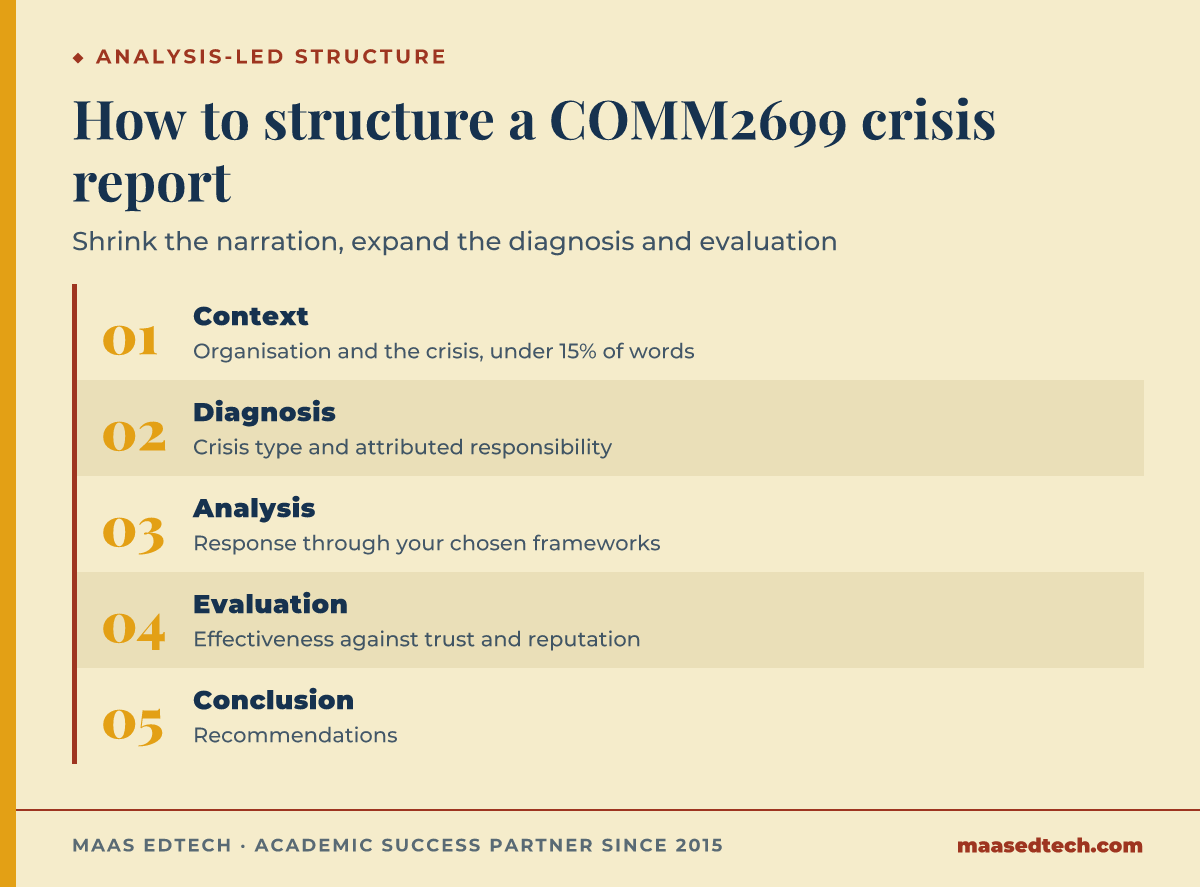
Direct answer: Use an analysis-led structure: (1) brief context of the organisation and the issue or crisis (keep it under 15% of the word count), (2) diagnosis of the crisis type and attributed responsibility, (3) analysis of the response using your chosen frameworks, (4) critical evaluation of effectiveness against trust, reputation, and stakeholder outcomes, (5) conclusion or recommendations. The single biggest fix is shrinking the narration and expanding the diagnosis and evaluation, where the marks concentrate.
Evidence: RMIT rewards "logical, well-supported reasoning", which a diagnosis-analysis-evaluation structure produces directly. It also protects you against the most common COMM2699 failure: a vivid but analytically empty account that the marker cannot map to any framework.
Example: A student's report was a wall of narrative with a short theory paragraph tacked on the end. His mentor kept the facts but moved theory to the front of each section, diagnosing before describing. The content did not change; the analytical structure and the mark both jumped.
What are the most common mistakes Vietnamese students make in COMM2699?
Direct answer: The recurring mistakes are: narrating the crisis instead of diagnosing its type; applying a framework as a label without working it through the facts; ignoring attributed responsibility, which drives which response is defensible; evaluating "did they apologise" rather than "did the response protect reputation"; and treating a crisis as a sudden event rather than the late stage of a mismanaged issue. Each of these loses marks even when the writing is fluent.
Evidence: Because the subject is criterion-referenced and theory-led, the marker penalises retelling and rewards diagnosis. A student who says a company "used SCCT" without classifying the crisis or matching the strategy to attributed responsibility has named a theory without applying it, and earns little for it.
Example: A Vietnamese student labelled a crisis "reputational" and moved on, without asking how much responsibility the public assigned to the organisation. His MAAS mentor did not rewrite the analysis; he asked one question, "how responsible did stakeholders hold them, and does the response match that level?", and let the student rework the diagnosis. The correction stuck because he reasoned to it.
How can a MAAS mentor help you approach COMM2699 without crossing the line?
Direct answer: A MAAS mentor works alongside you, not instead of you. The mentor helps you decode the brief and rubric, walks you through SCCT or Image Repair until you can apply it to your own case, reviews a draft and points to where narration has crowded out analysis, and models how an adviser defends a response strategy. You keep authorship of every diagnosis and every sentence; the mentor raises the ceiling of what you can justify on your own.
Evidence: Because COMM2699 is graded on justified diagnosis rather than storytelling, the durable gain comes from understanding crisis typologies, response strategies, and issues management well enough to reapply them in a capstone, an internship, or a communication role, the integrated view the field's standard handbook and textbook (Coombs & Holladay, 2012; Ulmer et al., 2019) are built to teach. Coaching that builds that reasoning is what moves marks and, more importantly, what survives the semester.
Example: A Vietnamese RMIT student arrived able to describe crises vividly but unable to analyse any of them. Over a few sessions her MAAS mentor had her diagnose each case aloud, crisis type, attributed responsibility, matched strategy, until the analysis became automatic. She wrote and submitted the assignment herself. The mark rose, and so did her confidence going into the PR capstone.
Frequently asked questions
Is COMM2699 hard for international students?
The reading is manageable; the difficulty is analysis. Many students can narrate a crisis but lose marks because they never diagnose its type or evaluate the response against reputation. Building the habit of diagnosing before describing closes most of that gap.
What is SCCT in COMM2699?
SCCT (Situational Crisis Communication Theory, Coombs) matches a crisis response strategy to the crisis type and the responsibility the public attributes to the organisation. It is the most useful diagnostic framework in the subject because it forces you to classify before you evaluate.
What is the difference between an issue and a crisis in COMM2699?
An issue is a developing problem that can still be managed; a crisis is what an unmanaged issue becomes when it threatens reputation and demands immediate response. Framing a crisis as the late stage of an issue is a mark of analytical maturity in this subject.
Does MAAS write the COMM2699 assignment for me?
No. MAAS provides mentoring and review. A mentor helps you decode the rubric, apply the theory, and strengthen your own draft, but you remain the author of every diagnosis and evaluation you submit.
How much of the report should be the case narrative?
Keep it short, usually under 15% of the word count. Markers reward diagnosis and evaluation, so any space spent retelling events is space not earning analysis marks.
Can I use MAAS if I only need help choosing a framework?
Yes. Many students book a short session to diagnose their case and select between SCCT and Image Repair, then write the analysis on their own.
How MAAS mentors support COMM2699 students
If you are approaching the COMM2699 Issues, Risk and Crisis Communication assignment and want a clearer path, MAAS offers a free 20-minute consultation to review your brief and map your approach. Bring your assignment brief and we will match you with a subject mentor within 48 hours when our network already covers that field. If it does not, MAAS opens a dedicated recruitment round for your case, which usually takes about two weeks. Around 23% of MAAS experts hold a PhD, and our communication mentors are experienced practitioners who work with you to raise what you can defend on your own, never to write the work for you.
Related reading: see our guides to COMM2921 Contemporary Media Relations and COMM2920 Advocacy and Voice in Public Relations, and our academic support service for how mentoring works end to end.
References
Coombs, W. T. (2019). Ongoing crisis communication: Planning, managing, and responding (5th ed.). Sage.
Benoit, W. L. (2015). Accounts, excuses, and apologies: Image repair theory and research (2nd ed.). State University of New York Press.
Coombs, W. T., & Holladay, S. J. (Eds.). (2012). The handbook of crisis communication. Wiley-Blackwell.
Heath, R. L., & Palenchar, M. J. (2009). Strategic issues management: Organizations and public policy challenges (2nd ed.). Sage.
Jaques, T. (2009). Issue management as a post-crisis discipline: Identifying and responding to issue impacts beyond the crisis. Journal of Public Affairs, 9(1), 35–44. https://doi.org/10.1002/pa.310
Ulmer, R. R., Sellnow, T. L., & Seeger, M. W. (2019). Effective crisis communication: Moving from crisis to opportunity (4th ed.). Sage.