
COMM2384 Client Management, taught at RMIT's Saigon South campus, which opened in 2001, and the Hanoi campus, which opened in 2004, asks you to manage a professional relationship between a communication team and its client. The rubric rewards how you justify and negotiate value, not how polished your campaign looks. Struggling students can present a plan but cannot defend its price or handle pushback. This guide answers the seven questions Vietnamese RMIT students ask MAAS mentors most often.
Author: MAAS Editorial Team · Reviewed by a Senior Communications mentor (account management)
Last updated: 2026-07-23
Category: communication-pr

What is COMM2384 Client Management about?
Direct answer: COMM2384 is a 12 credit point RMIT undergraduate communication course, offered at RMIT Vietnam within the Bachelor of Professional Communication, that develops skills to manage professional relationships between communication practitioners, their clients, and colleagues. It covers account management and the negotiation needed to manage multiple stakeholders' expectations, wanting you to think like an account manager, not a producer.
Evidence: The course description is explicit that the core is the relationship, developing an environment of trust, respect and partnership, and managing needs and expectations across stakeholders. Because the subject is practised through case studies and a simulated client meeting, the marks live in how you justify, negotiate, and manage the relationship, not in the polish of the deliverable itself.
Example: A Vietnamese RMIT student came to MAAS focused entirely on making her campaign look impressive. Her mentor reframed it: the assessment is about managing the client, defending value, handling pushback, and holding the relationship, not just presenting the work. Once she prepared to justify her decisions under questioning, her roleplay moved from a Pass level to a Distinction.
What assessment does the COMM2384 assignment usually involve?
Direct answer: At RMIT Vietnam, COMM2384 is typically assessed through three linked tasks: a case study analysing client management practice, a team assignment developing a client account or campaign, and a team roleplay, a simulated client meeting where you pitch, price, justify, and negotiate your work. The roleplay tests whether you can defend the plan in real time, not just write it. Always confirm the exact brief and weighting in your own Canvas shell, because assessment detail changes by semester.
Evidence: RMIT assessment is criterion-referenced, meaning your work is marked against published rubric criteria rather than ranked against classmates. Because the roleplay rewards responding to questions, handling pushback, and justifying decisions on your feet, the criteria value preparation and reasoning over a scripted presentation.
Example: A team submitted a strong written plan then froze in the roleplay when the "client" questioned their pricing. Their MAAS mentor pointed to the rubric line rewarding negotiation and justification under pressure, which no amount of slide design could rescue. The plan was fine; the unprepared client conversation cost them.
How is the COMM2384 assignment graded, what does the rubric actually reward?
Direct answer: COMM2384 rubrics reward four things, in roughly this order: (1) understanding of account and relationship management principles applied to the case, (2) the ability to justify and defend decisions, including price and value, (3) negotiation and expectation management under questioning, and (4) professional teamwork and communication. A polished deliverable that you cannot defend earns little; a well-justified position, calmly negotiated, earns most. The jump from Credit to Distinction is almost always the ability to argue and adapt, not to present.
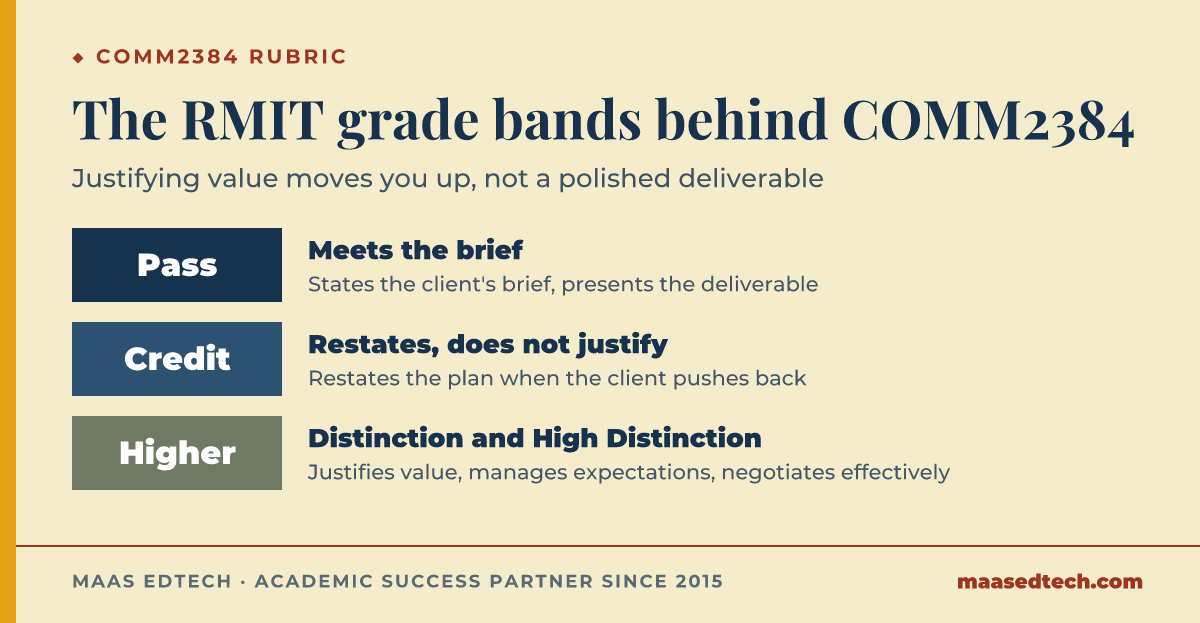
Evidence: RMIT communication rubrics use criterion bands mapped to its university-wide grading scale, Pass at 50 to 59%, Credit at 60 to 69%, Distinction at 70 to 79%, and High Distinction at 80% and above, and the higher bands are defined by evaluative language, "critically applies relationship management", "justifies value", "manages expectations", "negotiates effectively". A student who delivers a plan but cannot handle a client's challenge cannot reach those bands, however attractive the work.
| Rubric focus | Describe (lower band) | Manage and justify (higher band) |
|---|---|---|
| Client relationship | States the client's brief | Applies relationship principles to build trust and partnership |
| Value and pricing | Presents the deliverables | Justifies why the work is worth its price to the client |
| Handling pushback | Restates the original plan | Negotiates and adapts while protecting the relationship |
| Stakeholders | Names the people involved | Manages competing expectations across stakeholders |
Example: A MAAS mentor ran a mock client meeting and colour-coded the student's answers, green for a justified, relationship-aware response, red for a defensive or scripted one. The answers were mostly red. After one practice pass focused on justifying value calmly, the same student's roleplay moved up two full bands.
Which frameworks and concepts should you use in COMM2384?
Direct answer: Anchor your work in a few established relationship and negotiation concepts rather than improvising. The most useful for COMM2384 are: relationship management theory, whose dimensions of trust, control mutuality, commitment and satisfaction come from Hon and Grunig (1999) and are developed as a school of practice in Ledingham and Bruning (2000); account management practice, the practitioner as the bridge between client and delivery team, treated as integrated communications planning in Young (2014); principled negotiation, separating people from the problem and focusing on interests rather than positions, from Fisher, Ury and Patton (2011); and stakeholder management in the sense set out by Freeman (2010), to handle competing expectations. Choose the concepts that fit your case and apply them; do not just name them.
Evidence: These concepts are examiner-recognised because they turn "being nice to the client" into something you can analyse and defend. The guidelines define trust itself in one plain sentence: "One party's level of confidence in and willingness to open oneself to the other party" (Hon & Grunig, 1999), precise enough to test against a specific action in your case study rather than assert as an adjective. The four dimensions Hon and Grunig (1999) set out are only useful when you argue how a specific action built trust or control mutuality, that argument is the analysis the rubric rewards.
Example: A Vietnamese RMIT student described her client interactions as "keeping them happy". Her MAAS mentor had her reframe each interaction through relationship dimensions, which action built trust, which managed expectations, and through interest-based negotiation. The same interactions, now analysed against theory, lifted her case-study mark two bands.
How should you structure the COMM2384 deliverables?
Direct answer: Treat the case study, team assignment, and roleplay as one arc. In the case study, analyse client management practice against relationship and account-management theory. In the team assignment, develop an account or campaign with the client relationship built in, not bolted on, planned as one integrated piece of communication rather than a set of disconnected tactics (Young, 2014).
In the roleplay, prepare to pitch, justify value and price, anticipate objections, and negotiate while protecting the relationship. The single biggest fix is preparing your justifications and likely objections in advance, so the client meeting is reasoned rather than improvised.
Evidence: RMIT rewards "logical, well-supported reasoning", and a client meeting is where that reasoning is tested live. Preparing justifications and anticipating pushback is exactly what separates a Distinction roleplay from a plan that collapses under the first hard question.
Example: A team scripted a polished pitch but prepared no answers to obvious objections. Their mentor ran two mock meetings, forcing them to justify price and scope repeatedly. They changed nothing in the plan; the preparation to defend it turned a shaky roleplay into a strong one.
What are the most common mistakes Vietnamese students make in COMM2384?
Direct answer: The recurring mistakes are: focusing on the deliverable and neglecting the relationship; being unable to justify price or value when questioned; treating pushback as conflict rather than negotiation; describing client interactions instead of analysing them against relationship theory; and preparing a scripted pitch with no answers to obvious objections. Each of these loses marks even when the campaign itself is strong.
Evidence: Because the subject is criterion-referenced and relationship-led, the marker penalises work that cannot be defended in a client conversation and rewards justified, adaptive management. A student who presents beautifully but cannot explain why the work is worth its price has done the delivery without earning the client-management marks.
Example: A Vietnamese student in a roleplay met a pricing challenge by lowering the price immediately. His MAAS mentor did not rewrite his plan; he asked one question, "what is the value to the client that justifies this price, and how would you explain it before conceding?", and let the student rebuild his negotiation. The change stuck because he reasoned to it.
How can a MAAS mentor help you approach COMM2384 without crossing the line?
Direct answer: A MAAS mentor works alongside you, not instead of you. The mentor helps you decode the brief and rubric, applies relationship and negotiation theory to your case, runs mock client meetings so you can practise justifying and negotiating, and points to where you are describing rather than analysing a relationship. You keep authorship of every analysis, plan, and negotiation; the mentor raises the ceiling of what you can defend on your own.
Evidence: Because COMM2384 is graded on justified relationship management rather than deliverable polish, the durable gain comes from understanding account management, the relationship dimensions of Hon and Grunig (1999), and the principled negotiation of Fisher et al. (2011) well enough to reapply them in an internship or a communication role, where managing clients is the job. Coaching that builds that reasoning is what moves marks and, more importantly, what survives into your career.
Example: A Vietnamese RMIT student arrived able to present but unable to negotiate. Over a few sessions her MAAS mentor ran repeated mock client meetings until justifying value and handling pushback became automatic. She prepared and performed the roleplay herself. The mark rose, and so did her confidence walking into her first real client meeting on placement.
Frequently asked questions
Is COMM2384 hard for international students?
The plan is manageable; the difficulty is defending it. Many students present well but lose marks because they cannot justify value or negotiate pushback in the client meeting. Practising mock client conversations closes most of that gap.
What is account management in COMM2384?
Account management is the practice of acting as the bridge between a client and the delivery team, understanding the client's needs, managing expectations, and maintaining a relationship built on trust, respect, and partnership. It is the core lens of the subject.
What is the roleplay assessment in COMM2384?
The roleplay is a simulated client meeting where your team pitches, prices, justifies, and negotiates your work in real time. It tests whether you can defend the plan under questioning, not just write it, so preparing your justifications and likely objections matters most.
Does MAAS write the COMM2384 assignment for me?
No. MAAS provides mentoring and review. A mentor helps you decode the rubric, apply the theory, and practise the client meeting, but you remain the author and performer of every analysis, plan, and negotiation you submit.
How do I prepare for the client meeting?
Anticipate the hardest questions, especially on price and scope, prepare a value-based justification for each, and practise negotiating without immediately conceding. A mock meeting with a mentor or peer is the most effective preparation.
Can I use MAAS if I only need help with negotiation?
Yes. Many students book a short session to run a mock client meeting and practise justifying value and handling pushback, then complete the rest of the assignment on their own.
How MAAS mentors support COMM2384 students
If you are approaching the COMM2384 Client Management assignment and want a clearer path, MAAS offers a free 20-minute consultation to review your brief and map your approach. Bring your assignment brief and we will match you with a subject mentor within 48 hours when our network already covers that field. If it does not, MAAS opens a dedicated recruitment round for your case, which usually takes about 2 weeks. Around 23% of MAAS experts hold a PhD, and our communication mentors are experienced practitioners who work with you to raise what you can defend on your own, never to write the work for you.
Related reading: see our guides to COMM2381 Communication Strategy and Planning and COMM2789 Digital Content Creation, and our academic support service for how mentoring works end to end.
References
Ledingham, J. A., & Bruning, S. D. (Eds.). (2000). Public relations as relationship management: A relational approach to the study and practice of public relations. Lawrence Erlbaum Associates.
Fisher, R., Ury, W., & Patton, B. (2011). Getting to yes: Negotiating agreement without giving in (3rd ed.). Penguin Books.
Freeman, R. E. (2010). Strategic management: A stakeholder approach. Cambridge University Press.
Hon, L. C., & Grunig, J. E. (1999). Guidelines for measuring relationships in public relations. Institute for Public Relations.
Young, A. (2014). Brand media strategy: Integrated communications planning in the digital era (2nd ed.). Palgrave Macmillan.