
◆ Communication & PR
COMM2381 Communication Strategy and Planning (RMIT): how do you approach the assignment?
COMM2381 Communication Strategy and Planning at RMIT asks you to build a communication plan that flows from a diagnosis, and the rubric rewards the logic connecting objectives to evidence, not a list of tactics. Most students who struggle jump straight to "what we will post" without a situation analysis, measurable objectives, or a way to evaluate success. This guide answers the seven questions Vietnamese students at RMIT ask MAAS mentors most often before they start COMM2381.

◆ Question 1 / 7 · The course
What is COMM2381 Communication Strategy and Planning about?
Direct answer: COMM2381 is an RMIT communication course (offered at RMIT Vietnam, within the Bachelor of Professional Communication) that teaches strategic communication planning: turning an organisational problem into a defensible communication plan through situation analysis, audience segmentation, message design, tactics and evaluation. The course wants you to think like a strategist who justifies choices from diagnosis, not a coordinator who lists activities.
Evidence: Courses of this type are built on established planning models (research, objectives, strategy, tactics, evaluation) (Chaffee, 1985) and on situation analysis techniques. The learning outcomes emphasise applying frameworks and analysing efficacy, so the marks live in the reasoning that links each plan element back to the analysis, not in the length of the tactics list.
Example: A Vietnamese RMIT student came to MAAS with a colourful list of campaign activities and expected a strong mark. Her mentor reframed it: a plan is an argument that runs from a diagnosed problem to measurable objectives to justified tactics. Once she rebuilt it from a situation analysis outward, her draft moved from a Pass level to a Distinction.
◆ Question 2 / 7 · Assessment
What assessment does the COMM2381 assignment usually involve?
Direct answer: COMM2381 is typically assessed through a sequence built around a real or simulated organisation: a case study or situation analysis, a strategic analysis with recommendations, and a full communication plan, often as a group. The tasks build on each other, so a shallow situation analysis weakens every objective and tactic that follows. Always confirm the exact brief, weighting, and requirements in your own Canvas shell, because assessment detail changes by semester.
Evidence: RMIT assessment is criterion-referenced, meaning your work is marked against published rubric criteria rather than ranked against classmates. Because the tasks are sequential, the criteria reward internal logic, objectives that answer the situation analysis, strategies that serve the objectives, and tactics and evaluation that trace back to both.
Example: A Vietnamese student wrote a strong situation analysis then proposed objectives that had nothing to do with it. His MAAS mentor pointed to the rubric line on alignment, which he had ignored. Each section was competent; the broken thread between them cost him a full band.
◆ Question 3 / 7 · Grading
How is the COMM2381 assignment graded, what does the rubric actually reward?
Direct answer: COMM2381 rubrics reward four things, in roughly this order: (1) a rigorous situation analysis that diagnoses the real problem, (2) clear, measurable (SMART) objectives that answer that diagnosis, (3) strategy, messages, and tactics justified from the objectives and the audiences, and (4) a genuine evaluation plan with metrics. Listing tactics earns little; a plan whose every element traces back to evidence earns most. The jump from Credit to Distinction is almost always the word "justified", not "more activities".
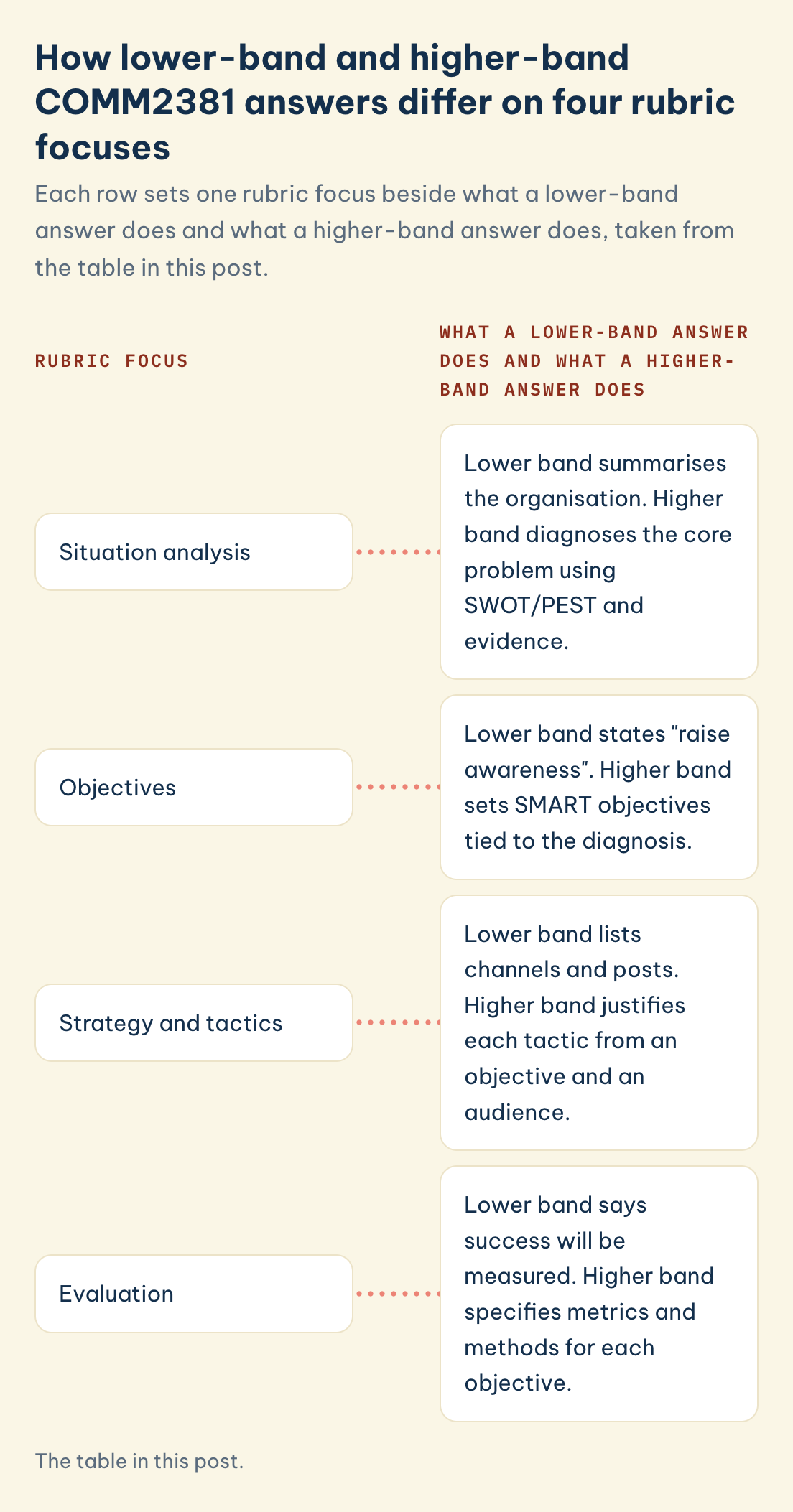
How lower-band and higher-band COMM2381 answers differ on four rubric focuses
Each row sets one rubric focus beside what a lower-band answer does and what a higher-band answer does, taken from the table in this post.
Rubric focus
What a lower-band answer does and what a higher-band answer does
Situation analysis
Lower band summarises the organisation. Higher band diagnoses the core problem using SWOT/PEST and evidence.
Objectives
Lower band states "raise awareness". Higher band sets SMART objectives tied to the diagnosis.
Strategy and tactics
Lower band lists channels and posts. Higher band justifies each tactic from an objective and an audience.
Evaluation
Lower band says success will be measured. Higher band specifies metrics and methods for each objective.
Save this figure
Evidence: RMIT communication rubrics use criterion bands (Pass / Credit / Distinction / High Distinction), and the higher bands are defined by evaluative language, "critically analyses the situation", "sets measurable objectives", "justifies the strategy", "evaluates effectiveness". A student who lists tactics without objectives or evaluation cannot reach those bands, however polished the plan looks.
| Rubric focus | Describe (lower band) | Strategise and justify (higher band) |
|---|---|---|
| Situation analysis | Summarises the organisation | Diagnoses the core problem using SWOT/PEST and evidence |
| Objectives | States "raise awareness" | Sets SMART objectives tied to the diagnosis |
| Strategy and tactics | Lists channels and posts | Justifies each tactic from an objective and an audience |
| Evaluation | Says success will be measured | Specifies metrics and methods for each objective |
Example: A MAAS mentor colour-coded a student's plan, green for an element justified from the analysis, red for a tactic with no rationale. The plan was mostly red. After one pass that tied each tactic to an objective and each objective to the situation analysis, the same plan moved up two full bands.
◆ Question 4 / 7 · Frameworks
Which frameworks and models should you use in COMM2381?
Direct answer: Anchor your plan in a recognised planning model and a couple of analysis tools rather than improvising a structure. The most useful for COMM2381 are: a strategic planning model such as Smith's phases (formative research, strategy, tactics, evaluative research) (Smith, 2020) or the RACE/ROSTIR logic; situation analysis tools such as SWOT and PEST; SMART objectives to make goals measurable; and audience or stakeholder segmentation to target messages. Choose the model that fits your brief and apply it fully; do not list several and use none.
Evidence: These models are examiner-recognised because they enforce a logic, research before objectives, objectives before tactics, evaluation designed in from the start (Austin & Pinkleton, 2015). A SWOT, for instance, is only useful when its findings actually drive the objectives; a SWOT that sits decoratively beside unrelated tactics earns little.
Example: A Vietnamese RMIT student building a plan for a local NGO ran a thorough SWOT then ignored it when choosing tactics. Her MAAS mentor had her derive each objective from a specific SWOT finding and each tactic from an objective. The analysis was the same; the logic that now connected it to the plan lifted the mark two bands.
◆ Question 5 / 7 · Plan structure
How should you structure the COMM2381 communication plan?
Direct answer: Follow the planning model as your structure: (1) situation analysis diagnosing the problem, (2) SMART objectives that answer it, (3) target audiences and key messages, (4) strategy and tactics justified from the objectives, (5) timeline and resources, (6) evaluation with metrics for each objective. The single biggest fix is making the thread from diagnosis to evaluation explicit, so each section visibly earns the next.
Evidence: RMIT rewards "logical, well-supported reasoning", which a research-objectives-tactics-evaluation structure produces directly (Wilcox et al., 2015). It also protects you against the most common COMM2381 failure: an attractive tactics list with no objectives above it and no evaluation below it, which the marker cannot map to any strategic logic.
Example: A student's plan led with tactics and buried the objectives at the end. His mentor simply reordered it to lead with the situation analysis and objectives, then justify tactics against them. The content did not change; the strategic logic and the mark both jumped.
◆ Question 6 / 7 · Common mistakes
What are the most common mistakes Vietnamese students make in COMM2381?
Direct answer: The recurring mistakes are: jumping to tactics before diagnosing the problem; writing vague objectives ("raise awareness") that cannot be measured; running a SWOT or PEST that never informs the plan; segmenting no audiences, so messages are generic; and omitting evaluation, so there is no way to know whether the plan worked. Each of these loses marks even when the tactics themselves are creative.
Evidence: Because the subject is criterion-referenced and process-led, the marker penalises tactics with no strategic justification and rewards the logic that connects a tactic to an objective to a diagnosis (Sheehan & Xavier, 2014). Smith (2020) names the exact failure mode: "After identifying a problem, our tendency too often is to skip ahead to seeking solutions, leaping over research and analysis" (Smith, 2020), which is exactly what jumping to tactics before a situation analysis does. A student who proposes a clever campaign with no measurable objective has done the creativity without earning the strategy marks.
Example: A Vietnamese student proposed an ambitious event with the objective "increase engagement". His MAAS mentor did not redesign the event; he asked one question, "engagement of whom, by how much, by when, and measured how?", and let the student rewrite the objective as SMART. The fix stuck because he reasoned to it.
◆ Question 7 / 7 · MAAS mentor
How can a MAAS mentor help you approach COMM2381 without crossing the line?
Direct answer: A MAAS mentor works alongside you, not instead of you. The mentor helps you decode the brief and rubric, pressure-tests your situation analysis, checks that your objectives are measurable and derived from the diagnosis, reviews a draft plan for broken logic, and models how a strategist justifies a tactic. You keep authorship of every objective, message, and tactic; the mentor raises the ceiling of what you can justify on your own.
Evidence: Because COMM2381 is graded on justified planning rather than tactical flair, the durable gain comes from understanding the planning model, situation analysis, SMART objectives, and evaluation well enough to reapply them in a capstone, an internship, or a communication role. Coaching that builds that reasoning is what moves marks and, more importantly, what survives the semester.
Example: A Vietnamese RMIT student arrived able to brainstorm tactics but unable to justify any of them. Over a few sessions her MAAS mentor had her build a plan from the situation analysis outward, deriving each objective and tactic aloud until the logic became automatic. She wrote and submitted the assignment herself. The mark rose, and so did the strength of the plan she could show an employer.
Frequently asked questions
Is COMM2381 hard for international students?
The tactics are manageable; the difficulty is logic. Many students can list creative activities but lose marks because those activities answer no measurable objective and no diagnosis. Building the habit of planning from a situation analysis outward closes most of that gap.
What is a SMART objective in COMM2381?
A SMART objective is Specific, Measurable, Achievable, Relevant, and Time-bound, for example "increase newsletter sign-ups among students by 20% within one semester". Vague goals like "raise awareness" cannot be evaluated and stall in the lower bands.
Which planning model should I use?
Any recognised model that runs research, objectives, strategy, tactics, and evaluation in order, such as Smith's phases or the RACE/ROSTIR logic. What matters is applying it fully so the plan's logic is visible, not which label you choose.
Does MAAS write the COMM2381 assignment for me?
No. MAAS provides mentoring and review. A mentor helps you decode the rubric, tighten your logic, and strengthen your own plan, but you remain the author of every objective, message, and tactic you submit.
How much should the situation analysis be?
Enough to diagnose the real problem and drive the objectives, usually a substantial section, because everything else depends on it. A weak analysis undermines the whole plan, so it is worth the space.
Can I use MAAS if I only need help with objectives?
Yes. Many students book a short session to turn vague goals into SMART objectives tied to their situation analysis, then build the rest of the plan on their own.
How MAAS mentors support COMM2381 students
If you are approaching the COMM2381 Communication Strategy and Planning assignment and want a clearer path, MAAS offers a free 20-minute consultation to review your brief and map your approach. Bring your assignment brief and we will match you with a subject mentor within 48 hours when our network already covers that field. If it does not, MAAS opens a dedicated recruitment round for your case, which usually takes about two weeks. Around 23% of MAAS experts hold a PhD, and our communication mentors are experienced practitioners who work with you to raise what you can defend on your own, never to write the work for you.
Related reading: see our guides to COMM2789 Digital Content Creation and COMM2920 Advocacy and Voice in Public Relations, and our academic support service for how mentoring works end to end.
References
Smith, R. D. (2020). Strategic planning for public relations (6th ed.). Routledge.
Austin, E. W., & Pinkleton, B. E. (2015). Strategic public relations management: Planning and managing effective communication campaigns (3rd ed.). Routledge.
Wilcox, D. L., Cameron, G. T., & Reber, B. H. (2015). Public relations: Strategies and tactics (11th ed.). Pearson.
Sheehan, M., & Xavier, R. (2014). Public relations campaigns. Oxford University Press.
Chaffee, E. E. (1985). Three models of strategy. Academy of Management Review, 10(1), 89–98. https://doi.org/10.2307/258215
A free 20-minute consultation is a conversation about where you are with COMM2381.
Book a free consultation ▸