
◆ IT & Data
COMM 226 Concordia: how do you pass Business Technology Management?
COMM 226 Business Technology Management at Concordia University is a 3-credit course with no prerequisite in which a 100% multiple-choice final decides about half the grade and must itself reach 50%. Three assignments worth 40% use SAP, a database and Power BI. This guide sets out how MAAS mentors read that structure and where marks tend to slip.
Note on the code: this guide describes COMM 226 as the Fall 2026 eConcordia (section EC) outline publishes it. Other Concordia sections and terms can differ, and search results for the same code sometimes point to other schools, so check your own section's outline before relying on any weighting you find. MAAS is an independent academic support provider with no affiliation to Concordia University.
◆ Question 1 / 7 · The course
What is COMM 226 Business Technology Management, and who takes it?
Direct answer: COMM 226 is a 3-credit undergraduate course offered by Concordia's Department of Supply Chain and Business Technology Management. It asks how information technology creates business value, and it gives students hands-on practice with an ERP system (SAP), a database and business analytics. The Fall 2026 outline lists no prerequisite.
Evidence: The eConcordia course page lists a Fall term from 8 September to 7 December 2026 and a Winter term from 11 January to 12 April 2027. The outline gives 12 teaching weeks plus a reading week, with the last day to withdraw with a tuition refund on 21 September and the last day for academic withdrawal on 16 November 2026. Its four learning objectives are to explain and apply business technology management processes, explain the components of IT and information systems operations and implementation, describe contemporary issues, and explain the role of ethics in technology decisions.
Example: A marketing or accounting student often expects an IT course to be about gadgets. The weekly schedule suggests otherwise: Lesson 2 covers hardware, software, cloud and networks, but Lessons 3 to 5 are about business processes and ERP, and Lessons 7 and 8 are about analytics and dashboards. The course is closer to "how does a firm run on its data" than to "how does a computer work".
◆ Question 2 / 7 · Assessment
How is COMM 226 assessed in Fall 2026?
Direct answer: The evaluation table gives two quizzes 5% in total, two interactive business cases 5%, knowledge checks 5%, three assignments 40% and the final exam 45%. The final is 100% multiple choice and must be passed at 50% or more on its own. The overall pass mark is D-, which is 50% to 52%.
Evidence: The evaluation table adds to exactly 100%. Assignment 1 (SAP, individual) is worth 10%, Assignment 2 (process mapping and entity-relationship diagram, group) is worth 15% and Assignment 3 (business intelligence, group) is worth 15%. One sentence in the same outline calls the final "worth 50%", which would push the total to 105%, so treat 45% as the working figure and confirm it in your own course site. Late work loses 50% on the first day and a further 10% for each extra day.
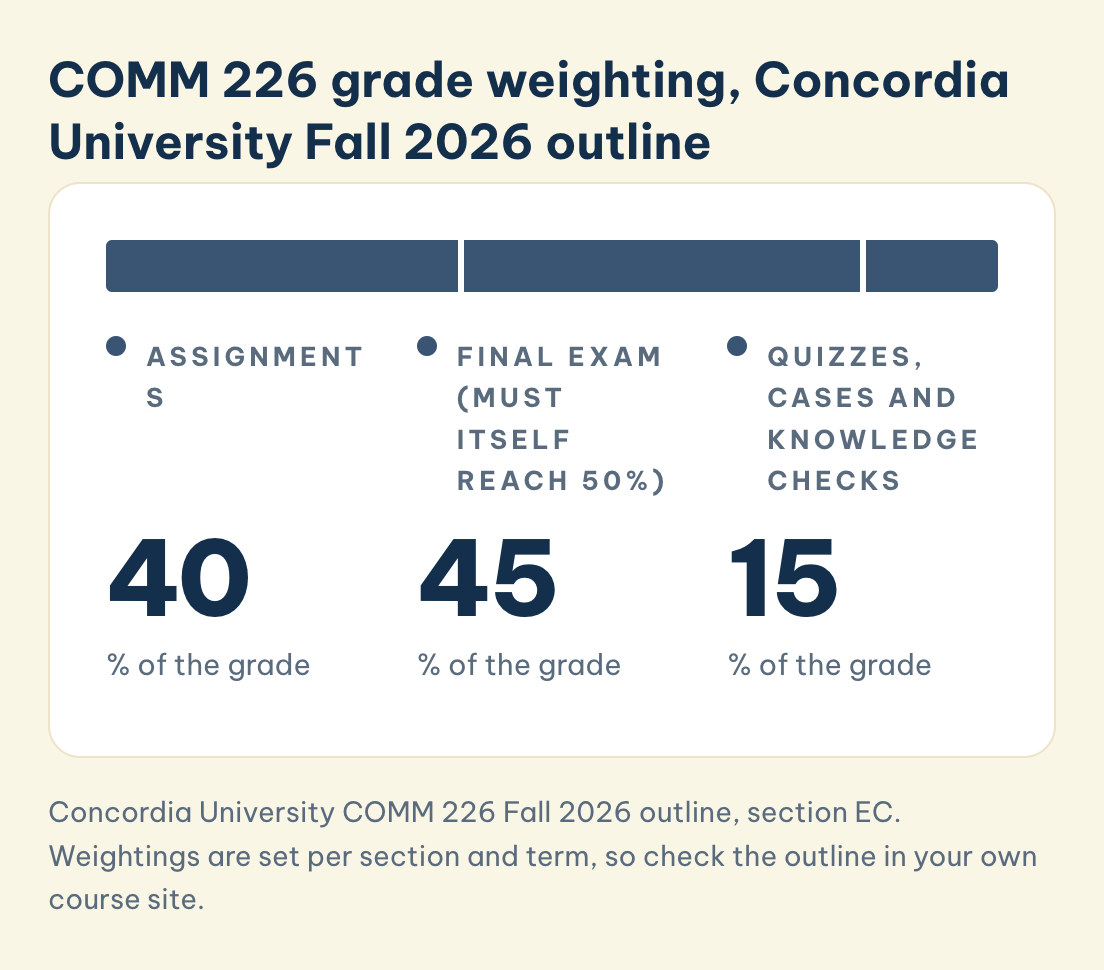
COMM 226 grade weighting, Concordia University Fall 2026 outline
The bars show the COMM 226 grade weighting in the Concordia University Fall 2026 outline, section EC.
Assignments
40
% of the grade
Final exam (must itself reach 50%)
45
% of the grade
Quizzes, cases and knowledge checks
15
% of the grade
Save this figure
| Component | Weight | What it rewards |
|---|---|---|
| Quizzes (2) | 5% (2.5% each) | Multiple-choice recall of Weeks 1 to 2 and Weeks 9 to 10 |
| Interactive business cases (2) | 5% | Completing the case and its reflection document |
| Knowledge checks | 5% | Finishing the short lesson quizzes on time |
| Assignment 1, SAP (individual) | 10% | Following a business process through an ERP system |
| Assignment 2, process map and ERD (group) | 15% | Modelling a process and designing the data behind it |
| Assignment 3, business intelligence (group) | 15% | Turning data into a decision-ready analysis |
| Final exam, 100% multiple choice | 45% | Applying concepts across all chapters; at least 50% to pass the course |
Example: The final is worth more than the three assignments combined, yet it is easy to give it the least time because the assignments have visible deadlines (27 October, 13 November and 27 November). A student who reaches the exam with 38 of 40 assignment marks but below 50% on the final still fails the course, because the pass rule names the final separately.
◆ Question 3 / 7 · The final
How do you study for the COMM 226 multiple-choice final?
Direct answer: Study by retrieval. Close the textbook, answer practice questions from the lesson headings, then check and repeat after a gap. The final covers every chapter in the two textbooks and every assignment, so the revision plan needs a list of the twelve lessons, not a list of favourite topics.
Evidence: Roediger and Karpicke compared students who restudied a passage with students who tested themselves on it. A week later the self-tested group recalled about 61% of the material against about 40% for the restudy group, despite having read the passage far fewer times. They concluded that "testing is a powerful means of improving learning, not just assessing it" (Roediger & Karpicke, 2006, p. 249). The outline adds a practical cue: the final is described as comprehensive and multiple choice, and Google's "people also search for" box for the course is dominated by mock exams, test banks and Reddit threads, which tells you where students look, not whether those sources match your term. A mock exam from a different year can test the wrong chapters.
Example: After Lesson 6 on databases and big data, a student writes ten questions of their own, such as "which key links a child table to its parent?" and "why is a pivot table not a database?". Two weeks later they answer all ten from a blank page and mark them. The questions they miss go on a short list that is reread before the exam. That list, not the textbook, is the revision material.
◆ Question 4 / 7 · SAP assignment
What does the SAP individual assignment ask for?
Direct answer: Assignment 1 asks you to carry a business process through an ERP system, using SAP GUI. It is individual and worth 10%. The outline says specific instructions are released when the assignment is announced, so the safest preparation is to practise the tutorials early and keep your own record of each step.
Evidence: The assessment table links Assignment 1 to the outcome "use of an ERP/SAP in business processes". The course materials note that all software, including Microsoft Access, Excel, Power BI and Visio, runs in uCertify virtual machines except SAP GUI, which has its own installation instructions. Davenport (1998) argues that an enterprise system embeds assumptions about how a business should operate, which is why an SAP exercise is as much about the sequence of processes as about the buttons.
Example: In a procurement exercise the order of events matters: a purchase requisition leads to a purchase order, then a goods receipt, then an invoice. A student who saves a screenshot of each confirmation message can show exactly where a step failed, whereas a student who only remembers "it worked" cannot. Such a record also lets a tutor explain the logic without touching your submission.
◆ Question 5 / 7 · ERD
How do you structure an ERD and state your assumptions?
Direct answer: Start from the business rules in the case, name the entities, mark each relationship as one-to-one, one-to-many or many-to-many, and write the assumption you made beside any choice the case does not settle. Assignment 2 combines process modelling with database design, and it is a group assignment worth 15%.
Evidence: Chen (1976) introduced the entity-relationship model as a way to describe data in terms of entities and the relationships between them. A many-to-many relationship, such as students and courses, is normally resolved by an extra entity that holds the link, for example an enrolment record with its own key. The group sign-up opens with Quiz 1 on 23 and 24 September, so the team forms before the assignment is assigned.
Example: A case describes a clinic where patients book appointments with doctors. The case does not say whether a patient can see several doctors. State it: "Assumption: a patient can book many appointments and a doctor can have many appointments, so an Appointment entity links the two." Without that sentence a marker cannot tell whether your design is a choice or an accident.
◆ Question 6 / 7 · Power BI
What does the Power BI business intelligence assignment reward?
Direct answer: Assignment 3 asks groups to use an analytics tool to answer a business question, and it is worth 15%. Strong submissions begin with the decision the data should inform, clean the data before charting it, and connect every chart to a recommendation instead of leaving a gallery of visuals.
Evidence: The outline places the analytics lesson in Week 7, pivot tables and digital dashboards in Week 8, and the Power BI tutorial in the textbook appendix, with Assignment 3 due on 27 November 2026. Porter (1979) described five competitive forces that shape an industry, and the same habit of mind applies here: a dashboard is a way of showing which force or cost is changing, not decoration. The outline's own late rule, a 50% penalty on day one, makes a finished simple dashboard worth more than an unfinished elaborate one.
Example: A group has a sales table with 12 months of orders. A weak report shows nine charts. A stronger one asks "which product line is slipping in which region?", shows two charts that answer it, and ends with a one-sentence recommendation. The second report is shorter, easier to mark and harder to dispute.
◆ Question 7 / 7 · Getting help
Can you get help with COMM 226 assignments?
Direct answer: You can get help understanding methods, but every submission must be your own work, or your group's work where the assignment is a group one. Concordia treats plagiarism and unauthorized collaboration as academic offences under its Code, so work you did not do yourself, or with your group where the task is a group one, puts you at risk.
Evidence: Concordia's academic integrity page names the Academic Code of Conduct as the university's official policy and lists plagiarism, unauthorized collaboration and other academic offences, and the outline says the final is held on university premises. Search results for COMM 226 include test banks and ready-made answer sets. Using them to produce a submission falls inside the policy, and it leaves you unpractised for a final that decides about half the grade.
Example: A legitimate use of a tutor looks like this: a student brings an ERD they drew, explains each relationship aloud, and is asked "what would break if a patient had two doctors?". The student then redraws it. The tutor never touches the file, and the design that is submitted is the student's.
Frequently asked questions
Is COMM 226 hard?
It is manageable for most business students, but the workload is spread across many small items. Twelve lessons, nine to ten knowledge checks, two quizzes, two cases and three assignments mean that missing a deadline costs more than missing a concept.
What score do I need on the COMM 226 final?
At least 50% on the final examination, which the outline states separately from the overall pass mark. The overall minimum is D-, which covers 50% to 52%.
Is the COMM 226 final multiple choice?
Yes. The Fall 2026 outline says the final is 100% multiple choice and is written on the university premises. Some third-party documents describe essay questions, which may reflect an older term.
Are the COMM 226 assignments individual or group?
Assignment 1 (SAP) is individual. Assignments 2 (process map and ERD) and 3 (business intelligence) are group assignments, and group self-selection opens in the week of Quiz 1.
What software do I need for COMM 226?
SAP GUI, Microsoft Access, Excel, Power BI and Microsoft Visio. Everything except SAP GUI is available through uCertify virtual machines, and the instructor provides SAP GUI instructions with the assignment.
Does MAAS complete COMM 226 assignments or exams?
No. MAAS mentors explain methods and review practice work you have already attempted. Every submission must be your own, in line with Concordia's academic code of conduct.
Related reading
- COMM 214 Business Analytics: the analytics side of a Concordia business degree, with a different weighting pattern
- COMM 305 Managerial Accounting: how a Canadian business school weights exams against coursework
- How to revise for final exams effectively: a longer look at spaced and retrieval practice before a final that carries most of the grade
Where MAAS fits
- Subject tutoring, one to one: 60 or 90 minute sessions with a tutor matched to information systems, working through practice you have already attempted. Tutoring is advisory, so it carries no grade target; if the tutor is not the right fit, you can ask to change expert
- Exam coaching resources: how MAAS mentors approach preparation for timed, invigilated exams
References
- Chen, P. P.-S. (1976). The entity-relationship model: Toward a unified view of data. ACM Transactions on Database Systems, 1(1), 9–36. https://doi.org/10.1145/320434.320440
- Davenport, T. H. (1998). Putting the enterprise into the enterprise system. Harvard Business Review, 76(4), 121–131. https://hbr.org/1998/07/putting-the-enterprise-into-the-enterprise-system
- Porter, M. E. (1979). How competitive forces shape strategy. Harvard Business Review, 57(2), 137–145. https://hbr.org/1979/03/how-competitive-forces-shape-strategy
- Roediger, H. L., & Karpicke, J. D. (2006). Test-enhanced learning: Taking memory tests improves long-term retention. Psychological Science, 17(3), 249–255. https://doi.org/10.1111/j.1467-9280.2006.01693.x
Tools & resources
- Concordia University. (2026). COMM 226: Business Technology Management, section EC, Fall 2026 [Course outline]. Retrieved October 17, 2026, from https://www.econcordia.com/outlines/information_systems.pdf
- Concordia University. (n.d.). Academic integrity. Retrieved October 17, 2026, from https://www.concordia.ca/conduct/academic-integrity.html
- McKinney, E. H., Jr., & Kroenke, D. M. (2021). Processes, systems, and information (4th ed.). Pearson.
- Roch, S., Fowler, J., Smith, B., & Bourgeois, D. (2021). Information systems for business and beyond. eCampusOntario. https://ecampusontario.pressbooks.pub/informationsystemscdn/
Not sure how this guide applies to your own case? Talk it through with MAAS in a free 20-minute consultation.
Book a free consultation ▸