
◆ Business & Management
COMM1100: what happens when the law says yes and the ethics say no?
A supplier offers a price no competitor can match. The contract is lawful, the margin is excellent, and the working conditions in that supplier's factory would embarrass you if a journalist described them accurately. Every discipline in this course has something to say about that decision, and the three answers do not agree. Learning how to hold all three at once, rather than choosing the one you find most comfortable, is what COMM1100 is for.
Note on the code: this guide describes the UNSW Sydney course. COMM 1100 codes at several North American institutions refer to introductory communications subjects, which are unrelated.
Author: MAAS Editorial Team
Last updated: 2026-08-24
Category: business-management

◆ Question 1 / 7 · Where it sits
Where the course sits, and what it combines
Direct answer: COMM1100 Business Decision Making is a 6 unit-of-credit UNSW course and the opening course of the Integrated First Year of the Bachelor of Commerce, built around the interaction of economic principles, legal principles and corporate responsibility in a single decision.
Evidence: The UNSW handbook entry lists the course at 6 units of credit, describes it as the first course in the Integrated First Year of the Bachelor of Commerce, and publishes 5 course learning outcomes. CLO3 reads "Explain the interplay of economic, legal, and corporate responsibility principles in business decisions", and CLO5 reads "Identify appropriate economic models and analyse how they are used in business decisions". Assessment items and weightings are not on that page; they appear in the course outline released for your term, so confirm those there.
Held together, the published record reads: code COMM1100, 6 units of credit, UNSW Sydney, UNSW Business School, opening course of the Integrated First Year of the Bachelor of Commerce, 3 disciplinary strands, 5 course learning outcomes, campus listed as Sydney. In CLO3 the load-bearing word is interplay, and it is not the same word as and. A course that wanted three separate treatments would say so, and the questions would be divisible into three parts worth roughly a third each. Interplay means the assessed object is what happens between them.
◆ Question 2 / 7 · One discipline
Why does answering from one discipline feel complete and mark poorly?
Direct answer: Because each of the three strands produces an internally coherent answer on its own, so an incomplete response does not feel incomplete while you are writing it. A purely economic answer reads as decisive, a purely legal answer reads as rigorous, and a purely ethical answer reads as principled. All three can be half of the mark.
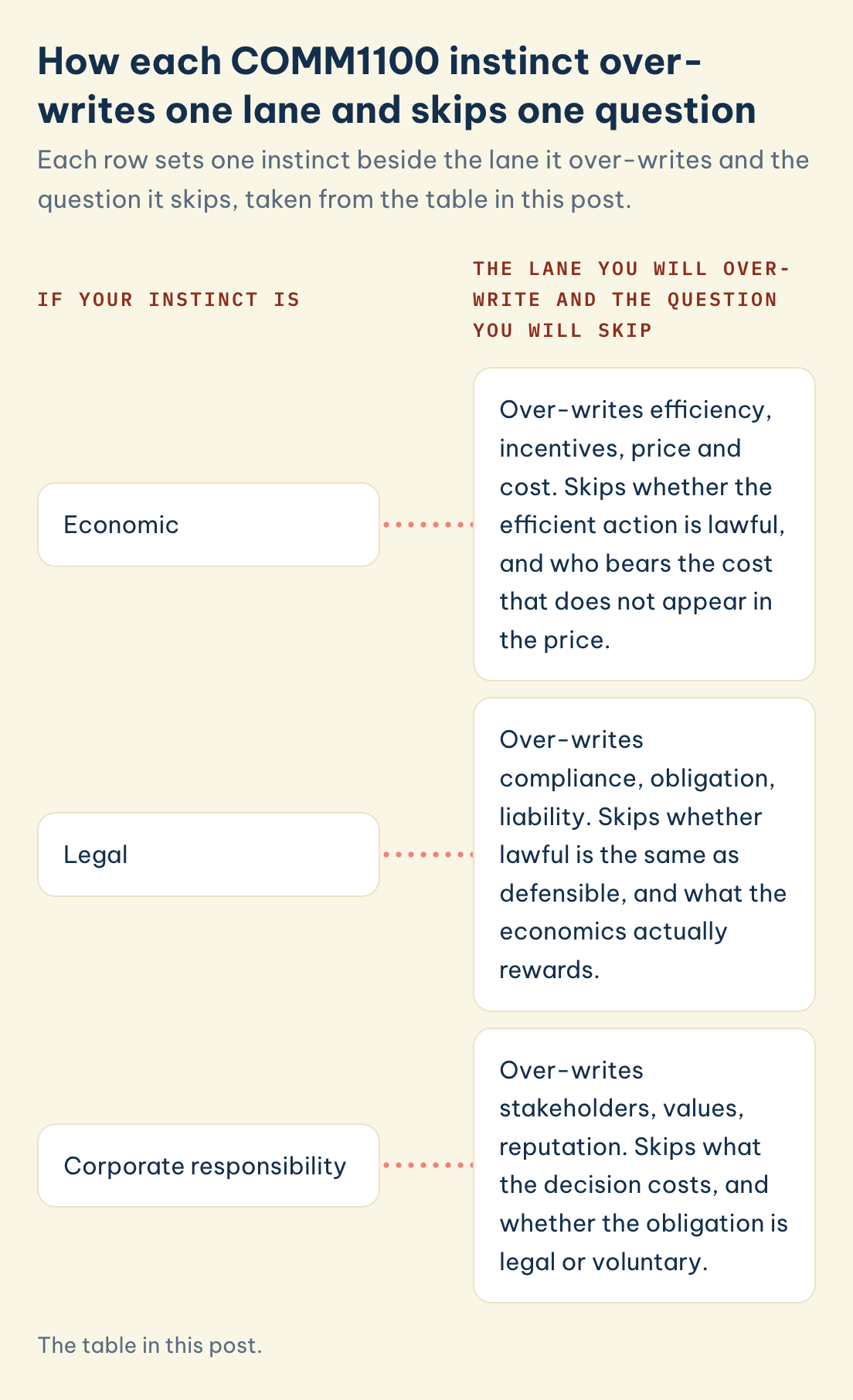
How each COMM1100 instinct over-writes one lane and skips one question
Each row sets one instinct beside the lane it over-writes and the question it skips, taken from the table in this post.
If your instinct is
The lane you will over-write and the question you will skip
Economic
Over-writes efficiency, incentives, price and cost. Skips whether the efficient action is lawful, and who bears the cost that does not appear in the price.
Legal
Over-writes compliance, obligation, liability. Skips whether lawful is the same as defensible, and what the economics actually rewards.
Corporate responsibility
Over-writes stakeholders, values, reputation. Skips what the decision costs, and whether the obligation is legal or voluntary.
Save this figure
Students arrive with a preference, usually formed before university. Some find the economic reasoning natural and treat law as a boundary condition and responsibility as sentiment. Others find the ethical reasoning natural and treat the economics as something the case has already settled. Neither instinct is stupid, and both produce answers with an obvious hole in them. Carroll (1991) is useful even at this stage, because his 4 layers show that 2 of the 3 strands in this course are not the same kind of claim at all.
| If your instinct is | The lane you will over-write | The question you will skip |
|---|---|---|
| Economic | efficiency, incentives, price and cost | whether the efficient action is lawful, and who bears the cost that does not appear in the price |
| Legal | compliance, obligation, liability | whether lawful is the same as defensible, and what the economics actually rewards |
| Corporate responsibility | stakeholders, values, reputation | what the decision costs, and whether the obligation is legal or voluntary |
The corrective is procedural rather than clever. Before you write, put 3 headings on scrap paper and force one sentence under each, including the strand you find least natural. If a strand genuinely has nothing to say about this case, that itself is a finding worth one sentence, and it is stronger than silence.
◆ Question 3 / 7 · A genuine tension
What does a genuine tension look like on the page?
Direct answer: It looks like a sentence naming what each strand recommends, followed by a sentence explaining why the recommendations differ, followed by a decision that acknowledges what it is giving up. A recommendation with no cost attached is the surest sign the tension was never located.
Evidence: Carroll (1991) is the most directly useful framework here, because it separates a firm's economic, legal, ethical and philanthropic responsibilities into distinct layers and argues that the ethical layer covers exactly what law does not yet require. That distinction gives you the vocabulary to say why an action can be lawful and still fail. Friedman (1970) supplies the opposing position in its strongest form, holding that a manager's responsibility runs to the owners and that spending their money on social objectives is a decision managers are not authorised to make. As Friedman put it, "In each of these cases, the corporate executive would be spending someone else's money for a general social interest" (Friedman, 1970).
Example: On the supplier question above, a mid-range answer says the arrangement is legal but that the company should consider its social responsibilities. A stronger answer says the contract is lawful because the obligations sit with the supplier under the supplier's jurisdiction, that the cost advantage is real and quantifiable, that Carroll's ethical layer is precisely the space where law is silent, and that choosing the cheaper supplier accepts a reputational exposure the price does not capture. The second answer has named the trade and can then choose either way. Carroll (1991) appeared in Business Horizons, volume 34, issue 4, and Friedman (1970) in The New York Times Magazine on 13 September 1970.
Notice that the stronger answer is not the more ethical one. It is the one that shows the working. A student who recommends the cheaper supplier, states the exposure plainly, and proposes an audit condition will usually outscore a student who recommends the expensive supplier and calls it the right thing to do.
◆ Question 4 / 7 · Stakeholders
How should you handle stakeholder analysis without listing?
Direct answer: Handle it by ranking rather than by enumerating. A list of stakeholders is a preliminary step and not yet an analysis. The analysis begins at the point where you say whose claim is strongest, on what basis you judge it strongest, and what happens to the people whose claim you have subordinated.
There is a fourth strand the guide-writing habit tends to skip, and it is CLO2, which asks students to apply appropriate search strategies to research and summarise relevant and valid information from a range of suitable sources. Where your evidence came from is itself assessed, so name your sources and say why each is suitable.
Evidence: Donaldson and Preston (1995) separated three different reasons for taking stakeholders seriously, distinguishing descriptive accuracy, instrumental usefulness and normative justification, and their point is that these are not interchangeable. Arguing that consulting a community is profitable is a different argument from arguing it is owed, and mixing them produces an answer that sounds thorough and commits to nothing. Freeman (1984) had earlier set out the underlying view that a firm's strategy must account for the groups affected by it rather than shareholders alone.
In practice this means a stakeholder paragraph should be able to survive one hostile question: what would you say to the group that loses? An analysis with no losing group has usually described a decision nobody needed to make. Donaldson and Preston (1995) published their 3-way distinction in Academy of Management Review, volume 20, issue 1, and Freeman (1984) set out the underlying position in a book published by Pitman.
◆ Question 5 / 7 · Economic model
What does an economic model contribute that intuition does not?
Direct answer: An economic model makes the mechanism explicit and therefore checkable. CLO5 asks you to identify appropriate economic models and analyse how they are used in business decisions, so the assessed skill is choosing and applying a model, not recalling that models exist.
The word appropriate is the operative one. Marks come from selecting the model that fits the situation and saying why, then applying it to the facts in the case. A model reproduced accurately but attached to nothing scores as recall. A model chosen deliberately, applied to the numbers you were given, and then qualified where its assumptions do not hold, scores as analysis.
Qualification is where most of the available depth sits and it takes one sentence. Every model in this course rests on assumptions that the case will violate somewhere, whether that is perfect information, mobile resources or costless entry. Saying which assumption fails here, and in which direction it biases your conclusion, is the single highest-yield sentence you can add to an economics-heavy answer. One sentence, roughly 25 words, is enough.
◆ Question 6 / 7 · Different systems
What is hardest for students who studied in a different system?
Direct answer: The hardest requirement is being asked to disagree with a source. Many secondary systems reward accurate reproduction of an authority's position, while this course asks you to set two authorities against each other and then choose between them, which can feel presumptuous rather than expected of you.
The permission is built into the design. Carroll (1991) and Friedman (1970) genuinely disagree, and a course that assigns both is not asking you to reconcile them into a bland middle. It is asking you to say which analysis fits the case in front of you and why the other one does not.
There is also a vocabulary trap worth naming. Words like responsibility, obligation, liability and duty are near-synonyms in ordinary English and are not synonyms here. Liability is legal and enforceable. Obligation may be legal or contractual. Responsibility in the corporate responsibility strand often means precisely the thing that is not enforceable. Using them interchangeably makes a careful argument read as a vague one, and it costs marks that have nothing to do with your English.
Keep a 4 word glossary and check it before you submit. It takes 2 minutes and it repairs a class of error that recurs across the whole Integrated First Year, including COMM1140, COMM1170 and COMM1190.
◆ Question 7 / 7 · Taking to a mentor
What is worth taking to a mentor in a course built on tension?
Nobody else can supply the judgement this course is testing, so a mentor who hands you an answer has wasted the session. For a course built on tension, the useful work is diagnostic: reading your draft to find which of the 3 strands you left thin, and pressing on whether your recommendation actually names what it gives up. In 3 strands, one thin lane is usually worth more lost marks than 10 small wording errors.
If you are on the academic support pathway, the most productive material is a returned assessment together with the case it responded to. In this course the lost marks are usually visible as a whole missing lane rather than as scattered small errors, and that is a fast diagnosis once someone reads for it.
Frequently asked questions
Where does COMM1100 sit in the degree?
It is the opening course of the Integrated First Year of the Bachelor of Commerce at UNSW, at 6 units of credit. Confirm the current structure in the handbook for your year of enrolment.
Do I need economics or legal studies from school?
No. The course is designed as an introduction to all three strands. Students with a background in one of them often find that background becomes a liability if it makes them neglect the other two.
Is it an economics course or an ethics course?
Neither on its own. CLO3 is built around the interplay of economic, legal and corporate responsibility principles, so an answer confined to one of them is answering a narrower question than the one asked.
How do I know which economic model to use?
Start from the decision rather than the model. Identify what the case is actually asking you to compare, then choose the model that represents that comparison, and state the assumption you are relying on.
Does the course want a particular ethical position?
No. It assesses the quality of the reasoning and whether you have engaged the strands that cut against your conclusion. Both Carroll and Friedman are defensible positions when argued against the facts of the case.
Related reading
References
Carroll, A. B. (1991). The pyramid of corporate social responsibility: Toward the moral management of organizational stakeholders. Business Horizons, 34(4), 39–48. https://doi.org/10.1016/0007-6813(91)90005-G
Donaldson, T., & Preston, L. E. (1995). The stakeholder theory of the corporation: Concepts, evidence, and implications. Academy of Management Review, 20(1), 65–91. https://doi.org/10.5465/amr.1995.9503271992
Freeman, R. E. (1984). Strategic management: A stakeholder approach. Pitman.
Friedman, M. (1970, September 13). The social responsibility of business is to increase its profits. The New York Times Magazine, 32–33, 122–126.
A free 20-minute consultation is a conversation about where you are with COMM1100.
Book a free consultation ▸