
◆ Business & Management
BUSS2000: does the quiz that told you your leadership style survive this unit?
Somewhere in a second-year leadership unit, most students reach for an instrument: a personality type, a strengths profile, a leadership style questionnaire, often one they met at school or in a workshop. It gives a tidy label and a paragraph of description that feels like the self-knowledge the assignment is asking for. The difficulty is that this unit also asks you to evaluate evidence critically, and several popular instruments do not do well once that standard is applied.
Note on the code: this guide describes the University of Sydney unit.
Author: MAAS Editorial Team
Last updated: 2026-08-26
Category: business-management

◆ Question 1 / 7 · Unit and entry
Where the unit sits, and what the entry rule signals
Direct answer: BUSS2000 Leading and Influencing in Business is a 6 credit point unit in the University of Sydney Business School, taught by Work and Organisational Studies, offered in Semester 1 and Semester 2, with a prerequisite of at least 48 credit points completed including BUSS1000 or BUSS1001.
Evidence: The published unit page introduces the unit as covering the knowledge and skills required "to successfully lead and influence people in an increasingly global and diverse workplace", with content spanning values reflection, communication, teamwork, ethical responsibility, inclusive leadership and cultural awareness. There are no prohibitions and no assumed knowledge listed.
Held together, the published record reads: code BUSS2000, 6 credit points, University of Sydney Business School, Work and Organisational Studies, Semester 1 and Semester 2, prerequisite 48 credit points including BUSS1000 or BUSS1001, no prohibitions, 6 published learning outcomes.
The unit page lists the delivery as normal day, face to face, on the Camperdown and Darlington campus, and shows the unit running every year from 2020 to 2025 as well as in 2026, so this is a standing second-year offering rather than a recent addition to the curriculum. The 6 outcomes move in a deliberate order: LO1 applies theory to leading and influencing, LO2 pairs evaluating evidence with self-reflection, LO3 reflects on values and strengths shaping career choices, LO4 covers oral and written communication, LO5 covers collaboration and teamwork, and LO6 covers ethical career planning and positive business impact.
The prerequisite is worth reading carefully because it gates on volume rather than on content. 48 credit points is a full year of study, equal to roughly 8 standard 6 credit point units, so the unit assumes you have done university-level work before, not that you have studied leadership before. That combination produces a specific cohort: students confident at analysing organisations and mostly untrained at analysing themselves to the same standard.
◆ Question 2 / 7 · Evaluation and reflection
Why is critical evaluation listed alongside self-reflection?
Direct answer: Because they are meant to operate on the same material. One outcome pairs identifying successful practice with evaluating evidence critically and engaging in self-reflection, which means a claim you make about yourself is expected to meet an evidentiary standard, not merely to sound sincere.
Students separate the two by instinct. The analytical half goes into the sections about organisations and theory, and the reflective half becomes a warmer, looser register where assertions arrive without support. A sentence like I discovered I am a natural collaborator would never survive in a paragraph about a firm, where it would need evidence, a qualification and a source. It is the same sentence.
| Claim about a firm | The equivalent claim about yourself |
|---|---|
| The company has a strong safety culture | I am a strong communicator |
| Needs incident data, comparison, a time frame | Needs a specific situation, what you actually did, and how you know it worked |
| A single anecdote would be treated as illustration | A single anecdote is also illustration, not proof |
Evidence: Boud, Keogh and Walker (1985), in a book published by Kogan Page, framed reflection as a deliberate process of returning to an experience, attending to the feelings it produced and then re-evaluating it, rather than as recall. The re-evaluation step is the one students skip, and it is where the marks are. A description of what happened is the input to reflection, not the output.
◆ Question 3 / 7 · The instrument
What is wrong with the instrument you were going to cite?
Direct answer: Several popular instruments carry weak evidence for the claims routinely made about them, and citing one uncritically is precisely the failure that the critical evaluation outcome exists to catch. The safer move is not to avoid the instrument but to cite it and then assess it in the same paragraph.
Evidence: Pittenger (2005), in Consulting Psychology Journal volume 57, issue 3, pages 210 to 221, reviewed the Myers-Briggs Type Indicator and raised sustained concerns about its psychometric properties, including the stability of type classifications when the same person retakes it and the weakness of evidence for the practical claims commonly attached to it. Pashler, McDaniel, Rohrer and Bjork (2008), writing in Psychological Science in the Public Interest volume 9, pages 105 to 119, examined the learning-styles idea and found that the studies capable of testing it properly largely failed to support it, despite its popularity in education and training. Their own conclusion was direct: "We conclude therefore, that at present, there is no adequate evidence base to justify incorporating learning-styles assessments into general educational practice" (Pashler et al., 2008, p. 105).
The instrument itself is worth naming precisely, because the precision is part of the critical evaluation. Katharine Cook Briggs and Isabel Briggs Myers published the first version of the questionnaire in 1944, building on Carl Jung's typology in his 1921 book Psychological Types, and the tool was renamed the Myers-Briggs Type Indicator in 1956. A tool that is now more than 80 years old is not automatically wrong, but Pittenger's 2005 critique is worth citing precisely for that reason: age is not the same as validity, and the assignment rewards students who say why an instrument is weak rather than simply that it is old or popular.
None of that is an argument for avoiding instruments. It is an argument for using one the way the unit asks. A student who writes that a questionnaire classified them as a particular type, notes that the instrument has been criticised on stability grounds, and then treats the result as a hypothesis to test against their own recorded behaviour, has demonstrated exactly the outcome. A student who reports the label and builds three paragraphs on it has demonstrated the opposite.
Example: One student opened by naming a type and describing their team behaviour in its terms throughout. A stronger version used the same result as a starting question, then reported that in 2 of 3 group projects that semester they had in fact taken the coordinating role they supposedly avoided, and asked what the discrepancy meant. The second version is shorter, more uncertain, and worth more.
◆ Question 4 / 7 · The evidence
Is there evidence behind any of it?
Direct answer: Yes, and knowing where the evidence is stronger is itself a way to demonstrate critical evaluation. Personality does relate to leadership emergence and effectiveness, and the accurate version of that finding is more useful in an assignment than either uncritical enthusiasm or blanket dismissal.
Evidence: Judge, Bono, Ilies and Gerhardt (2002), pages 765 to 780, conducted a meta-analysis of personality and leadership organised around the Big Five model, and reported a multiple correlation of .48 between the five traits taken together and leadership, which they described as strong support for the trait perspective, while the individual trait correlations were much smaller. Of the five, Extraversion carried the strongest individual link to leadership, followed by Conscientiousness and Openness, with Neuroticism negatively related and Agreeableness the weakest and least reliable of the five. Note what the paper does not do: it does not compare the Big Five model against the type-based instruments popular in workshops, so it cannot be cited as evidence against those.
Writing this well takes one careful sentence with the numbers in it. Saying that a meta-analysis reports a multiple correlation of .48 across five traits, while individual traits correlate far more weakly, is accurate and checkable. Saying that research proves extroverts make better leaders is neither.
◆ Question 5 / 7 · Reflective structure
How should the reflective sections be structured?
Direct answer: Around a specific incident rather than a general trait. A named situation, what you did, what happened, what you would test next time. General claims about your character have no evidence attached and no way to be wrong, which makes them unassessable.
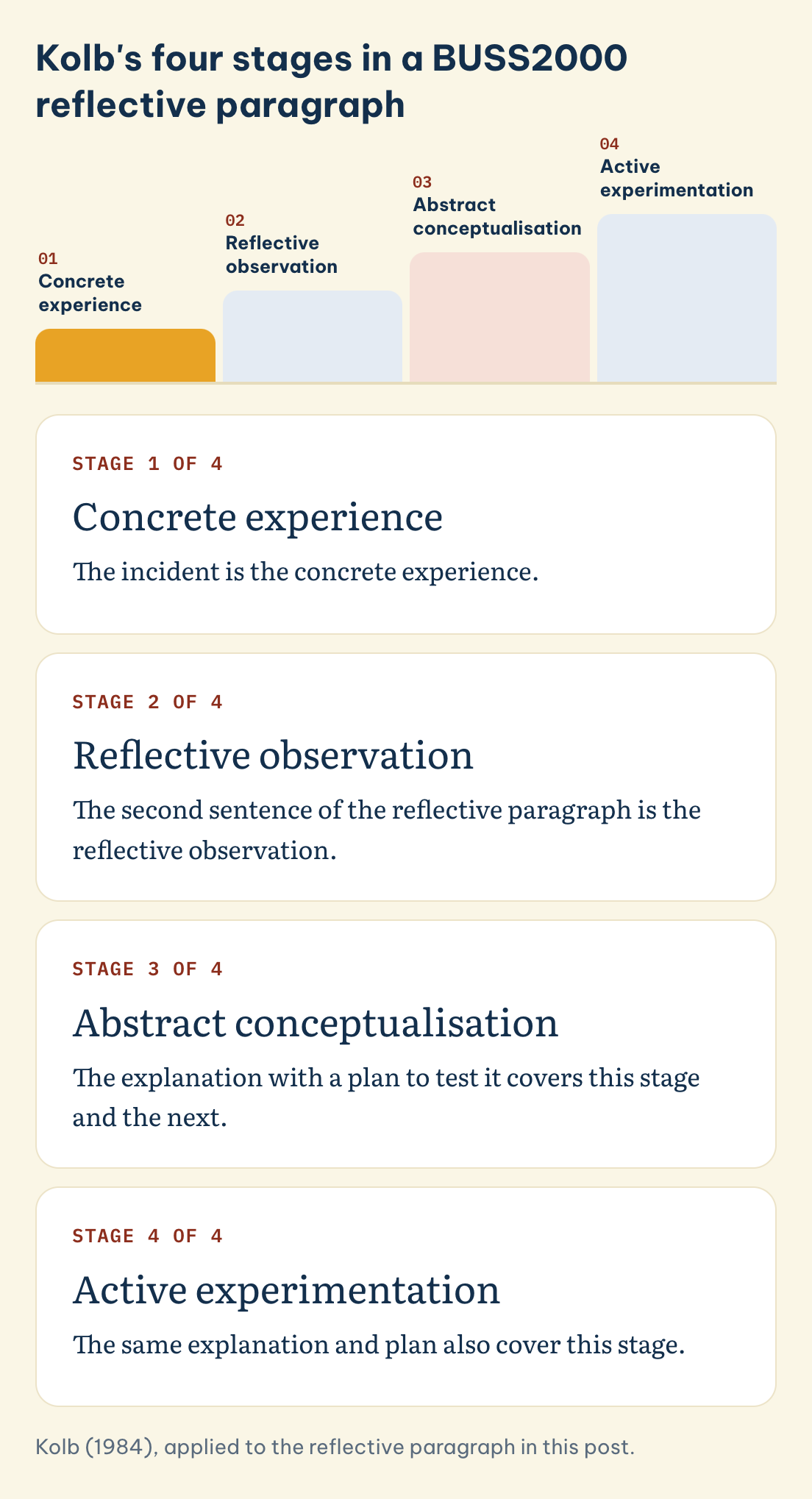
Kolb's four stages in a BUSS2000 reflective paragraph
The post maps each stage of Kolb's cycle onto the incident and the sentences of one reflective paragraph. The bar heights and colours only mark the order and carry no weight.
Stage 1 of 4
Concrete experience
The incident is the concrete experience.
Stage 2 of 4
Reflective observation
The second sentence of the reflective paragraph is the reflective observation.
Stage 3 of 4
Abstract conceptualisation
The explanation with a plan to test it covers this stage and the next.
Stage 4 of 4
Active experimentation
The same explanation and plan also cover this stage.
Save this figure
Choose incidents with friction in them. A group project that went smoothly generates a paragraph saying it went smoothly. A group project where two people wanted incompatible things, and you did something about it that half worked, generates real material. Markers are not scoring how well you performed. They are scoring whether you can analyse what happened.
Three sentences carry most reflective paragraphs in this unit. What I expected. What actually happened. What I now think explains the gap, and how I would check that. The third sentence is where theory belongs, because a framework used to explain a specific gap is doing work, while a framework defined at the top of the section is decoration.
That three-sentence pattern is not invented for this unit. Kolb (1984) frames experiential learning as a 4-stage cycle, concrete experience, reflective observation, abstract conceptualisation and active experimentation, and the pattern above walks that same cycle in order: the incident is the concrete experience, the second sentence is the reflective observation, and the explanation with a plan to test it covers both abstract conceptualisation and active experimentation. Naming the stage you are in as you write is a fast way to check you have not skipped one.
One more structural point. The unit's outcomes include communicating across multiple modes and audiences, so if the assessment includes a presentation or a professional document, the register is part of the task. A reflective essay and a professional development plan are not written in the same voice, and using one voice for both is a visible error.
◆ Question 6 / 7 · International students
What tends to be hardest for international students here?
Direct answer: Writing critically about yourself in a register that is neither boastful nor self-deprecating. Many students arrive from contexts where writing about your own strengths reads as immodest, and the safe alternative they choose, which is to describe their weaknesses at length, reads to a marker as a missing analysis rather than as humility.
The way out is evidential rather than tonal. Do not claim a strength and do not disclaim one. Report what you did in a specific situation and what followed. In the second week I noticed our timeline had no buffer, raised it, and we moved two deadlines forward makes a claim about your judgement without ever asserting one, and it can be assessed.
There is also a genuine content dimension here that the unit names directly, since cultural awareness and inclusive leadership are listed topics. Your own experience of working across cultures is legitimate material for this unit rather than a disadvantage in it. A student who has coordinated a team across two languages and several assumptions about hierarchy has observations that a monolingual classmate cannot produce, and the unit description names cultural awareness directly, while one outcome asks for understanding and appreciating individual and cultural differences.
◆ Question 7 / 7 · Who can help
Who can help with writing that has to be about you?
Nobody can write your reflection for you, and in a unit built on your own experience an outsourced reflection is worthless as well as prohibited. The useful work is selection and pressure: choosing which incidents actually contain something to analyse, then reading your draft for the places where a claim about yourself arrives without evidence.
If you are on the academic support pathway, bring the assessment brief along with 3 or 4 candidate incidents in note form. Most weak reflective work is weak because the wrong incident was chosen in the first hour, and that is a fast conversation rather than a long one.
Frequently asked questions
What has to be finished first?
At least 48 credit points completed, including BUSS1000 or BUSS1001. There are no prohibitions and no assumed knowledge listed. Confirm the rule for your own year of enrolment.
Do I need work experience?
No. Group projects, part-time work, volunteering and student societies all provide the kind of incidents the unit works with. What matters is that the situation was real and that something in it did not go to plan.
Can I cite a personality test?
Yes, if you evaluate it. The published outcomes ask you to evaluate evidence critically, so an instrument reported with its limitations acknowledged is fine, and an instrument reported as fact is a missed outcome.
Is the assessment knowledge or performance?
Both. The outcomes ask you to apply theory and research to leading and influencing, and also to communicate, collaborate and plan career development, which are performances rather than knowledge.
How personal should the reflection be?
Specific rather than intimate. The unit needs concrete situations and honest analysis, not disclosure. A detailed account of a routine team disagreement is better material than a private difficulty.
Related reading
References
Boud, D., Keogh, R., & Walker, D. (1985). Reflection: Turning experience into learning. Kogan Page.
Judge, T. A., Bono, J. E., Ilies, R., & Gerhardt, M. W. (2002). Personality and leadership: A qualitative and quantitative review. Journal of Applied Psychology, 87(4), 765–780. https://doi.org/10.1037/0021-9010.87.4.765
Kolb, D. A. (1984). Experiential learning: Experience as the source of learning and development. Prentice-Hall.
Pashler, H., McDaniel, M., Rohrer, D., & Bjork, R. (2008). Learning styles: Concepts and evidence. Psychological Science in the Public Interest, 9(3), 105–119. https://doi.org/10.1111/j.1539-6053.2009.01038.x
Pittenger, D. J. (2005). Cautionary comments regarding the Myers-Briggs Type Indicator. Consulting Psychology Journal: Practice and Research, 57(3), 210–221. https://doi.org/10.1037/1065-9293.57.3.210
A free 20-minute consultation is a conversation about where you are with BUSS2000.
Book a free consultation ▸