
◆ Business & Management
BUSS1000: the first-year unit that is easier to pass than to do well in
BUSS1000 Future of Business arrives with no prerequisite, no technical content and no obvious way to fail, which is why it produces many mid-band marks. Students read the frameworks once, recognise them in the assessment, and write about them accurately, yet accurate recognition is not what the marking criteria reward. The unit is assessed on whether you can make a framework do work on a messy business problem, a harder request than a heavy content unit ever makes.

◆ Section 1 / 7 · The unit
What is the unit, and where does it sit?
Direct answer: At the University of Sydney, BUSS1000 Future of Business is a 6 credit point undergraduate unit taught by the Business School, offered in both Semester 1 and Semester 2 at the Camperdown and Darlington campus in normal day mode. There is no prerequisite, and it is prohibited against BUSS1001. It is accredited by AACSB, EQUIS and AMBA.
Evidence: The University of Sydney was founded in 1850 and its Business School, a member of the Group of Eight and accredited by AACSB, EQUIS and AMBA, uses BUSS1000 as the entry point most Bachelor of Commerce students meet in their first semester. The published unit description positions it as a mandatory first-year unit introducing commencing business students to foundational concepts, built around business stakeholders, business challenges, and the ways business leaders might approach responding to those challenges. The teaching pattern blends face-to-face lectures and seminars with interactive online modules, and the stated topics reach into climate change, sustainability, changes in the workforce, and diversity. Reference lists in this unit are usually expected in APA 7th style, the same convention the Business School applies across its first-year curriculum, so it is worth learning once rather than relearning per unit.
Example: A student who had scored well above 80% in HSC Business Studies expected an easier version of the same thing. The content overlapped considerably. The marks did not, because the school subject rewarded knowing what a stakeholder is and this unit rewarded deciding which stakeholders matter most in a specific situation, and defending that decision.
◆ Section 2 / 7 · Assessment
What is actually being assessed?
Direct answer: The learning outcomes name the skills, and they are worth reading before the reading list. Students are expected to understand relevant business theory and conceptual frameworks, critically assess challenges and opportunities in key economic sectors, apply frameworks to derive business insights, communicate effectively across multiple formats and audiences, collaborate effectively within teams, and demonstrate a commitment to ethical and sustainable practice.
Evidence: Four of those six outcomes are verbs of doing rather than knowing. Understanding theory is listed once, at the start, and everything after it assumes the theory is already in hand. Read against Bloom's (1956) taxonomy of educational objectives, "understand" sits near the bottom of the six-level hierarchy, "apply" sits one level above it, and "critically assess" belongs with the higher levels of "analyse" and "evaluate", which is a useful way to see why a paragraph that only understands correctly still lands mid-band. Assessment in this unit has historically combined written analysis of a business situation, typically 1,500 to 2,000 words and worth somewhere in the 30% to 40% range, with team-based work and a report addressed to a decision-maker rather than to a marker, though weightings and task names change between offerings, so confirm the current split in your own unit outline rather than in an older one circulating online.
Example: A student wrote 1,800 words that explained stakeholder theory, then explained the triple bottom line, then explained shared value, and concluded that the company should consider all three. Every paragraph was correct. Nothing in the piece told the reader what the company should do on Monday, which is what a report format asks for.
◆ Section 3 / 7 · Middle band
Why does a correct answer land in the middle band?
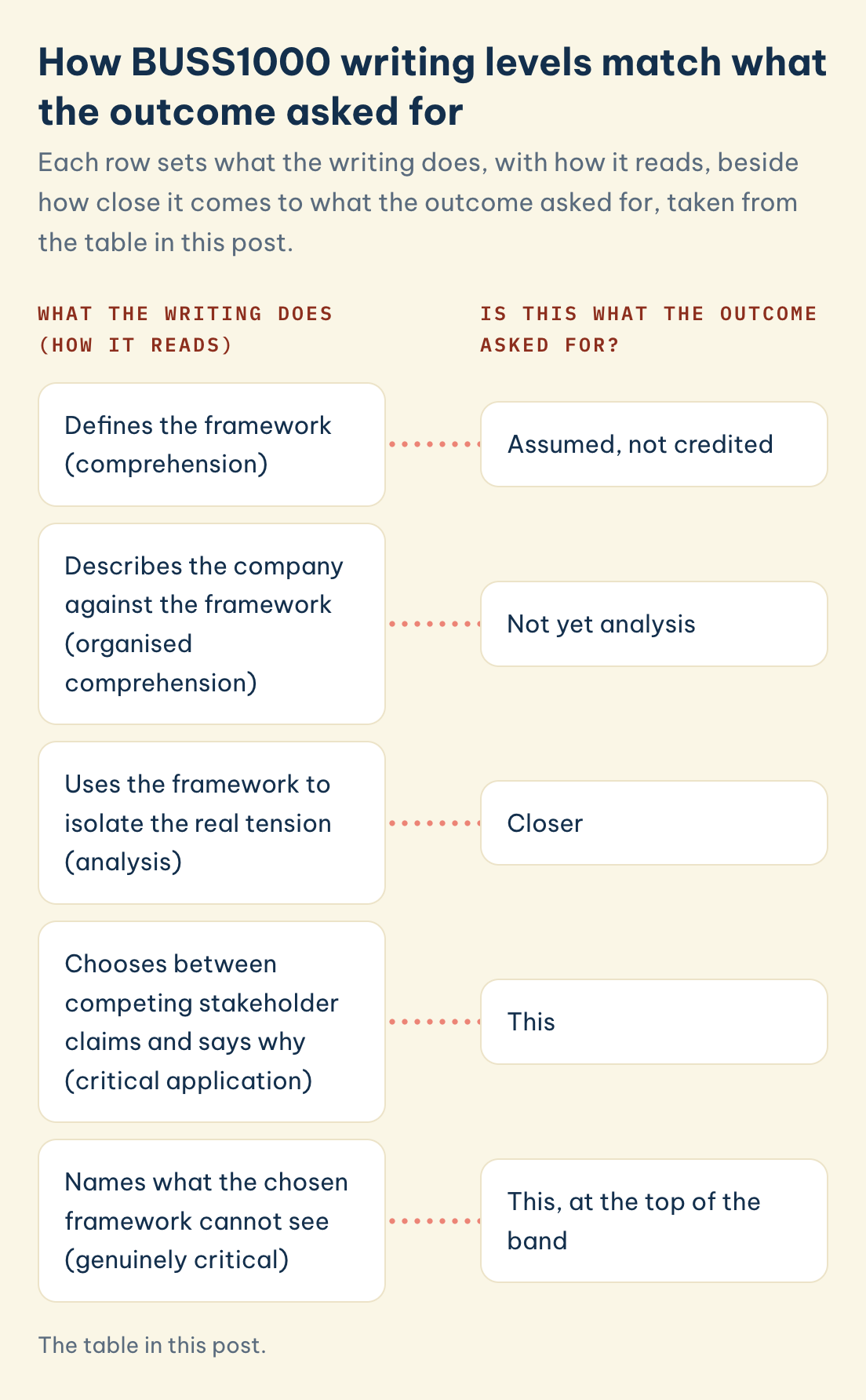
Direct answer: Because describing and applying a framework correctly is comprehension, not analysis, and the criteria reward the row above it: naming what the chosen framework cannot see. Given a retailer facing a 20% emissions cut within 3 years, the student who named the trade-off in 4 pages outscored the one who mapped every stakeholder neutrally across 6 pages.
How BUSS1000 writing levels match what the outcome asked for
Each row sets what the writing does, with how it reads, beside how close it comes to what the outcome asked for, taken from the table in this post.
What the writing does (how it reads)
Is this what the outcome asked for?
Defines the framework (comprehension)
Assumed, not credited
Describes the company against the framework (organised comprehension)
Not yet analysis
Uses the framework to isolate the real tension (analysis)
Closer
Chooses between competing stakeholder claims and says why (critical application)
This
Names what the chosen framework cannot see (genuinely critical)
This, at the top of the band
Save this figure
| What the writing does | How it reads | What the outcome asked for |
|---|---|---|
| Defines the framework | Comprehension | Assumed, not credited |
| Describes the company against the framework | Organised comprehension | Not yet analysis |
| Uses the framework to isolate the real tension | Analysis | Closer |
| Chooses between competing stakeholder claims and says why | Critical application | This |
| Names what the chosen framework cannot see | Genuinely critical | This, at the top of the band |
Evidence: The gap between rows three and four is where most first-year business marks are decided. A framework applied without a choice being made produces a description in a nicer shape, because the framework has organised the facts without resolving anything. The outcome that says apply frameworks to derive business insights puts the weight on the word derive, and an insight is something the reader did not already have before reading you.
Example: Given a retailer facing pressure to cut emissions by 20% within 3 years while holding prices, one student mapped every stakeholder group and their interests, thoroughly and neutrally, across 6 pages. Another observed that two groups on the map want incompatible things within the same financial year, worked out which one the business cannot afford to lose, and made the trade-off explicit in 4 pages. The second was shorter.
◆ Section 4 / 7 · Frameworks
Which framework should you learn properly?
Direct answer: Stakeholder salience, in the form set out by Mitchell, Agle and Wood (1997). It is the one that turns a stakeholder list into a decision, and a decision is what the assessment is missing when it lands mid-band.
Evidence: Freeman's (1984) formulation established the stakeholder view in strategic management by defining a stakeholder as any group or individual who can affect or is affected by the achievement of an organisation's objectives. That definition is deliberately wide, and its width is the practical problem: it identifies who counts without telling a manager who counts most. Mitchell et al. (1997), published in the Academy of Management Review, answered that by proposing that managers attend to stakeholders according to three attributes, power, legitimacy and urgency, with salience rising as a stakeholder holds more of them and shifting as attributes are gained or lost.
That structure is directly useful in an assessment, because it converts a map into a ranking, and a ranking commits you to a position you then have to defend. It also gives you something to be critical about, since deciding that a claim is legitimate is itself a judgement rather than an observation.
Example: A student writing about a mining company listed a local community as a stakeholder in a single sentence, 20 words, and moved on. Applying salience, the same student had to ask whether that community held power, and having concluded it did not hold much directly but held a great deal through regulators and media, wrote the paragraph of 150 words the essay had been missing.
◆ Section 5 / 7 · Sustainability
What to do with sustainability content without sounding like a brochure
Direct answer: Treat the sustainability frameworks as contested rather than settled. The unit lists climate change and sustainability among its topics, and the fastest route to a distinction-level paragraph is showing you know where these ideas are argued about.
Evidence: The triple bottom line is the usual starting point, and its own author has publicly reconsidered it. Elkington (2018), writing in the Harvard Business Review, said he was issuing a management-concept recall on the term he coined in 1994, on the grounds that it had been widely adopted as an accounting and reporting device when it was intended to provoke a rethinking of capitalism, so that companies could report three sets of numbers while changing very little. Elsewhere in the same piece he asked, "How often are management concepts subjected to recalls by the people who invented them? It is hard to think of a single case." (Elkington, 2018) Porter and Kramer (2011), in the same journal, attacked the same problem from a different direction, arguing that corporate social responsibility programmes sat at the periphery of the business and proposing shared value, policies that enhance competitiveness while advancing the economic and social conditions in the communities where a company operates. Carroll's (1991) pyramid, first set out in Business Horizons, remains the standard four-part account of economic, legal, ethical and philanthropic responsibilities, and it is worth knowing precisely because it is the model the other two are reacting against.
Example: A student wrote that the company should adopt the triple bottom line to balance people, planet and profit. The sentence is unobjectionable and adds nothing. A revision that noted Elkington's own concern about the framework being used as a reporting exercise, then specified which decision in this company would actually change, did the work the first sentence only gestured at.
◆ Section 6 / 7 · Group work
The group assessment, treated as an assessed skill
Direct answer: Collaborating effectively is a named learning outcome, which means the team task is not an administrative convenience. It is being marked, and the artefact your group submits is the evidence, typically produced by a group of 4 to 5 students over the second half of a semester that runs 13 weeks.
Evidence: Group work in first-year business units usually fails in one of two ways, and both are visible in the final document. Either the sections are divided cleanly and stitched together at the end, producing a report with four voices and no argument, or one member absorbs the work and the analysis narrows to a single perspective, which is precisely what a cross-disciplinary unit is trying to avoid. Tuckman (1965) named the stages most groups pass through, forming, storming, norming and performing, and the report usually reads like whichever stage the group stalled in: a forming-stage report lists, a storming-stage report contradicts itself between sections, and only a group that reached performing produces one argument in one voice. Neither failure is about effort.
Example: A group that met for 3 sessions of 60 minutes produced a stronger report than a group that met for 8 sessions, because the first group spent its first meeting agreeing what the recommendation would be and its remaining time testing that recommendation, while the second spent every meeting allocating and reviewing sections that had never been pointed at a shared conclusion.
◆ Section 7 / 7 · Order of work
A practical order of work
Direct answer: Seven steps across a semester of 13 weeks: read the assessment verbs before the readings, learn two frameworks properly rather than five loosely, write what each framework hides as well as what it shows, write towards the reader's decision, rank conflicting stakeholders, agree the group's conclusion early and attack it, then check for one genuinely surprising sentence.
- Read the assessment descriptions and the learning outcomes before the readings. The verbs in them are the marking criteria in plain sight.
- Pick two frameworks and learn them to the point where you know their limits, rather than the five or six a semester of 13 weeks of lectures will have introduced you to, and to the point where you can only define them.
- For every framework you use, write one line on what it makes visible and one line on what it hides. The second line is where criticality comes from.
- In any written task, identify the decision the reader has to make. Write towards it rather than around it.
- Where stakeholders conflict, rank them and say why. An unranked map is a description.
- In group work, agree the conclusion early and spend the remaining time attacking it. Sections written before the conclusion exists rarely cohere.
- Check that at least one paragraph states something a careful reader would not have assumed before reading you. If none does, the analysis has not started.
Frequently asked questions
Is BUSS1000 hard?
It is not difficult to pass and it is not easy to do well in. The content is accessible and the skill being marked, applying frameworks to reach a defensible judgement, is one most students have not practised before university.
Do I need business background to take it?
No. There is no prerequisite, unlike many second-year units that assume 12 credit points of prior study, and this unit introduces its concepts from the beginning. Prior study can be a mild disadvantage if it trains you to recall definitions rather than argue with them.
How many frameworks should one assessment use?
Follow your unit outline. As a working rule, 1 framework applied properly across 4 to 5 paragraphs outperforms 3 mentioned once each, because the marks sit on application rather than coverage.
Can I criticise the frameworks the unit teaches?
Yes, and doing so well is usually what separates the upper bands from the middle. Criticism has to be sourced and specific, which is why knowing that Elkington (2018) reconsidered his own concept, or that Mitchell et al. (1997) built salience on three separate attributes rather than one, is more useful than a general reservation.
What is the difference between this unit and BUSS1001?
They are prohibited against each other, so you take one or the other rather than both. Check with the Business School which applies to your degree before enrolling.
Where MAAS fits
MAAS mentors work alongside business students rather than in place of them. In a unit like this the most useful session is usually spent on a single question put to your draft: what does the reader now have to decide, and have you told them what to decide? If the draft describes a situation and stops, the framework has been recited rather than used, and finding that out in week seven is considerably better than finding it out from the feedback. The writing stays yours. If that is useful, our academic support service and our tutoring service are the two places to start.
References
Bloom, B. S. (1956). Taxonomy of educational objectives: The classification of educational goals. Longmans, Green.
Carroll, A. B. (1991). The pyramid of corporate social responsibility: Toward the moral management of organizational stakeholders. Business Horizons, 34(4), 39–48. https://doi.org/10.1016/0007-6813(91)90005-G
Elkington, J. (2018, June 25). 25 years ago I coined the phrase "triple bottom line." Here's why it's time to rethink it. Harvard Business Review. https://hbr.org/2018/06/25-years-ago-i-coined-the-phrase-triple-bottom-line-heres-why-im-giving-up-on-it
Freeman, R. E. (1984). Strategic management: A stakeholder approach. Pitman.
Mitchell, R. K., Agle, B. R., & Wood, D. J. (1997). Toward a theory of stakeholder identification and salience: Defining the principle of who and what really counts. Academy of Management Review, 22(4), 853–886. https://doi.org/10.2307/259247
Porter, M. E., & Kramer, M. R. (2011). Creating shared value. Harvard Business Review, 89(1/2), 62–77.
Tuckman, B. W. (1965). Developmental sequence in small groups. Psychological Bulletin, 63(6), 384–399. https://doi.org/10.1037/h0022100
Tools & resources
The University of Sydney. (2026). BUSS1000: Future of Business. https://www.sydney.edu.au/units/BUSS1000
A free 20-minute consultation is a conversation about where you are with BUSS1000.
Book a free consultation ▸