
◆ Business & Management
BUSS1040 Economics for Business Decision Making: writing in exams
Most first-year economics units keep the writing and the economics apart, putting the argument in an essay and the technique in a test. BUSS1040 does not. Its third learning outcome asks students to demonstrate effective written communication through the assessment tasks, and then names where: the in-semester test and the final exam. That single sentence relocates the writing task into the most time-pressured place in the unit, which is why students who write well at home still lose marks here.

◆ Question 1 / 6 · The unit
What the unit is, and the entry condition nobody reads
Direct answer: BUSS1040 Economics for Business Decision Making is a 6-credit-point undergraduate unit taught by the University of Sydney Business School, offered in both Semester 1 and Semester 2 at the Camperdown/Darlington campus. It carries no prerequisites, but it does assume senior secondary mathematics, and it is prohibited against two other introductory economics units.
Evidence: The published unit page opens with the claim that "Economics underlies all business decisions, from pricing to product development, to negotiations, to understanding the general economic environment." It lists no prerequisites, prohibitions against ECON1001 and ECON1040, and assumed knowledge of mathematics equivalent to band 4 in NSW HSC Mathematics Advanced, or band E3 in Mathematics Extension 1 or 2, or MATH1111.
The gap between no prerequisite and assumed knowledge is where students get hurt. A prerequisite blocks enrolment. Assumed knowledge does not block anything, so a student without Band 4 Advanced Mathematics can enrol on Monday and meet a demand-curve manipulation on Friday with nobody having warned them. The Band 4 boundary on the reported HSC scale sits at 70 marks out of 100, with Band 5 at 80 and Band 6 at 90 (NSW Education Standards Authority, n.d.), so the assumed level sits above a bare pass without being exceptional. NESA does not publish the raw marks behind those boundaries, only the aligned scale, which is why a student cannot simply check a mark sheet and know for certain which side of Band 4 they finished on before results are released. The regulator is explicit about why: "the NSW Education Standards Authority (NESA) uses a procedure called 'standards setting' to align raw exam marks to performance band descriptions" (NSW Education Standards Authority, n.d.), which means the Band 4 threshold a student is assumed to have cleared is a moderated score, not a raw exam mark. The unit page also accepts a band E3 in Mathematics Extension 1 or 2 as equivalent, which the shorthand Band 4 Advanced hides. If your senior mathematics was Mathematics Standard rather than Mathematics Advanced, treat the first 3 weeks as remedial work rather than revision, and finish it before the in-semester test rather than after. MATH1111 Introduction to Calculus at the University of Sydney is the named alternative and carries the same 6 credit points as BUSS1040 itself.
The prohibitions are equally informative. Because BUSS1040 is prohibited against ECON1001, the two units are treated as substitutes rather than complements. You are not taking a lighter economics unit alongside the real one. You are taking the version of introductory economics that the University of Sydney Business School has pointed at business decisions, and it is marked accordingly. Note that ECON1040 is the Sydney School of Economics companion code in the same prohibition line, which means the restriction covers 2 alternative pathways rather than 1.
◆ Question 2 / 6 · Writing outcome
Why does the writing outcome change how you should study?
Direct answer: Because the unit examines argument and technique in the same sitting. Learning outcome three attaches written communication to the in-semester test and the final exam, so clarity is not a separate assessment you can prepare separately. It is scored under the clock, beside the diagrams.
What students rehearse for BUSS1040 and what the outcome asks for
Each row sets one thing students rehearse beside what the learning outcome asks for instead, taken from the table in this post.
What students rehearse
What the outcome asks for
Drawing the correct diagram
Explaining what the diagram implies for a named decision
Reciting a definition of elasticity
Using elasticity to argue for or against a specific price change
Listing macroeconomic effects of a policy
Evaluating which effect dominates for this firm, and saying why
Save this figure
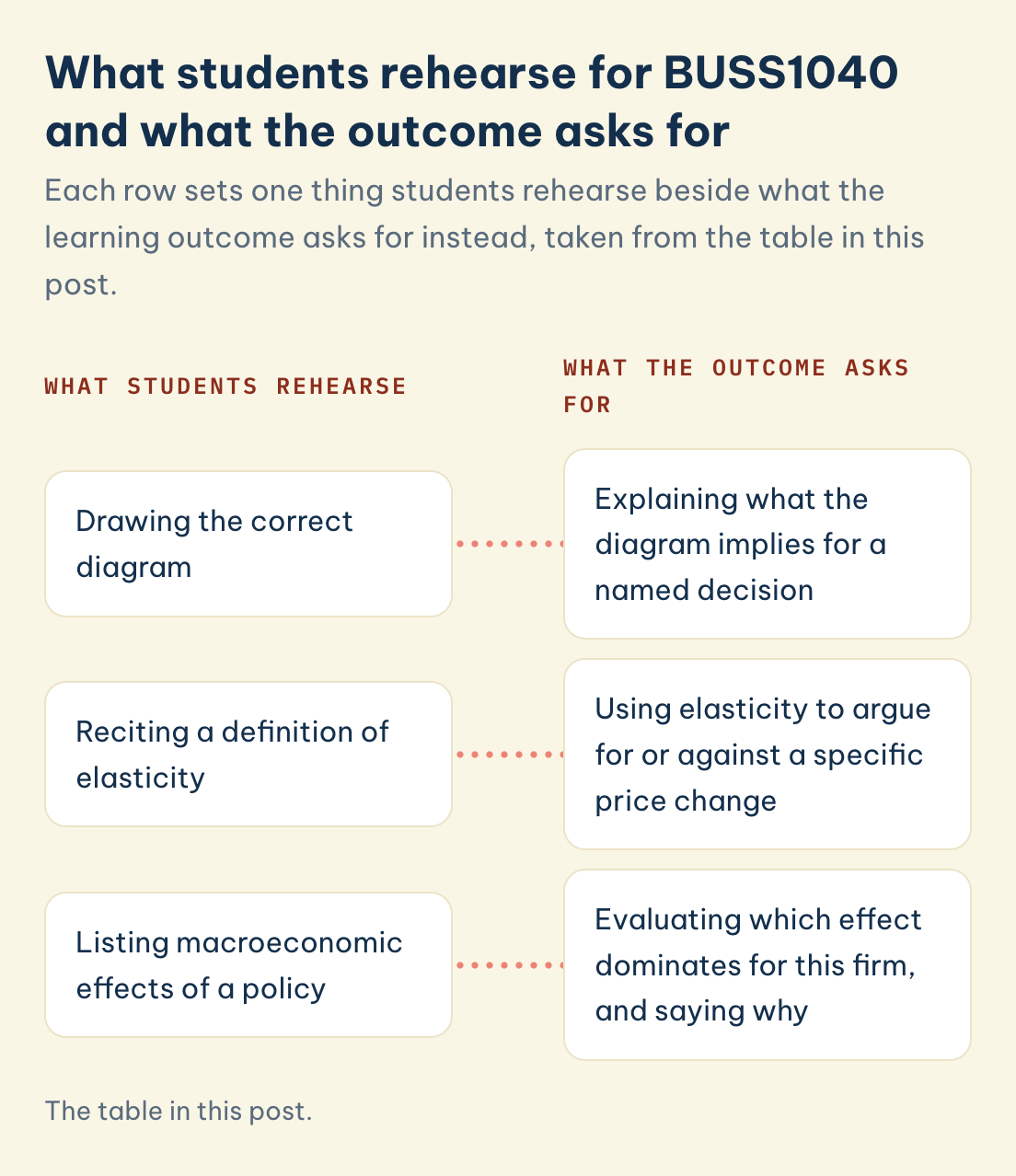
Students prepare for economics exams by rehearsing mechanics: shift the curve, find the new equilibrium, compute the elasticity, label the deadweight loss. That preparation is necessary and it is not sufficient here, because a marked answer in this unit is usually a short piece of prose in which a diagram appears as support. An answer that ends at the diagram has stopped one step before the marked step.
| What students rehearse | What the outcome asks for |
|---|---|
| Drawing the correct diagram | Explaining what the diagram implies for a named decision |
| Reciting a definition of elasticity | Using elasticity to argue for or against a specific price change |
| Listing macroeconomic effects of a policy | Evaluating which effect dominates for this firm, and saying why |
Evidence: Hansen (2001) set out expected proficiencies for undergraduate economics students and placed the ability to communicate economic reasoning, in writing and to non-specialists, alongside the technical proficiencies rather than beneath them. Siegfried and colleagues (1991), writing a decade earlier in the same journal, made the broader case that the goal of undergraduate economics is to teach students to "think like an economist," a skill they described as a habit of reasoning rather than a body of content to be recalled. Colander (2004) later connected both points directly to teaching method, arguing that lecture-only delivery leaves this habit unpractised.
Example: Asked whether a coffee chain should raise prices after a supply shock, one student drew an accurate supply shift, marked the new equilibrium, and stopped. A second used the same diagram, noted that the chain's customers face several nearby substitutes, argued that demand is therefore relatively elastic in this segment, and concluded that passing the full cost through would reduce revenue. Both diagrams were identical. Only the second answered the question asked. Becker and Watts (2001) surveyed teaching practice across United States economics departments and found chalk-and-talk delivery still dominant, which helps explain why students arrive expecting recall to be the assessed skill.
◆ Question 3 / 6 · Decision making
What does "for business decision making" actually change?
Direct answer: It changes the unit of analysis. General economics asks what happens to a market. This unit asks what a named firm should do, which means every answer needs an agent, a decision, and a recommendation with a stated condition attached.
Learning outcome two is explicit that students analyse business problems by identifying and critically evaluating the implications of business decisions using micro- and macroeconomic principles. The verb pair matters. Identifying is the descriptive half and most students do it well. Critically evaluating means weighing an implication against an alternative and saying which is more likely to hold, and it is where the distinction marks live.
A workable habit is to finish every answer with a conditional sentence. Rather than concluding that the firm should lower price, conclude that the firm should lower price provided that demand in this segment is elastic and rivals do not match within the quarter. The condition is not hedging. It names the assumption your recommendation depends on, which is exactly the critical evaluation the outcome asks for.
Colander (2004) argued that good economics teaching foregrounds the limits of models rather than their elegance, and that students learn most when they are shown where a model stops describing the world. In a unit built around decisions, those limits are the content. A firm operating with sticky contracts, incomplete information about rivals, or a brand that customers are loyal to is not the frictionless firm of the textbook diagram, and saying so precisely earns marks that repeating the diagram does not.
◆ Question 4 / 6 · Exam prose
How do you write economics prose under exam time pressure?
Direct answer: Write the conclusion first, then the mechanism, then the qualification. Three sentences in that order answer most short exam questions completely, and the order protects you if you run out of time, because the marked claim is already on the page.
Under time pressure the common failure is a long warm-up. Students restate the question, define the concepts, describe the diagram, and reach the answer in the final line, which is often the line that never gets written. Reversing the order is a mechanical fix that costs nothing to practise.
A second habit is to keep the diagram and the sentence in agreement. If your written answer says quantity falls and your diagram shows the new equilibrium to the right, a marker cannot award the reasoning even if one of the two is correct, because the answer as a whole is inconsistent. Check the two against each other before moving on, which takes about ten seconds per question.
A third is to name numbers when the question gives them. If a question supplies a price elasticity of 0.4, an answer that says demand is fairly unresponsive is weaker than one that says a ten per cent price rise reduces quantity by four per cent, so revenue rises. The second sentence has done arithmetic the first only gestured at, and arithmetic is fast. Elasticity below 1 means inelastic demand and elasticity above 1 means elastic demand, and that single threshold decides the direction of the revenue conclusion in a large share of BUSS1040 short-answer questions.
◆ Question 5 / 6 · English habits
Which English habits cost marks in an economics answer?
Direct answer: The obstacle is rarely vocabulary. It is hedging and connectives. Economics answers turn on precise causal language, and students often replace a causal claim with a vague one, which reads to a marker as an absent argument rather than as a language difficulty, and is marked accordingly.
The technical vocabulary of economics is learnable and most international students learn it quickly, because the terms are few and repeated. The difficulty sits in the joining words that carry the argument: therefore, provided that, unless, which implies, all else equal. An answer that strings observations together with and leaves the marker to infer the reasoning, and markers are instructed to mark what is written.
The second pattern is over-hedging. Writing that a price rise may possibly tend to reduce demand is three layers of caution around a claim the unit expects you to make plainly. Economics has a standard hedge already built in, the phrase all else equal, and it does the job of all three. Use it once and then commit to the claim.
A practical drill is to write ten answer-sentences a week in the pattern because X, Y, provided that Z, using scenarios from your tutorial questions. The structure is short enough to rehearse and it is the structure the exam rewards. Ten sentences a week across a 13 week semester gives roughly 130 rehearsed answers before the final exam, which is more practice than most students accumulate by rereading lecture slides. Hansen (2001) argued that an economics programme should be judged by what its graduates can do rather than by what they have covered, which is the case for practising the performance rather than rereading the material.
◆ Question 6 / 6 · Mentor help
What can a mentor usefully do for a unit examined by writing?
A mentor cannot sit the exam with you, so the work has to happen before it. For a unit like this, a session usually means taking a past tutorial question you have already attempted, examining whether your conclusion follows from your mechanism, and rehearsing the three-sentence structure until it is automatic under time. Where mathematics is the barrier, the work is diagnostic first, identifying which specific operation is missing rather than reteaching a whole syllabus. In practice that is usually 2 or 3 operations, most often rearranging a linear demand equation and reading a slope, not the whole of Mathematics Advanced.
If you are on the academic support pathway, bring your marked in-semester test rather than a blank question. The gap between what you wrote and what earned marks is the fastest available diagnostic, and it is specific to how your own answers fail.
Frequently asked questions
Do I need to have studied economics at school?
No. The unit page lists no prerequisites and no assumed economics knowledge. It does assume mathematics equivalent to band 4 in Mathematics Advanced, or band E3 in Mathematics Extension 1 or 2, or MATH1111, which is a different and more binding condition.
Can I take BUSS1040 and ECON1001 together?
No. The published prohibitions list ECON1001 and ECON1040, which means the units count as substitutes. Check the prohibition list for your own year of enrolment before planning a major.
Is it more microeconomics or macroeconomics?
Both. Learning outcome one names macro and micro real-world contexts explicitly, and learning outcome two names micro- and macroeconomic principles. Preparing only for micro is a common and costly assumption.
How much of the mark depends on writing?
The unit does not publish a percentage, and assessment details appear in the unit outline released about 2 weeks before teaching starts. What is published is that written communication is examined through the in-semester test and the final exam, so treat it as scored in both.
Are diagrams enough on their own?
Rarely. A diagram supports a claim and does not constitute one. The outcomes ask for explanation and critical evaluation, both of which are verbs performed in sentences.
Is this advice specific to Sydney, or does it apply anywhere economics is examined by writing?
The unit-specific facts, the 6 credit points, the Band 4 mathematics assumption, the ECON1001 and ECON1040 prohibitions, come from the University of Sydney's own published unit page. The writing-under-exam advice does not: Hansen (2001), Siegfried et al. (1991), Becker and Watts (2001), and Colander (2004) describe undergraduate economics teaching generally rather than this specific unit, so the three-sentence structure and the all-else-equal habit travel to any first-year economics unit examined by written answer.
Where this guidance comes from
The teaching-practice claims above are drawn from four peer-reviewed sources on undergraduate economics education, not from general study-skills advice: Hansen (2001) and Siegfried et al. (1991) both appeared in The Journal of Economic Education, ten years apart, Becker and Watts (2001) appeared in the American Economic Review, and Colander (2004) appeared in the International Review of Economics Education. All four are cited specifically for what they say about how economics is taught and assessed, not paraphrased from a secondary summary.
Related reading
References
Becker, W. E., & Watts, M. (2001). Teaching economics at the start of the 21st century: Still chalk-and-talk. American Economic Review, 91(2), 446–451. https://doi.org/10.1257/aer.91.2.446
Colander, D. (2004). The art of teaching economics. International Review of Economics Education, 3(1), 63–76. https://doi.org/10.1016/S1477-3880(15)30144-4
Hansen, W. L. (2001). Expected proficiencies for undergraduate economics majors. The Journal of Economic Education, 32(3), 231–242. https://doi.org/10.1080/00220480109596105
NSW Education Standards Authority. (n.d.). Determining HSC results. Retrieved August 21, 2026, from https://www.nsw.gov.au/education-and-training/nesa/hsc/results-and-certificates/determining-results
Siegfried, J. J., Bartlett, R. L., Hansen, W. L., Kelley, A. C., McCloskey, D. N., & Tietenberg, T. H. (1991). The status and prospects of the economics major. The Journal of Economic Education, 22(3), 197–224. https://doi.org/10.1080/00220485.1991.10844710
A free 20-minute consultation is a conversation about where you are with BUSS1040.
Book a free consultation ▸