
◆ Research Methods
What changed in Braun and Clarke's thematic analysis after 2006?
Category: research-methods
Last updated: 2026-10-21
Most methods chapters that use thematic analysis cite one paper: Braun and Clarke (2006). The authors themselves no longer describe their approach the way that paper did. Since 2019 they call it reflexive thematic analysis, they have renamed several of the six phases, and they now say that "thematic analysis" covers at least three different families of method. If your chapter cites 2006 and then reports a codebook, two coders and a kappa score, an examiner who knows the later work will notice the contradiction. This guide explains what changed, which paper to cite for which claim, and how to write a methods paragraph that matches what you actually did. For the step-by-step coding itself, see our companion guide on how to do a thematic analysis.
◆ Question 1 / 6 · Since 2006
What did Braun and Clarke change after their 2006 paper?
Direct answer: Three things changed. The approach got a name, reflexive TA, which treats the researcher's subjectivity as a resource. The six phases were reworded so that themes are generated and developed, not found. And the authors split thematic analysis into coding reliability, codebook and reflexive versions with different quality standards.
The original article is Braun and Clarke (2006), published in Qualitative Research in Psychology, and the year matters because many students treat it as the final word. In their 2021 paper the authors are direct about the gap: "There are some differences between this brief account of (reflexive) TA, and that in our 2006 paper" (Braun & Clarke, 2021, p. 332). They also accept part of the blame for the confusion, writing that "our failure to fully articulate the assumptions informing our approach to TA" contributed to the misconceptions they now see in published research (Braun & Clarke, 2021, p. 332).
The naming came first. Braun and Clarke (2019) set out why they now use the label reflexive, and in 2021 they explain that the label "emphasises the importance of the researcher's subjectivity as analytic resource, and their reflexive engagement with theory, data and interpretation" (Braun & Clarke, 2021, p. 330). That sentence is the core shift. In 2006 the paper offered flexible procedures and left the underlying values implicit, and later writing makes those values explicit and argues that they decide how quality should be judged.
◆ Question 2 / 6 · Six phases
What are Braun and Clarke's six steps of thematic analysis now?
Direct answer: The six steps still run from getting to know the data, through coding and theme building, to the write-up. What changed is the wording: notes now belong to familiarisation, and themes are generated and then developed rather than searched for. Braun and Clarke treat the sequence as a flexible guide, not a recipe.
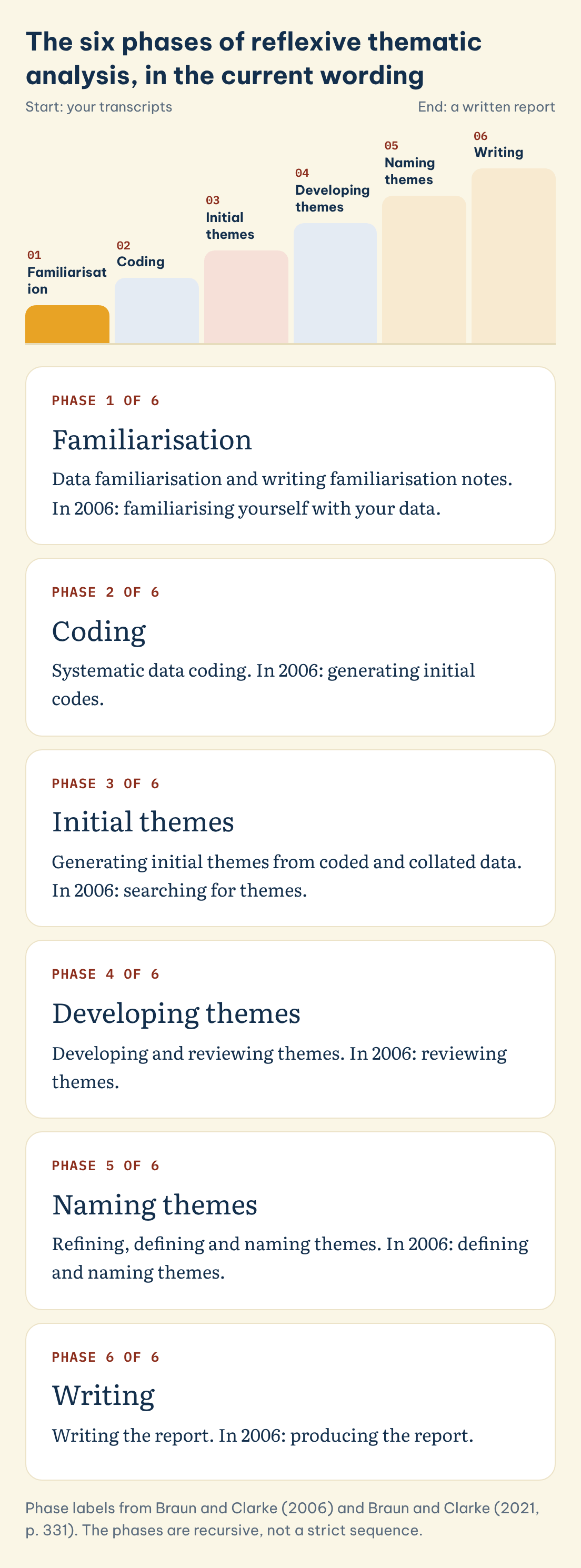
Braun and Clarke (2021, p. 331) give their "most recent articulation" of the process as "1) data familiarisation and writing familiarisation notes; 2) systematic data coding; 3) generating initial themes from coded and collated data; 4) developing and reviewing themes; 5) refining, defining and naming themes; and 6) writing the report." Compare that with the 2006 labels, which most textbooks still reproduce, and the change in verbs is clear. Phase 3 used to be "searching for themes", which implies that themes sit in the data waiting to be found. The new wording says you generate them from codes you have already built.
The same page warns that "this phase-approach is not intended to be followed rigidly" and that the phases "can blend together somewhat" as your analytic skill develops (Braun & Clarke, 2021, p. 331). Byrne (2022) gives a worked example that walks through each phase on a real dataset, which is useful if you want to see what the recursion looks like in practice rather than in a diagram. In your methods chapter, the practical point is simple: name the phases using the current wording and say briefly how you moved back and forth between them.
The six phases of reflexive thematic analysis, in the current wording
Tap a phase to see how its wording changed since 2006.
Phase 1 of 6
Familiarisation
Data familiarisation and writing familiarisation notes. In 2006: familiarising yourself with your data.
Phase 2 of 6
Coding
Systematic data coding. In 2006: generating initial codes.
Phase 3 of 6
Initial themes
Generating initial themes from coded and collated data. In 2006: searching for themes.
Phase 4 of 6
Developing themes
Developing and reviewing themes. In 2006: reviewing themes.
Phase 5 of 6
Naming themes
Refining, defining and naming themes. In 2006: defining and naming themes.
Phase 6 of 6
Writing
Writing the report. In 2006: producing the report.
Save this figure
| Phase | 2006 label | Current wording (Braun & Clarke, 2021, p. 331) | What changed |
|---|---|---|---|
| 1 | Familiarising yourself with your data | Data familiarisation and writing familiarisation notes | Writing notes is now part of the phase |
| 2 | Generating initial codes | Systematic data coding | Coding is the work, not a quick first pass |
| 3 | Searching for themes | Generating initial themes from coded and collated data | Themes are built, not found |
| 4 | Reviewing themes | Developing and reviewing themes | Themes keep developing while you review |
| 5 | Defining and naming themes | Refining, defining and naming themes | Refinement added before naming |
| 6 | Producing the report | Writing the report | Little change |
◆ Question 3 / 6 · Three types
What are the three types of thematic analysis?
Direct answer: Braun and Clarke now group thematic analysis into coding reliability, codebook and reflexive versions. Coding reliability uses fixed codebooks and inter-rater agreement. Codebook approaches such as framework and template analysis use a structured frame without agreement scores. Reflexive TA uses open, organic coding by a researcher whose interpretation is the point.
The key sentence is on page 333: "We now think that it is better to conceptualise TA as having several different 'versions'; we cluster the approaches into what we call 'coding reliability', 'codebook' and 'reflexive' variations" (Braun & Clarke, 2021, p. 333). The authors admit that in 2006 they "privately" dismissed more positivist approaches such as Boyatzis (1998) instead of naming the difference, which is part of why so many later studies mixed the families without noticing.
Each version has its own logic. Coding reliability TA is concerned with "objective" and "unbiased" coding, uses a codebook and several coders, and often develops themes early (Braun & Clarke, 2021, p. 333). Codebook TA, which includes framework analysis, matrix analysis and template analysis, keeps a structured coding frame but sits within a qualitative paradigm and does not usually rely on inter-rater reliability (Braun & Clarke, 2021, pp. 333, 335). Reflexive TA is the version the authors themselves practise. On their account, "a research team is not required or even desirable for quality", and "coding is open and organic, with no use of any coding framework" (Braun & Clarke, 2021, pp. 333-334).
For a master's or PhD student the choice usually follows from the project. A large funded team delivering a policy report to a deadline may fit a codebook approach, which the authors describe as well suited to applied research (Braun & Clarke, 2021, p. 335). A single student interpreting interview data for a dissertation usually fits reflexive TA. Neither is wrong, but you have to say which one you used.
◆ Question 4 / 6 · Inter-rater reliability
Why does reflexive TA reject inter-rater reliability?
Direct answer: Because reflexive TA assumes that meaning is situated and that the researcher's perspective shapes the analysis. Measuring agreement between coders treats that perspective as bias to be removed, which contradicts the method's own assumptions. Braun and Clarke call coding reliability in reflexive TA "illogical, incoherent and ultimately meaningless".
The full sentence reads: "Demonstrating coding reliability and the avoidance of 'bias' is illogical, incoherent and ultimately meaningless in a qualitative paradigm and in reflexive TA, because meaning and knowledge are understood as situated and contextual, and researcher subjectivity is conceptualised as a resource for knowledge production" (Braun & Clarke, 2021, pp. 334-335). Many supervisors and reviewers still ask for a second coder by default, and this sentence gives you a citable reason for declining.
Declining a kappa score does not mean skipping quality work. In reflexive TA the evidence of quality is a coherent analysis that you can account for: a reflexivity statement about your position, familiarisation notes, a record of how codes became themes, and themes that carry a shared meaning rather than a list of topics. Braun and Clarke (2019) describe themes as creative and interpretive stories about the data, produced at the intersection of the researcher's assumptions, the dataset and the analytic skill applied to it. If a co-supervisor reads your transcripts too, report that conversation as a way of deepening interpretation, not as an agreement check.
◆ Question 5 / 6 · Which reference
Which Braun and Clarke reference should you cite?
Direct answer: Cite the source that supports each claim. Use Braun and Clarke (2006) for the original phased approach, Braun and Clarke (2019) for the reflexive label, Braun and Clarke (2021) for the three types and quality standards, and their 2022 book for a full practical account. Read the full text before citing any of them.
The people who search for this topic ask about the original article, the year, the book, the website and the PDF, and the answer is that each serves a different purpose. The original article is Braun and Clarke (2006). The 2019 paper in Qualitative Research in Sport, Exercise and Health is where the authors reflect on how their thinking moved and why reflexive is now the accurate name (Braun & Clarke, 2019). The 2021 paper in Qualitative Research in Psychology sets out the typology and ten common problems in published TA. Their book, Thematic Analysis: A Practical Guide (Braun & Clarke, 2022), is the longest treatment and suits a PhD methods chapter that needs more than a paragraph.
The authors also maintain a website, listed under Tools and resources below, and footnote it in the 2021 paper (Braun & Clarke, 2021, p. 330). Treat the website as a guide to the literature and cite the published papers in your reference list. Whichever source you use, Braun and Clarke (2021, p. 336) ask researchers not to cite any TA author "without: a) reading the methodological guidelines provided; b) confirming that what you did is what is advocated; and c) being clear on why any 'deviations' from the broad approach were adopted."
◆ Question 6 / 6 · Common mistakes
What mistakes do examiners spot in Braun and Clarke methods sections?
Direct answer: The common ones are citing 2006 and then describing a codebook, coder agreement or saturation; mixing incompatible versions of TA without justification; treating TA as atheoretical; and presenting topic summaries as themes. Braun and Clarke (2021) list these among ten problems they found in published research.
The most direct is what the authors call citing without reading. They describe papers that claim to follow Braun and Clarke (2006) and then report codebooks, consensus coding, theme saturation and theme frequency, all practices the 2006 paper did not advocate, and their response is blunt: "Reader, we do not!" (Braun & Clarke, 2021, p. 336). The second is the unexplained "mash-up", such as combining reflexive TA with codebooks and reliability measures without discussing the tension between them (Braun & Clarke, 2021, p. 336).
Two further problems concern theory. Braun and Clarke (2021, p. 337) argue that TA can "never be conducted in a theoretical vacuum", so even an inductive analysis needs a short statement of your assumptions about what the data represent. They also reject the idea that TA is only descriptive, arguing that "even TA with a descriptive purpose is an interpretative activity" (Braun & Clarke, 2021, p. 339). For many international students writing in a second language, the safest move is to write one paragraph naming the version of TA, its philosophical position, and the phases followed, then make sure every later sentence of the chapter matches it.
Frequently asked questions
What year was Braun and Clarke's thematic analysis published?
The original article appeared in 2006 in Qualitative Research in Psychology, volume 3, pages 77 to 101. The authors later named the approach reflexive thematic analysis (2019) and set out three types of TA in a 2021 paper.
What are the 6 steps of Braun and Clarke thematic analysis?
In the current wording they are familiarisation with notes, systematic coding, generating initial themes, developing and reviewing themes, refining, defining and naming themes, and writing the report (Braun & Clarke, 2021, p. 331). The phases are recursive, not a strict sequence.
Is reflexive thematic analysis different from Braun and Clarke 2006?
It is the same approach, more fully explained. The authors say there are "some differences" between the 2006 account and their current one, mainly the explicit place of researcher subjectivity and the wording of the phases (Braun & Clarke, 2021, p. 332).
Do I need a second coder for reflexive thematic analysis?
No. Braun and Clarke (2021, p. 333) write that a research team "is not required or even desirable for quality" in reflexive TA. If your project needs coder agreement, a coding reliability or codebook approach is the better fit.
Can I use a codebook with Braun and Clarke?
Not with reflexive TA, where coding is "open and organic, with no use of any coding framework" (Braun & Clarke, 2021, p. 334). If you need a codebook, name a codebook approach such as framework or template analysis and cite its own authors.
Which Braun and Clarke book should I read?
Thematic Analysis: A Practical Guide (Braun & Clarke, 2022) is their most complete account. For a shorter route, read the 2006 article alongside the 2019 and 2021 papers.
Need a second pair of eyes on your analysis chapter?
If your methods paragraph and your analysis do not yet tell the same story, a review with someone who works with qualitative data can catch the contradiction before your examiner does. MAAS data analysis support pairs you with an expert from your discipline who explains the options, reviews your coding decisions and gives feedback on how you report them, while the interpretation and every sentence stay yours. Matching usually takes up to 48 hours where our network already covers the field.
Explore data analysis support with MAAS → or talk to us through the contact page.
Related guides
- How do you do a thematic analysis?: the coding steps in detail
- Which qualitative research methods fit your research question?: choosing how to collect the data you will analyse
- Which qualitative data analysis software fits your thesis?: tools for storing and retrieving your codes
- Data analysis support: one-to-one help with your analysis chapter
References
- Boyatzis, R. E. (1998). Transforming qualitative information: Thematic analysis and code development. SAGE.
- Braun, V., & Clarke, V. (2006). Using thematic analysis in psychology. Qualitative Research in Psychology, 3(2), 77–101. https://doi.org/10.1191/1478088706qp063oa
- Braun, V., & Clarke, V. (2019). Reflecting on reflexive thematic analysis. Qualitative Research in Sport, Exercise and Health, 11(4), 589–597. https://doi.org/10.1080/2159676X.2019.1628806
- Braun, V., & Clarke, V. (2021). One size fits all? What counts as quality practice in (reflexive) thematic analysis? Qualitative Research in Psychology, 18(3), 328–352. https://doi.org/10.1080/14780887.2020.1769238
- Braun, V., & Clarke, V. (2022). Thematic analysis: A practical guide. SAGE.
- Byrne, D. (2022). A worked example of Braun and Clarke's approach to reflexive thematic analysis. Quality & Quantity, 56(3), 1391–1412. https://doi.org/10.1007/s11135-021-01182-y
Tools & resources
- Braun, V., & Clarke, V. (n.d.). Thematic analysis [Website]. https://www.thematicanalysis.net
This article is part of the MAAS Journal series for Vietnamese international postgraduate students and researchers. MAAS is an advisory service; we coach students with feedback from discipline-matched experts. We do not write, submit, or guarantee the outcome of work on a student's behalf.
Not sure how this guide applies to your own case? Talk it through with MAAS in a free 20-minute consultation.
contact page ▸