
ACCY122 Accounting Principles at the University of Wollongong is a first-year, 6 credit point subject that teaches the double-entry system through two exams and one assignment. The 2026 handbook gives the exams 80 per cent of the mark between them, so most of your result depends on whether you can work a transaction from journal to financial statements under time pressure. This guide gives general advice checked against the handbook's own learning outcomes, and the assignment brief itself is set in your Subject Outline.
Author: MAAS Editorial Team
Last updated: 2026-10-10
Category: accounting-finance
What is ACCY122 Accounting Principles about?
Direct answer: ACCY122 is a 100-level undergraduate subject in the University of Wollongong's School of Business, within the Faculty of Arts, Society and Business. It introduces the principles of a double-entry accounting system: identifying, classifying, processing, recording and presenting accounting information, using accounting software and with an emphasis on ethics and professional judgement.
Evidence: The 2026 UOW Course Handbook lists four learning outcomes. Students must explain the nature, role and importance of ethics to the accounting profession, describe the foundational principles that inform accounting practice, demonstrate technical competence in applying double-entry accounting and preparing financial statements, and use accounting software to record business transactions and prepare financial statements. The subject carries 2 hours of lectures and 2 hours of tutorials a week and is designated as embedded work integrated learning. The handbook lists Hoggett, Medlin, Chalmers, Beattie, Hellmann and Maxfield (2021), Accounting, 11th edition, as the textbook.
Example: Notice that only one of the four outcomes is purely technical. A student who can post every journal entry but cannot explain why accountants owe a duty of honesty to users of financial reports has met half the subject, and the exams and assignment are built around all four.
Is ACCY122 the same as ACCY111 or WUCB122?
Direct answer: The handbook records two equivalences for ACCY122: ACCY111 Accounting Fundamentals In Society and WUCB122 Accounting Principles. That matters when you transfer credit, read an old study guide, or search for past material, because the code you were given may not be the code on the guide in front of you.
Evidence: The 2026 handbook page is headed "ACCY122 - Accounting Principles". It lists ten offerings for 2026, including Wollongong on-campus and distance, Dubai, Singapore Institute of Management, and several regional campuses such as Liverpool, Sutherland and Shoalhaven. The Wollongong Spring on-campus offering runs from 27 July to 19 November 2026 with a census date of 31 August 2026. Different offerings can carry different task dates and local instructions, so use the Subject Outline for your own campus and session.
Example: A student at a regional campus downloads a guide written for the Dubai autumn offering and plans around its dates. The weights may match, but the due dates will not, so the first job each session is to copy the dates from your own Subject Outline into a calendar.
How is ACCY122 assessed?
Direct answer: The 2026 handbook lists three individual assessments: a mid-session exam at 30 per cent, an assignment at 20 per cent, and a final exam at 50 per cent. The exams together decide 80 per cent of the result, so the assignment is best treated as both a mark and the practice ground for the software and ethics outcomes.
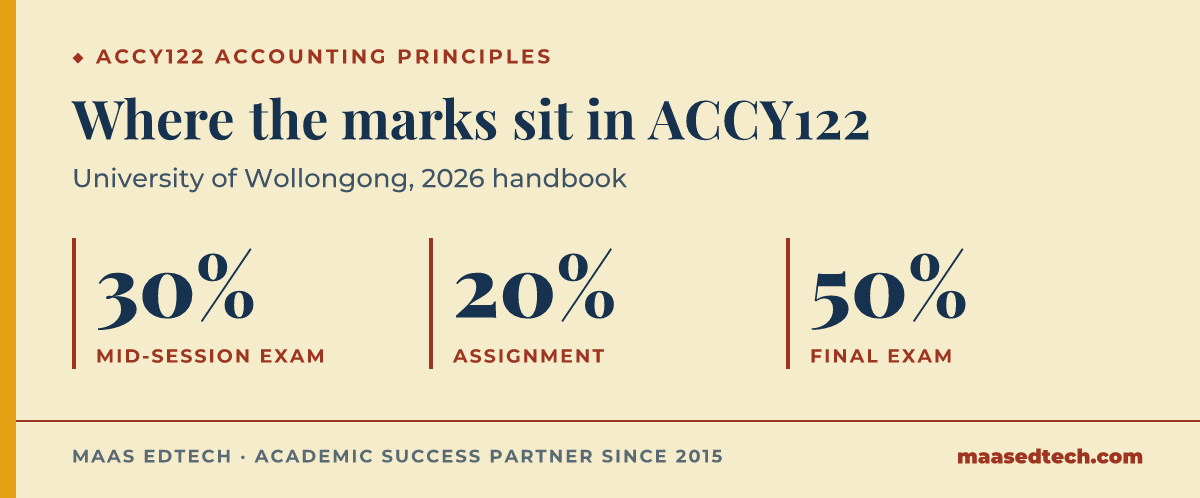
| Assessment | Type in handbook | Weight | Mode |
|---|---|---|---|
| Mid-session Exam | Exam | 30% | Individual |
| Assignment | Assignment | 20% | Individual |
| Final Exam | Exam | 50% | Individual |
Evidence: These figures were read on the Wollongong Spring on-campus offering of the 2026 handbook. The handbook does not state word limits, task wording, due dates or any hurdle requirement. Those sit in the Subject Outline and on the subject's Moodle site. Always check whether the subject sets a minimum mark on a task or a rule about passing the exam component, because that rule can matter more than any single weight.
Example: A student scores well on the assignment and assumes the 50 per cent final exam is a formality. If the Subject Outline contains a rule about the exam component, that assumption could cost the subject. Reading the pass rules in week one costs ten minutes.
How does double-entry work, and where do first-year students slip?
Direct answer: Every transaction is recorded twice, as equal debits and credits, so that the accounting equation (assets equal liabilities plus equity) always balances. Students slip in three places: choosing the wrong side of an account, forgetting the adjusting entries at period end, and treating a balanced trial balance as proof that the books are correct.
Evidence: Take a business that begins with the owner contributing $20,000 in cash. You debit Cash $20,000 and credit Owner's Capital $20,000. If it then buys $6,000 of equipment on credit, you debit Equipment $6,000 and credit Accounts Payable $6,000. At balance date, if $1,200 of wages is owed, you debit Wages Expense $1,200 and credit Wages Payable $1,200. Depreciating that equipment over five years with no residual value gives $1,200 a year, debited to Depreciation Expense and credited to Accumulated Depreciation. A trial balance totals debits and credits, but it cannot detect an entry posted to the wrong account with the right amount.
Example: Two students prepare the same set of financial statements. One stops when the trial balance balances. The other checks each adjusting entry against a list: accrued expenses, prepaid expenses, depreciation, unearned revenue, and bad debts. The second student's net profit is the one that matches the answer, even though both trial balances balanced.
How do you prepare for the accounting software component?
Direct answer: Learn the accounting first, then the buttons. The handbook's fourth outcome asks you to use accounting software to record transactions, process information and prepare financial statements, so the tool is a means of doing the same double-entry work, and a student who understands the debit and credit behind each screen recovers quickly from a wrong click.
Evidence: Your Subject Outline will name the software package and the brief. The handbook says only "accounting software". Research on an Australian first core accounting unit found that purpose-made videos on the software were "an effective resource that provided enhanced learning opportunities for students" (Jones et al., 2021). The same authors stress that students also need to understand the accounting processes behind the software, which matches the handbook's wording about recording and processing information.
Example: When a bank feed suggests a match for a payment, ask what the entry would look like on paper. If you cannot say which account is debited and which is credited, you are accepting a suggestion rather than making a decision, and that is where errors enter the books.
How should you handle the ethics outcome?
Direct answer: Link each ethical idea to a concrete behaviour in a business setting, and name the principle you are applying. Australian professional bodies use five fundamental principles from the APES 110 Code of Ethics: integrity, objectivity, professional competence and due care, confidentiality, and professional behaviour. Using that vocabulary precisely is usually worth more than a long general discussion.
Evidence: The Accounting Professional and Ethical Standards Board (APESB) states that the Code's obligations rest on "the five fundamental principles of integrity, objectivity, professional competence and due care, confidentiality and professional behaviour" (APESB, 2025). The Code uses a conceptual framework to identify, evaluate and address threats to those principles. A first-year answer does not need the full Code, but it should show the pattern: name the situation, name the threatened principle, say what a professional would do.
Example: A manager asks a bookkeeper to record a sale before the goods are delivered so that the month's results look stronger. Strong answer: this threatens integrity because it is not straightforward and honest, and it is an improper adjustment to the financial statements; the bookkeeper should decline and raise it with someone senior. Weak answer: "this is unethical."
How do you prepare for the mid-session and final exams?
Direct answer: Practise by working full problems on paper in timed conditions, then explain each answer in one sentence. The mid-session exam is worth 30 per cent and the final exam 50 per cent, so a weekly routine of problems, checked against the textbook's worked solutions, is more dependable than leaving topics to the last week.
Evidence: The handbook gives the textbook as the main resource, and its chapter questions mirror the subject's four outcomes. Plan around what the exam asks you to do: journalise, post, prepare a trial balance, make adjusting entries, and prepare financial statements. Confirm the exam format, permitted materials and in-person requirements in the Subject Outline, because they vary by session and campus.
Example: A simple weekly routine: after each tutorial, redo two tutorial problems without notes within a set time, mark them against the solutions, and write down every error type on one page. By the mid-session exam you will have a list of your own five most frequent slips, and that list is a better revision guide than a rewritten set of notes.
Which mistakes cost the most marks?
Direct answer: Four mistakes recur: reading the pass rules too late, treating the assignment as a software exercise instead of an accounting one, leaving adjusting entries until the end of an exam question, and using someone else's guide written for a different offering. Each is cheap to avoid if you check early.
Evidence: The first three are about process, and the fourth is about source control. Because the handbook lists ten offerings of the same code across several campuses and sessions, only your own Subject Outline defines your tasks. Academic integrity rules also apply to the assignment: take the Subject Outline's position on tools and collaboration as binding, and ask your tutor when it is unclear.
Example: Before you submit, check each answer against four labels: T for transaction, A for adjustment, S for statement, and E for ethics. If the assignment has no E, you have not addressed outcome one, and if it has no A, your profit figure is probably wrong.
A practical order of work
Direct answer: Read the Subject Outline and the pass rules in week one, build the weekly problem routine in weeks two to six, start the assignment as soon as it is released, and keep two weeks before the final exam for timed full-paper practice. The order protects the two largest marks first.
Evidence: With 80 per cent in two exams and 20 per cent in one assignment, the order follows the weights: routine practice for the exams, early software practice for the assignment, and an ethics note kept as you go so that the outcome is covered by evidence, not by a last-minute paragraph.
Example: Keep a one-page "what I got wrong" sheet. After the mid-session exam, add the types of error that cost marks. Reading it the night before the final exam is far more useful than skimming every chapter again.
Frequently asked questions
Which institution offers ACCY122?
The University of Wollongong, where the 2026 handbook records it as Accounting Principles, a 100-level subject worth 6 credit points in the School of Business. Confirm against your own enrolment record, because codes of this shape are reused elsewhere for unrelated subjects.
How is ACCY122 assessed?
The 2026 handbook lists a mid-session exam (30%), an assignment (20%) and a final exam (50%), all individual. Task details and any pass requirement are in your Subject Outline.
What are the prerequisites?
The 2026 handbook page shows no prerequisite for the offering reviewed. Enrolment rules are restated each year, so check the entry for your commencement year.
What is ACCY122 equivalent to?
The handbook lists ACCY111 Accounting Fundamentals In Society and WUCB122 Accounting Principles as equivalents.
How do I prepare for the accounting software assignment?
Learn the double-entry logic first, then practise the software on small sets of transactions. Your Subject Outline names the software and the brief.
Is generative AI allowed in the assignment?
Rules differ by task. Take the Subject Outline's statement as binding and ask your tutor if it is unclear, because academic integrity breaches carry penalties.
Related reading
- ACCY200 Financial Accounting: the next subject in the sequence, where standards and the Conceptual Framework are applied in a report
- ACCY201 Advanced Financial Accounting: the advanced subject after that, where complex arrangements are accounted for
- ACCT1101 Accounting for Decision Making: a first-year accounting subject at another university, with a user-focused view of the same reports
Where MAAS fits
- Coursework and assignment support: developmental feedback on your own draft through the Outline, Draft, Final model with a discipline-matched expert
- Subject tutoring, one to one: 60 or 90 minute sessions with a tutor matched to your subject area. Tutoring is advisory, so it carries no grade target; if the tutor is not the right fit, you can ask to change expert
- Course-code assignment coaching: how MAAS mentors approach any unit assignment
References
- Accounting Professional and Ethical Standards Board. (2025). APES 110 Code of ethics for professional accountants (including independence standards). Accounting Professional and Ethical Standards Board.
- Hoggett, J., Medlin, J., Chalmers, K., Beattie, C., Hellmann, A., & Maxfield, S. (2021). Accounting (11th ed.). John Wiley & Sons Australia.
- Jones, G., Jones, H., Pensiero, D., & Beattie, C. (2021). Enhancing students' employability skills and experiential learning through integration of Xero software. In ASCILITE 2021 conference proceedings: Back to the future. ASCILITE Publications. https://publications.ascilite.org/index.php/APUB/article/view/361
Tools & resources
- Accounting Professional and Ethical Standards Board. (2025). APES 110 code of ethics. https://www.apesb.org.au/apes-110-code-of-ethics/
- University of Wollongong. (2026). Course handbook: ACCY122 Accounting Principles. Retrieved October 10, 2026, from https://courses.uow.edu.au/subjects/2026/ACCY122
This article is part of the MAAS Journal series for Vietnamese international students. MAAS Assignment & Essay Support is an academic support partner; we coach students through the Outline, Draft, Final delivery model with developmental feedback from discipline-matched experts. We do not write or submit work on a student's behalf.