
Most students treat Preparation for Research Project as a warm-up that produces no findings, and nothing in it feels final. That reading is expensive, because the work produced here is the work students will be held to. Hertfordshire places this module immediately before the Research Project itself, and students are advised not to deviate from what they developed. A proposal written to sound impressive commits its author to a study they may not be able to run.
Committing to a design before the fact is the same discipline protocol reporting standards such as SPIRIT emphasise (Chan et al., 2013). Below is how MAAS mentors frame the module for Vietnamese clinicians and health students taking it.
Author: MAAS Editorial Team
Last updated: 2026-08-10
Category: health-education

Where does 7HSK2049 sit in the sequence?
Direct answer: 7HSK2049 Preparation for Research Project is a Level 7 module in the School of Health and Social Work at the University of Hertfordshire, worth 15 credits. It is the middle step in a three-module chain: Research Methods, then Preparation for Research Project, then the Research Project itself. Both earlier modules must be completed before you can take the project.
Evidence: The university publishes the module openly among its short courses and continuing professional development provision, with the prerequisite chain and the part-time credit structure stated. The cohort it serves is drawn from practising health professionals, including nurses, midwives, paramedics, physiotherapists, radiographers and radiotherapists, who are working towards a master's award alongside clinical employment, the same practitioner-researcher population Polit and Beck (2021) write their evidence text for.
Example: One student assumed she could refine her question later, during the project, and used this module to explore three possible directions rather than commit to one. When the project began, her supervisor held her to the proposal she had submitted. The exploration had been genuinely useful thinking, and none of it was in the document that counted.
Two consequences follow from the sequencing, and they are worth planning around before you write a word. Your proposal is a commitment rather than a draft, the same commitment Polit and Beck (2021) describe a protocol making before a single participant is recruited. And because you study part-time while working clinically, the feasibility questions in it are about your real calendar, not a hypothetical one.
What is actually being assessed?
Direct answer: Your judgement about what can be done, not the ambition of what you would like to do. A proposal is assessed on whether the question is answerable, whether the method can reach the data, whether access and ethical approval are realistic, and whether the whole thing fits the time and credit envelope available, the same elements SPIRIT requires a clinical protocol to state before the study begins (Chan et al., 2013).
Evidence: This judgement-based assessment is the standard function of a research protocol across health disciplines, which is why reporting guidance in the field puts such weight on stating design, participants, data sources and analysis before the study begins rather than after (Chan et al., 2013). The logic is that a protocol written in advance can be judged on its reasoning, while one written afterwards can be shaped to fit whatever happened, the same standard Polit and Beck (2021) apply when they describe how nursing research is judged for rigour before data collection begins. Your marker is reading for reasoning.
Example: A proposal set out to compare patient experience across three hospital departments over six months. Asked what would happen if one department declined access, the writer had no answer, and the study had no fallback. Narrowing to one department with a clear access route produced a smaller study and a considerably stronger proposal, because every element of it could now actually occur, the pre-specification discipline SPIRIT was built to enforce (Chan et al., 2013).
Which parts do students underestimate?
Direct answer: Ethics and governance, feasibility, and the analysis plan. All three are unglamorous, all three are where a proposal is judged, and all three are routinely written as a paragraph of intention rather than a worked plan, the gap between description and specification that Ritchie et al. (2014) treat as the difference between a competent and a fundable design.
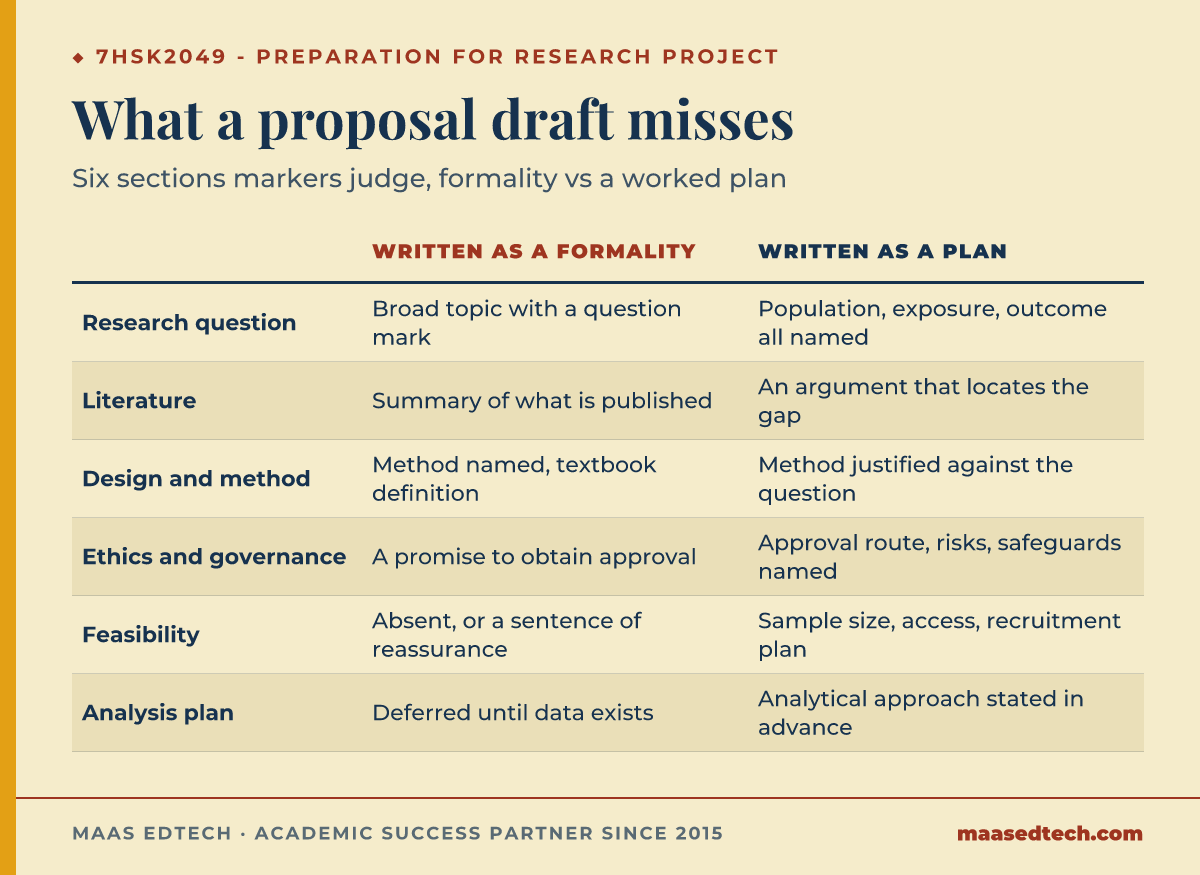
| Section | Written as a formality | Written as a plan |
|---|---|---|
| Research question | A broad topic area with a question mark added | One answerable question with its population, exposure or focus, and outcome all named |
| Literature | A summary of what has been published | An argument that locates the specific gap this study addresses |
| Design and method | The method named, with a textbook definition | The method justified against the question, with alternatives considered and rejected for stated reasons |
| Ethics and governance | A promise to obtain approval | The approval route identified, the specific risks to participants named, and the safeguards described |
| Feasibility | Absent, or a sentence of reassurance | Sample size or sampling logic, access route, recruitment window, and what happens if recruitment underperforms |
| Analysis plan | Deferred until data exists | The analytical approach stated in advance, matched to the data the design will produce |
Evidence: The costliest omission is usually the analysis plan, because deciding how to analyse after seeing the data invites selective reporting and reviewers know it. In qualitative work the equivalent error is naming an approach without specifying how it will be applied, which is why Braun and Clarke (2006) set out thematic analysis as a sequence of decisions rather than a label, and why Ritchie et al. (2014) treat the analytic framework itself, not just the interview questions, as something a proposal should specify in advance. Where clinical research is concerned, the governance route is not a formality either: studies involving NHS patients, staff or data sit within a defined approval system, and a proposal that does not acknowledge it has skipped the step most likely to delay the project.
Example: A student planned semi-structured interviews with nurses about handover practice and wrote that data would be "analysed thematically." Pressed on what that meant procedurally, she specified how transcripts would be coded, at what level themes would be generated, and who would check the coding. The design had not changed. The proposal now showed a researcher who knew what she would be doing on the day the first transcript arrived, the procedural specificity Braun and Clarke (2006) built their six-phase sequence to make explicit.
How should feasibility be argued rather than asserted?
Direct answer: By costing the study in the currency you actually have, which for a part-time clinician is time, access and goodwill. State the numbers, state where they come from, and state what you will do if they do not hold, including for a qualitative design, where Malterud, Siersma and Guassora write that "information power indicates that the more information the sample holds, relevant for the actual study, the lower amount of participants is needed" (Malterud et al., 2016), rather than following a fixed rule of thumb.
Evidence: Recruitment shortfall is among the most common reasons small health studies fail to deliver, and it is largely predictable at the proposal stage from the eligible population and a realistic consent rate. A proposal that names both figures and derives a recruitment window from them has demonstrated judgement. One that states a target number with no derivation has stated a hope.
Example: A proposal aimed to recruit forty participants from a single clinic. The clinic saw roughly sixty eligible patients a month, and the writer had assumed most would consent. Working backwards from a conservative consent rate turned forty participants into a four-month recruitment window that did not fit the submission deadline. The target became twenty-four, the design shifted accordingly, and the study became one that could be completed.
How does this differ from writing a dissertation proposal in another discipline?
Direct answer: Two features are specific to health. The governance layer is external to the university, often running through the Health Research Authority and its Integrated Research Application System rather than the university alone, and your dual role as clinician and researcher creates ethical questions that a student outside practice never faces.
Evidence: Recruiting participants from a service where you also work introduces the possibility that patients or colleagues feel obliged to take part, which is a recognised concern in insider research within professional settings. Naming that risk and describing how you will separate the two roles, for instance by having someone else approach potential participants, is precisely the kind of reasoning that distinguishes a Level 7 proposal from a competent undergraduate one, and the kind of positionality Ritchie et al. (2014) expect a qualitative researcher to state rather than leave implicit.
Example: A midwife proposed interviewing women she had cared for, on the reasonable grounds that they trusted her. Her supervisor asked how a participant would decline. Because she could not describe a comfortable way for someone to say no, the recruitment route changed, and the proposal gained a paragraph of ethical reasoning it had been missing, the kind of researcher-role scrutiny Polit and Beck (2021) expect a nursing research protocol to show explicitly.
What should the writing itself look like?
Direct answer: Precise, hedged where the evidence is uncertain, and specific everywhere else. A proposal is one of the few academic genres where vagueness is read as a design flaw rather than a stylistic one, because every unspecified detail is a decision you have not yet made, the complexity-and-incomplete-data standard QAA (2024) sets for master's-level work.
Evidence: The transferable skills expected at master's level include making critical use of relevant literature and defending your work in detail and in context, and a proposal is the document where that defence is rehearsed. The Quality Assurance Agency frames master's attainment in terms of originality in applying knowledge and dealing with complexity and incomplete data (QAA, 2024). Acknowledging what you do not yet know is therefore part of the standard rather than a weakness in it.
Example: A draft stated that the study "will improve patient outcomes." The claim was well intentioned and unsupportable, since a small qualitative study cannot demonstrate outcome improvement. Rewritten to say that the study would describe how staff understand a specific handover practice, and that this understanding could inform later intervention design, the sentence became modest and defensible at once, closer to the honesty about incomplete data that QAA (2024) treats as part of master's-level attainment rather than a weakness in it.
What do MAAS mentors actually do on this module?
MAAS works as an academic advisor. Because this module locks the shape of the project that follows, the most valuable conversation is early: is this question answerable within your access, your timetable and your credit envelope? A mentor then reads your proposal against the module's requirements, asks the questions a supervisor and an ethics reviewer would ask, and points out where an intention has been written in place of a plan. You write and submit your own work, and you remain responsible for your own ethics application. Referencing is checked inside that read rather than sold separately.
Frequently asked questions
How many credits is 7HSK2049 worth?
15 credits at Level 7, studied part-time within the School of Health and Social Work.
Do I have to take it before the Research Project?
Yes. The published sequence requires Research Methods and Preparation for Research Project to be completed successfully before the Research Project module, and this one is intended to be studied immediately beforehand.
Can I change my topic after this module?
Students are advised not to deviate significantly from the work developed here, so treat the proposal as a commitment. If you have genuine doubts about your question, raise them during this module rather than after it, when changing course is far more costly, the same commitment logic SPIRIT applies to clinical protocols more broadly (Chan et al., 2013).
Who is the module for?
It serves practising health professionals working towards a master's award, including nurses, midwives, paramedics, physiotherapists, radiographers and radiotherapists.
Do I need ethical approval before I submit the proposal?
Requirements differ by programme and by study, and your module handbook and supervisor are the authority, though many NHS-facing studies route through the Health Research Authority rather than the university alone. What is consistently expected in the proposal itself is that you identify the correct approval route and show you understand what it will require of your design.
Is a small study a weak study?
No. At this level, a small study that is fully specified and can actually be completed marks higher than an ambitious one that could not survive its first contact with recruitment, in line with Malterud et al.'s (2016) argument that a sample size should be justified by the information it can realistically deliver.
Related reading
- How to write a dissertation proposal
- How to calculate sample size for a research study
- Academic mentoring from MAAS
Talk to a MAAS mentor about your module
References
Braun, V., & Clarke, V. (2006). Using thematic analysis in psychology. Qualitative Research in Psychology, 3(2), 77–101. https://doi.org/10.1191/1478088706qp063oa
Chan, A.-W., Tetzlaff, J. M., Altman, D. G., Laupacis, A., Gøtzsche, P. C., Krleža-Jerić, K., Hróbjartsson, A., Mann, H., Dickersin, K., Berlin, J. A., Doré, C. J., Parulekar, W. R., Summerskill, W. S. M., Groves, T., Schulz, K. F., Sox, H. C., Rockhold, F. W., Rennie, D., & Moher, D. (2013). SPIRIT 2013 statement: Defining standard protocol items for clinical trials. Annals of Internal Medicine, 158(3), 200–207. https://doi.org/10.7326/0003-4819-158-3-201302050-00583
Malterud, K., Siersma, V. D., & Guassora, A. D. (2016). Sample size in qualitative interview studies: Guided by information power. Qualitative Health Research, 26(13), 1753–1760. https://doi.org/10.1177/1049732315617444
Polit, D. F., & Beck, C. T. (2021). Nursing research: Generating and assessing evidence for nursing practice (11th ed.). Wolters Kluwer.
Quality Assurance Agency for Higher Education. (2024). The frameworks for higher education qualifications of UK degree-awarding bodies. QAA. https://www.qaa.ac.uk/docs/qaa/quality-code/the-frameworks-for-higher-education-qualifications-of-uk-degree-awarding-bodies-2024.pdf
Ritchie, J., Lewis, J., McNaughton Nicholls, C., & Ormston, R. (Eds.). (2014). Qualitative research practice: A guide for social science students and researchers (2nd ed.). SAGE.