
The module is called Strategy and Leadership for Tourism and Events, and most coursework answers only the first noun. Students produce a competent strategic analysis of a hotel group or a festival operator, close with recommendations, and never explain who inside that organisation would lead the change, or why it would survive contact with them. The module asks students to reflect on their own practice, a learning outcome analysis alone leaves untouched.
Author: MAAS Editorial Team
Last updated: 2026-08-09
Category: business-management

What is 6BUS2063 actually about?
Direct answer: Strategy and Leadership for Tourism and Events is a 15-credit final-year option in Hertfordshire Business School's events and tourism provision. It covers strategic management theories, decision-making techniques, and analytical skills for managerial careers, set against a changing global environment and digital transformation. Students also analyse leadership dimensions, particularly change management under volatile conditions.
Evidence: That wording comes from Hertfordshire's published undergraduate course pages, where the module appears in the optional block. The provenance matters more than usual here. Hertfordshire keeps its Definitive Module Documents behind a student login, so the pages circulating publicly under the code 6BUS2063 are almost entirely reposts by assignment-selling sites. Some of those pages carry a plausible-looking brief, complete with word count and reference minimums; none of them can be verified against the University, and several are dated to academic years that have passed.
Example: A student told her MAAS mentor she had to cite "at least twenty-five sources, seven of them academic," a figure she had taken from one of those reposted pages. Her own assessment brief on the module site set a different expectation. She had been building her reading list to satisfy a rule that did not apply to her cohort, and had been treating the count as the target rather than the argument.
The practical instruction is simple and worth stating plainly: whatever this article or any other page says about the brief, the version in your own module handbook is the only one that marks your work. Use external material, including Mintzberg (1994) and Yukl (2013), to understand the subject, never to infer the task.
Why do so many reports pass on strategy and stall on leadership?
Direct answer: Because the two halves reward different kinds of writing, and students are trained in only one. Strategic analysis is a diagnostic activity with familiar tools and a visible output: you apply a framework, generate findings, and the page fills. Leadership analysis is about agency and constraint, which means writing about people who might refuse, hesitate, or lack the authority to act. It produces no tidy diagram, so students skip it and compensate by adding a fourth framework to the strategy section. The result is a report that grows longer without becoming more analytical, the trap Mintzberg (1994) describes as mistaking the production of analysis for the act of deciding.
Evidence: Mintzberg (1994) argued that strategic planning had been widely mistaken for strategic thinking, with organisations mistaking the production of analysis for the act of deciding. The critique lands directly on this genre of coursework. Meanwhile, the leadership literature the module points toward is concerned with exactly what the analysis leaves out. Bass and Riggio (2006) set out transformational leadership as a mechanism through which followers' commitment is altered rather than their instructions changed, and Yukl (2013) documents how far leadership effectiveness depends on situational variables rather than traits. Kotter (1996) remains the reference point for why change programmes fail on implementation rather than design. None of these can be applied by a report that never names a person or a decision.
Example: A student produced a strong Porter-and-VRIO analysis of a Vietnamese resort group and recommended a shift toward high-margin wellness tourism. His mentor asked a single question: who signs that off? It emerged that the group's property managers were paid on occupancy, and a wellness pivot would depress occupancy for two seasons before margins improved. The recommendation was not wrong, but it was unleadable as written, missing exactly the follower-commitment mechanism Bass and Riggio (2006) describe. Adding one section on the incentive conflict and the leadership approach required to hold the line through those two seasons moved the report from a description of a good idea into an argument about whether the organisation could execute it.
Which frameworks do the work, and which are decorative?
Direct answer: Pair one framework that explains the industry position with one that explains the internal capability, then add one that explains the human mechanism of change. Three used precisely beats six surveyed. In a sector defined by seasonality, perishable inventory and external shocks, the frameworks that assume a stable environment need to be used with explicit caveats rather than applied straight.
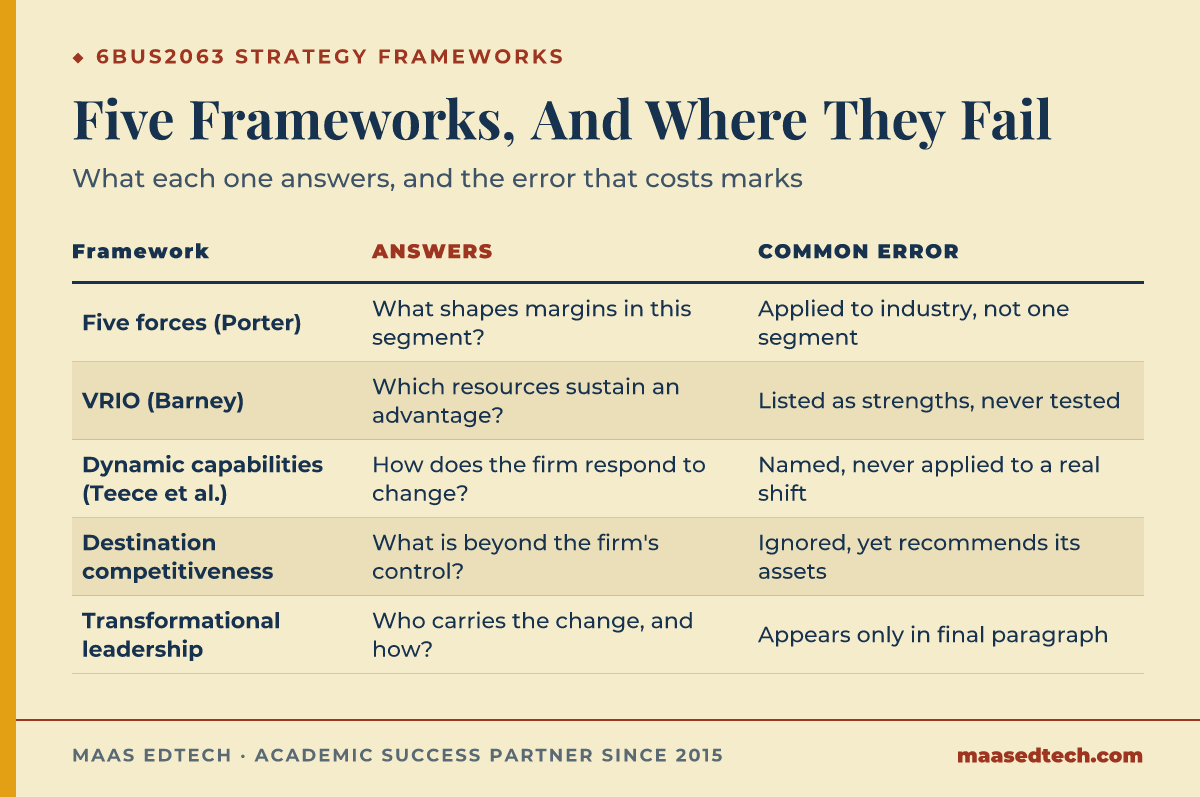
| Framework | The question it answers | Where students go wrong |
|---|---|---|
| Five forces and generic strategy (Porter) | What structural pressures shape margins in this segment? | Applying it to "the tourism industry" rather than to a defined segment, which produces findings true of everyone and useful to no one |
| Resource-based view and VRIO (Barney) | Which resources could sustain an advantage? | Listing "excellent location" and "strong brand" without testing imitability, which is where the framework earns its keep |
| Dynamic capabilities (Teece, Pisano & Shuen) | How does the firm sense and reconfigure when conditions shift? | Naming the concept and then never applying it to an actual shift, despite the sector supplying obvious ones |
| Destination competitiveness (Ritchie & Crouch) | What is beyond the individual firm's control? | Ignoring it entirely, then recommending actions that depend on destination-level assets the firm does not own |
| Transformational leadership and change (Bass & Riggio; Kotter) | Who carries the change, and what makes them stop? | Appearing only in the final paragraph as an assertion that "strong leadership will be required" |
Evidence: Porter (1985) framed competitive advantage as the product of five structural forces and three generic strategies, cost leadership, differentiation and focus, which is exactly the segment-level application the table above expects rather than a description of "the tourism industry" in general. Barney (1991) opens by naming the problem the VRIO test was built to solve: "Understanding sources of sustained competitive advantage has become a major area of research in strategic management" (Barney, 1991, p. 99). He then established that an advantage is sustained only when a resource is valuable, rare, imperfectly imitable and non-substitutable, and that most named strengths fail the third test. Teece, Pisano and Shuen (1997) shifted the question from what a firm owns to how it reconfigures, a framing that fits an industry where demand can vanish in a quarter. Ritchie and Crouch (2003) demonstrated that competitiveness in tourism is substantially determined at destination level, which means an analysis stopping at the firm boundary has excluded part of the causal picture.
Example: A student assessing a boutique hotel listed a heritage building as a rare and valuable resource. Her mentor asked whether a competitor could replicate the effect. Three other operators in the same district had converted comparable buildings within 4 years. The resource was valuable and imitable, which is a different strategic situation and demands a different recommendation. That one correction reframed the report around service design rather than property, and it came from applying the VRIO test Barney (1991) set out, instead of adding another framework.
How should a consultancy-style report be structured?
Direct answer: Treat it as an argument delivered in report clothing. The formatting conventions of the genre, executive summary, numbered sections, recommendations, are packaging; the mark comes from whether the recommendations are derived from the analysis rather than appended to it. A structure that holds up at Level 6: an executive summary that states the finding and the recommendation, not the method; an introduction naming the organisation and the specific strategic question; an external and internal analysis in which every framework produces a stated finding; a synthesis section that says which findings conflict; recommendations traceable line by line to those findings; and a leadership and implementation section that names who acts, what resistance is expected, and how it is addressed.
The synthesis and leadership sections are the two most often missing, and between them they hold most of the marks available above a bare pass. A report in which the analysis and the recommendations could be swapped for another company's without anyone noticing has failed at the join, the synthesis failure Evans (2015) treats as a distinct problem in tourism strategy.
Evidence: The UK Quality Assurance Agency's descriptor for a bachelor's degree with honours expects graduates to critically evaluate arguments and evidence and to appreciate the uncertainty and limits of knowledge in their discipline (QAA, 2024). A recommendations section with no account of what could go wrong has structurally removed the criterion it most needs to meet. Evans (2015) makes the same point from inside the sector, treating strategic implementation in tourism and hospitality as a distinct problem rather than a coda to analysis.
Example: A student's report recommended that a tour operator diversify into domestic packages after inbound demand fell. The analysis supported it. What the report never said was that the operator's competitive advantage, its foreign-language guides, had no value in the domestic segment. His mentor asked him to write the counter-case in full. He kept the recommendation but narrowed it to a two-year bridge with an explicit exit condition, and named the internal argument the managing director would face from the guiding team. The report became defensible precisely because it stopped being confident, meeting the QAA (2024) expectation to appreciate the limits of the analysis.
What does the reflective element actually require?
Direct answer: Where the brief asks you to reflect on your own leadership, it is asking for evidence that you can apply the module's concepts to a case you know from the inside, not for a personality description. "I am a democratic leader" is a claim without evidence. A short account of a specific episode, a group project, a part-time job, a student club event, analysed with the same vocabulary you applied to the organisation, is what the outcome is testing.
Evidence: Yukl (2013) documents the contingent nature of leadership effectiveness, which is why a self-assessment naming a fixed style is weaker than one describing behaviour under specific conditions. The reflective writing literature makes a parallel point: description of an experience is the entry level, and the marks sit in the analysis and the reasoned change in future practice (Moon, 2004).
Example: A student wrote that she had learned to "communicate better" after a group event ran over budget. Her mentor asked what she had actually done differently the second time. She had started circulating a written cost position before each meeting rather than raising it verbally, which changed who spoke up. That is a leadership intervention with a mechanism, the situational behaviour change Yukl (2013) describes, and it took four sentences to say.
Common mistakes that cost marks in 6BUS2063
- Analysing "the tourism industry" instead of a segment. Five forces applied at industry level produces conclusions no board would pay for.
- Frameworks with no findings. A PESTEL table that is not referred to again is a table, not an analysis.
- Recommendations that appear from nowhere. Every recommendation should be traceable to a numbered finding.
- Leadership as a closing sentence. If the word appears only in the conclusion, half the module title is unaddressed.
- Ignoring the destination level. In this sector, some determinants sit outside the firm; saying so is analysis, not an excuse.
- Treating a downloaded brief as authoritative. Your module handbook governs; nothing else does.
- Writing in the first person when the brief forbids it. A style rule is cheap to satisfy and irritating to lose marks on.
Five sources behind this guide
Direct answer: Five studies do most of the work behind the frameworks above, and each is worth reading past the summary before you cite it.
- Barney (1991), published in the Journal of Management, set out the VRIO test for a sustained resource-based advantage.
- Teece, Pisano and Shuen (1997), published in the Strategic Management Journal, introduced dynamic capabilities as the ability to sense and reconfigure.
- Ritchie and Crouch (2003), published in The Competitive Destination, argued that tourism competitiveness is set partly at destination level.
- Bass and Riggio (2006), in Transformational Leadership, described how commitment is altered rather than instructions changed.
- Kotter (1996), in Leading Change, traced why change programmes fail on implementation rather than design.
Example: A student who wanted to check whether her mentor had summarised Barney (1991) correctly searched the author name plus the year on Google Scholar and read the original definition of VRIO before using it.
Frequently asked questions
Do I need a real organisation or can I invent one?
Use a real one. The module asks you to relate practical business examples to theory, the same standard Evans (2015) applies to tourism strategy cases, and an invented firm lets you supply whatever evidence your argument needs, which removes the difficulty the assessment is measuring. Choose an organisation with enough public reporting to support claims, and be prepared to say where the evidence stops.
How many frameworks should I use?
Enough to answer the question and no more. Two or three applied properly, each generating a finding you use later, will outscore six named in passing. Examiners can see the difference immediately, because a decorative framework has no consequences anywhere else in the report, the same test Barney (1991) applies when a resource fails the imitability check.
Can I use news articles and company websites as sources?
Yes, and in this module you should. Sector evidence, the kind Ritchie and Crouch (2003) draw on for destination-level analysis, is often only available in trade press and company reporting. Keep the distinction visible: academic sources, such as Kotter (1996), supply the concepts you reason with, practitioner sources supply the facts about the case. Problems arise when a trade article is used to establish a theoretical claim that belongs to Mintzberg (1994) or Barney (1991) instead.
What if my chosen organisation was badly hit by an external shock?
That is usually an advantage. Shocks make dynamic capabilities visible, since you can observe what the firm sensed, how it reconfigured, and what it could not change. A firm that had a quiet, stable year gives you much less to analyse, since Teece, Pisano and Shuen (1997) define the capability by how it responds to change, not by how it looks when nothing changes.
Is a Vietnamese organisation acceptable?
Normally yes, unless your brief specifies otherwise, and it can strengthen the report, echoing the local-context point Ritchie and Crouch (2003) make about destination-level evidence, because you may have access to context that published sources lack. Ensure you can evidence your claims to a marker who does not know the market, and translate the names of any sources you cite, the same discipline Moon (2004) expects in reflective writing that names a specific, verifiable episode.
Related reading
- How to write a university report
- Critical thinking in academic writing
- Academic support from MAAS mentors
Talk to a MAAS mentor about your module
References
Barney, J. (1991). Firm resources and sustained competitive advantage. Journal of Management, 17(1), 99–120. https://doi.org/10.1177/014920639101700108
Bass, B. M., & Riggio, R. E. (2006). Transformational leadership (2nd ed.). Lawrence Erlbaum Associates.
Evans, N. (2015). Strategic management for tourism, hospitality and events (2nd ed.). Routledge.
Kotter, J. P. (1996). Leading change. Harvard Business School Press.
Mintzberg, H. (1994). The rise and fall of strategic planning. Prentice Hall.
Moon, J. A. (2004). A handbook of reflective and experiential learning: Theory and practice. RoutledgeFalmer.
Porter, M. E. (1985). Competitive advantage: Creating and sustaining superior performance. Free Press.
Quality Assurance Agency for Higher Education. (2024). The frameworks for higher education qualifications of UK degree-awarding bodies. QAA. https://www.qaa.ac.uk/docs/qaa/quality-code/the-frameworks-for-higher-education-qualifications-of-uk-degree-awarding-bodies-2024.pdf
Ritchie, J. R. B., & Crouch, G. I. (2003). The competitive destination: A sustainable tourism perspective. CABI Publishing.
Teece, D. J., Pisano, G., & Shuen, A. (1997). Dynamic capabilities and strategic management. Strategic Management Journal, 18(7), 509–533. https://doi.org/10.1002/(SICI)1097-0266(199708)18:7<509::AID-SMJ882>3.0.CO;2-Z
Yukl, G. (2013). Leadership in organizations (8th ed.). Pearson.