
◆ Study Hacks
How does time blocking work for university students?
Last updated: 2026-10-23
Category: study-hacks
Time blocking is a way of deciding, before the day starts, which task will get which hours. Instead of a to-do list that only says what must happen, you give every task a start time, an end time and a place in the day. This guide, written on 23 October 2026, explains the technique step by step: how to size a block, where to put a buffer, how to protect a block once it exists, and what to do when the day breaks. It draws on three meta-analyses, a review and two classic studies of planning, and it says plainly where the evidence stops.
Direct answer: Time blocking means dividing your day into blocks of hours, giving each block one task, and leaving buffer time between blocks. No study tested time blocking by name. Research on time management and planning does support its parts: structuring time, deciding when and where you will act, and allowing for overruns.
◆ Question 1 / 8 · What does time blocking mean
What does time blocking mean?
Direct answer: Time blocking means writing your day as a sequence of blocks, each with a start time, an end time and one task. The idea is popular through Newport (2016), but none of the 6 academic sources cited here tested the method under that name.
The best academic description of what time blocking tries to do comes from research on time management in general. Aeon et al. (2021, p. 2) quote a definition of time management as "a form of decision making used by individuals to structure, protect, and adapt their time to changing conditions". That sentence maps closely onto the three skills a block schedule needs. You structure the day by cutting it into blocks, you protect each block from other demands, and you adapt by moving blocks when the day changes.
A block is different from a to-do item, and the Aeon et al. (2021) definition lists 3 skills that a block uses together. "Write methods section" is a task that can sit on a list for a week. "Tuesday, 09:00 to 11:00, library, methods section" is a block, because it names a time and a place. Everything below follows from that one difference (Newport, 2016). If an item on your list has no start time, it is still only a wish.
◆ Question 2 / 8 · Is time blocking really
Is time blocking really effective?
Direct answer: The evidence is indirect but encouraging. A meta-analysis found that time management has a moderate link with academic achievement, and other research supports planning when and where you will act. None of it proves that time blocking itself raises grades, so treat it as a method to trial.
Aeon et al. (2021) combined 76 samples with 30,605 students and found a correlation of r = 0.262 between time management and academic achievement. The same meta-analysis found a link of r = 0.313 with overall wellbeing (Aeon et al., 2021, p. 11). Its authors concluded that "Time management has a moderate influence on job performance, academic achievement, and wellbeing" (Aeon et al., 2021, p. 14). Two cautions apply, and Aeon et al. (2021) make both. The analysis is correlational, so it cannot show that managing time causes better results. And it measures time management in general, not blocks of hours specifically.
Two further lines of research support parts of the method. Gollwitzer and Sheeran (2006) pooled 94 tests of implementation intentions, plans that state when, where and how you will act, and found an effect of d = .65 on goal attainment. Sheeran et al. (2025) later reviewed 642 tests and reported effects between d = .27 and d = .66 across cognitive, affective and behavioural outcomes (Sheeran et al., 2025). A block with a time and a place resembles such a plan, though no study read here tested blocks directly. Britton and Tesser (1991) surveyed 90 college students in 1983 and read their GPA in 1987, and found that two time-management components predicted grades with R² = .21 (Britton & Tesser, 1991). These studies are reasons to try blocking, not a guarantee that it works for you.
| Source | What it found | What it cannot tell you |
|---|---|---|
| Aeon et al. (2021) | r = 0.262 with academic achievement, 76 samples, N = 30,605 | Whether blocks of hours cause the gain |
| Gollwitzer & Sheeran (2006) | d = .65 on goal attainment, 94 tests | Whether a block schedule counts as an implementation intention |
| Sheeran et al. (2025) | d = .27 to d = .66, 642 tests | Which block lengths work best |
| Britton & Tesser (1991) | R² = .21 for GPA, 90 students | Whether the habits were blocks or something else |
◆ Question 3 / 8 · How big should a block be
How big should a block be, and how much buffer do you need?
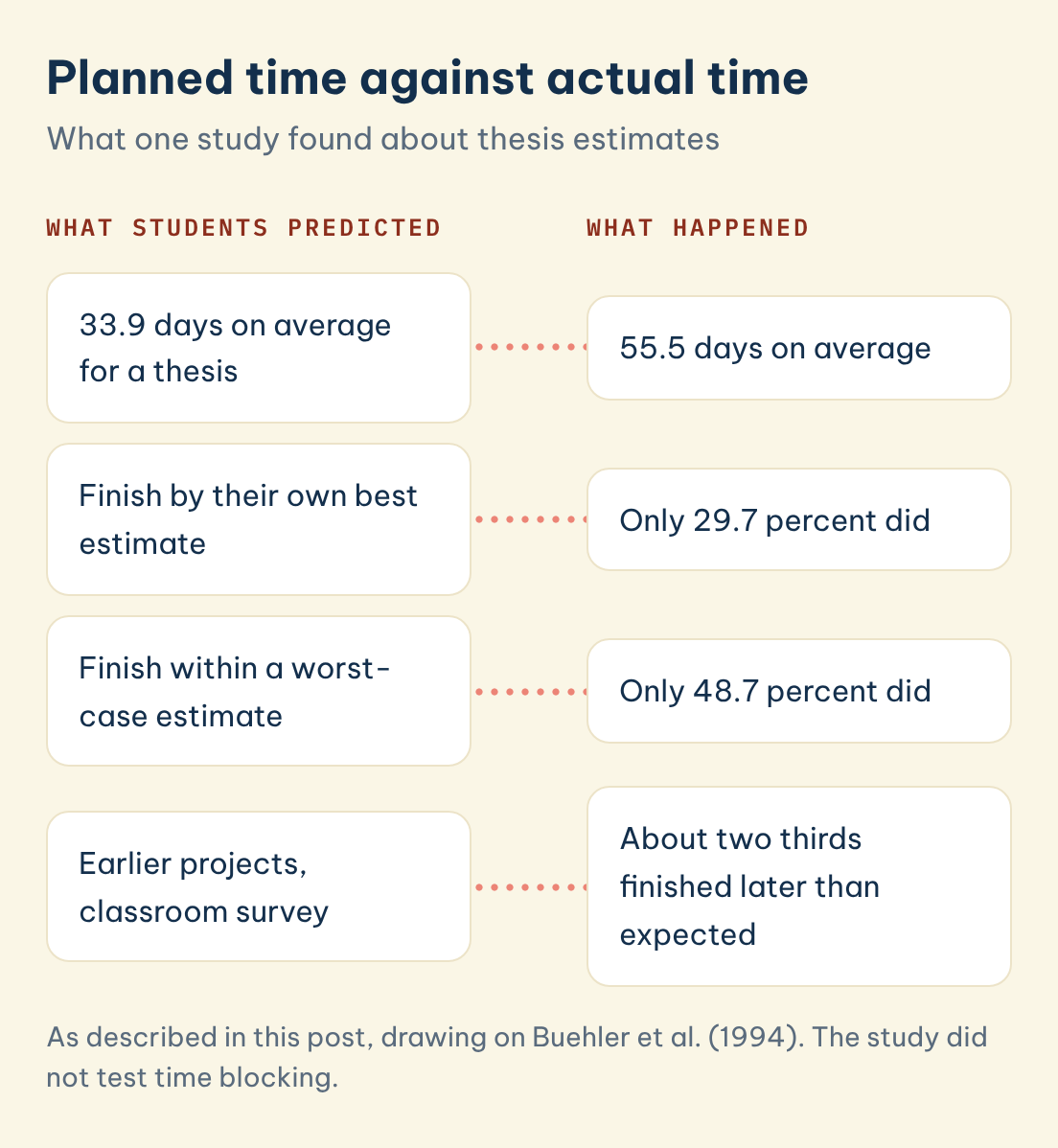
Direct answer: None of the sources read here gives an ideal block length, so choose one you can really keep. Add buffer because people underestimate tasks: students in one study predicted 33.9 days for a thesis and took 55.5 days on average.
Start with the task, not the clock. Pick one block length, say 90 minutes, that matches how long you can really keep working on one thing, and treat that as an experiment rather than a rule. One starting point is a block of 60 to 120 minutes for demanding work such as reading or writing, with blocks of 30 minutes for email, admin and errands. This guide offers that as a starting suggestion only, because no study read here tests specific block sizes.
Buffers matter more than block size, and here the evidence is stronger. Buehler et al. (1994) asked 37 honours thesis students at the University of Waterloo to predict how long their thesis would take. They predicted 33.9 days on average and actually took 55.5 days. Only 29.7 percent finished by their own best estimate, and even when asked for a worst case, only 48.7 percent finished within it. In a classroom survey, students finished about two thirds of earlier projects later than expected (Buehler et al., 1994). The practical lesson of Buehler et al. (1994) is to leave unscheduled space between blocks, such as 30 minutes after a demanding one, and a spare block at the end of the day, so that one late task does not push everything else out.
Planned time against actual time
What one study found about thesis estimates
What students predicted
What happened
33.9 days on average for a thesis
55.5 days on average
Finish by their own best estimate
Only 29.7 percent did
Finish within a worst-case estimate
Only 48.7 percent did
Earlier projects, classroom survey
About two thirds finished later than expected
Save this figure
◆ Question 4 / 8 · Time blocking example: what
Time blocking example: what does a blocked day look like?
Direct answer: A blocked day names one task for each block, puts the hardest work first, and keeps a spare block near the end. The table below is an illustration written for this guide, not data from any study, so adapt it to your own timetable.
Imagine a student with a lecture at 14:00 and a 2,000-word assignment due on Friday, 4 days away. The morning is the part of the day she controls, so the blocks go there. Each block has a task, a place and an end time, and there are gaps between them for a break and for overrun. The final block is left empty on purpose, as a landing place for whatever did not fit.
| Time | Block | Place |
|---|---|---|
| 09:00 to 11:00 | Draft the assignment's second section | Library |
| 11:00 to 11:30 | Buffer: break, overrun from the first block | Anywhere |
| 11:30 to 12:30 | Read the week's seminar article | Library |
| 12:30 to 13:30 | Lunch and travel | Campus |
| 14:00 to 16:00 | Lecture | Lecture hall |
| 16:30 to 17:30 | Email, admin, reference list | Home |
| 17:30 to 18:00 | Spare block for anything unfinished | Home |
If you need the bigger picture first, our guide to planning a dissertation timeline covers the stages and deadlines that your daily blocks should serve.
◆ Question 5 / 8 · Time blocking template
Time blocking template and Google Calendar: how do you set it up?
Direct answer: Any tool works if it shows time on a grid. Paper, a spreadsheet or Google Calendar all let you give each block a start, an end and a place. Choose the tool you already open every day, because a template you ignore does nothing.
A template needs only four columns: start time, end time, task and place. Google Calendar is a convenient choice because a calendar already shows fixed commitments such as lectures, and a block is simply an event you create for yourself. Give the event a task name that starts with a verb, such as "Draft section 2", so that you know what to do when it appears on Google Calendar at 09:00. Use one colour for study blocks to see at a glance how much of the week is claimed.
The reason to write the place into the block is the research above. Plans that specify when and where you will act are close to the plans studied under implementation intentions (Gollwitzer & Sheeran, 2006). Setting up the grid takes about 10 minutes on Sunday evening or the night before.
◆ Question 6 / 8 · How do you protect a block
How do you protect a block, and what do you do when the day breaks?
Direct answer: Protect a block by treating it like a lecture: tell people it is taken, move your phone out of reach, and decline new tasks until it ends. When the day breaks, re-block the rest of the day instead of abandoning the plan.
Aeon et al. (2021, p. 2) name protecting time as one of three parts of time management, next to structuring and adapting. Protection is practical: a block that anyone can take over is only a suggestion. Before the block begins, decide what counts as a genuine reason to stop. Everything else waits for the buffer.
Days do break, and that is expected, not a failure. When a block runs over, use the buffer. When the buffer is gone, move the unfinished task into the spare block or into tomorrow's first block, and delete the least important block of today rather than squeezing all of them. Wolters and Brady (2021) describe, in a 2021 review, time management as a self-regulated learning process that runs through forethought, performance and reflection phases, so a quick look at the end of the day, asking which blocks ran long and by how much, gives you better block lengths for next week.
◆ Question 7 / 8 · Is time blocking good
Is time blocking good for ADHD?
Direct answer: The sources read here are about students in general, so they cannot say whether time blocking helps people with ADHD. Ask your university's disability or accessibility service, which can advise on support that suits you. This is not medical advice.
This guide has no study to settle whether a visible grid of times helps. The general evidence shows that planning when and where you will act worked across 642 tests (Sheeran et al., 2025). If you have a diagnosis or suspect one, the accessibility or disability team at your university can discuss reasonable adjustments and study support, and a doctor or specialist can advise on health questions.
Searches often pair time blocking with Elon Musk, but no primary source was found for that claim, so this guide does not rely on it.
◆ Question 8 / 8 · Can a tutor help you build
Can a tutor help you build your blocks?
Direct answer: Yes. A subject tutor can sit with you, look at your deadlines and help you turn them into a set of daily blocks that fit your lectures. The tutor supports the planning conversation, and you still do the work and make the decisions.
Our university subject tutoring is one-to-one coaching built around your own courses. In a session, a tutor can help you estimate how long a reading or a draft really takes, choose where the buffers go, and review which blocks ran over. The service does not promise a grade or a result, and you remain the author of everything you submit. If you prefer to start with your exams, our guide to revising for final exams effectively explains what to put inside the blocks.
Frequently asked questions
What does time blocking mean?
Time blocking means splitting your day into blocks of hours, each with a start time, an end time and one task (Newport, 2016). It is the practice of deciding in advance where your time will go, rather than reacting as the day unfolds.
Is time blocking really effective?
Research shows time management has a moderate link with academic achievement (Aeon et al., 2021, p. 14), but no study read here tested time blocking by name. Treat it as a reasonable method to trial, not a proven cure.
How much buffer should I leave between blocks?
The sources give no figure. Because Waterloo students took 55.5 days against a prediction of 33.9 days (Buehler et al., 1994), leave a gap after demanding blocks and a spare block at the end of the day.
Is time blocking good for ADHD?
The evidence used here covers students in general, so it cannot answer for ADHD. Ask your university's disability or accessibility service for advice that fits you. This guide is not medical advice.
Does Elon Musk use time blocking?
No primary source was found for this claim, so this guide does not rely on it. Judge the method by whether it works for your own timetable.
What do I do when my day goes wrong?
Use the buffer first. Then move the unfinished task to a spare block or tomorrow's first block, drop the least important block of today, and note which blocks ran long so you can size them better next time (Wolters & Brady, 2021).
References
Aeon, B., Faber, A., & Panaccio, A. (2021). Does time management work? A meta-analysis. PLOS ONE, 16(1), e0245066. https://doi.org/10.1371/journal.pone.0245066
Britton, B. K., & Tesser, A. (1991). Effects of time-management practices on college grades. Journal of Educational Psychology, 83(3), 405-410. https://doi.org/10.1037/0022-0663.83.3.405
Buehler, R., Griffin, D., & Ross, M. (1994). Exploring the "planning fallacy": Why people underestimate their task completion times. Journal of Personality and Social Psychology, 67(3), 366-381. https://doi.org/10.1037/0022-3514.67.3.366
Gollwitzer, P. M., & Sheeran, P. (2006). Implementation intentions and goal achievement: A meta-analysis of effects and processes. Advances in Experimental Social Psychology, 38, 69-119. https://doi.org/10.1016/S0065-2601(06)38002-1
Newport, C. (2016). Deep work: Rules for focused success in a distracted world. Grand Central Publishing.
Sheeran, P., Listrom, O., & Gollwitzer, P. M. (2025). The when and how of planning: Meta-analysis of the scope and components of implementation intentions in 642 tests. European Review of Social Psychology, 36(1), 162-194. https://doi.org/10.1080/10463283.2024.2334563
Wolters, C. A., & Brady, A. C. (2021). College students' time management: A self-regulated learning perspective. Educational Psychology Review, 33(4), 1319-1351. https://doi.org/10.1007/s10648-020-09519-z
Not sure how this guide applies to your own case? Talk it through with MAAS in a free 20-minute consultation.
Book a free consultation ▸