
◆ Writing Tips
How do you structure reflective writing with Gibbs or Driscoll?
Three models come up again and again in university guidance on reflective writing structure: Gibbs's six-stage cycle, the three-question What? So what? Now what? model in Driscoll's 1994 adaptation, and the Rolfe et al. version of those same questions. University of Edinburgh (2024b) describes the shorter model as simple enough to apply to any field or experience, while Gibbs gives you more stages to fill. This guide compares them and shows how to build a reflective piece with each one.
◆ Question 1 / 8 · What is reflective writing
What is reflective writing and why is it important?
Direct answer: Reflective writing analyses an experience and what you learned from it, usually in the first person. University of Edinburgh (n.d.) advises describing only enough for the reader to understand your context, because the analysis matters more than the retelling. The three models below all build on that rule, each in its own way.
The assessment logic is stated plainly by University of Edinburgh (n.d.): "as learning tends to happen when analysing and synthesising rather than describing, a good rule of thumb is to describe just enough such that the reader understands your context." The same page gives no fixed percentage for the split between describing and analysing, so you should be wary of any guide that quotes one as a rule. What the sources agree on is the direction of travel, which is less description and more analysis.
Gibbs (1988) explains why structured stages exist at all. He observed that learners often "lurch from superficial descriptions of what happened to premature conclusions about what to do next, without adequate reflection or analysis" (Section 4.3.5). A model is a guard against that lurch, because it forces the middle ground of feelings, evaluation and analysis to appear on the page. For the wider skills that sit around this genre, our guide on how to write a reflection essay covers topic choice, voice and length, and this post stays with the models themselves.
◆ Question 2 / 8 · What are the three main
What are the three main reflective models and where do they come from?
Direct answer: Gibbs published his cycle in 1988. The What? So what? Now what? questions trace back to Terry Borton in 1970, and John Driscoll adapted them in 1994. Rolfe, Freshwater and Jasper published a later version in 2001. University of Edinburgh (2024b) notes that many theorists have changed and adapted Borton's original approach.
The origins matter because the labels are used loosely across universities. University of Edinburgh (2024b) writes that Driscoll developed the model in 1994 from three simple questions that Terry Borton originally asked in 1970. It adds that some people recognise the model as the work of Rolfe and colleagues, and calls that "also correct as many theorists have changed and adapted the original approach by Borton." University of Wollongong (2026) agrees that the Rolfe model was inspired by the foundational work of Terry Borton and notes that the model was developed as a "how to reflect" guide for nursing and other health care practitioners.
Citation details are a place where guides disagree. Driscoll's 1994 paper appeared in the journal Senior Nurse, volume 14, issue 1, pages 47 to 50, although some reading lists print a different volume number. Exeter's guide attributes the model to a later Driscoll book chapter from 2007, which means two universities can both be right while citing different dates. When you reference a model, cite the source your own course names, and check the original before relying on a secondary guide's wording. Edinburgh's toolkit traces the questions to Borton, and this post draws on that trace rather than on Borton's own text.
◆ Question 3 / 8 · How do you structure
How do you structure reflective writing with the Gibbs cycle?
Direct answer: Take the six stages one at a time and let each become a section or a block of paragraphs, from the opening account of the event to a closing plan of action. You need not answer every prompt, and University of Edinburgh (2024a) names the analysis stage as the natural home for literature.
Gibbs's own wording is worth knowing because the tidy six-label version circulating online is a simplification. In the 1988 text the stages are Description, Feelings, Evaluation, Analysis, Conclusions, split into general and specific, and Personal action plans. University of Edinburgh (2024a) presents the standard six-stage form of Description, Feelings and thoughts, Evaluation, Analysis, Conclusion and Action plan. Both are legitimate, but if your marker expects "general" and "specific" conclusions, follow the original. Gibbs (1988) asks for pure description first: "Don't make judgements yet or try to draw conclusions; simply describe."
For a single event, University of Edinburgh (2024a) notes that Gibbs "originally advocated its use in repeated situations, but the stages and principles apply equally well for single experiences too," and that the action plan then "may become more general." Here is a skeleton you can adapt to your own word limit.
| Stage | What the section does | Where theory goes |
|---|---|---|
| Description | States what happened, briefly and without judgement | None needed |
| Feelings | Records your reactions at the time | Optional |
| Evaluation | Judges what was good and bad about the experience | Optional; some guides add theory here |
| Analysis | Explains why it happened, using ideas from outside the experience | Main home for literature |
| Conclusion | States what you learned, in general and about your own practice | Link back to analysis |
| Action plan | Names the specific steps you will take next time | None needed |
The six stages of the Gibbs cycle as a structure for reflective writing
Tap a stage to see what the section does.
Stage 1 of 6
Description
States what happened, briefly and without judgement.
Stage 2 of 6
Feelings
Records your reactions at the time.
Stage 3 of 6
Evaluation
Judges what was good and bad about the experience.
Stage 4 of 6
Analysis
Explains why it happened, using ideas from outside the experience.
Stage 5 of 6
Conclusion
States what you learned, in general and about your own practice.
Stage 6 of 6
Action plan
Names the specific steps you will take next time.
Save this figure
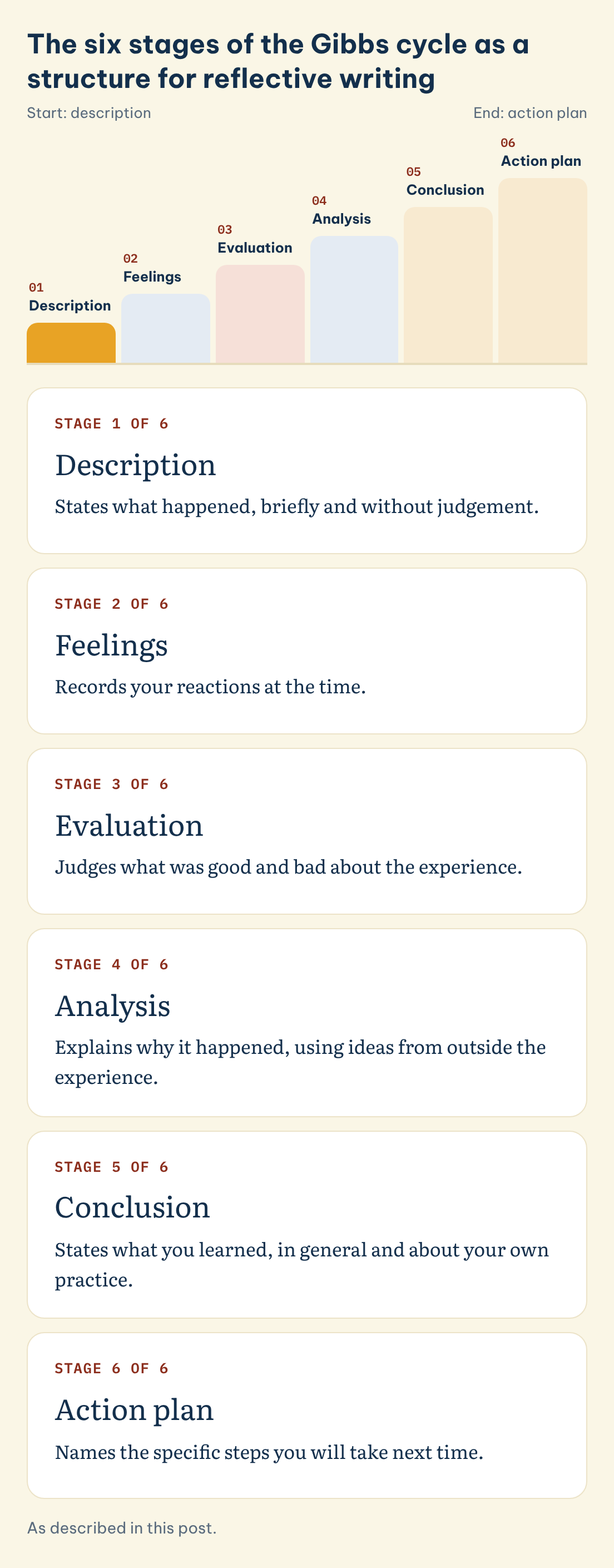
The advantage of this structure is that it hands you six headings before you have written a word. The cost, which Sow et al. (2025) put plainly, is that translating these phases into practical actions "may prove difficult, leaving both novice instructors and learners uncertain of what to do during each stage."
How do you structure reflective writing with the What? So what? Now what? model?
Direct answer: Use three blocks. What? describes the event, So what? analyses why it mattered and brings in theory, and Now what? states what you will do next. University of Edinburgh (2024b) advises making the action plan concrete rather than writing generic comments such as "I will do things differently/better".
The model's appeal is how little it asks you to remember. University of Edinburgh (2024b) calls its simplicity "both a great strength and a possible limitation," because "by just answering the three main questions the reflection does not achieve a meaningful and critical depth." In practice, that warning is about the middle block. Edinburgh places theory under So what?, framing the question as what other information, theories, models or literature can help you understand the situation. If your So what? section is a single sentence, the piece will read as a short diary entry however neat the three headings look.
Sow et al. (2025) describe the same trade-off from the faculty side: the "What" model "is characterised by its simplicity and straightforwardness, facilitating learners' comprehension and application," but "unlike Gibbs' and Kolb's models, it does not explore multiple dimensions or phases of reflection, and thereby can be lacking in depth and complexity of reflection." A practical way to guard against that is to give the So what? block most of your words, and to split it into paragraphs by theme, since University of Edinburgh (n.d.) suggests exploring one theme or learning per paragraph.
◆ Question 5 / 8 · Where does the Rolfe et al
Where does the Rolfe et al. version fit?
Direct answer: It uses the same three questions as the What model but was written as a guide for nursing and other health care practitioners. University of Wollongong (2026) says its simplicity has led to use across a range of disciplines and career stages, so you structure a piece with it exactly as you would with What? So what? Now what?.
Because the structure is the same, the choice between the two is usually a matter of what your course cites, not of how you lay out the page. University of Edinburgh (2024b) treats them as one family of models, and the Wollongong hub describes the work as inspired by Borton and also visible in Driscoll's adoption of the model for healthcare professionals. If your module handbook names the 2001 Rolfe, Freshwater and Jasper book, cite it in your text and reference list, and take the prompt questions from the book itself.
Rolfe et al. wrote it for nursing and health care, so nursing and allied health courses often name it; check your handbook. For students in business, engineering or design, the question is whether the module asks for a labelled model at all. When it does not, you can still use the three questions as a private planning tool and write the finished piece as continuous prose. That is a legitimate use of a framework, and it keeps the structure from showing through the writing as a checklist.
◆ Question 6 / 8 · How do the three models
How do the three models compare side by side?
Direct answer: Gibbs offers six stages and the most detailed prompts, while the What? So what? Now what? family offers three and is quicker to apply. Sow et al. (2025) recommend integrating the simpler "What" model into Gibbs's cycle. The sources also disagree on where feelings belong.
The table below sets the models against the features that affect how you plan a piece.
| Feature | Gibbs cycle | What? So what? Now what? (Borton, Driscoll) | Rolfe et al. version |
|---|---|---|---|
| Number of stages | Six in the common form | Three | Three |
| Year of the model | 1988 | 1970 questions, adapted 1994 | 2001 |
| Original setting | Debriefing of experiential learning | Educational materials, then nursing | Nursing and health care |
| Main strength | Detailed prompts for each stage | Easy to remember and apply | Same simplicity, applied across a range of disciplines |
| Main risk | Learners unsure what to do at each stage | Reflection may stay shallow | Reflection may stay shallow |
| Where theory goes | Analysis stage | So what? | Middle question |
Sow et al. (2025) conclude that "integrating the 'What' model into the Gibbs' reflective cycle or Kolb's experiential learning framework is recommended to enhance learners' comprehension and application of the reflective process through a simple and practical approach." Read that as a tip for structure: use the three questions as the plain-language handle on each Gibbs stage.
One disagreement to be aware of is the placement of feelings. Edinburgh's toolkit puts facts and feelings under What?, while the Exeter guide places the question of how you felt at that moment under So what? (University of Edinburgh, 2024b; McGarvey, n.d.). Neither is wrong, but your marking criteria may care. Gibbs separates the two cleanly, with Feelings as its own stage, so if your marker wants emotion kept apart from description, the Gibbs layout is the safer choice.
◆ Question 7 / 8 · Is there a reflective
Is there a reflective writing structure template or sample you can copy?
Direct answer: You can copy a skeleton, not a finished answer. Use the stages of your chosen model as headings or as a paragraph plan, then fill each one with your own experience and sources. Thejll-Madsen (2018) warns that question prompts are "a support and not the sole approach to reflection" (p. 11).
The warning in that quotation is the most useful sentence for anyone searching for a template. Thejll-Madsen (2018) adds that "Mechanical or thoughtless reflection is often accompanied with a checklist of questions students are required to answer in order to reflect" (p. 11). A template is therefore a scaffold for your first draft and not a form to fill in. University of Edinburgh (n.d.) says the structure of an academic reflection "should closely mirror an academic essay with an introduction, main body and conclusion," which is the frame to build around whichever model you pick.
Here is a model-neutral outline for a short piece, with placeholders where your own experience goes.
- Introduction: name the event, say what you will examine, and state the main thing you learned.
- Description: give only the context the reader needs to follow your analysis.
- Analysis: take one theme or learning per paragraph, tie each to a theory or source, and ask how and why.
- Conclusion and action: say what changed in your understanding and name concrete steps for next time.
A published sample is easy to find, but treat any sample as an illustration of structure and not as wording to reuse. Your event, your reasoning and your cited sources have to be your own, and a marker reads them against your module's criteria. To see how the same discipline applies to a different part of an essay, the guide to writing an essay conclusion shows how a closing section turns analysis into a clear takeaway.
◆ Question 8 / 8 · How can MAAS help you
How can MAAS help you structure a reflective piece?
Direct answer: MAAS works as a tutor and advisor. A mentor can help you choose between Gibbs and the three-question model, check that your analysis carries the weight, and give feedback on your outline and draft, while you do the writing and the reflecting yourself.
MAAS Essay and Assignment Support follows an Outline, Draft, Final sequence with a mentor matched to your discipline. For reflective work this usually starts with your assignment brief and the model your module names, so the mentor can show you where the weak stage in your plan is. If theory is the missing half of your piece, the theoretical framework guide explains how to anchor your analysis in the literature.
Frequently asked questions
What is the best reflective writing structure for a short assignment?
The three-question model is quicker to apply, and University of Edinburgh (2024b) notes that it is easy to remember. Spend most of the words on the middle question so the piece does not stay shallow.
Which is better, Gibbs or the What? So what? Now what? model?
Neither is better in every case. Sow et al. (2025) describe Gibbs as encouraging depth and the "What" model as simple but sometimes lacking depth, and they recommend combining the two.
Do I have to use all six Gibbs stages?
Not necessarily. University of Edinburgh (2024a) says you do not have to answer every prompt, but they can guide what makes sense to include at each stage.
How much of a reflective piece should be description?
No fixed split exists. University of Edinburgh (n.d.) advises describing just enough that the reader can follow your analysis.
Who created the What? So what? Now what? model?
University of Edinburgh (2024b) traces the three questions to Terry Borton in 1970 and says Driscoll developed the model from them in 1994. The Rolfe, Freshwater and Jasper version from 2001 is a later adaptation.
Where should I put theory in a reflective piece?
In the analysis stage of Gibbs, according to University of Edinburgh (2024a), or under So what? in the three-question model, according to University of Edinburgh (2024b).
References
Gibbs, G. (1988). Learning by doing: A guide to teaching and learning methods. Further Education Unit, Oxford Polytechnic. https://dsdweb.co.uk/wp-content/uploads/2021/10/learning-by-doing-graham-gibbs.pdf
McGarvey, J. (n.d.). Models of reflection. In Reflective writing. University of Exeter Library. https://libguides.exeter.ac.uk/c.php?g=727258&p=5293510
Sow, C. F., Rasiah, S., & Er, H. M. (2025). A critical exploration of theoretical frameworks for reflective learning: Reflections from a faculty development workshop. Medical Science Educator, 35(1), 503-507. https://doi.org/10.1007/s40670-024-02173-y
Thejll-Madsen, T. (2018). Literature review [Reflection Toolkit]. Employability Consultancy, University of Edinburgh. https://edwebcontent.ed.ac.uk/sites/default/files/atoms/files/reflection_literature_review.pdf
University of Edinburgh. (n.d.). Structure of academic reflections. Reflection Toolkit. https://reflection.ed.ac.uk/reflectors-toolkit/producing-reflections/academic-reflections/structure
University of Edinburgh. (2024a, October 15). Gibbs' reflective cycle. Reflection Toolkit. https://reflection.ed.ac.uk/reflectors-toolkit/reflecting-on-experience/gibbs-reflective-cycle
University of Edinburgh. (2024b, October 15). What? So what? Now what? Reflection Toolkit. https://reflection.ed.ac.uk/reflectors-toolkit/reflecting-on-experience/what-so-what-now-what
University of Wollongong. (2026, March 27). Model of reflection: The Rolfe et al. model. L&T Hub. https://ltc.uow.edu.au/hub/article/rolfe-et-al-model
Not sure how this guide applies to your own case? Talk it through with MAAS in a free 20-minute consultation.
Book a free consultation ▸