
◆ Research Methods
How do you tell if an article is peer reviewed?
To tell if an article is peer reviewed, work through four checks: tick the peer review limiter in your library database, look up the journal in Ulrichsweb for the refereed icon, read the journal's author instructions, and check the received and accepted dates printed on the article. University of Queensland Library (2026) adds that editorials and book reviews inside a peer-reviewed journal are not refereed, so check the article type as well.
◆ Question 1 / 8 · How can you tell if
How can you tell if a journal article is peer reviewed?
Direct answer: Work through four checks, starting with the cheapest: tick the peer review filter when you search your library catalogue, find the journal's refereed symbol in Ulrichsweb, read what the journal tells its authors, then compare when the article was received and when it was accepted. Deakin University Library (2025) treats the limiter and the icon as the first two steps.
Most students stop at the first check, and that is usually fine for a first-year essay. The University of Reading Library (2026) says that on the library's Summon discovery service you can apply the "Peer review" limit to restrict your results to the highest quality articles. Deakin University Library (2025) describes the same idea as a limiter checkbox that narrows a search to peer reviewed content. The checks that follow matter when a marker or a unit guide asks you to show that a source is scholarly, or when an article turns up outside the database, for example through a general web search or a reference list.
Each check proves something slightly different, and none of them is perfect on its own. The table below sets out where to look, what each check shows and where it can mislead you, so you can decide how much checking an assignment needs. For a deeper look at what happens to a paper behind the scenes, our post on the peer review timeline walks through the stages from submission to decision.
| Check | Where to look | What it shows | Limitation |
|---|---|---|---|
| Database limiter | Tick box or filter in your library search | The journal is classed as peer reviewed | Works on the journal, so editorials and book reviews still pass (CASRAI, 2026) |
| Refereed icon | Ulrichsweb record for the journal | Deakin University Library (2025) says the icon marks a refereed journal | The journal must be listed; if it is not, move to the next check |
| Author instructions | About this journal, Instructions for authors | The journal describes its own review process (University of Queensland Library, 2026) | Written by the publisher, so read it critically |
| Received and accepted dates | Near the title, in the footer or on the landing page | A gap between dates hints at review and revision (CASRAI, 2026) | Indirect evidence only |
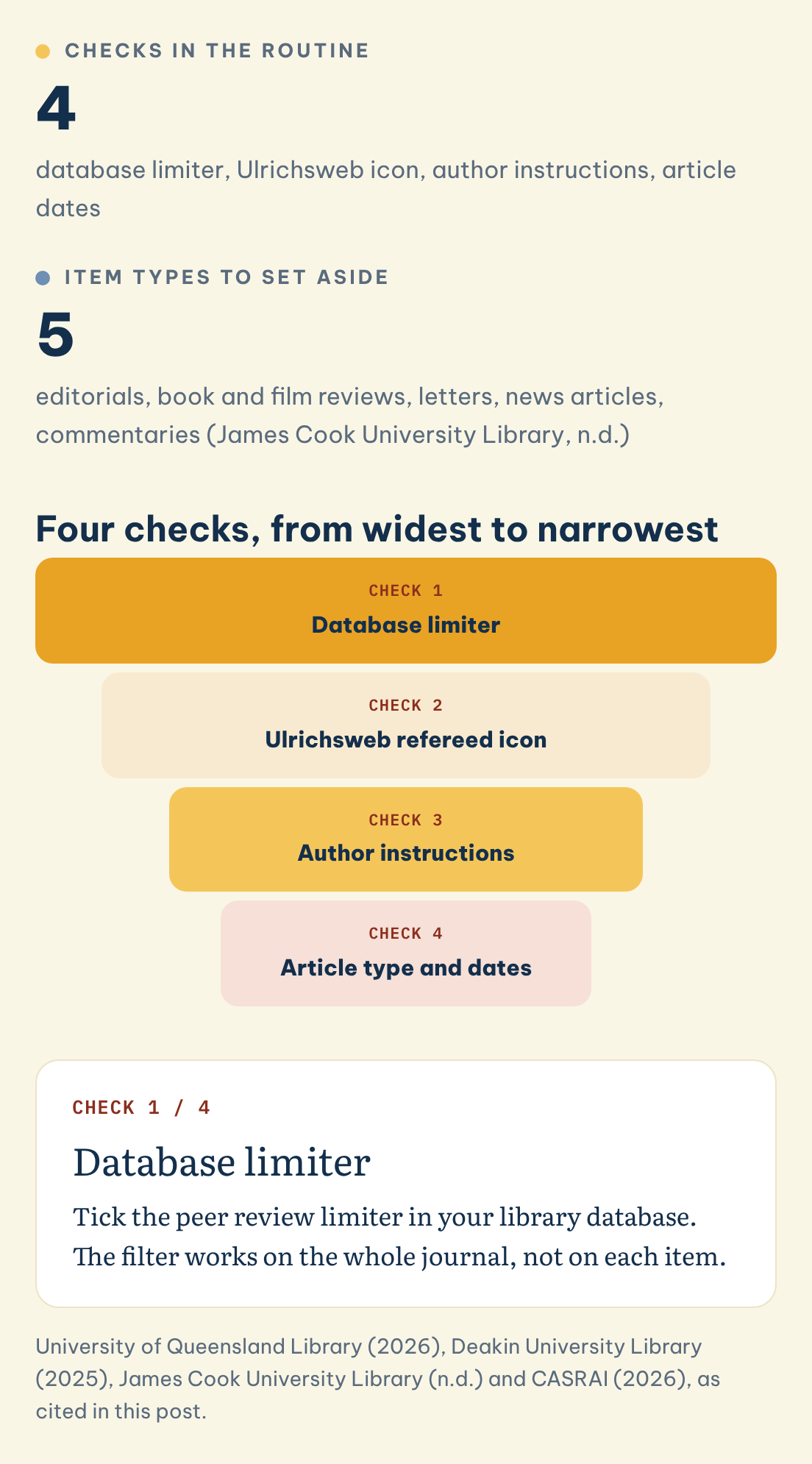
Checks in the routine
4
database limiter, Ulrichsweb icon, author instructions, article dates
Item types to set aside
5
editorials, book and film reviews, letters, news articles, commentaries (James Cook University Library, n.d.)
Four checks, from widest to narrowest
Tap a check to see what it tells you.
Check 1 / 4
Database limiter
Tick the peer review limiter in your library database. The filter works on the whole journal, not on each item.
Check 2 / 4
Ulrichsweb refereed icon
Search the journal title. A refereed icon next to it means the journal is peer reviewed.
Check 3 / 4
Author instructions
If the journal is not listed, read its About page or Instructions for authors for a description of review.
Check 4 / 4
Article type and dates
Open the article itself: rule out editorials and reviews, then look for received and accepted dates.
Save this figure
◆ Question 2 / 8 · How do I find peer reviewed
How do I find peer reviewed articles in a database?
Direct answer: Search your topic in the library discovery service, then apply the peer review limiter before you scroll. The University of Reading Library (2026) says the "Peer review" limit on its Summon service restricts results to the highest quality articles, and Deakin University Library (2025) describes a similar limiter checkbox.
The limiter saves time because it removes news pieces, trade magazines and most websites in one click. Treat it as a filter on where you look, not as a verdict on each paper you open. Library databases in the UK and Australia label the option slightly differently, so look for wording such as "Peer reviewed", "Scholarly (peer reviewed) journals" or "Refereed", usually in the left-hand column of the results page. If you search several databases for one assignment, apply the limiter in each one, because a filter set in one tool does not carry across to the next.
CASRAI (2026) explains the main weakness of this shortcut. It says the filter "operates at the level of the journal as a whole, not the individual item", so an editorial, letter, book review or correction inside a peer-reviewed journal will typically still pass the filter. That is why the limiter is the start of your checking and not the end. CASRAI is a secondary source here, and the university guides in this post make the same point with stronger authority. If you are collecting sources for a larger piece of writing, our guide to writing a literature review shows how to log each source as you go.
◆ Question 3 / 8 · What is Ulrichsweb and how
What is Ulrichsweb and how does it show refereed journals?
Direct answer: Ulrichsweb is a directory of periodicals that shows whether a journal is refereed. University of Queensland Library (2026) says "A refereed icon appears next to the journal title if it is peer-reviewed." Deakin University Library (2025) says the icon is shaped like an umpire's jersey.
"Refereed" is simply another word for peer reviewed, and Deakin University Library (2025) says the symbol indicates the journal is peer reviewed. To use the check, search Ulrichsweb for the journal title, not the article title, and look at the journal's record. Your library website normally links to Ulrichsweb from its list of databases, and you may need to log in with your student account. Search by the exact journal name, because similar titles are common and a lookalike with a different publisher can send you to the wrong record.
If the journal is not listed, that does not prove it is unreviewed. University of Queensland Library (2026) says that in this case you should check the journal's own pages for a description of its review process, which leads to the third check below. Keep a note of what you found in each tool. A short record, such as "Ulrichsweb: refereed icon present, checked 20 October 2026", takes ten seconds and is useful if a tutor questions a source in your reference list.
◆ Question 4 / 8 · How do you check a journal's
How do you check a journal's author instructions and the article's dates?
Direct answer: Go to the journal's own site and find the page that explains how submissions are handled, then see whether the article prints a submission history. University of Queensland Library (2026) tells students to try the Author guidelines, Instructions for authors or About this journal sections.
The University of Reading Library (2026) gives the same advice for a source you are unsure about: take a look at the instructions for authors on the journal's website, which should indicate if a review takes place. Deakin University Library (2025) lists four page names where this information often sits: about us, editorial policies, instructions for authors and submission guidelines. Look for specific wording, such as the number of reviewers, whether they are external experts and whether reviewers know the author's name. A page that mentions peer review only in passing, or not at all, is a warning sign.
The dates give a second line of evidence. Sheffield Hallam University Library (n.d.) says review may be worked out from the submitted, accepted and published dates on articles. CASRAI (2026) notes that most peer-reviewed articles print a submission history near the title, in the footer or on the publisher's landing page, and that a visible gap between received and accepted dates is indirect evidence that a review and revision cycle took place. Indirect is the key word: a gap of a few months suggests review, but a missing date proves nothing either way.
◆ Question 5 / 8 · Is everything
Is everything in a peer-reviewed journal peer reviewed?
Direct answer: No. Deakin University Library (2025) warns that peer reviewed journals can contain letters to the editor, editorials and book reviews that are not peer reviewed, so you should not assume everything in them was reviewed in the same way. Check the article type before you cite.
James Cook University Library (n.d.) lists the same kinds of item: scholarly journals also publish editorials, book and film reviews, letters, news articles and commentaries, which it says are not considered scholarly articles. University of Queensland Library (2026) puts it plainly: "Be aware that not all articles in peer-reviewed journals are refereed or peer-reviewed, for example, editorials and book reviews." This is the most common slip in student reference lists, because a short opinion piece in a respected journal looks authoritative and passes the database limiter.
A quick test is to look at the structure and length. A reviewed research article normally has an abstract, a method, results and a reference list, and it runs for several pages. A one-page piece with no abstract, no method and a handful of references is more likely to be an editorial or a commentary. When in doubt, look for an article-type label on the publisher's page, such as "Original research", "Review article" or "Letter". If you cannot tell, choose a different source for any claim that carries weight in your argument.
◆ Question 6 / 8 · Why does peer review matter
Why does peer review matter for your essay?
Direct answer: Peer review is a quality filter, and markers expect you to know when you are relying on one. Kelly et al. (2014) state that "Submission of low quality manuscripts has become increasingly prevalent, and peer review acts as a filter to prevent this work from reaching the scientific community" (p. 227).
The same authors add a warning that applies directly to online searching. Kelly et al. (2014) write that "the recent explosion in online only/electronic journals has led to mass publication of a large number of scientific articles with little or no peer review" (p. 228). Their article is a decade old, so treat the figures of the time with care, but the underlying point has not gone away: a polished website and a journal-style title do not show that anyone reviewed the paper. This is why UK and Australian library guides send students to databases and to checks such as the ones above rather than to a general search engine.
For marking, the practical effect is on your reference list. Many unit guides ask for "scholarly" or "academic" sources, and a tutor who finds an editorial or an unreviewed website listed as a journal article may reduce the mark for source quality. You do not need to document every check in the essay itself. You do need to be able to say, if asked, how you decided that a source was suitable.
◆ Question 7 / 8 · How do you spot a predatory
How do you spot a predatory journal?
Direct answer: Look for a journal that takes fees without providing editorial services. Predatory journals are those which charge a publication fee with no intention of providing expected services, such as editorial or peer review (Think. Check. Submit., n.d.). Sheffield Hallam University Library (n.d.) says a journal that promises acceptance cannot be reviewing the content.
Think. Check. Submit. (n.d.) also notes that charging a fee is a legitimate business model, so a fee alone is not the red flag. Its listed warning signs include advertising very fast times from submission to publication, no editorial board or a board of dead, retired or non-specialist scholars, and a lack of information on the journal's policies, including peer review. Sheffield Hallam University Library (n.d.) adds that unsolicited emails offering to publish research should make you extra vigilant, since established publishers do not usually approach scholars. That guide is written for authors choosing where to publish, but the same checks transfer to readers.
The University of Reading Library (2026) describes these journals as publishing articles without checking them for quality and legitimacy, and says one way to check whether a journal is a reputable source is to see whether it is listed on the Directory of Open Access Journals (DOAJ). For a longer treatment, including what to do if you have already cited such a paper, see our guide to avoiding predatory journals.
◆ Question 8 / 8 · What is the fastest workflow
What is the fastest workflow for a UK or Australian assignment?
Direct answer: Search through your library, apply the peer review limiter, check the article type, then confirm the journal in Ulrichsweb or on its own website. Keep a note of what you found. Deakin University Library (2025) recommends the limiter, Ulrichsweb and the journal website in that order, and University of Queensland Library (2026) covers the Ulrichsweb, article-type and journal-website checks.
Start in the library discovery service and tick the limiter, then open the article and read the first page to see the article type, the abstract and the dates. Next, search the journal in Ulrichsweb, and if it is not listed, open the journal's author instructions. Save the records you trust in your reference manager with a short note on how you checked them.
If you want a second pair of eyes on a source list, essay and assignment support from MAAS works as tutor and advisor guidance: with guidance from a MAAS expert, you review your sources against the marking criteria and keep the thinking and the submission yourself. Most students begin by sending the assignment brief and their draft reference list.
Frequently asked questions
How can I tell if an article is peer reviewed without a library login?
Open the journal's website and read the About page or Instructions for authors. University of Queensland Library (2026) tells students to look in the Author guidelines, Instructions for authors or About this journal sections for information on the review process.
What does the refereed icon mean?
Deakin University Library (2025) says "refereed" is another term for peer reviewed, so the umpire's jersey symbol in Ulrichsweb indicates that the journal is peer reviewed. The icon describes the journal, not each article inside it.
Are book reviews and editorials peer reviewed?
Usually not. James Cook University Library (n.d.) lists editorials, book and film reviews, letters, news articles and commentaries as items scholarly journals publish that are not considered scholarly articles.
Can I trust the peer review filter in a library search?
Use it as a starting point. CASRAI (2026) says the filter works at the level of the journal, so non-reviewed items inside a reviewed journal can still pass. Check the article type yourself.
Do the received and accepted dates prove peer review?
No, they only suggest it. CASRAI (2026) calls a visible gap between the two dates indirect evidence that a review and revision cycle took place, and Sheffield Hallam University Library (n.d.) says dates can help you work out whether review happened.
Is a journal that charges a fee always predatory?
No. Think. Check. Submit. (n.d.) says charging a fee is a legitimate business model, provided the publisher gives a good publishing service in return, including editorial and peer review services.
References
CASRAI. (2026, August 5). How to know if an article is peer reviewed. https://casrai.org/guides/how-to-know-if-an-article-is-peer-reviewed
Deakin University Library. (2025, November 12). Finding peer review resources. LibGuides: Peer Review. https://deakin.libguides.com/peer_review/finding
James Cook University Library. (n.d.). Evaluating journals. InfoSkills3: Evaluating resources. https://libguides.jcu.edu.au/InfoSkills3/journals
Kelly, J., Sadeghieh, T., & Adeli, K. (2014). Peer review in scientific publications: Benefits, critiques, & a survival guide. EJIFCC, 25(3), 227-243. https://pmc.ncbi.nlm.nih.gov/articles/PMC4975196/
Sheffield Hallam University Library. (n.d.). Choosing where to publish. Library Research Support. https://libguides.shu.ac.uk/researchsupport/choosing-publish
Think. Check. Submit. (n.d.). About predatory publishing. https://thinkchecksubmit.org/resources/about-predatory-publishing/
University of Queensland Library. (2026, October 15). Check if it's peer reviewed. Peer-reviewed journal articles. https://guides.library.uq.edu.au/tools-and-techniques/peer-reviewed-journal-articles/check
University of Reading Library. (2026, September 2). Journal quality and peer review. How to find articles and journals. https://libguides.reading.ac.uk/articles-and-journals/quality
Not sure how this guide applies to your own case? Talk it through with MAAS in a free 20-minute consultation.
Book a free consultation ▸