
◆ Citation & Formatting
How do you cite a website in APA 7 with no author or date?
When a webpage has no named person, use the organisation as the author. When it has no author or organisation at all, move the title into the author position. When it has no date, write (n.d.). The American Psychological Association (2022) sets these three substitutions out in one table, and they work for almost every page you will meet.
◆ Question 1 / 9 · Who is the author of a page
Who is the author of a page on an organisation's website?
Direct answer: The organisation is the author. The American Psychological Association (n.d.-b) says that for a page from an organisation's website without individual authors, you use the name of the organisation as the author. Check the page first, because a named person sometimes appears on an "about us" page.
The American Psychological Association (n.d.-a) adds that on a page from an organisational or government agency website, the organisation or agency itself is considered the author, unless otherwise specified. It also notes that the author of a webpage or website may be located on an "about us" or acknowledgments page. So before you decide a page has no author, scroll to the footer and open the about page.
There is one more rule for organisation pages. The American Psychological Association (n.d.-b) says that because the author of the webpage and the site name are the same, you omit the site name from the source element to avoid repetition. The University of Queensland Library (n.d.) gives the same instruction: leave out the name of the website if the author and site name are the same. In practice the entry shrinks, as in this teaching example from a page of the Australian Psychological Society:
Australian Psychological Society. (n.d.). Anxiety disorders. https://www.psychology.org.au/for-the-public/Psychology-Topics/Anxiety
In your own reference list, set the page title in italics: Anxiety disorders.
The in-text form is (Australian Psychological Society, n.d.), or you can write the organisation in your sentence and put only (n.d.) in brackets. If the page belongs to a department within a larger body, the parent body goes in the source element, as in the next question.
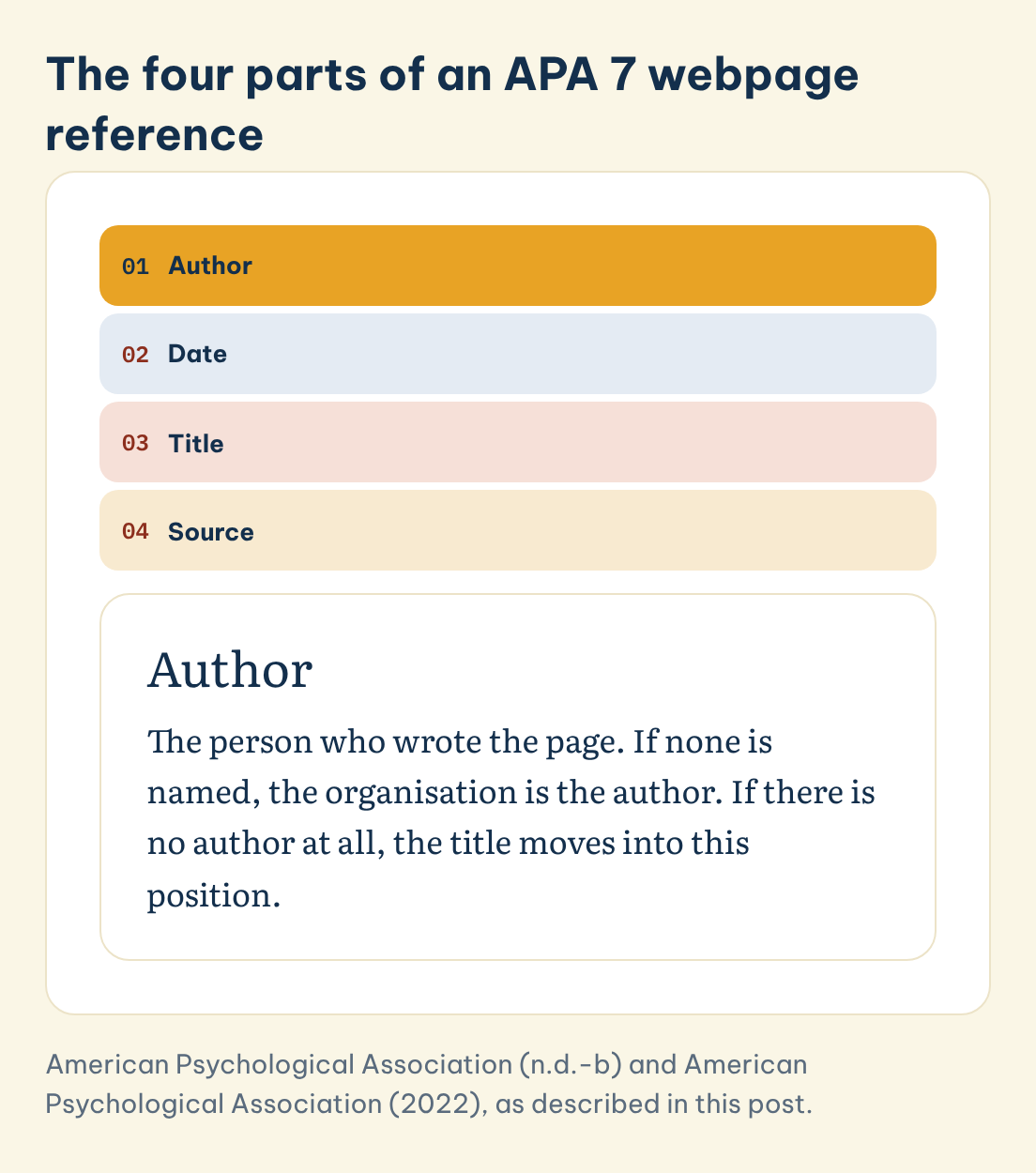
The four parts of an APA 7 webpage reference
Tap a part to see what goes there when the page has no author or no date.
Author
The person who wrote the page. If none is named, the organisation is the author. If there is no author at all, the title moves into this position.
Date
The most exact date the page gives. Use n.d. when you cannot find one, and never use a date of last review.
Title
The title of the page, in italics and sentence case.
Source
The site name and URL. Leave out the site name when it matches the author. Add a retrieval date only for pages designed to change that are not archived.
Save this figure
◆ Question 2 / 9 · What do you do when
What do you do when a webpage has no individual author?
Direct answer: If an organisation published the page, it is the author. If you truly cannot find any author or authoring body, the title moves into the author position. Victoria University Library (n.d.) says to use the title of the webpage where there is no identifiable author or authoring body.
Do not write "Anonymous". The American Psychological Association (2022) says not to use "Anonymous" as the author unless the work is actually signed "Anonymous". A missing author is not the same as an anonymous author, and a marker who sees the word will assume you did not look hard enough.
Here is the difference in practice. A government statistics page with no personal byline is a page with no individual author, so the department or agency is the author. A blog-style page from a private site with no name, no organisation and no about page is a page with no author at all, so its title leads the entry. In the second case the University of Sheffield Library (n.d.) advises that you use the first few words of the title and the year in the text. Because the title is the lead element, the entry sits in your reference list in alphabetical order by the first significant word of that title.
◆ Question 3 / 9 · How do you cite a webpage
How do you cite a webpage with no date?
Direct answer: Write n.d. in brackets where the year would go. According to the American Psychological Association (2022), an undated work carries the abbreviation in two places: your list of sources at the end, and every citation inside your text. Do not guess a year from the page design or from search results.
The American Psychological Association (n.d.-a) tells you what to do when you are unsure: when you cannot determine the date of publication, treat the work as having no date. The University of Sheffield Library gives the same convention: "If no date of publication or copyright can be found, use n.d. for 'no date'" (University of Sheffield Library, n.d., p. 6).
Be careful with "last updated" dates. Victoria University Library (n.d.) says some webpages will have a "last updated" date, and you should use it only if it is clearly related to the content you are citing, not if it applies to the whole website. Otherwise use n.d. The American Psychological Association (n.d.-b) goes further and says not to include a date of last review in a reference, because content that has been reviewed has not necessarily been changed. A footer that says "Last reviewed" is therefore never a publication date.
◆ Question 4 / 9 · Which reference format
Which reference format applies when something is missing?
Direct answer: Use the template that matches the missing element. The American Psychological Association (2022) sets out three versions, one each for a missing author, a missing date, and both missing. The in-text citation changes with them, so build the reference first and copy its lead element into the text.
| What is missing | Reference template | In-text citation |
|---|---|---|
| Author | Title. (Date). Source. | (Title, year) |
| Date | Author. (n.d.). Title. Source. | (Author, n.d.) |
| Author and date | Title. (n.d.). Source. | (Title, n.d.) |
Table based on American Psychological Association (2022).
The American Psychological Association (2022) also says that in general the title is italicised for a work that stands alone, such as a book, a report or a webpage on a website. That is the rule the table follows. When the title is the lead element, keep sentence case in the reference list.
The tidy check is to ask what sits first in the entry. Whatever sits first is what the reader will look up in your list, so it must be what you write in brackets in your text. If the entry opens with an organisation, write the organisation. If it opens with a title, write the title.
◆ Question 5 / 9 · How do you write the in-text
How do you write the in-text citation when the title replaces the author?
Direct answer: Use the title, in Title Case, followed by the year or n.d. Victoria University Library (n.d.) says to use Title Case in the text even though the reference list uses sentence case, and to keep italics only if the title is italic in the list.
For a standalone page, that means (Current World Population, n.d.) in the text, because the title is italic in the list. Titles of articles or chapters inside a larger work take quotation marks instead. The University of Sheffield Library (n.d.) says that for chapters in books, web pages and journal articles, quotation marks go around the title (p. 6).
Referencing guides disagree on title formatting. APA italicises the title of a standalone webpage on a website, which is what the American Psychological Association (2022) states. The Sheffield guide groups web pages with the items that take quotation marks. Neither is a typo. Universities adapt APA for their students, so when your own university's guide and the APA site disagree, follow your own university's guide. If you are unsure which applies, ask your tutor or check the referencing page on your library's website before you format a whole list.
◆ Question 6 / 9 · When do you need a retrieval
When do you need a retrieval date?
Direct answer: Only for pages designed to change over time that are not archived. The American Psychological Association (n.d.-b) says that when the contents of a page are designed to change over time but are not archived, you include a retrieval date in the reference. A normal article or policy page does not need one.
The APA example for this is a live counter, shown here as a teaching example:
U.S. Census Bureau. (n.d.). U.S. and world population clock. U.S. Department of Commerce. Retrieved January 9, 2020, from https://www.census.gov/popclock/
Notice two things. The page changes by the second, so a retrieval date tells the reader which version you saw. And the department, "U.S. Department of Commerce", appears as the source because the Census Bureau is only part of it, so the author and source are not the same. The American Psychological Association (2025) uses another live page, a Worldometer population counter, in its common examples guide, again with a retrieval date and "n.d." for the date.
For most pages, skip it. Adding "Retrieved" to a stable page does no harm, but it adds clutter, and it can suggest you do not understand which sources are designed to change. A dashboard, a ticker or a counter needs a date. A published guide or statement usually does not.
◆ Question 7 / 9 · How do you quote from
How do you quote from a webpage with no page numbers?
Direct answer: Use a paragraph number instead of a page number. The University of Sheffield Library says quotes need a "page citation (or paragraph for non-paginated sources such as websites)" (University of Sheffield Library, n.d., p. 6). Count the paragraph where the quote starts and write para. 4, for example.
If the page has headings, the Sheffield guide shows a heading named in quotation marks plus a paragraph count within that section. Keep it short, because the aim is to let a reader find the passage in seconds.
◆ Question 8 / 9 · How do you cite a news site
How do you cite a news site article, or mention a whole website?
Direct answer: A news story is credited to the journalist who wrote it, with the outlet named after the title. For a whole website mentioned in general, do not make a reference at all. The University of Queensland Library (n.d.) treats a general mention of a site as needing no bracketed citation and no entry at the end of your work.
The American Psychological Association (n.d.-b) treats news-site articles as pages where the writer is the author and the news site is the source, so a byline matters.
For a general mention, name the site in your sentence and put the address in brackets straight after it. The University of Queensland Library (n.d.) says to include the website name in the text with the URL in parentheses. If you instead use several pages from the same website, the same guide says to reference each page individually, and the Sheffield guide quotes the APA manual on when the webpage format applies: "Use the webpages and websites category if there is no other reference category that fits and the work has no parent or overarching publication (e.g. journal, blog, conference proceedings) other than the website itself" (American Psychological Association, 2020, p. 350, as cited in University of Sheffield Library, n.d., p. 81).
◆ Question 9 / 9 · How can MAAS help
How can MAAS help with referencing?
Direct answer: MAAS works as a tutor and advisor. With the guidance of a MAAS expert you check each source against your university's guide, fix patterns in your list, and learn why each element sits where it does, while the reading, the writing and the submission remain yours.
If your reference list has more pages than anyone can check by eye, essay and assignment support from MAAS follows an Outline, Draft, Final sequence in which a mentor gives feedback at each stage. For the general rules behind this post, our guide to APA 7th referencing covers the basics. If you have a lot of sources to track, reference management software can store the data, though you still need to correct missing authors and dates by hand, because tools often fill them wrongly.
Frequently asked questions
Can I use "Anonymous" when a webpage has no author?
No. The American Psychological Association (2022) says not to use "Anonymous" unless the work is actually signed "Anonymous". Move the title into the author position instead.
What date do I use when I cannot find one?
Use n.d. The American Psychological Association (2022) says to write "n.d." in both the reference list entry and the in-text citation.
Can I use the "last updated" date at the bottom of a page?
Only if it clearly relates to the content you are citing. Victoria University Library (n.d.) says not to use it if it applies to the whole website, and the American Psychological Association (n.d.-b) says not to use a date of last review.
Do I need "Retrieved from" and a date every time?
No. The American Psychological Association (n.d.-b) asks for a retrieval date only when the content is designed to change and is not archived.
Do I include the site name if the author is the same organisation?
No. The University of Queensland Library (n.d.) says to leave out the name of the website if the author and site name are the same.
Should the webpage title be italic or in quotation marks?
APA italicises a standalone webpage title, according to the American Psychological Association (2022). The University of Sheffield Library (n.d.) uses quotation marks for web pages, so follow your own university's guide.
How do I cite a whole website I only mention?
Name it in your sentence with the URL in brackets, and leave it out of the reference list, as the University of Queensland Library (n.d.) advises.
References
American Psychological Association. (n.d.-a). Elements of reference list entries. APA Style. https://apastyle.apa.org/style-grammar-guidelines/references/elements-list-entry
American Psychological Association. (n.d.-b). Webpage on a website references. APA Style. https://apastyle.apa.org/style-grammar-guidelines/references/examples/webpage-website-references
American Psychological Association. (2022). Missing reference information. APA Style. https://apastyle.apa.org/style-grammar-guidelines/references/missing-information
American Psychological Association. (2025). APA Style common reference examples guide. https://apastyle.apa.org/instructional-aids/reference-examples.pdf
The University of Queensland Library. (n.d.). Webpage: APA 7th referencing style. https://guides.library.uq.edu.au/referencing/apa7/webpage
University of Sheffield Library. (n.d.). APA referencing (7th ed.) [PDF guide]. https://librarydevelopment.group.shef.ac.uk/Assets/pdfs/referencing/apa-7ed.pdf
Victoria University Library. (n.d.). Webpages: APA 7th referencing. https://libraryguides.vu.edu.au/apa-referencing/7Webpages
Not sure how this guide applies to your own case? Talk it through with MAAS in a free 20-minute consultation.
Book a free consultation ▸