
ECON1003 Financial Institutions and Markets rewards students who explain why an institution or market behaves as it does, rather than students who merely describe it. Most who struggle are not short on effort: they define what a bank does, what a bond is, and how a central bank sets rates, then stop before using it to reach a judgement about a real event. This guide answers the seven questions Vietnamese finance students in Australia ask MAAS mentors most.
Author: MAAS Editorial Team
Last updated: 2026-07-20
Category: economics

What is ECON1003 Financial Institutions and Markets about?
Direct answer: ECON1003 is a finance course about the structure and function of the financial system. It typically covers why financial intermediaries exist, money and capital markets, bond pricing, equity valuation, foreign exchange, the central bank's role in monetary policy, and bank regulation. The course wants you to analyse how funds and risk move through the system, not to memorise institution types.
Evidence: The teaching frame follows the standard financial systems curriculum represented by Mishkin's The Economics of Money, Banking and Financial Markets, whose structure of intermediation, asymmetric information, interest rate theory, and central banking maps closely onto most ECON1003 assessments. Diamond and Dybvig's model of bank runs remains the reference point for why bank funding is fragile.
Example: A Vietnamese student in Australia arrived at MAAS with a draft that listed the functions of commercial banks, investment banks, and insurers. Her mentor reframed the task around one question: why did depositors run on a specific bank in a specific week? Once the draft used maturity transformation and information asymmetry to answer that, her mark moved from a Pass level draft to a Distinction.
What assessment does the ECON1003 assignment usually involve?
Direct answer: Courses of this type are commonly assessed through an individual report or case analysis of a market event, an institution, or a policy decision, often with problem sets on bond pricing and yields, a group task, and a final exam. You are typically asked to apply financial theory to evidence such as yield data, policy statements, or a documented episode, and to reach a justified conclusion. Confirm the exact task, word count, and weighting in your own course outline, because structure varies by provider and by teaching period.
Evidence: Australian higher education assessment in this field is criterion referenced, meaning marks are awarded against published rubric criteria rather than by ranking students against each other. That is why reading the rubric closely matters far more than how many institutions you can describe.
Example: A Vietnamese student spent half of a 1,500 word report explaining the history of a central bank before reaching the analysis. His MAAS mentor cut the history to three sentences and reallocated the words to interpreting the yield curve data he had already collected. Same data, same word count, and the analysis led version earned a clear Distinction.
How is the ECON1003 assignment graded, and what does the rubric reward?
Direct answer: Rubrics for this course type reward four things, roughly in this order: correct application of financial theory to the specific institution or market, accurate interpretation of quantitative evidence such as yields, spreads, or exchange rates, critical evaluation of policy trade offs and alternative explanations, and academic writing with correct referencing. Describing an institution earns almost no marks on its own. Marks live in why the mechanism applies here, what the numbers show, and whether the policy or decision was justified once you weigh the costs.
Evidence: Criterion bands typically run Pass, Credit, Distinction, and High Distinction, and the jump from Credit to Distinction is usually defined by the words critical and justified rather than by additional description or more charts.
Example: A MAAS mentor marked one Vietnamese student's draft sentence by sentence, labelling each as describe, apply, or evaluate. The draft was 70% describe, with a yield curve chart left to speak for itself. After one restructuring pass that added interpretation under the chart and a balanced evaluation of the policy, the same evidence moved up 2 full rubric bands.
Which frameworks should you use in ECON1003?
Direct answer: Anchor your analysis in two or three mechanisms that fit your question rather than surveying the syllabus. The most useful are the intermediation and asymmetric information frame for why banks exist and how adverse selection and moral hazard shape lending, maturity transformation and liquidity risk for why bank funding is fragile, the term structure of interest rates for reading the yield curve as a signal, interest rate parity and the exchange rate channel for currency questions, and the monetary policy transmission mechanism for tracing a policy rate change through to output and prices.
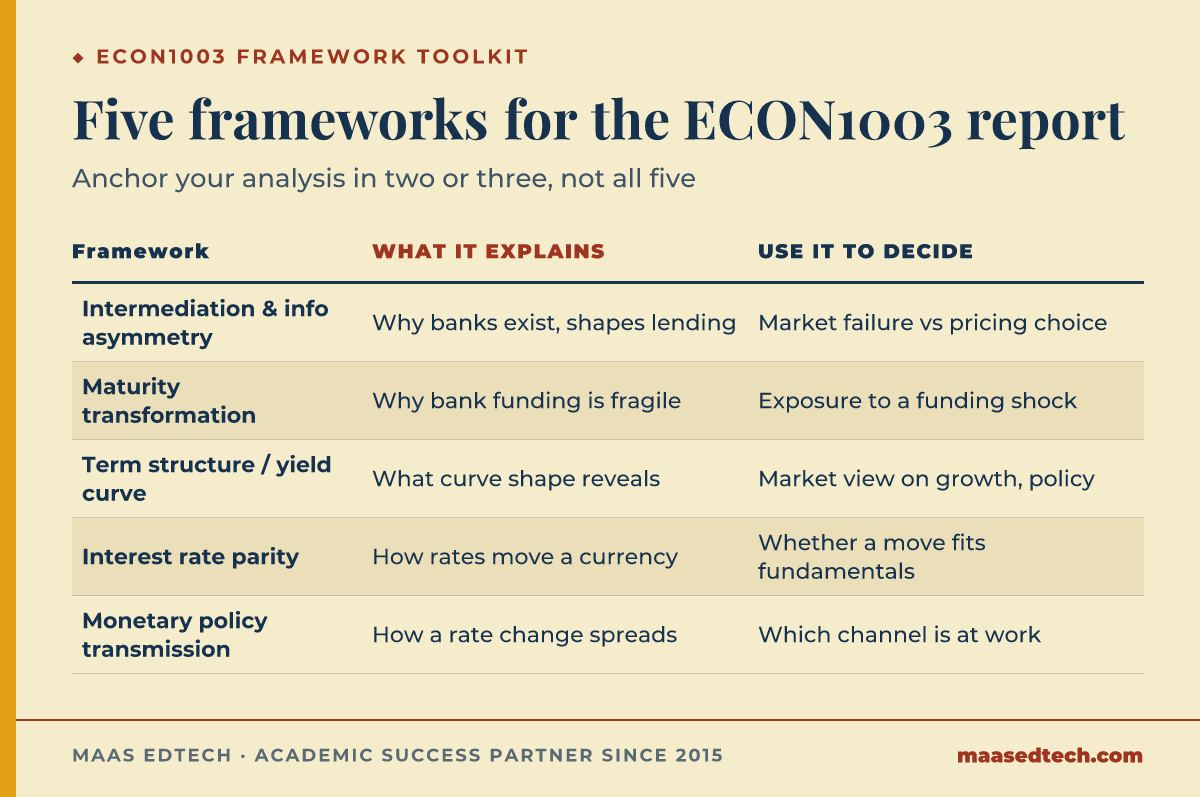
| Framework | What it explains | Use it to decide |
|---|---|---|
| Intermediation and asymmetric information | Why banks exist and how adverse selection and moral hazard shape credit | Whether a lending outcome reflects a market failure or a pricing choice |
| Maturity transformation and liquidity risk | Why banks borrow short and lend long, and why that is fragile | How exposed an institution is to a funding shock |
| Term structure and the yield curve | What the shape of the curve reveals about expectations | What the market believes about growth and future policy |
| Interest rate parity and exchange rates | How rate differentials and expectations move a currency | Whether a currency move is consistent with fundamentals |
| Monetary policy transmission | How a policy rate change reaches credit, spending, and inflation | Which channel a policy decision is actually working through |
Evidence: These frameworks are examiner recognised, textbook level foundations. Mishkin's (2022) textbook is now in its 13th edition and covers intermediation, the term structure, and policy transmission; Diamond and Dybvig (1983), in the Journal of Political Economy volume 91, issue 3, pages 401 to 419, formalises bank runs and the case for deposit insurance; Bernanke and Gertler (1995), in the Journal of Economic Perspectives volume 9, issue 4, pages 27 to 48, sets out the credit channel, and states the mechanism directly: "According to advocates of the credit channel, monetary policy affects not only the general level of interest rates, but also the size of the external finance premium" (Bernanke & Gertler, 1995, p. 35). For the bond-pricing and yield-curve mechanics themselves, Fabozzi (2021), now in a 10th edition, is the standard reference, and Saunders and Cornett (2021), also in a 10th edition, frames the same institutions through a risk-management lens rather than a pure pricing one, which is the more useful angle when your question is about fragility rather than valuation. Central bank publications are legitimate primary sources for policy statements and data, and should be cited with their date.
Example: A Vietnamese student analysing an interest rate rise tried to apply five mechanisms at once, each shallowly. Her MAAS mentor cut it to two, the expectations component of the term structure and the credit channel, and used both on the same episode. Fewer mechanisms, deeper application, higher mark.
How should you structure the ECON1003 report?
Direct answer: Use a question led structure. Open with the question and your position, keeping institutional background under 10% of the word count. Apply the relevant theory to your case. Present data and charts that you interpret rather than display. Evaluate the policy or outcome critically, weighing costs against benefits and naming alternative explanations. Close with a justified conclusion. Every figure needs a label and a sentence in the text explaining what it means for your argument, because a chart no sentence explains earns nothing.
Evidence: Criterion referenced rubrics weight application of theory, interpretation of evidence, and critical evaluation far above background and description. Matching your word budget to the rubric weighting is the most reliable way to lift a grade without collecting new data.
Example: A Vietnamese student submitted a report with a 400 word introduction and a two line conclusion that restated his position. His MAAS mentor inverted the balance, giving the evaluation room to weigh the policy's effect on borrowers, savers, and bank margins. The final report, with the same data, moved from a borderline Credit to a Distinction.
What are the most common mistakes that lose marks in ECON1003?
Direct answer: Three recurring mistakes show up across MAAS finance coaching. First, students describe institutions instead of analysing behaviour, so the report reads like a glossary. Second, quantitative evidence is presented without interpretation or a stated date range, which matters greatly when yields and exchange rates move weekly. Third, policy conclusions are one sided rather than balanced evaluations that name winners, losers, lags, and assumptions. Fixing these three lifts most drafts by at least one rubric band.
Evidence: Across MAAS finance coaching, marker feedback before intervention clusters heavily on needs more analysis and evidence not interpreted, the two phrases that most often separate a Credit from a Distinction in finance rubrics.
Example: A Vietnamese student concluded that raising rates was bad for the economy. His MAAS mentor pushed him to specify: bad for whom, borrowers and rate sensitive sectors, better for whom, savers and the currency, over what horizon, given the lag in transmission, and under what assumption about inflation expectations. The specified version earned full marks on the evaluation criterion the blunt claim had failed.
How long is the ECON1003 assignment and what referencing style does it use?
Direct answer: Confirm the exact word count and style in your course outline. Individual finance reports at this level commonly sit between 1,500 and 2,500 words, with tables, appendices, and reference lists often excluded from the count. Referencing style varies by provider, and both APA 7th and Harvard are common in Australian business programs, so use whichever your outline specifies and apply it consistently. Cite every data series with its source, its date, and the period it covers, and prefer central bank and regulator publications over news summaries for policy facts.
Evidence: Australian business programs typically nominate a single referencing style in the course outline and mark consistency as part of academic writing criteria. Markers routinely deduct marks for unreferenced data, undated figures, or reference lists that do not match in text citations, even when the analysis is strong.
Example: A Vietnamese student lost several marks because his yield data carried no source and his in text citations did not match his reference list. A MAAS pre submission audit closed the gaps in under an hour, with every series sourced to the central bank and dated. On his next assessment, clean sourcing recovered marks on a criterion that requires no extra analysis at all.
Frequently asked questions
Is ECON1003 a hard course?
It is conceptually demanding rather than mathematically hard for most tasks. There is some calculation in bond pricing and yields, but the course rewards clear reasoning about mechanisms far more than heavy computation.
Do I need advanced maths?
Usually not. Most tasks ask you to price a bond, read a yield curve, or interpret published data correctly rather than to build models. Accurate, well explained basic work beats complex maths left unexplained.
Can I use Vietnam as my case?
Often yes, and it can work well because the State Bank of Vietnam publishes policy statements and data you can cite. The risk is describing the system rather than using it to test a mechanism, so keep the case in service of the argument.
How current does my data need to be?
Current enough to support the claim, and always dated. Interest rates, spreads, and exchange rates move constantly, so state the window your figures cover and note it in the text.
What referencing style does ECON1003 use?
It depends on the provider, with APA 7th and Harvard both common. Use the style named in your course outline, applied consistently, including for central bank data and policy statements.
Can MAAS help me with ECON1003?
Yes. MAAS Assignment & Essay Support coaches you through the assessment with the Outline, Draft, Final model, covering mechanism choice, data interpretation, structuring the evaluation, and a pre submission referencing audit, all with PhD level mentors. We coach your work and we do not write it for you.
Ready to approach ECON1003 with a clear strategy?
If you have the data but not the argument, that is exactly where a discipline-matched expert helps most. MAAS Assignment & Essay Support is an academic support partner. We work alongside you through Outline, Draft, Final so the analysis stays yours and the structure earns the marks.
Bring your ECON1003 brief and we will match you to a banking and finance mentor, and 23% of our 100+ experts hold a PhD, within 48 hours when our network already covers that field. If it does not, MAAS opens a dedicated recruitment round for your case, which usually takes about 2 weeks.
Book a free 15-minute ECON1003 consultation with MAAS Assignment & Essay Support
Related guides
- BAFI3182 assignment: how do you approach Financial Markets? is the closest sibling guide on market structure and intermediation
- How to approach the BAFI3287 Financial Technology assignment? covers how technology is changing these institutions
- BAFI3230 assignment: how do you approach Corporate Finance? covers valuation logic and its limits
- MAAS Academic Mentoring service offers 1:1 coaching with PhD level mentors in your discipline
- Course-code assignment coaching is the pillar guide on tackling any unit assignment with a MAAS mentor
References
- Bernanke, B. S., & Gertler, M. (1995). Inside the black box: The credit channel of monetary policy transmission. Journal of Economic Perspectives, 9(4), 27-48. https://doi.org/10.1257/jep.9.4.27
- Diamond, D. W., & Dybvig, P. H. (1983). Bank runs, deposit insurance, and liquidity. Journal of Political Economy, 91(3), 401-419. https://doi.org/10.1086/261155
- Fabozzi, F. J. (2021). Bond markets, analysis, and strategies (10th ed.). MIT Press.
- Mishkin, F. S. (2022). The economics of money, banking and financial markets (13th ed.). Pearson.
- Saunders, A., & Cornett, M. M. (2021). Financial institutions management: A risk management approach (10th ed.). McGraw-Hill.
Tools and resources
- Tertiary Education Quality and Standards Agency. (n.d.). Higher education good practice hub. Retrieved July 20, 2026, from https://www.teqsa.gov.au/guides-resources/higher-education-good-practice-hub
This article is part of the MAAS Journal series for Vietnamese international students. MAAS Assignment & Essay Support is an academic support partner. We coach students through the Outline, Draft, Final delivery model with developmental feedback from discipline-matched experts. We do not write or submit work on a student's behalf.