
◆ Economics
ECO349 Money, Banking and Financial Markets: read the prerequisite list before you read anything else
Three prerequisite streams gate this University of Toronto course. Intermediate microeconomics, intermediate macroeconomics, and a full year of statistics or its equivalent. Courses with one prerequisite assume you remember a subject. Courses with three assume you can hold three toolkits in working memory at once and move between them inside a single question. That is the actual difficulty of ECO349, and it is invisible in the course description, which reads like a reasonable survey of money and banking.
◆ Section 1 / 7 · Which course
The course, and which one you are actually enrolled in
Direct answer: ECO349H1 Money, Banking and Financial Markets is a University of Toronto Arts and Science course in the Economics subject area, running 24 lecture hours and 12 tutorial hours. The H suffix marks it as a half credit and the 300-level code places it in third year, though the calendar entry states neither in those words.
Evidence: The University of Toronto Arts and Science calendar lists the course under its 300-series numbering and describes it as studying the interaction of the monetary and banking sectors with financial markets and the broader economy. It states that the course builds especially on tools developed in intermediate macroeconomics, and that it focuses on the institutional structure of the Canadian monetary sector including the role and operation of the Bank of Canada. It carries the breadth category Society and its Institutions, and lists exclusions against ECO348H5 and ECO349H5.
Those exclusions are worth understanding rather than skipping. The H5 suffix marks the University of Toronto Mississauga campus, so ECO349H5 is the parallel course at a different campus. If you are searching for past materials, a file labelled ECO349 may belong to either campus, and the label alone will not tell you which. Search the course title with the university name attached, and check the campus suffix before you rely on anything.
The line that should change your preparation: the calendar says the course focuses on the institutional structure of the Canadian monetary sector. This is not a generic money and banking course with Canadian examples decorating it. The institutions are the content.
◆ Section 2 / 7 · Prerequisites
Why the prerequisite structure predicts who struggles
Direct answer: Because the course does not revisit its prerequisites, and a partial grasp of intermediate macroeconomics that was survivable in that course becomes disabling here.
What ECO349 does with each prerequisite you were tested on
Each row sets a skill you were tested on in a prerequisite beside what ECO349 does with it, taken from the table in this post.
The prerequisite you were tested on
What ECO349 does with it
Solving a macro model to equilibrium
Changing an assumption and predicting the new equilibrium
Reading a regression table
Judging whether the identification supports the causal claim
Stating a policy rule
Arguing when the rule should be departed from
Describing a market
Explaining what breaks when information is asymmetric
Save this figure
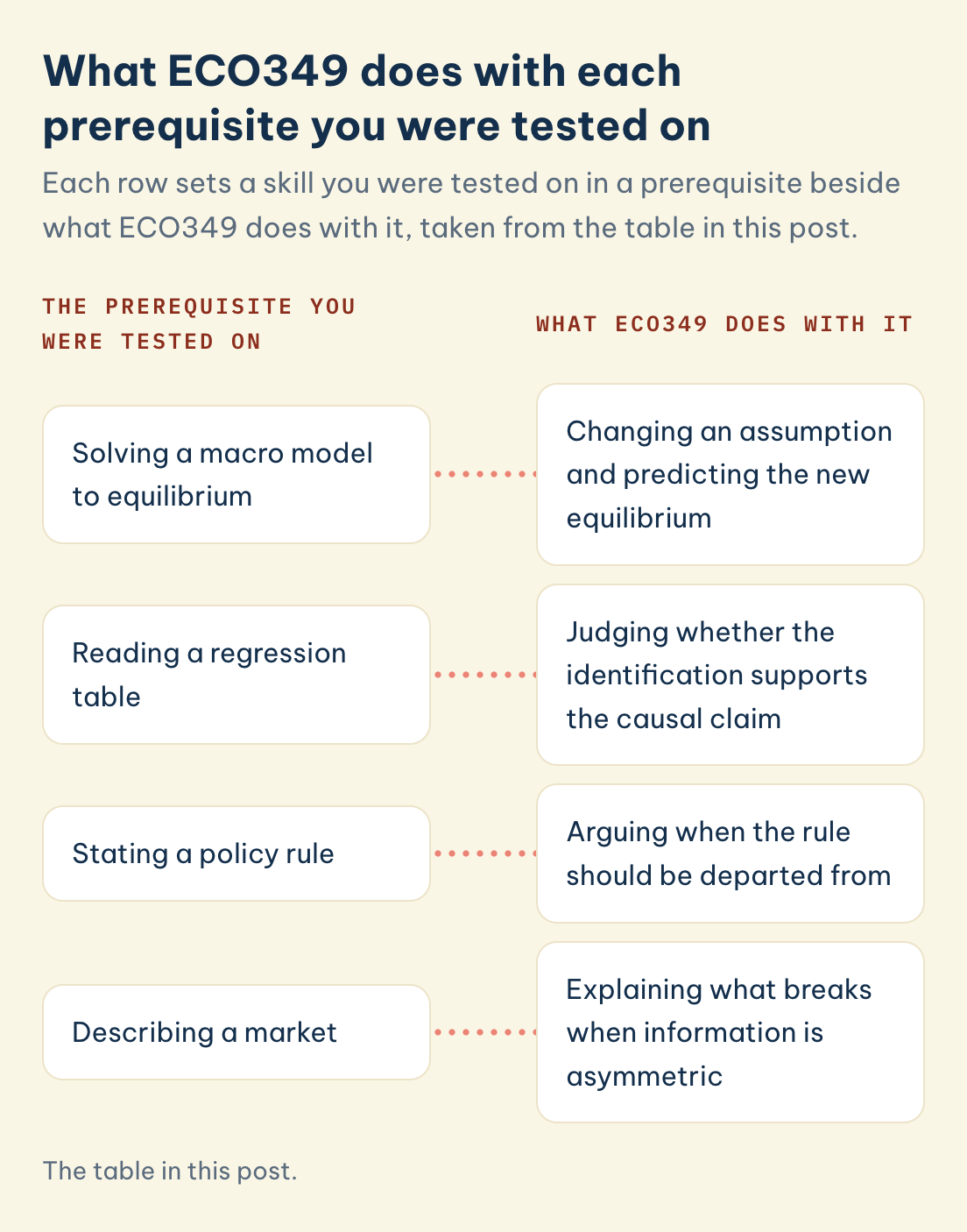
The published prerequisites, listed in the Arts and Science calendar, cover intermediate microeconomics, intermediate macroeconomics, and a year of statistics through several accepted pathways. A student who passed intermediate macro by memorising the shape of the models rather than understanding what they assume will find that ECO349 immediately asks them to modify those models, and modification is impossible without knowing why each piece is there. The most common failure point is the IS-LM model: recalling that the LM curve slopes upward is not the same as knowing which parameter shift moves it versus which one shifts the underlying money demand function.
| The prerequisite you were tested on | What this course does with it |
|---|---|
| Solving a macro model to equilibrium | Changing an assumption and predicting the new equilibrium |
| Reading a regression table | Judging whether the identification supports the causal claim |
| Stating a policy rule | Arguing when the rule should be departed from |
| Describing a market | Explaining what breaks when information is asymmetric |
The practical response is unglamorous and effective. In the first 2 weeks, deliberately re-derive the core intermediate macro results rather than reviewing your notes about them. Reviewing produces recognition, and recognition feels like knowledge until an exam asks you to manipulate the model rather than recall it.
◆ Section 3 / 7 · Canadian institutions
The Canadian institutional layer, and why international students underweight it
Direct answer: Students who studied economics elsewhere often treat central banking as a set of universal principles, and this course is partly examining a specific institution with specific operating procedures.
If your prior economics education was in Vietnam, or anywhere outside Canada, you have theory but not the institutional grounding that domestic students absorbed passively from Bank of Canada news coverage. That gap is entirely closable, and it is closable cheaply, but only if you notice it exists. Most students who notice it late describe the same experience: the theory questions went fine and the questions about how policy is actually implemented did not.
The efficient fix is to read primary institutional material rather than summaries. The Bank of Canada publishes its policy decisions with reasoning attached, and reading a handful of those documents across a term does more for the institutional outcomes than any secondary explanation, because it shows you the vocabulary and the reasoning pattern that the institution itself uses. Those decisions are set against an inflation-control target, first agreed jointly with the federal government in 1991, now expressed as a range of 1% to 3% and renewed on a five-year cycle, and the target itself is a fact worth naming in an answer rather than treating as background colour. Two of the Bank of Canada's own publications are the most efficient primary sources for this: the Monetary Policy Report and the Financial System Review, both of which state the reasoning behind a decision in the institution's own vocabulary rather than a textbook paraphrase of it.
Evidence: Goodfriend (2007), writing in the Journal of Economic Perspectives, is a useful frame for what you are reading. He opens by calling that shift "a great achievement that, especially when viewed from the perspective of 30 years ago, is a remarkable success story" (Goodfriend, 2007), then traces how central banks converged on a broadly shared approach to monetary policy, which means the modern framework you are studying is a historical settlement rather than a permanent truth. Reading it that way makes the institutional detail feel like evidence of a working system rather than arbitrary procedure to memorise.
Evidence: Taylor (1993), in the Carnegie-Rochester Conference Series on Public Policy, matters here for a reason students often invert. The rule he described was offered as a description of how policy had actually behaved, and it became widely used as a benchmark. The examinable skill is not reciting it. It is being able to say what a systematic rule buys a central bank, and under what conditions departing from it is defensible.
◆ Section 4 / 7 · Banking answers
What separates a strong answer on banking questions
Direct answer: Recognising that banks exist because of frictions, so every question about banking is a question about which friction is doing the work.
Students often approach banking as institutional description: banks take deposits, make loans, hold reserves. That description is accurate and unmarkable. The theory in this course exists to explain why an institution with that structure emerges at all, and what makes it fragile. Modern prudential regulation encodes that same fragility directly. The Basel III Liquidity Coverage Ratio, phased in from 2015, requires a bank to hold enough high-quality liquid assets to survive a stress scenario lasting 30 days, which is a regulatory answer to the run mechanic Diamond and Dybvig (1983) describe rather than a separate topic. In Canada that same fragility is why deposit insurance is provided by the Canada Deposit Insurance Corporation (CDIC), and why the ratio is enforced domestically by the Office of the Superintendent of Financial Institutions (OSFI), working alongside the Bank of Canada and the Department of Finance Canada.
Evidence: Diamond and Dybvig (1983), published in the Journal of Political Economy, is the load-bearing model for most of this material. Their account shows that a bank creates value by transforming illiquid assets into liquid deposits, and that this same transformation makes a run possible as an equilibrium outcome, without anyone behaving irrationally. The result is powerful in an exam because it lets you answer a question about fragility without appealing to panic or mismanagement, which is where weaker answers go.
Evidence: Bernanke and Gertler (1995), also in the Journal of Economic Perspectives, extend the reasoning to policy transmission, arguing that the effect of monetary policy runs partly through the balance sheets of borrowers and lenders rather than through interest rates alone. This is the framework behind questions asking why a given rate change had a larger or smaller effect than expected, and answers that stay inside the interest rate channel will look incomplete against it.
Example: Asked about a Bank of Canada policy rate reduction that produced a weaker credit response than in earlier episodes, a thin answer noted that transmission takes time and that other factors were at work. A well-marked answer identified that the borrowers most sensitive to rates were also those whose collateral values had fallen, so the credit channel was working against the rate channel, and stated what evidence would distinguish that explanation from the alternatives.
◆ Section 5 / 7 · Tutorials
Handling the tutorials
Direct answer: With 12 tutorial hours against 24 lecture hours, tutorials carry a third of the contact time, and they are where the problem-solving technique is transmitted rather than the content.
Lectures in this University of Toronto course necessarily move at the pace of the material rather than the pace of the room. Tutorials are the only structured opportunity to find out whether you can execute a derivation rather than follow one. Students who attend and watch get the same information they could have read; students who attempt the problem before the tutorial and arrive with a specific point of failure convert the hour into diagnosis.
That distinction matters more here than in a descriptive course, because in mathematical economics the gap between following a derivation and producing one is wide and almost invisible from the inside. The only reliable test is a blank page.
Evidence: Woodford (2003), in Interest and Prices, is not tutorial reading, but it is worth knowing what the frontier of this material looks like, because it clarifies what your course is a simplification of. Seeing that the intuitive relationships in your lectures are derived rather than assumed at the research level tends to change how students treat the derivations they are given, from formalities to be tolerated into the actual argument.
◆ Section 6 / 7 · Half-credit planning
Planning around a half-credit course
Direct answer: A half credit compresses a full conceptual arc into limited contact time, so gaps compound rather than get absorbed. Keep a running list of every model's assumptions, connect each topic to the Canadian institutional material the calendar names, and verify current exclusions, ECO348H5 and ECO349H5, before building a timetable.
A half credit compresses a full conceptual arc into limited contact time, which changes the cost of falling behind. In a full-year course, a bad fortnight can be absorbed. Here the material is cumulative and the sequence is short, so a gap in the early treatment of money supply and the banking system will still be doing damage when the course reaches policy transmission.
Two habits carry most of the protection. Keep a running list of every model introduced with its assumptions written out in your own words, since the assumptions are what exam questions vary. And after each topic, write one paragraph connecting it to the Canadian institutional material, the same material the calendar ties to the Bank of Canada, because the calendar entry names that connection explicitly and it is the part most easily left as two separate bodies of knowledge that never meet.
Verify the enrolment rules for your own session with the Faculty of Arts and Science before you build a timetable around this. The published exclusions are ECO348H5 and ECO349H5, and prerequisite lists get revised between calendar years, so the combination that worked for a student two years ahead of you may no longer be the combination the calendar accepts.
◆ Section 7 / 7 · Working with a mentor
Working with a mentor on a course this cumulative
Direct answer: MAAS mentor sessions start from a blank page rather than your notes, testing whether you can derive the Diamond and Dybvig (1983) style models rather than merely follow them. Discovering a gap in week 5 costs an evening of rework; discovering it in the exam costs the course, so sessions probe both derivation and institutional mechanism.
The blank page is the only honest test in mathematical economics, the same test behind the Diamond and Dybvig (1983) model, and it is also the test students avoid, because following a derivation feels almost exactly like being able to produce one right up until the moment it does not.
So the sessions with a MAAS mentor tend to start with a blank page rather than with your notes. Derive it again. State the assumption before you state the result. Then, on the institutional side, the pressure shifts: your answer names a fact about the Bank of Canada, but does it name a mechanism? And does your explanation actually rule out the competing explanation, or merely fit the one you happened to think of first?
This blank-page approach is deliberately uncomfortable, and it is the cheapest place to be uncomfortable. Finding out in week 5 that you can follow but not reproduce costs an evening. Finding out in the exam costs the course. The problem sets are yours throughout, and so are the conclusions.
Frequently asked questions
Whose course is this, and at which campus?
The University of Toronto, Faculty of Arts and Science, where ECO349H1 Money, Banking and Financial Markets is a half-credit Department of Economics course. ECO349H5 is the separate Mississauga offering, and the code appears at unrelated institutions as well, so confirm the source of any material you find.
What do I need to have completed first?
The Arts and Science calendar lists intermediate microeconomics, intermediate macroeconomics, and a year of statistics, each satisfiable through several accepted course combinations. Check the exact list for your calendar year, since these are revised.
How much of the course is Canadian specific?
Enough that it cannot be treated as background. The calendar states the course focuses on the institutional structure of the Canadian monetary sector including the role and operation of the Bank of Canada, which places that material inside the examinable content.
Is a strong maths background enough?
It is necessary and not sufficient. The mathematical work, built on models like Diamond and Dybvig (1983), is the vehicle, and the questions that separate grades ask what a result means for an institution or a policy decision, which is interpretation rather than computation.
How heavy is the contact load?
The calendar records 24 lecture hours and 12 tutorial hours. The tutorial share is substantial, and it is where problem-solving technique is transmitted rather than restated.
I studied economics outside Canada, for example in Vietnam. Am I behind?
On theory, no. On institutional context, usually yes, and it is the cheapest gap in the course to close. Reading the Bank of Canada's own published policy material across the term addresses it directly.
Related reading
- ECON2050: money and finance: builds on the same Diamond and Dybvig framework
- ECON1101: microeconomics 1: a microeconomics refresher before the intermediate prerequisites
- ECON1310: introductory statistics for social sciences: a statistics refresher for the year of statistics ECO349 assumes
Ask a MAAS mentor about your course
References
Bernanke, B. S., & Gertler, M. (1995). Inside the black box: The credit channel of monetary policy transmission. Journal of Economic Perspectives, 9(4), 27–48. https://doi.org/10.1257/jep.9.4.27
Diamond, D. W., & Dybvig, P. H. (1983). Bank runs, deposit insurance, and liquidity. Journal of Political Economy, 91(3), 401–419. https://doi.org/10.1086/261155
Goodfriend, M. (2007). How the world achieved consensus on monetary policy. Journal of Economic Perspectives, 21(4), 47–68. https://doi.org/10.1257/jep.21.4.47
Taylor, J. B. (1993). Discretion versus policy rules in practice. Carnegie-Rochester Conference Series on Public Policy, 39, 195–214. https://doi.org/10.1016/0167-2231(93)90009-L
Woodford, M. (2003). Interest and prices: Foundations of a theory of monetary policy. Princeton University Press.
A free 20-minute consultation is a conversation about where you are with ECO349.
Book a free consultation ▸