
◆ Communication & PR
COMM3030: who runs your plan after the course ends?
The partner organisation you work with in COMM3030 does not mark your work, and the people who grade it will not live with the consequences. That gap sits at the centre of the course. A team can build a polished social business plan, present it well, and be assessed favourably, yet still leave behind a proposal the partner cannot run once the term ends. The published outcomes make that risk assessable, since one names sustainable impact directly.
Note on the code: this guide describes the UNSW Sydney course. COMM 3030 codes at other institutions refer to unrelated communications subjects.

◆ Question 1 / 7 · The course
How is the course built?
Direct answer: COMM3030 Social Entrepreneurship Practicum is a 6 unit-of-credit UNSW course managed by the Centre for Social Impact, offered in Summer Term and in Terms 1, 2 and 3, in which student teams work with a partner organisation on a real social entrepreneurship project across several delivery modes including an intensive.
Two structural facts about COMM3030 at UNSW Sydney and what each changes
Each row sets one structural fact beside what it changes, taken from the table in this post.
Structural fact
What it changes
A team project inside a real partner organisation
Your output has a user who is not your marker, and their constraints outrank your preferences.
An intensive delivery option at 7 contact hours per week
In intensive mode the whole arc from briefing to handover compresses into weeks, so the handover has to be designed at the start rather than arranged at the end.
Save this figure
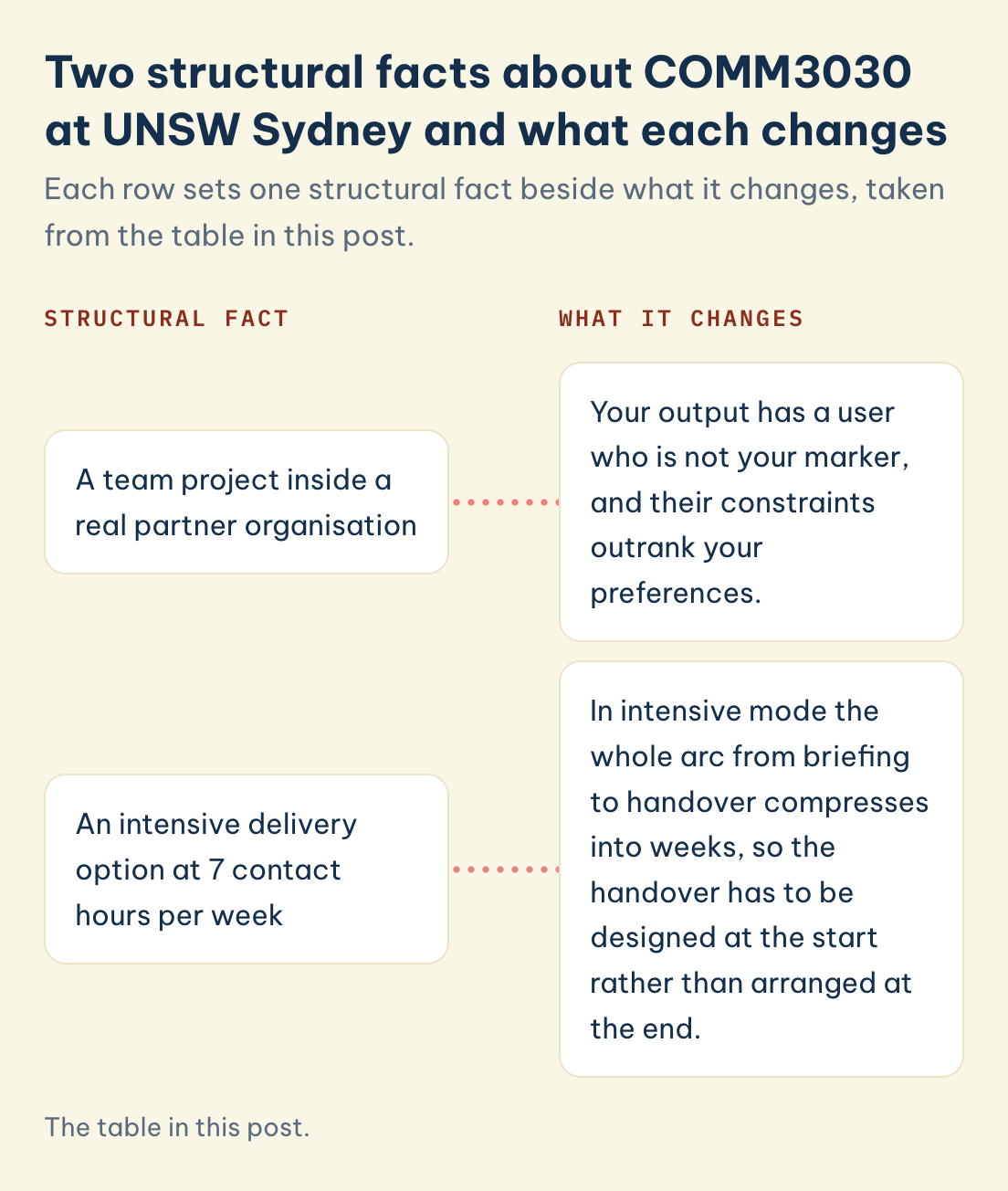
Evidence: The UNSW handbook entry states that the course is managed by the Centre for Social Impact and describes it as "a Work Integrated Learning (WIL) course designed to integrate theory with experiential practice and involve authentic and purposeful engagement with partner organisations". Students work with partners drawn from industry, social enterprises, not-for-profits and foundations. The handbook records indicative contact of 7 hours per week in the in-person intensive mode, 3.5 in in-person standard delivery and 3 in multimodal delivery.
The published specification: code COMM3030, 6 units of credit, UNSW Sydney, Business School, managed by the Centre for Social Impact, undergraduate, offering terms Summer Term plus Terms 1, 2 and 3, team-based, 5 course learning outcomes.
Two structural facts follow, and each changes how you should work. Note that the 5 outcomes and the assessment map sit on the same handbook page as the contact hours, so all 3 can be checked in one visit.
| Structural fact | What it changes |
|---|---|
| A team project inside a real partner organisation | Your output has a user who is not your marker, and their constraints outrank your preferences |
| An intensive delivery option at 7 contact hours per week | In intensive mode the whole arc from briefing to handover compresses into weeks, so the handover has to be designed at the start rather than arranged at the end |
Delivery mode matters more than most students expect when they enrol. The same 6 units of credit can arrive spread across a standard term at 3.5 contact hours per week, or compressed into an intensive at 7. Check which mode your offering uses before you plan the rest of your study load, because the calendar you are working against is not the same in the two cases. The gap between 7 hours and 3.5 hours per week is a factor of 2 in weekly load for identical credit.
◆ Question 2 / 7 · Social business plan
What makes a social business plan different from a business plan?
Direct answer: The test is different, and Santos (2012) draws the line precisely at this point. A commercial plan succeeds if the venture captures enough value to sustain itself. A social venture plan succeeds if value reaches the intended beneficiaries, who are usually not the people paying, which means your plan must show who receives the benefit and how it keeps arriving.
Evidence: Santos (2012) draws the distinction directly, arguing that social entrepreneurship is oriented toward value creation rather than value capture, and that the ventures worth calling social are the ones addressing neglected positive externalities where the beneficiary and the payer come apart. That separation is not a technicality. It is the reason a plan that would satisfy a commercial subject can fail here. Santos (2012) appeared in the Journal of Business Ethics, volume 111, issue 3.
Example: One team proposed a small tailoring cooperative and built a persuasive revenue model showing the cooperative breaking even in month 9. The marker's question was who bears the loss in months 1 through 8, and the plan had no answer, because in a commercial framing that gap is financed by an investor expecting a return, and no such investor existed here. A stronger version named a specific grant stream, stated its application window, and set out what happens if the grant is refused. Santos (2012) is useful here because it supplies the vocabulary for saying why months 1 to 8 are a design question rather than an accounting one.
The practical consequence, following directly from Santos (2012), is that every claim in your plan needs a named holder. Not the partner will maintain the equipment, but which person, with what training, paid by whom, and what happens when that person moves on.
◆ Question 3 / 7 · Handover
Why does the handover belong in week one?
Direct answer: Because the course assesses solutions meant to keep working without you, and the handover is the only part that cannot be improvised, exactly the failure Guttentag (2009) documents across short-term placements more broadly. Deciding in the final days who takes over is too late to train anyone, which makes the end of the engagement a design constraint from the start rather than an ending.
The research literature on short-term volunteering and development placements is blunt about this failure. Guttentag (2009), writing in the International Journal of Tourism Research, volume 11, issue 6, catalogued the negative impacts that recur when well-intentioned short placements are poorly designed, including a neglect of what local people actually wanted and a dependency created when outsiders perform work local people could do themselves. His own abstract frames this as a call to attention: "there are numerous possible negative impacts of volunteer tourism that deserve increased attention from both researchers and project managers" (Guttentag, 2009, p. 537). Simpson (2004), in the Journal of International Development, volume 16, issue 5, argued that short development placements often produce a simplified account of poverty in the volunteer's own understanding, which is a critique of how such placements teach rather than a measurement of what they leave behind.
Reading those two papers before you start is worth more than reading them afterwards, and neither Guttentag (2009) nor Simpson (2004) is long. They are not an argument against the course. They are a catalogue of the specific mistakes the course is designed for you to avoid, which means demonstrating you have avoided them is what earns marks.
A concrete test to apply to your own proposal: cross out every task in the implementation plan that requires a team member to be present. If what remains cannot function, the plan describes your involvement rather than proposing something for the partner.
◆ Question 4 / 7 · Five outcomes
What are the five outcomes actually asking for?
Direct answer: The published course learning outcomes are what the assessment items map to, not the professional-skills list that appears in the course blurb. There are five of them, they are numbered CLO1 to CLO5 on the handbook page, and one of them names a requirement that most student plans never mention at all.
The handbook publishes 5 outcomes. CLO1 covers working collaboratively and responsibly in a team while demonstrating leadership and professional practices. CLO2 covers applying social entrepreneurship approaches and integrating the United Nations Sustainable Development Goals to develop and evaluate solutions that create sustainable and meaningful social and environmental impact. CLO3 covers collaborating with a partner organisation to address social or environmental challenges. CLO4 covers communicating complex ideas logically, succinctly and persuasively to diverse audiences. CLO5 covers reflecting on personal and professional development including an enhanced understanding of ethical, social and environmental issues.
CLO2 is the one to read twice. It asks you to integrate the United Nations Sustainable Development Goals, and it is mapped to the assessment items in the handbook's own assessment table. A plan that never names a specific SDG, never says which target it addresses and never explains how the venture moves that target has left a published outcome unaddressed, however good the venture is. There are 17 SDGs and naming the right one or two, with the specific target beneath it, takes a sentence. The 17 goals were adopted by United Nations member states in 2015 with a target date of 2030.
The word evaluate in the same outcome does separate work from develop. Developing a solution is proposing it. Evaluating it means saying how you would know whether it worked, which means naming an indicator and a time frame before you leave.
CLO5, on reflecting for personal and professional development, is best served by notes taken during the work rather than assembled afterwards. Keep a running log with 3 columns: what we assumed, what we found, what we changed. Ten entries across an engagement is a stronger evidence base than a long reflective piece written at the end, and it takes about 5 minutes a day. Kolb (1984) framed learning as a cycle in which concrete experience becomes useful only once it is reflected on and re-tested, and the log is that cycle written down while it is still recoverable.
◆ Question 5 / 7 · Where teams lose marks
Where do teams lose marks?
Direct answer: Marks are lost in three recurring places. Teams solve the problem they find interesting rather than the one the partner named, they mistake activity for progress, and they write up the experience instead of the proposal. Each of the three is a scoping failure rather than an effort failure, and each is visible weeks before submission.
The first is scoping. Partner organisations arrive with a brief because they have already decided what they need, and a team that quietly substitutes a more exciting problem produces work the partner cannot use. If you believe the brief is wrong, the correct move is to say so early, in writing, with reasons, and then negotiate. Doing it silently reads as not having listened.
The second shows up in the report as a list of things the team did: hours worked, meetings held, people met. None of those is an outcome, and none of them maps to any of the 5 published outcomes. Convert each activity into what changed because of it, and delete anything that survives no such conversion.
The third is a genre error and the most common. The assessed artefact is a plan a partner can act on. Your personal growth belongs in the reflective component, which CLO5 names explicitly, and even there it is stronger when tied to a decision you changed rather than a feeling you had, the difference Kolb (1984) draws between an experience and a reflected-on experience.
◆ Question 6 / 7 · Language
Where does language actually cost a team marks?
Direct answer: The negotiation, not the writing. This course requires disagreeing with a partner organisation or a teammate in real time, in English, politely, and many students default to agreement to stay courteous, which then reads in the report as an absence of critical thinking.
Two small habits help more than they sound like they should. Separating agreement from understanding out loud is the first. Saying I want to make sure I have understood before I respond buys thinking time and is heard as care rather than resistance. Putting the disagreement in writing afterwards is the second. A short message noting we discussed X, my concern is Y, could we consider Z creates the record the assessment needs and is easier to compose than a live objection.
The team dynamic carries the same risk. In a small team working to a compressed schedule, the fastest speaker sets the direction by default. If your contribution consistently appears only in the written work, say so to the team early, and ask for the notes or the analysis to be the way you lead. That is a legitimate division of labour and it is visible to markers, since CLO4 is about communicating to diverse audiences and CLO1 is about professional practice within the team.
◆ Question 7 / 7 · MAAS mentors
How MAAS mentors prepare students for a partner-facing project
A mentor cannot join your team and does not write your plan. What a session does cover is the preparation and the structure around it: pressure-testing your scoping questions before the engagement starts, checking that your proposal names an SDG target rather than gesturing at impact, and afterwards reading your draft against the harder question of whether the proposal survives your absence.
For a course like this the most useful session usually happens twice. Once before you start, to build the assumption log and the handover test, and once when you have field notes but no structure. If you are on the academic support pathway, bring the partner brief itself, because most scoping problems are visible in the gap between that brief and what your team has started doing.
Frequently asked questions
When does COMM3030 run?
The handbook lists offering terms of Summer Term, Term 1, Term 2 and Term 3, with several delivery modes including an in-person intensive. Check the mode of the specific offering you enrol in, since contact hours differ between them.
How heavy is it?
The handbook records indicative contact of 7 hours per week in the in-person intensive mode, 3.5 in in-person standard and 3 in multimodal. The intensive compresses the same credit into a shorter calendar, so plan the surrounding weeks accordingly.
Do I need a business background?
The course develops professional skills including critical thinking, research and teamwork, and teams are usually mixed. A student from a non-business discipline is often the person who notices the assumption everyone else shares.
Do I have to use the Sustainable Development Goals?
CLO2 asks you to integrate them, so treat naming a specific goal and target as a requirement of the plan rather than as an optional framing.
How is it assessed?
Assessment items and weightings appear in the course outline released before your term starts, and the handbook maps each item to specific course learning outcomes. Confirm there rather than relying on what a previous cohort tells you.
Related reading
References
Guttentag, D. A. (2009). The possible negative impacts of volunteer tourism. International Journal of Tourism Research, 11(6), 537–551. https://doi.org/10.1002/jtr.727
Kolb, D. A. (1984). Experiential learning: Experience as the source of learning and development. Prentice Hall.
Santos, F. M. (2012). A positive theory of social entrepreneurship. Journal of Business Ethics, 111(3), 335–351. https://doi.org/10.1007/s10551-012-1413-4
Simpson, K. (2004). "Doing development": The gap year, volunteer-tourists and a popular practice of development. Journal of International Development, 16(5), 681–692. https://doi.org/10.1002/jid.1120
A free 20-minute consultation is a conversation about where you are with COMM3030.
Book a free consultation ▸