
◆ Business & Management
BUSS508: why is 60% of an economics paper marked on reflection?
Students enrol in an economics paper expecting supply and demand diagrams, and the assessment plan for this one puts 60% of the mark on two reflective journals. That is not a softer requirement than a calculation task; it is a different one, and it catches out capable students who have never been taught the genre. The journals also examine the paper's first two learning outcomes, so reflection is the vehicle for the economics, not a break from it.
Note on the code: this guide describes the Auckland University of Technology paper. AUT, established as a university in 2000, teaches BUSS508 through its Faculty of Business, Economics and Law. Some North American institutions run a BUS 508 in contemporary business, which is unrelated, so check the paper title on your own enrolment first.

◆ Question 1 / 7 · The paper
How is the paper built?
Direct answer: BUSS508 Economics and International Business is a 15-point Level 5 paper on the New Zealand Qualifications Framework, taught in AUT's Faculty of Business, Economics and Law, with a workload of 150 hours. The descriptor lists three assessments: Reflective Journal 1 at 30%, Reflective Journal 2 at 30%, and an integrated case study at 40%, all individual.
Evidence: The paper descriptor maps each assessment to specific learning outcomes, and the mapping is the most useful planning information available to you. Journal 1, worth 30% of the paper, examines outcome one, applying the laws of demand and supply in environmental policies and reflecting on the impact of economic activity on the environment. Journal 2, also worth 30%, examines outcome two, reflecting on the winners and losers in cross-border movement of goods, services, capital and labour over the last century. The case study examines all four outcomes together, adding the role of competition in consumer welfare and the evaluation of strategy, innovation and worker effort in building competitive advantage. The paper is restricted against BUSS504 and ECON501, so you cannot count it alongside those.
Example: A student who had studied economics at secondary school for 2 years found the content straightforward and the first journal difficult. The problem was never the demand curve. It was that nothing in his prior training had asked him to write about what a demand curve implied for a decision he had watched being made.
Descriptors are amended between teaching periods, so confirm the current assessment plan on Canvas and against the descriptor for your own intake.
◆ Question 2 / 7 · Reflection
Why is so much of the mark on reflection?
Direct answer: Because the outcomes are written as applied verbs, and the 60% weighting on the 2 journals reflects that design. Outcome one asks you to apply supply and demand in environmental policy while reflecting on impact, and outcome two asks you to reflect on winners and losers. A test of whether you can shift a curve would not examine either of those; it would examine a step before them.
The four levels of a BUSS508 reflective journal
Each row sets one level of the journal beside what that level looks like here, with the example taken from the table in this post.
Level in the journal
What it looks like here
Reporting
Petrol prices rose and traffic seemed lighter
Relating
This looks like the demand response we covered in class
Reasoning
Demand for fuel is inelastic in the short run, so a price rise of that size should change quantity far less than it appeared to, which suggests something else was also happening
Reconstructing
If I were assessing the policy, I would look for the effect over a longer window and against a comparison region
Save this figure
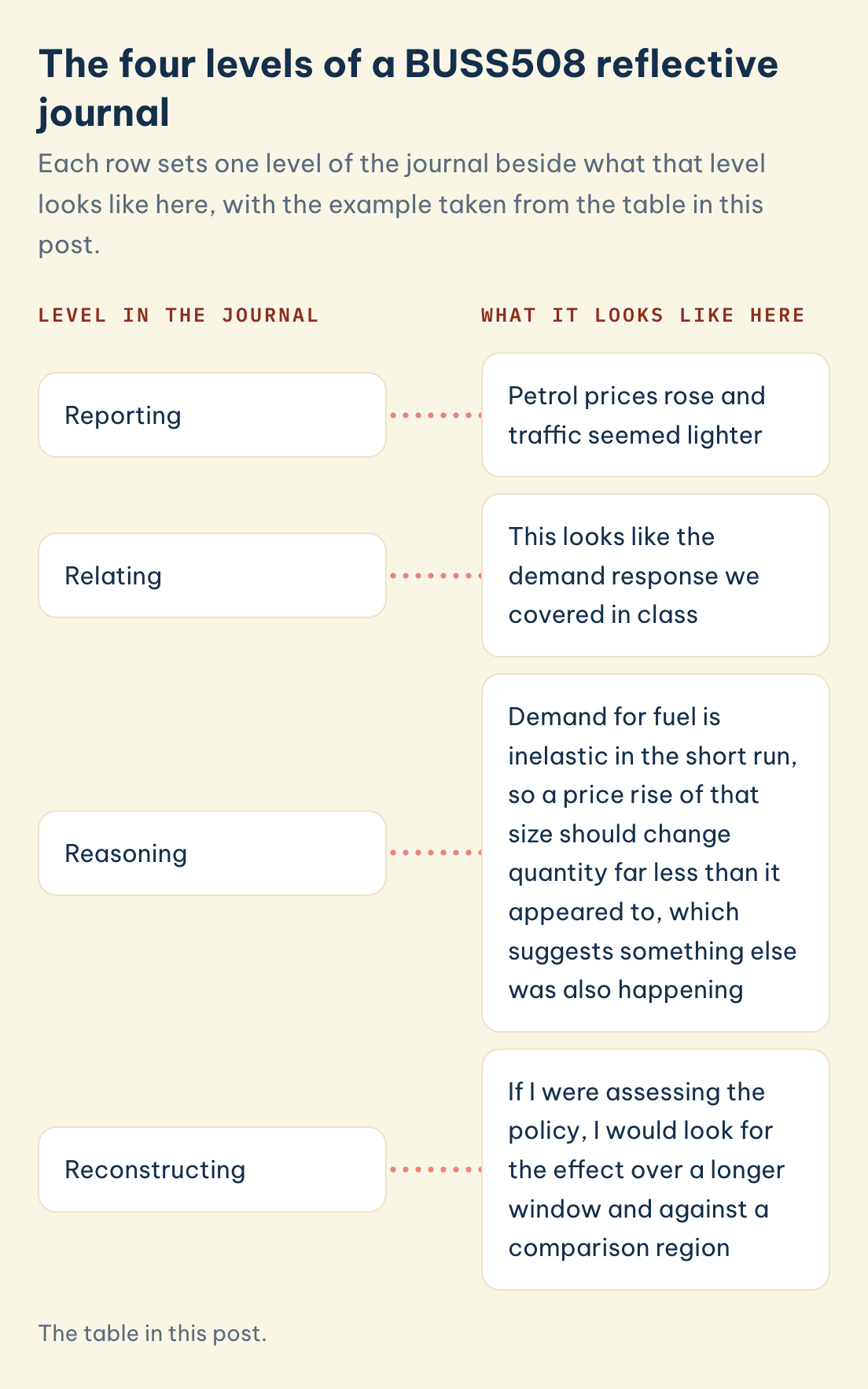
Evidence: Reflective writing has a structure that markers can assess, which is why it appears in assessment plans at all. Ryan (2011), writing in Teaching in Higher Education, argues that reflective writing is a discipline-specific genre with identifiable linguistic features, and that students improve when those features are made explicit rather than left implicit in the instruction to reflect. Ryan and Ryan (2013), in Higher Education Research & Development, build on this with a model for teaching and assessing reflective learning across a degree, which matters for how you read the task: there is a scale from reporting what happened, through relating it to what you know, to reasoning about why it happened and reconstructing what you would do differently. A journal that stops at the first two levels reads as a diary. The economics content is what allows you to reach the third.
| Level in the journal | What it looks like here |
|---|---|
| Reporting | Petrol prices rose and traffic seemed lighter |
| Relating | This looks like the demand response we covered in class |
| Reasoning | Demand for fuel is inelastic in the short run, so a price rise of that size should change quantity far less than it appeared to, which suggests something else was also happening |
| Reconstructing | If I were assessing the policy, I would look for the effect over a longer window and against a comparison region |
Example: Two journals, submitted 1 week apart, described the same fuel excise change. The first recorded the writer's frustration at the cost and concluded that taxes hurt households. The second reached the same starting observation, then asked what elasticity implied about who ultimately bore the cost. Only the second was answering the outcome.
◆ Question 3 / 7 · Critical
What does critical look like in this paper?
Direct answer: Naming a genuine dispute in the evidence and explaining what causes it, rather than reporting one number as though the question were settled.
Evidence: Carbon pricing is the clearest available example, and it sits directly on outcome one. Green (2021), writing in Environmental Research Letters, reviewed the ex-post quantitative evaluations of carbon pricing policies worldwide and found that the majority suggested aggregate emissions reductions of between 0% and 2% per year, noting that only 37 studies assessed actual policy effects. The review's own abstract states the finding directly: "the majority of studies suggest that the aggregate reductions from carbon pricing on emissions are limited" (Green, 2021). Döbbeling-Hildebrandt et al. (2024), published in Nature Communications, then synthesised 80 causal ex-post evaluations across 21 carbon pricing schemes, drawing on 483 effect sizes, and reported statistically significant reductions ranging from 5% to 21% across schemes, or 4% to 15% after correcting for publication bias. They also found considerable variation in magnitude between schemes.
Both reviews are legitimate. The gap between them is the interesting part, and explaining it is exactly the move that separates a credit-level journal from a distinction-level one: the later review had access to more than twice as many evaluations, and it corrected for publication bias, which is the tendency for studies finding large effects to be published more readily. A student who reports only the first figure looks underinformed, and one who reports only the second looks incurious. One who reports both, and says what the difference tells us about reading policy evidence, is doing economics.
Example: A journal that opened with a single confident sentence about carbon taxes being ineffective was accurate to one source and wrong about the state of knowledge. Adding 4 sentences on the second review and why the estimates diverge, roughly 90 words, turned an assertion into an argument.
◆ Question 4 / 7 · Winners and losers
Who are the winners and losers your second journal has to name?
Direct answer: Specific groups, in specific places, over a specific period, because the second outcome asks about the last 100 years rather than about trade in the abstract. A journal that concludes trade benefits everyone on average has avoided the question the outcome asks.
Evidence: Autor, Dorn and Hanson (2016), published in the Annual Review of Economics, examined how labour markets adjusted to the rapid growth of Chinese manufacturing exports over more than a decade and found the adjustment to be slower and more geographically concentrated than standard trade models had assumed, with effects persisting in exposed local labour markets. The finding does not overturn the case for trade. What it does is put a shape on the losses that aggregate figures hide, which is precisely what your outcome asks you to reflect on. Aggregate gains and concentrated losses are compatible, and an honest journal says so rather than choosing whichever half fits the conclusion it wanted.
Example: A student writing about her family's experience of an industry that moved offshore, over a period of roughly 3 years, had material most classmates lacked. Her first draft was a story. The version that scored well used the same story and asked whose gains were financing the loss she was describing, and over what period the adjustment was supposed to have happened.
◆ Question 5 / 7 · Case study
How is the integrated case study different from the journals?
Direct answer: The integrated case study is assessed against all four outcomes at once, so it has to hold together as a single analysis rather than as four separate answers. At 40% it is also the largest single piece in the paper.
Evidence: The two journals each map to one outcome, which lets them go deep on a narrow question. The case study maps to outcomes one through four, adding competition and consumer welfare and the sources of competitive advantage. Integration is the word doing the work in the task title: a case analysis that discusses environmental impact, then trade, then competition, then strategy, in four sealed sections, has covered the outcomes without integrating them. The stronger structure runs one thread through the case, with the frameworks entering where they change the reading of the evidence.
Example: Two analyses of the same firm, both around 2,500 words, covered identical ground. The first was organised by framework and read as a checklist. The second was organised around the firm's central choice, and each framework appeared at the point where it explained why that choice was hard.
◆ Question 6 / 7 · Lost marks
Where do international students most often lose marks?
Direct answer: In treating the reflective journal as personal writing and therefore as the one task where sources are unnecessary, and in using the first person as though it licenses unsupported claims.
Evidence: Reflective writing in a discipline still carries the discipline's evidentiary standards. Writing that you noticed something is a legitimate starting point; writing that this proves a policy failed is not, unless something beyond the observation supports it. Ryan (2011) treats this as a genre problem more than a language problem, and it is common among students whose prior education assessed economics through calculation and examination, where reflective genres rarely appear at all. The fix is unglamorous: keep the first person for the observation and the judgement, and cite for the claim about the world in between.
A second, smaller point is grading language. AUT's grade map for this paper runs A+ to A- as pass with distinction, B+ to B- as pass with merit, C+ to C- as pass, and D as fail, so when a rubric refers to distinction it is naming that band rather than speaking loosely.
Example: A journal used no sources on the ground that it described personal experience. Adding 2 citations, in around 30 words, at exactly the points where it made claims about the wider economy left the personal material untouched and moved the mark.
◆ Question 7 / 7 · MAAS mentors
What do MAAS mentors actually do on a paper like this?
The genre is where most of the difficulty sits, so that is where the work starts. Early on, a mentor will read a paragraph of roughly 100 words from your draft journal back to you and ask which level it is operating at, because most students cannot see the line between relating and reasoning in their own writing until someone points at it. Later, the questions are evidentiary: this sentence makes a claim about the economy, so what is holding it up. For the case study, the conversation is structural, since integration is difficult to achieve by editing and much easier to plan. You do the noticing, the reading and the writing. A mentor is the person who can tell you when a paragraph is a diary entry wearing an economics vocabulary.
If you have a journal draft and are not sure whether it is reflecting or just recounting, send us one paragraph and we will show you the difference.
Frequently asked questions
Do I need prior economics to take BUSS508?
The descriptor lists no prerequisites. It does list restrictions against BUSS504 and ECON501, meaning you cannot count this paper alongside those, so check your programme plan before enrolling.
How long should a reflective journal be?
The descriptor does not publish a word count, and requirements are set on Canvas for each intake. Ask early rather than guessing, since length expectations differ sharply between a journal and an essay.
Can I write in the first person?
Yes, and in a reflective journal you generally should. The first person governs your observations and judgements; it does not remove the need to support claims about the wider world.
What if my personal experience does not relate to the topic?
Reflection does not require a dramatic personal story. Something you observed, read or worked on is enough, and the assessed part is the reasoning you build on it rather than the vividness of the experience.
Is the case study a group task?
The published assessment plan lists all three assessments as individual. Confirm against your own intake's Canvas page, since assessment plans are amended between teaching periods.
Related reading
References
Autor, D. H., Dorn, D., & Hanson, G. H. (2016). The China shock: Learning from labor-market adjustment to large changes in trade. Annual Review of Economics, 8(1), 205–240. https://doi.org/10.1146/annurev-economics-080315-015041
Döbbeling-Hildebrandt, N., Miersch, K., Khanna, T. M., Bachelet, M., Bruns, S. B., Callaghan, M., Edenhofer, O., Flachsland, C., Forster, P. M., Kalkuhl, M., Koch, N., Lamb, W. F., Ohlendorf, N., Steckel, J. C., & Minx, J. C. (2024). Systematic review and meta-analysis of ex-post evaluations on the effectiveness of carbon pricing. Nature Communications, 15, 4147. https://doi.org/10.1038/s41467-024-48512-w
Green, J. F. (2021). Does carbon pricing reduce emissions? A review of ex-post analyses. Environmental Research Letters, 16(4), 043004. https://doi.org/10.1088/1748-9326/abdae9
Ryan, M. (2011). Improving reflective writing in higher education: A social semiotic perspective. Teaching in Higher Education, 16(1), 99–111. https://doi.org/10.1080/13562517.2010.507311
Ryan, M., & Ryan, M. (2013). Theorising a model for teaching and assessing reflective learning in higher education. Higher Education Research & Development, 32(2), 244–257. https://doi.org/10.1080/07294360.2012.661704
Tools & resources
A free 20-minute consultation is a conversation about where you are with BUSS508.
Book a free consultation ▸