
◆ Business & Management
BUSM3311 Global Business: how do you write a first-year report?
"In today's era of globalisation, the world is more connected than ever." If your BUSM3311 draft opens like that, delete the sentence: it carries no information. In 2026 its central assumption is also contested, since trade is fragmenting, tariffs have returned, and supply chains are being rebuilt along political lines. BUSM3311 is often the first business course where markers stop rewarding fluent generalisation and start asking for evidence, which is what the seven questions below work through.

◆ Question 1 / 7 · The module
What is BUSM3311, and why does the year level matter?
Direct answer: BUSM3311 is the RMIT course code for Global Business, delivered to undergraduates at RMIT Vietnam Saigon South. It sits in the first year, first semester, alongside foundational courses like Understanding the Business Environment and Business Decision Making. That matters because it sets the marker's expectations: this is where you learn to write business analysis.
Evidence: In the RMIT Handbook the course sits under record 001415, Global Business, with delivery codes by campus: BUSM3311 at RMIT Vietnam Saigon South, BUSM4626 at RMIT Vietnam Hanoi, BUSM1222 at Melbourne City Campus, BUSM1227 at the Singapore Institute of Management and BUSM3085 at Shanghai University of International Business and Economics. RMIT's sample study guide for the Global Business major places Global Business in Year 1, Semester 1.
Example: A student who had written strong argumentative essays at high school was surprised by a Pass on his first BUSM3311 report. The writing was fluent. The problem was that every claim was general and none was sourced. His mentor did not work on his prose at all; they worked on turning three assertions into evidenced claims, and the second assignment moved two bands.
◆ Question 2 / 7 · Report writing
What separates school writing from a first-year business report?
Direct answer: Three habits. First, claims carry sources; if a sentence states a fact about the world, a reader should be able to check it. Second, the structure serves an argument rather than a narrative, so sections are organised by analytical point, not by chronology. Third, the writing takes a position and defends it instead of balancing both sides and concluding that "it depends". A first-year business report is judged on whether a reader could disagree with you specifically, which is impossible if you never commit.
Evidence: RMIT's Bachelor of Business learning outcomes require graduates to identify, analyse, evaluate and address complex challenges in local and global contexts, and the Global Business major at RMIT Vietnam states that students learn to interpret and analyse international challenges using both qualitative and empirical data. Both formulations are about evidence and judgement rather than coverage.
Example: A student wrote a section listing five advantages and five disadvantages of foreign direct investment, then concluded that it had both benefits and drawbacks. Her mentor asked which mattered more for the country in her case and why. The rewritten section made a claim, supported it with two sources, and acknowledged the strongest objection. Same content, an argument instead of a list.
◆ Question 3 / 7 · Sources
Which sources count, and which quietly cost you marks?
Direct answer: Work in three tiers. Institutional data sources such as the World Bank, UNCTAD, the WTO and the IMF supply figures on trade, investment and development, and they are appropriate and expected at first-year level. Peer-reviewed articles and academic books supply the concepts you analyse with. Reputable business press supplies current context.
What quietly costs marks is building an argument on Wikipedia, generic definition sites, or content-marketing blogs, because none of them can be verified back to a method. Use a definition site to understand a term if you need to, then cite the source that establishes it.
Evidence: First-year business courses are where source discipline is taught, and it maps directly onto graduate outcomes about evidence-based analysis. A reference list of ten sources with eight websites signals the problem before a marker reads a word of your analysis.
Example: A student cited a definition site for "comparative advantage" and a blog for Vietnam's export figures. Her mentor replaced the first with the trade theory itself and the second with the World Bank's data portal. The argument did not change. The credibility of it did, and so did the mark.
◆ Question 4 / 7 · Concepts
Which concepts should a first-year global business assignment actually use?
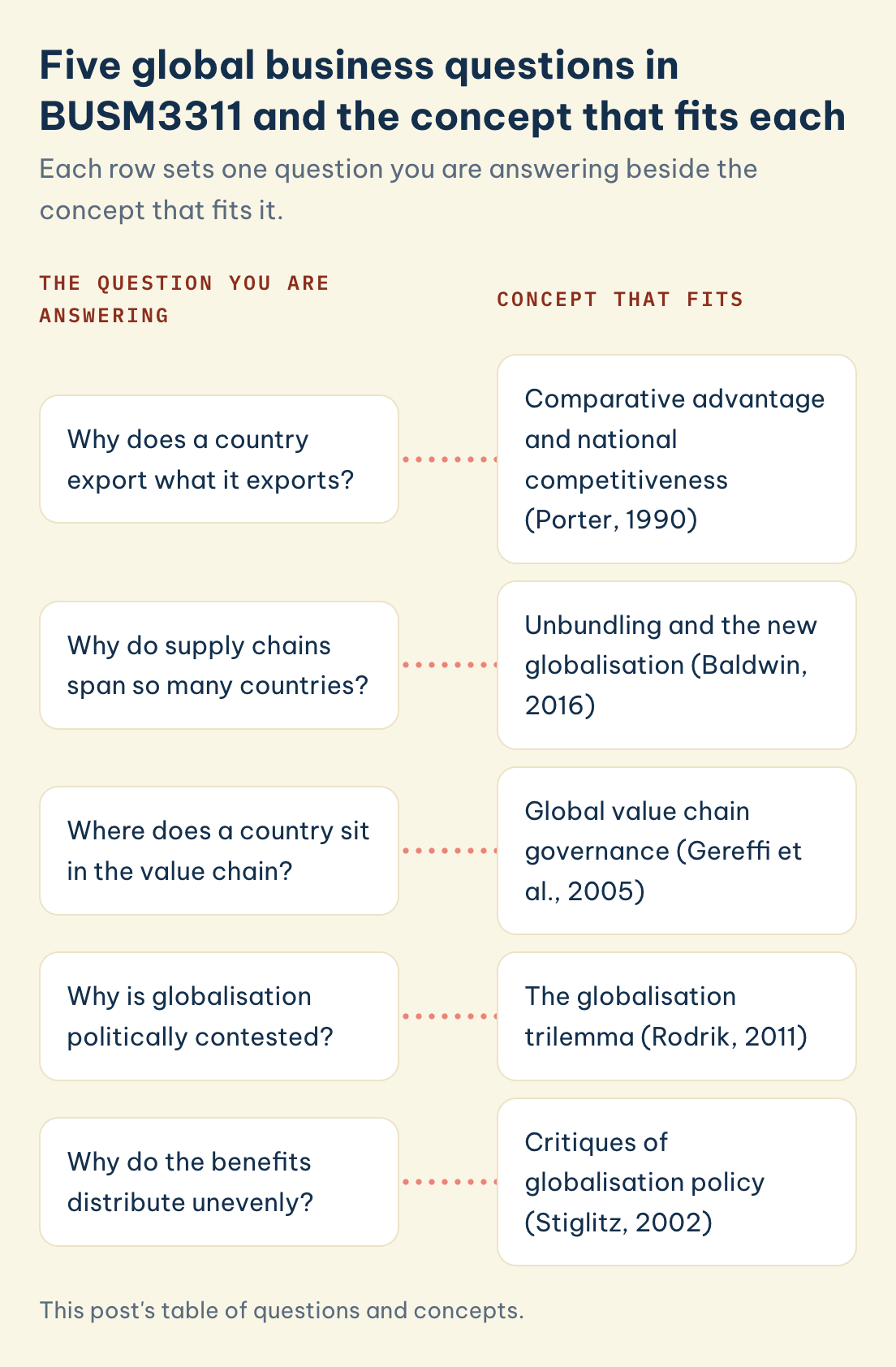
Direct answer: Pick two or three that fit your question and apply them properly, rather than defining six. At this level the frameworks below are the workhorses.
Five global business questions in BUSM3311 and the concept that fits each
Each row sets one question you are answering beside the concept that fits it.
The question you are answering
Concept that fits
Why does a country export what it exports?
Comparative advantage and national competitiveness (Porter, 1990)
Why do supply chains span so many countries?
Unbundling and the new globalisation (Baldwin, 2016)
Where does a country sit in the value chain?
Global value chain governance (Gereffi et al., 2005)
Why is globalisation politically contested?
The globalisation trilemma (Rodrik, 2011)
Why do the benefits distribute unevenly?
Critiques of globalisation policy (Stiglitz, 2002)
Save this figure
| The question you are answering | Concept that fits | What it lets you argue |
|---|---|---|
| Why does a country export what it exports? | Comparative advantage and national competitiveness (Porter, 1990) | Whether the advantage comes from factor conditions, demand, related industries or firm rivalry |
| Why do supply chains span so many countries? | Unbundling and the new globalisation (Baldwin, 2016) | That falling coordination costs, not just trade costs, reorganised where production happens |
| Where does a country sit in the value chain? | Global value chain governance (Gereffi et al., 2005) | Who controls the chain and who captures the value, which is not the same as who does the work |
| Why is globalisation politically contested? | The globalisation trilemma (Rodrik, 2011) | That deep integration, national sovereignty and democratic politics cannot all be maximised at once |
| Why do the benefits distribute unevenly? | Critiques of globalisation policy (Stiglitz, 2002) | That outcomes depend on the terms of integration, not integration alone |
Evidence: Rodrik (2011) argued that countries cannot simultaneously pursue deep economic integration, the nation state and democratic politics, and must choose two, which gives you a structured way to explain trade conflict rather than treating it as noise. Gereffi et al. (2005) developed a typology of value chain governance showing how power is distributed between lead firms and suppliers, which is often the single most useful concept for a Vietnamese case. Their framework sorts chains into five governance types "which range from high to low levels of explicit coordination and power asymmetry" (Gereffi et al., 2005, p. 78).
Example: A student wrote that Vietnam "benefits greatly from participating in global supply chains" and stopped there. His mentor introduced value chain governance. The revised argument distinguished assembly volume from value captured, and asked what would need to change for more value to stay in Vietnam. The claim became specific and defensible.
◆ Question 5 / 7 · Writing about Vietnam
How do you write about Vietnam without being either boosterish or dismissive?
Direct answer: Use figures and name the mechanism. Two failure modes are common. The first is promotional: Vietnam is a rising star, exports are booming, the future is bright. The second is dismissive: Vietnam only does low-value assembly. Both are conclusions without analysis. The stronger move is to state what the data shows, identify which stage of the value chain the activity sits at, and explain what determines movement between stages. That is analysis a marker cannot dismiss, and it is more interesting than either cheerleading or pessimism.
Evidence: Baldwin (2016) argued that the information and communications revolution allowed production stages to be separated and offshored, which explains why participation in manufacturing can rise sharply without a corresponding rise in captured value. Read alongside Gereffi et al. (2005), it gives you the mechanism rather than the slogan.
Example: A student's introduction called Vietnam "one of the fastest-growing economies in the world" with no source and no relevance to her question. Her mentor cut it and replaced it with a single sourced figure about her specific sector. The opening went from decorative to load-bearing.
◆ Question 6 / 7 · AI
Where does AI fit in a course that is explicitly about working alongside it?
Direct answer: Understand the boundary before you use it. RMIT Vietnam positions this major around thriving in an AI-driven, digital and interconnected world, which makes AI a legitimate topic of study in your assignment. That is different from using AI to produce the assignment. Using a tool to explain a concept you then verify against a real source is study.
Having a tool generate your argument, your case analysis or your references is not your work, and generated references frequently do not exist, which is the most common way students are caught. Always check your own institution's stated rules, since they are the ones that apply to you.
Evidence: RMIT Vietnam's description of the Global Business major emphasises critical thinking, adaptability, resilience and ethical decision-making as the human skills essential for working alongside intelligent technologies. Those are capabilities you demonstrate by reasoning, which is precisely what is lost when reasoning is outsourced.
Example: A student used a chatbot to build a reading list and cited four articles from it. Two did not exist and one had a different author. His mentor showed him how to verify a citation by resolving it to the journal in under a minute. He kept the tool for explanation and dropped it for evidence.
◆ Question 7 / 7 · Structure
What structure works, and what gets cut?
Direct answer: A dependable shape for a first-year report: introduction stating the question and your position; brief context limited to what your argument needs; analysis organised by point, with each section making a claim, presenting evidence and stating the implication; consideration of the strongest counter-argument; conclusion answering the question you set. What gets cut is the general history of globalisation, the definition paragraph for every term, and any framework introduced without being used. If a paragraph would sit equally well in another student's assignment on another country, it is not doing work.
Evidence: RMIT assessment is criterion-referenced, so your work is measured against published rubric criteria rather than ranked against classmates. A longer background section cannot lift a mark; converting description into claims with evidence can.
Example: A student opened with 400 words on globalisation since the 1990s in a 1,500-word report. His mentor cut it to two sentences that led directly into his question, and the recovered words went into the analysis section, where the rubric actually pays.
Frequently asked questions
Is BUSM3311 the same course as BUSM4626 or BUSM1222?
They are the same course record in the RMIT Handbook with different delivery codes by campus. BUSM3311 is RMIT Vietnam Saigon South, BUSM4626 is RMIT Vietnam Hanoi, BUSM1222 is Melbourne City Campus, BUSM1227 is the Singapore Institute of Management and BUSM3085 is Shanghai University of International Business and Economics. Assessment detail can differ, so use your own course guide and Canvas shell.
Is this a hard course to start university with?
It is demanding in a specific way: the concepts are accessible, but the writing standard is new. Most students who struggle are not confused about globalisation; they are still writing the way they wrote at school. Fixing that early pays off across the whole degree.
How many references does a first-year report need?
Your course guide is the authority. As a working guide, expect roughly six to twelve quality sources for a report of this level, mixing institutional data with peer-reviewed work. Quality and correct use matter far more than count.
Can I use a country other than Vietnam as my case?
Usually yes, unless your brief specifies. Choose the case where you can find reliable data rather than the one you find most interesting, because a first-year report lives or dies on whether the evidence exists.
Which referencing style does this course use?
RMIT business courses commonly use RMIT Harvard, but style varies by school and course. Confirm in your course guide and apply it consistently across in-text citations and the reference list. Getting this right in first year saves you three years of corrections.
How MAAS mentors support BUSM3311 students
MAAS works as an academic advisor, not a writing service. For a first-year course this usually means helping you decode your own brief and rubric, showing you how to turn a general statement into an evidenced claim, checking your sources before you build on them, and giving feedback that names exactly where description should become analysis. You write the assignment; the mentor helps you build the habits the next three years will assume you have.
If you are studying related international business courses, our guides to BUSM2716 Managing Multinational Enterprises and ECON1269 Business in a Globalised Economy cover neighbouring rubrics. You can also read how our academic support service works before you get in touch.
References
Baldwin, R. (2016). The great convergence: Information technology and the new globalization. Harvard University Press.
Gereffi, G., Humphrey, J., & Sturgeon, T. (2005). The governance of global value chains. Review of International Political Economy, 12(1), 78–104. https://doi.org/10.1080/09692290500049805
Porter, M. E. (1990). The competitive advantage of nations. Free Press.
Rodrik, D. (2011). The globalization paradox: Democracy and the future of the world economy. W. W. Norton.
Stiglitz, J. E. (2002). Globalization and its discontents. W. W. Norton.
Tools & resources
- RMIT Handbook record for Global Business (course 001415), for course learning outcomes and the delivery code attached to each campus.
- Your Canvas course shell and course guide, the only authoritative source for your assessment tasks, weightings and due dates.
- World Bank Open Data, UNCTAD and WTO statistics portals, for trade, investment and development figures you can cite with confidence.
- RMIT Learning Lab, for report structure, academic writing and RMIT Harvard referencing guidance.
A free 20-minute consultation is a conversation about where you are with BUSM3311.
Book a free consultation ▸