
BAFI3250 Cryptofinance and Cryptocurrency rewards students who analyse crypto assets using finance tools, valuation logic, risk, market microstructure and regulation, not those who explain how a blockchain works or argue that a coin will rise. Most students who struggle with this RMIT finance course are not short on interest. They write an accurate technical explainer, or a price-prediction essay, and neither is what the rubric asks for, which the seven questions below work through before BAFI3250 starts.
Author: MAAS Editorial Team
Last updated: 2026-07-20
Category: accounting-finance

What is BAFI3250 Cryptofinance and Cryptocurrency about?
Direct answer: BAFI3250 is an RMIT finance course that applies financial analysis to crypto assets and decentralised financial systems. It covers blockchain-based money economics, cryptocurrency market structure, valuation approaches, volatility and risk measurement, stablecoins, decentralised finance protocols, tokenomics, and the regulatory debate including central bank digital currencies. The course wants finance analysis of a new asset class, not a technology explainer.
Evidence: The teaching frame draws on the peer-reviewed crypto-finance literature: Yermack (2015) on whether Bitcoin functions as a currency by the standard economic tests, Liu and Tsyvinski (2021) on the risk-return characteristics of crypto assets, and Makarov and Schoar (2020) on market inefficiency and arbitrage across exchanges. Nakamoto (2008) remains the primary source for the original protocol design, and states the core design goal plainly: "What is needed is an electronic payment system based on cryptographic proof instead of trust, allowing any two willing parties to transact directly with each other without the need for a trusted third party" (Nakamoto, 2008), the claim any finance analysis of the asset should go on to test.
Example: A Vietnamese student at RMIT Vietnam arrived at MAAS with a draft that explained proof-of-work in careful detail and then predicted a bull market. Her mentor reframed the task: apply the three functions of money to the asset and say which it fails, then measure the volatility that causes the failure. Once the draft tested a claim instead of explaining a mechanism, her mark moved from a Pass-level draft to a Distinction.
What assessment does the BAFI3250 assignment usually involve?
Direct answer: Finance courses at this level are commonly assessed through an individual report or case analysis of a specific crypto asset, protocol, exchange, or policy question, often with a group component, a presentation, and sometimes a quantitative task using market data.
You are typically asked to analyse an asset or mechanism, evaluate its risks and regulatory position, and reach a justified conclusion, for example on whether a stablecoin's backing is credible, why a protocol failed, or how a jurisdiction should regulate. Always confirm the exact task, word count, and weighting in your own Canvas shell, because assessment structure changes by semester and campus.
Evidence: RMIT business assessments are criterion-referenced, meaning marks are awarded against published rubric criteria rather than ranked against classmates. This is set out in RMIT's Assessment policy, which is why decoding the rubric matters far more than how many protocols you can name.
Example: A Vietnamese RMIT student spent half of a 1,500-word report explaining consensus mechanisms before reaching his analysis. His MAAS mentor cut the technical section to a short paragraph and reallocated the words to the liquidity and counterparty risk he had identified in the exchange he was studying. Same topic, same word count, the analysis-led version earned a clear Distinction.
How is the BAFI3250 assignment graded, what does the rubric actually reward?
Direct answer: Cryptofinance rubrics at this level reward four things, roughly in this order: (1) correct application of finance concepts, risk, return, liquidity, valuation, market structure, to the crypto case, (2) accurate handling of quantitative evidence, including honest treatment of volatility and short data histories, (3) critical evaluation of risk, regulation, and failure modes, including who bears the loss when something breaks, and (4) academic writing and Harvard referencing. Explaining the technology, or forecasting a price, earns almost no marks on its own.
Evidence: RMIT business rubrics use criterion bands (Pass / Credit / Distinction / High Distinction). The jump from Credit to Distinction is almost always defined by the words "critical" and "justified", critical evaluation of a mechanism and justified interpretation of data, not by covering more coins or more protocols.
Example: A MAAS mentor marked one Vietnamese student's draft sentence by sentence, labelling each as "describe", "apply", or "evaluate". The draft was 70% describe and its conclusion was a directional call on price. After one restructuring pass that replaced the forecast with an analysis of the asset's risk profile and the conditions under which its peg or model would break, the same material moved up two full rubric bands.
Which frameworks should you use in BAFI3250?
Direct answer: Anchor your analysis in two or three finance lenses that fit your case rather than surveying the whole syllabus. A workable spine is: the three functions of money to test whether an asset really works as money; risk-return and volatility measurement to characterise the asset empirically; market microstructure to explain liquidity, spreads, and cross-exchange price gaps; a mechanism or tokenomics lens to ask who is paid, by whom, and what happens when incentives reverse; and the regulatory perimeter to ask whether the activity is licensed, exempt, or unregulated. Choose the lenses your evidence can actually support.
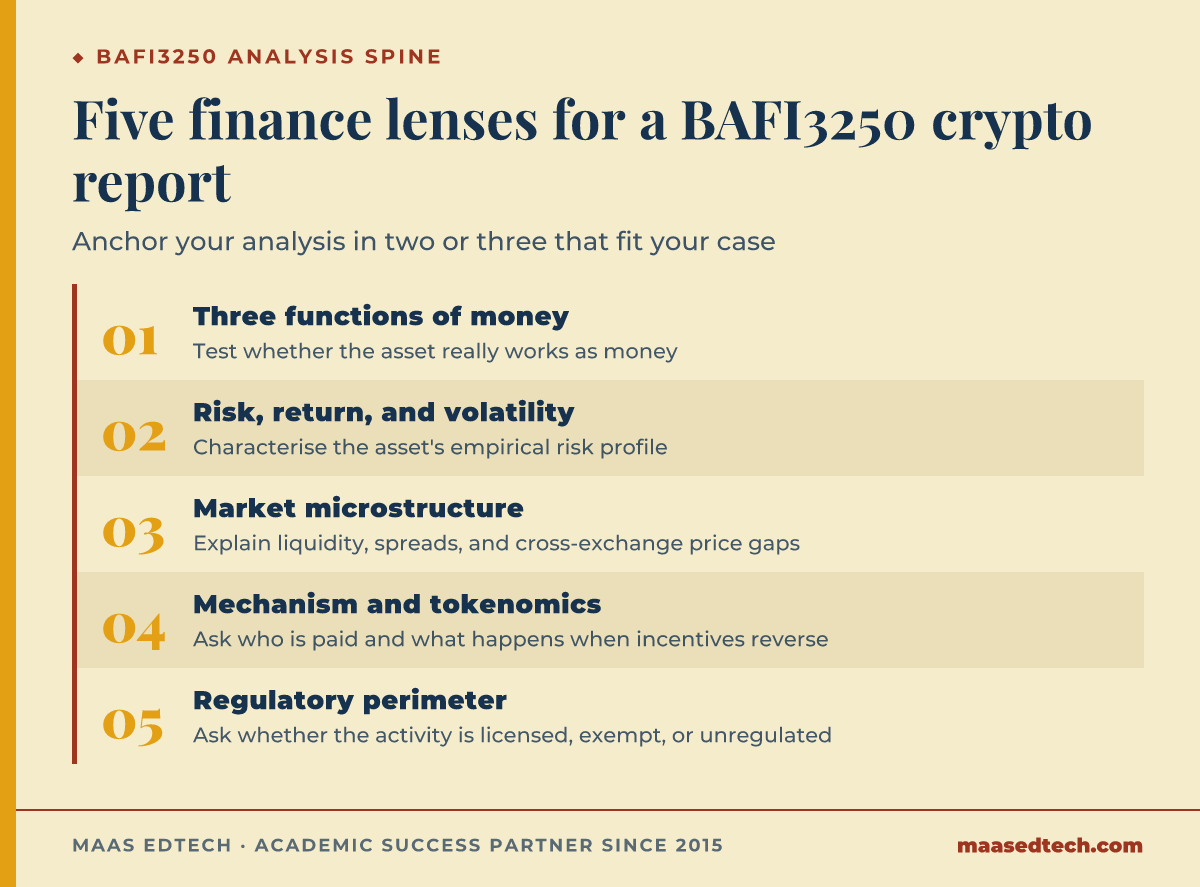
| Lens | What it explains | Use it to decide |
|---|---|---|
| Three functions of money | Whether an asset serves as medium of exchange, store of value, unit of account | Whether "digital currency" is an accurate label for this asset |
| Risk, return, and volatility | The empirical risk profile and how it compares with traditional assets | How to characterise the asset honestly rather than promotionally |
| Market microstructure | Liquidity, spreads, depth, and why prices differ across exchanges | Where execution and liquidity risk actually sit |
| Mechanism and tokenomics | Who earns, who pays, and what sustains the incentive | Whether the model survives when inflows slow |
| Regulatory perimeter | Whether the activity is licensed, exempt, or outside supervision | How exposed the model is if regulation tightens |
Evidence: These five lenses are examiner-recognised, peer-reviewed foundations rather than industry commentary: Yermack (2015) for the monetary-functions test, Liu and Tsyvinski (2021) for risk-return characteristics, Makarov and Schoar (2020) for market inefficiency, Nakamoto (2008) as the primary protocol source, and Schär (2021) for the mechanism and smart-contract lens behind decentralised finance protocols. Note the standing data caveat, crypto price histories are short and dominated by a few extreme episodes, so any statistic you report should be presented with its window and its limits.
Example: A Vietnamese RMIT student analysing an algorithmic stablecoin tried to apply five lenses shallowly. Her MAAS mentor cut it to two, the mechanism lens to show the peg depended on continuous demand for a paired token, and market microstructure to show what happens to liquidity under stress. Fewer lenses, deeper application, higher mark.
How should you structure the BAFI3250 report?
Direct answer: Use a question-led structure: (1) an introduction stating the asset or mechanism and the question you are answering, keeping technical background under 10% of the word count, (2) the finance analysis applying your chosen lens, (3) quantitative evidence, returns, volatility, spreads, total value locked, that you interpret rather than merely display, with the data window stated, (4) a critical evaluation of failure modes, regulation, and who bears the loss, and (5) a justified conclusion. Every chart must be referred to and interpreted in the text. The single biggest structural fix is shrinking the technology explanation and expanding the risk analysis.
Evidence: Criterion-referenced rubrics weight "application of concepts", "use of evidence", and "critical evaluation" far above "background and description". Matching your word budget to the rubric weighting is the most reliable way to lift a grade without gathering new data.
Example: A Vietnamese RMIT student submitted a report with a 400-word explanation of smart contracts and a two-line conclusion. His MAAS mentor inverted the balance, giving the evaluation room to weigh smart-contract risk, oracle dependence, and the absence of a lender of last resort. Same case, same sources, the report moved from a borderline Credit to a Distinction because the risks were finally being argued.
What are the most common mistakes that lose marks in BAFI3250?
Direct answer: Three recurring mistakes show up across MAAS finance coaching. First, the report explains the technology instead of analysing the finance, so it reads like documentation. Second, it slides into advocacy or forecasting, arguing an asset is undervalued or predicting a price, which is neither an academic claim nor something the rubric rewards.
Third, quantitative evidence is reported without its window or its caveats: a return figure covering a single bull run, or a volatility number with no comparison asset. Fixing these three lifts most drafts by at least one rubric band.
Evidence: Across MAAS finance coaching, marker feedback before intervention clusters heavily on "needs more analysis" and "evidence not interpreted", the two phrases that most often separate a Credit from a Distinction in RMIT business rubrics.
Example: A Vietnamese student's conclusion read "Bitcoin is a better store of value than gold." His MAAS mentor pushed him to specify: over what period, against which measure of purchasing power, with what drawdown, and whether the sample period includes a full cycle. The specified version acknowledged that the answer depends heavily on the window chosen and earned full marks on the evaluation criterion the blanket claim had failed.
How long is the BAFI3250 assignment and what referencing style does it use?
Direct answer: Confirm the exact word count and style in your assessment brief, individual finance reports at this level commonly sit between 1,500 and 2,500 words, with tables and reference lists often excluded from the count, and use Harvard referencing, which is RMIT's default business style. Stay within the 10% tolerance band. In this course, cite every market figure with its source, its date, and the period it covers, and prefer peer-reviewed research and regulator publications over project whitepapers and exchange blogs, which are promotional documents produced by interested parties.
Evidence: RMIT's Business school uses RMIT Harvard as its standard referencing style, documented in RMIT's Easy Cite referencing tool. Markers routinely deduct marks for reliance on whitepapers, undated market statistics, or inconsistent Harvard formatting even when the financial analysis is strong.
Example: A Vietnamese RMIT student lost several marks because his total-value-locked figures came from an undated dashboard screenshot and his in-text citations did not match his reference list. A MAAS pre-submission audit closed the gaps in under an hour, data re-sourced and dated, whitepaper claims replaced with peer-reviewed evidence, Harvard entries aligned. On his next BAFI3250 task, clean sourcing recovered marks on a criterion that requires no extra analysis at all.
Frequently asked questions
Is BAFI3250 a hard course?
It is analytically demanding rather than mathematically hard for most tasks. The challenge is applying settled finance reasoning to an asset class with short data histories, thin regulation, and a great deal of promotional noise around it. Students who treat it as "write about crypto" struggle; students who treat it as "apply finance to a new asset class" do well.
Do I need to code or understand smart contracts technically?
Usually not beyond an accurate conceptual level. Most BAFI3250 tasks ask for financial and risk analysis, not implementation. You need enough technical accuracy to avoid errors, but the marks come from the finance reasoning.
Should I give a view on whether an asset is a good investment?
No. Academic reports analyse risk, mechanism, and evidence; they do not issue investment recommendations, and a directional call is not a rubric criterion. Frame conclusions as analysis under stated conditions, what the evidence shows, and where the model breaks, rather than as advice.
Can I use a Vietnamese angle in my report?
Often yes, Vietnam has high reported retail crypto adoption and an evolving regulatory position, which makes it a useful case for the regulatory-perimeter and adoption questions. Source figures from regulators or reputable research rather than exchange marketing, and date every statistic.
What referencing style does BAFI3250 use?
RMIT Harvard is the default for business courses, and it applies to market data as well as academic literature. Always confirm in your own brief and use RMIT's Easy Cite tool to format entries consistently.
Can MAAS help me with BAFI3250?
Yes. MAAS Assignment & Essay Support coaches you through the assignment with the Outline, Draft, Final model, choosing the right lens, handling volatile data honestly, structuring the risk and regulation evaluation, and a pre-submission referencing audit, all with discipline-matched experts. We coach your work; we do not write it for you.
Ready to approach BAFI3250 with a clear strategy?
If you have the case but not the financial argument, that is exactly where a discipline-matched expert helps most. MAAS Assignment & Essay Support is an academic support partner; we work alongside you through Outline, Draft, Final so the analysis stays yours and the structure earns the marks.
Bring your BAFI3250 brief and we will match you to a finance mentor, 23% of our 100+ experts hold a PhD, within 48 hours when our network already covers that field. If it does not, MAAS opens a dedicated recruitment round for your case, which usually takes about two weeks.
Book a free 15-minute BAFI3250 consultation with MAAS Assignment & Essay Support →
Related guides
- How to approach the BAFI3287 Financial Technology assignment?: sibling RMIT guide on fintech business models and regulation
- BAFI3182 assignment: how do you approach Financial Markets?: for market structure and intermediation fundamentals
- BAFI3230 assignment: how do you approach Corporate Finance?: for valuation logic and its limits
- MAAS Academic Mentoring service: 1:1 coaching with PhD-level mentors in your discipline
- Course-code assignment coaching: pillar guide on tackling any unit assignment with a MAAS mentor
References
- Liu, Y., & Tsyvinski, A. (2021). Risks and returns of cryptocurrency. The Review of Financial Studies, 34(6), 2689–2727. https://doi.org/10.1093/rfs/hhaa113
- Makarov, I., & Schoar, A. (2020). Trading and arbitrage in cryptocurrency markets. Journal of Financial Economics, 135(2), 293–319. https://doi.org/10.1016/j.jfineco.2019.07.001
- Nakamoto, S. (2008). Bitcoin: A peer-to-peer electronic cash system. https://bitcoin.org/bitcoin.pdf
- Schär, F. (2021). Decentralized finance: On blockchain- and smart contract-based financial markets. Federal Reserve Bank of St. Louis Review, 103(2), 153–174. https://doi.org/10.20955/r.103.153-74
- Yermack, D. (2015). Is Bitcoin a real currency? An economic appraisal. In D. Lee Kuo Chuen (Ed.), Handbook of digital currency (pp. 31–43). Academic Press. https://doi.org/10.1016/B978-0-12-802117-0.00002-3
Tools & resources
- RMIT University. (n.d.). Assessment and exams. Retrieved July 20, 2026, from https://www.rmit.edu.au/students/student-essentials/assessment-and-exams
- RMIT University. (n.d.). Easy Cite referencing tool. Retrieved July 20, 2026, from https://www.rmit.edu.au/library/study/referencing
This article is part of the MAAS Journal series for Vietnamese international students. It is educational commentary on an academic course and is not financial or investment advice. MAAS Assignment & Essay Support is an academic support partner; we coach students through the Outline, Draft, Final delivery model with developmental feedback from discipline-matched experts. We do not write or submit work on a student's behalf.