
◆ Citation & Formatting
How do you cite multiple authors in APA 7th edition?
In APA 7th edition, the number of authors decides the format. Two authors are both named in every in-text citation. Three or more authors are cited as the first surname plus et al. from the first citation onwards. In the reference list you name up to 20 authors, and for 21 or more you list the first 19, an ellipsis and the last author.
◆ Question 1 / 8 · How do you do APA format
How do you do APA format when there are multiple authors?
Direct answer: Count the authors first, because APA 7 has one rule for two authors and another for three or more. University of Huddersfield (2024, p. 11) shows two authors as Ramsden and Jones (2019) or (Ramsden & Jones, 2019), and three or more as Ramsden et al. (2019) or (Ramsden et al., 2019).
The same rule applies to books, journal articles and web pages, so you do not need to learn a separate pattern for each source type. What changes between the in-text citation and the reference list is how many names you write. In the text you shorten long author lists, while in the reference list you write the names out in full so that a reader can find the exact source. American Psychological Association (2020) sets these rules in the Publication Manual, and the university library guides cited in this post explain them with worked examples.
The second thing to check is where the citation sits in your sentence. A parenthetical citation goes inside brackets at the end of a clause and uses an ampersand between two names. A narrative citation makes the authors the subject of your sentence and uses the word "and" instead. University of Huddersfield (2024, p. 16) puts it this way: "When citing two authors inside brackets, use an ampersand to join the two family names together, e.g. (Levitt & Bamberg, 2017)." Many students lose marks by mixing the two forms, for example writing Levitt & Bamberg (2017) argue in running text.
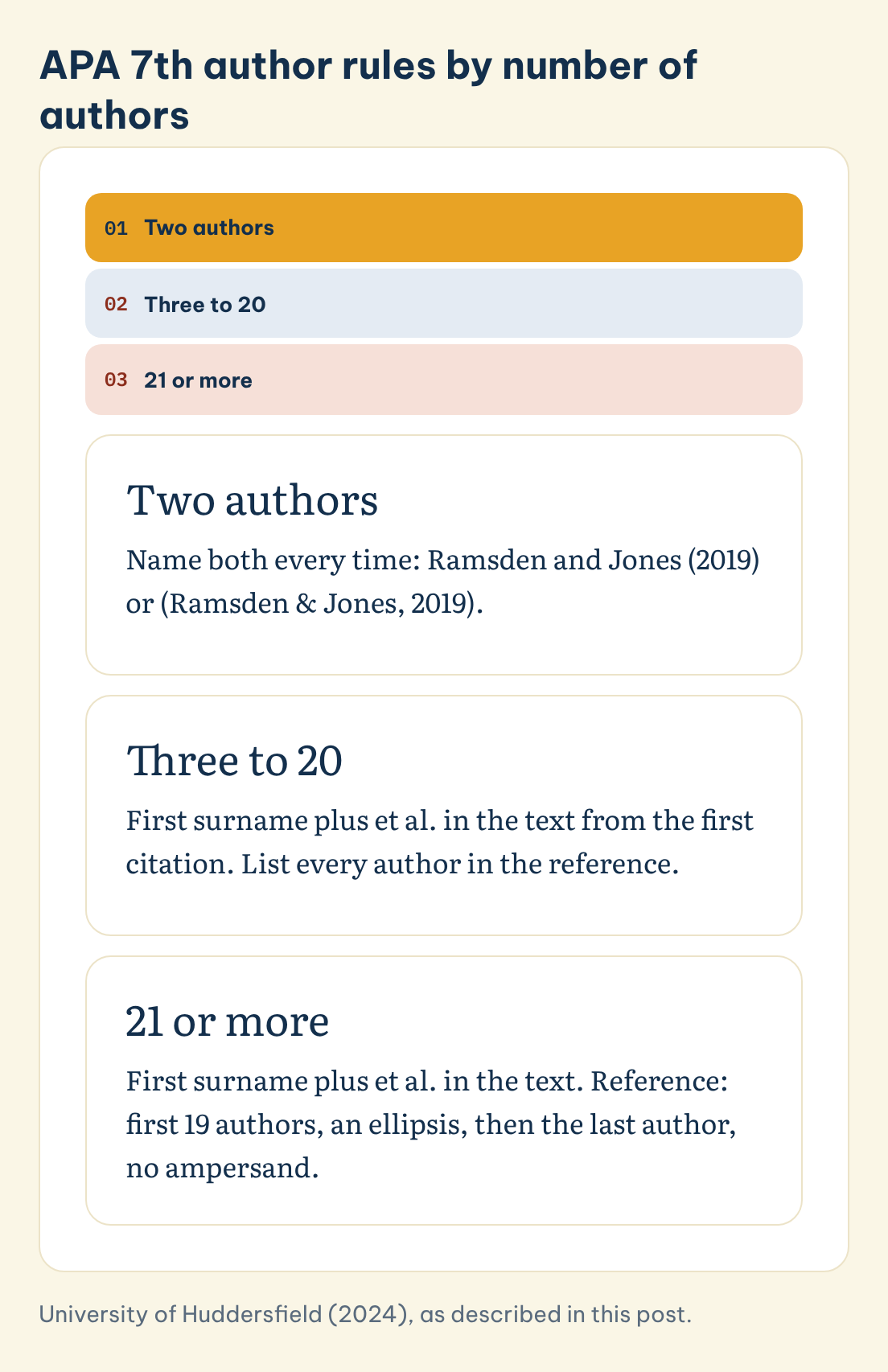
APA 7th author rules by number of authors
Tap a row to see the in-text and reference list rule for that many authors.
Two authors
Name both every time: Ramsden and Jones (2019) or (Ramsden & Jones, 2019).
Three to 20
First surname plus et al. in the text from the first citation. List every author in the reference.
21 or more
First surname plus et al. in the text. Reference: first 19 authors, an ellipsis, then the last author, no ampersand.
Save this figure
◆ Question 2 / 8 · What does each author count
What does each author count look like at a glance?
Direct answer: The table below sets out the in-text and reference list form for each author count, using the worked examples from the University of Huddersfield (2024) guide and Purdue Online Writing Lab (n.d.-b). Read across the row that matches your source.
| Number of authors | Narrative in-text | Parenthetical in-text | Reference list |
|---|---|---|---|
| One | Ramsden (2019) | (Ramsden, 2019) | Author, A. A. (Year). |
| Two | Ramsden and Jones (2019) | (Ramsden & Jones, 2019) | Soto, C. J., & John, O. P. (2017). |
| Three to 20 | Ramsden et al. (2019) | (Ramsden et al., 2019) | Every author, with an ampersand before the last name |
| 21 or more | Tanabashi et al. (2018) | (Tanabashi et al., 2018) | First 19 authors, an ellipsis, then the last author, with no ampersand |
The first three in-text rows follow University of Huddersfield (2024, p. 11), and the 21 or more row follows the same guide (2024, pp. 51-52). The two-author reference example comes from Purdue Online Writing Lab (n.d.-b). The sections below explain each row with full examples.
◆ Question 3 / 8 · Do I use et al. for 3
Do I use et al. for 3 authors in APA?
Direct answer: Yes. In APA 7th edition a work with three authors is cited as the first author's surname plus et al. in every citation, including the first one. James Cook University Library (2026) states, "For 3 or more authors, use the first author and "et al." for all in-text citations".
The et al. rule is the change that catches students who learnt APA 6th edition at school. The older edition asked you to write out three to five names the first time and shorten them only later. APA 7 drops that step, so a three-author article and a twelve-author article look the same in your text. Purdue Online Writing Lab (n.d.-a) gives (Kernis et al., 1993) and Kernis et al. (1993) suggest as its two examples.
Two small details matter here. Purdue Online Writing Lab (n.d.-a) notes that "et" is not followed by a full stop and only "al." is, so et al. is right and et. al. is wrong. The same page also warns that if two of your sources would shorten to the same et al. form, for example two papers from the same lead author and year with different co-authors, you write out more names until the citations are no longer identical. This ambiguity rule is the only exception to using et al. from the first citation.
◆ Question 4 / 8 · How do you reference two
How do you reference two authors in the APA 7 reference list?
Direct answer: Write both surnames with their initials, separate them with a comma, and put an ampersand before the second name. Purdue Online Writing Lab (n.d.-b) gives Soto, C. J., & John, O. P. (2017) as the pattern, with the comma kept before the ampersand.
The comma before the ampersand looks odd to many students, but it is part of the style. University of Huddersfield (2024, p. 13) says to "Use a comma after the author's initial(s) and before an "&" (ampersand), when there are multiple authors." The same guide lists Lundgren, R. E., & McMakin, A. H. (2013) as a book with two authors, which shows that books and articles share this layout. After the author names you add the year in brackets, the title and the source details as normal.
The order of names never changes. Copy the authors in the order printed on the title page or the article's first page, because the first author is the person a reader will look for in your reference list. Do not sort co-authors alphabetically, and do not drop a middle initial that the source prints. If one of the authors is an organisation, write its full name, as University of Huddersfield (2024, p. 14) does with National Health Service.
◆ Question 5 / 8 · How do you cite a 3 author
How do you cite a 3 author article in the reference list?
Direct answer: List all three authors in full in the reference list, even though the in-text citation uses et al. University of Huddersfield (2024) applies the et al. shortening to the in-text citation only, and its reference examples keep every author's surname and initials, with an ampersand before the last name.
The guide states the in-text rule directly: "If a work has 3-20 authors, include first author's family name followed by et al." (University of Huddersfield, 2024, p. 50). The Huddersfield guide shows this with Sahar, A. D., Brenninkmeyer, S. M., & O'Connell, D. C. (1997) in the reference list and Sahar et al. (1997) in the text (University of Huddersfield, 2024, p. 51). The same pattern runs up to 20 authors. Purdue Online Writing Lab (n.d.-b) notes that listing up to 20 names "is a departure from APA 6, which only required listing the first six authors before an ellipsis and the final author's name."
When you quote a source with several authors, the page number follows the year as usual. The Huddersfield guide quotes a six-author article as "Mobile phone addiction has become a worldwide problem due to its high occurrence rate, fast growth rate…" (Liu et al., 2018, p. 247), as shown in University of Huddersfield (2024, p. 51). If you are unsure how the rest of a journal reference is built, our guide to how to reference a journal article in APA covers volume, issue, pages and DOI.
◆ Question 6 / 8 · What do you do with 21
What do you do with 21 or more authors?
Direct answer: In the reference list, write the first 19 authors, then an ellipsis, then the final author's name, with no ampersand. University of Huddersfield (2024, p. 51) says to "list the names of the first nineteen authors followed by … and then the last author." In the text you still write the first surname plus et al.
Very large author lists are common in physics, genetics and clinical medicine, where one paper may report the work of a whole consortium. Purdue Online Writing Lab (n.d.-b) adds that "There should be no more than twenty names in the citation in total," which is a useful check after you have typed the list. Count the names you have written: if you see 20 names and an ellipsis, the reference is correct. If you see 21, one name should be removed.
The missing ampersand is the detail most often got wrong. For three to 20 authors the ampersand sits before the last name, but once an ellipsis appears, the ellipsis replaces it. Purdue Online Writing Lab (n.d.-b) shows the pattern with Pegion, K., Kirtman, B. P., and 17 more names before ". . . Kim, H. (2019)." Reference managers usually apply this rule for you, but check the output, because imported records sometimes carry fewer names than the article itself.
◆ Question 7 / 8 · How do you cite several
How do you cite several sources with multiple authors in one bracket?
Direct answer: Put the citations in one pair of brackets, separate them with semicolons, and order them alphabetically by the first author's surname. James Cook University Library (2026) shows this with a group of three sources, where a two-author source keeps its ampersand and a longer one keeps et al.
The example in that guide is (Corbin, 2015; James & Waterson, 2017; Smith et al., 2016). The internal form of each citation does not change when it sits in a group. A two-author source keeps its ampersand, and a source with three or more authors keeps et al. Grouping is useful when several studies support the same point, but it should not replace discussion. If one of the grouped studies matters more to your argument than the others, cite it on its own in a narrative sentence and explain what it found.
A practical habit is to decide early whether you are using a source to support a general claim or to make a specific point. General claims can carry a grouped citation at the end of the sentence. Specific points work better with a narrative citation such as Green et al.'s (2019) findings, which James Cook University Library (2026) also uses as an example. For the wider rules on in-text citations, see our guide to APA 7 in-text citations.
◆ Question 8 / 8 · How can MAAS help
How can MAAS help with citing multiple authors?
Direct answer: MAAS works as a tutor and advisor. A MAAS expert goes through your draft citations and reference list with you, explains each rule that applies, and shows the correct pattern, while you make the corrections and decide what goes into your submission.
If multi-author sources keep causing errors in your work, essay and assignment support from MAAS follows an Outline, Draft, Final sequence. With the guidance of a MAAS expert, you bring your own reading and your own draft, and the mentor gives feedback at each stage so that you understand why each fix is needed. Most students start by sending their reference list and the assignment brief, and the first conversation is free.
Frequently asked questions
How many authors before using et al. in APA 7?
Three. James Cook University Library (2026) says to use the first author and et al. for all in-text citations of works with three or more authors.
Do I write out all names the first time I cite a source?
No. In APA 7th edition et al. is used from the first citation for three or more authors. Purdue Online Writing Lab (n.d.-a) makes one exception, when the shortened form would make two of your sources look the same.
Is it "and" or "&" for two authors?
Use "&" inside brackets and "and" in running text, according to University of Huddersfield (2024, p. 16).
Is there a comma before the ampersand in the reference list?
Yes. University of Huddersfield (2024, p. 13) says to use a comma after the initials and before the ampersand when there are multiple authors.
How many names go in the reference list?
Up to 20 authors are all listed. For 21 or more, list the first 19, an ellipsis and the final author, as University of Huddersfield (2024, p. 51) explains.
Is it et al. or et. al.?
It is et al., with a full stop only after "al". Purdue Online Writing Lab (n.d.-a) notes that "et" is not followed by a full stop.
Where can I check the rules myself?
In American Psychological Association (2020), the Publication Manual, or in the library guide your department recommends.
References
American Psychological Association. (2020). Publication manual of the American Psychological Association (7th ed.). https://doi.org/10.1037/0000165-000
James Cook University Library. (2026). In-text citations: APA (7th edition) referencing guide. https://libguides.jcu.edu.au/apa/in-text
Purdue Online Writing Lab. (n.d.-a). In-text citations: Author/authors. Purdue University. https://owl.purdue.edu/owl/research_and_citation/apa_style/apa_formatting_and_style_guide/in_text_citations_author_authors.html
Purdue Online Writing Lab. (n.d.-b). Reference list: Author/authors. Purdue University. https://owl.purdue.edu/owl/research_and_citation/apa_style/apa_formatting_and_style_guide/reference_list_author_authors.html
University of Huddersfield. (2024). APA 7th referencing guide [PDF]. https://library.hud.ac.uk/webpages/files/referencing/APA_7th_Ref_Guide_Full.pdf
This guide is general information about citing multiple authors in APA 7th edition. Always check your own department's referencing guide and assignment brief for the rules that apply to your work.
Not sure how this guide applies to your own case? Talk it through with MAAS in a free 20-minute consultation.
Book a free consultation ▸