
◆ Study Hacks
Which A Level Maths revision topics carry the most marks?
Direct answer: The heaviest marks sit in pure maths and in skills that routine drills skip: proof and written reasoning, modelling in context, and statistics questions set on the large data set. Edexcel, AQA and OCR each set three two-hour papers of 100 marks, so a weak strand costs marks on every paper, not just one.
◆ Question 1 / 6 · Paper structure by board
How are A Level Maths papers structured on Edexcel, AQA and OCR?
Direct answer: Every board uses three equal written exams, and a calculator is permitted in each. Where they differ is in how pure, statistics and mechanics content is shared across those exams, so confirm your own specification code before you organise revision paper by paper.
Pearson Edexcel (specification 9MA0) puts Pure Mathematics on Papers 1 and 2 and combines Statistics and Mechanics on Paper 3; each paper is a "2-hour written examination", worth "33.33% of the qualification" and "100 marks" (Pearson Education, 2020, p. 5). AQA (7357) keeps pure content on all three papers, but adds vectors and mechanics to Paper 2 and the statistics topics to Paper 3; each is a "Written exam: 2 hours" worth "100 marks" and one third of the A level (AQA, 2018, pp. 8-9). OCR Mathematics A (H240) gives Paper 1 to pure mathematics in a single section of 100 marks, then splits Papers 2 and 3 into pure with statistics and pure with mechanics, in "two separate sections of approximately 50 marks each" (OCR, 2026, p. 2). The practical point is that pure mathematics appears on every paper at every board. A student who revises statistics only before the statistics paper is revising for the wrong exam structure.
| Board and code | Paper 1 | Paper 2 | Paper 3 |
|---|---|---|---|
| Edexcel 9MA0 | Pure, 100 marks | Pure, 100 marks | Statistics and Mechanics, 100 marks |
| AQA 7357 | Pure, 100 marks | Pure plus vectors and mechanics, 100 marks | Pure plus statistics, 100 marks |
| OCR H240 | Pure, 100 marks | Pure and Statistics, about 50 marks each | Pure and Mechanics, about 50 marks each |
Source: Pearson Edexcel, AQA and OCR specifications, read 23 October 2026.
◆ Question 2 / 6 · Pure topics first
Which topics should A Level Maths revision on Edexcel or AQA cover first?
Direct answer: Start with the pure topics, because they are examined on all three papers. Edexcel lists ten pure topics, from proof and algebra through to numerical methods and vectors, and AQA lists the same strands as content areas A to J. Statistics and mechanics come next, by paper.
Edexcel's ten pure topics are proof, algebra and functions, coordinate geometry, sequences and series, trigonometry, exponentials and logarithms, differentiation, integration, numerical methods and vectors (Pearson Education, 2020, p. 5). AQA's Paper 1 lists nine of those as areas A to I, with vectors as area J on Paper 2 (AQA, 2018, p. 8). Because the lists match so closely, a single pure revision plan serves either board. Order the topics by dependency rather than by the specification order. Algebra and functions sit underneath almost everything, and differentiation and integration depend on confident manipulation of exponentials, logarithms and trigonometric identities. A gap in algebra therefore shows up as lost marks in calculus questions, which can make a student think calculus is the problem. If you are sitting the last weeks before the exam and need a general timetable rather than a topic order, our guide on how to revise for exams effectively covers spacing and self-testing across subjects.
◆ Question 3 / 6 · Proof and reasoning
Why do proof and reasoning questions cost so many marks?
Direct answer: Because a quarter of the marks are for reasoning and communication, not for getting a number. Edexcel weights the objective "reason, interpret and communicate mathematically" at 23-27% of the A level, so an unexplained correct answer can still drop marks.
Edexcel A Level Maths marks by assessment objective
Share of the whole qualification, Edexcel 9MA0.
Assessment objective
Share of the A level (%)
AO1 standard techniques
48-52
AO2 reasoning
23-27
AO3 problem solving
23-27
Save this figure
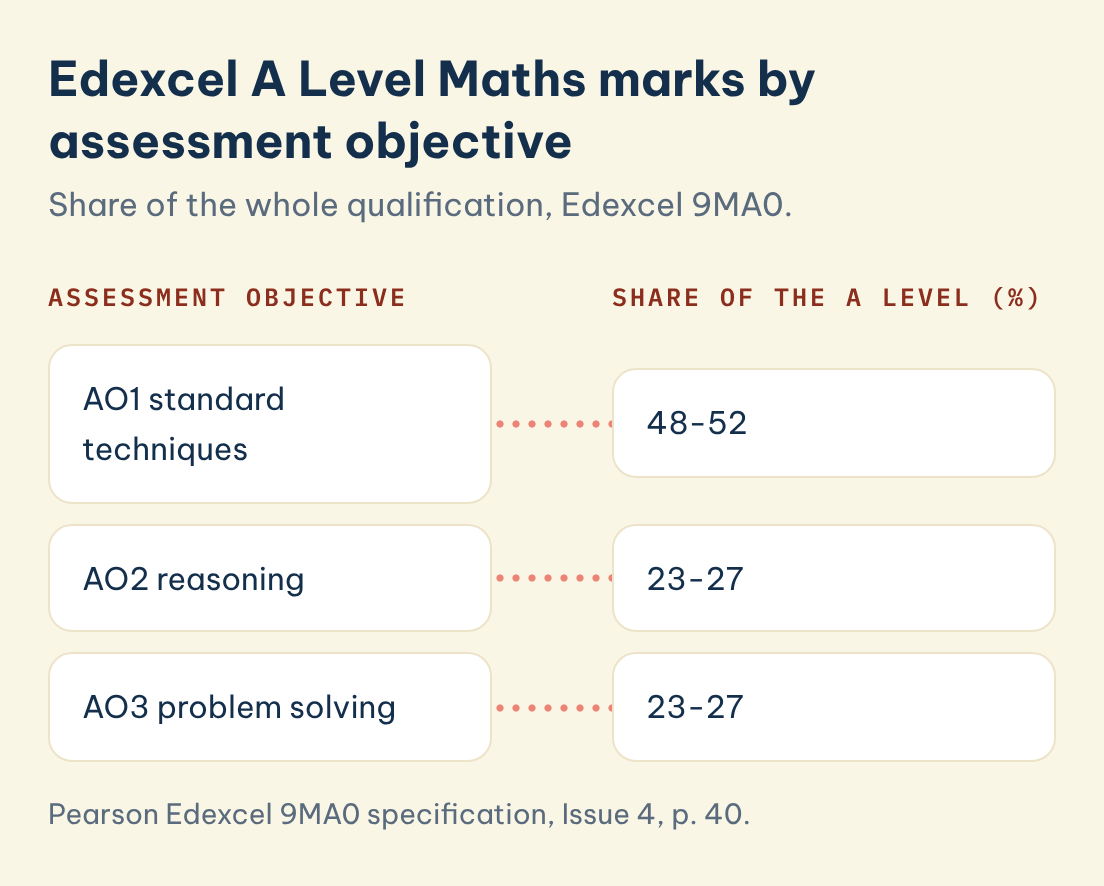
Pearson Education (2020, p. 40) sets three assessment objectives: AO1, "use and apply standard techniques", at 48-52%; AO2, reasoning and communication, at 23-27%; and AO3, "solve problems within mathematics and in other contexts", also at 23-27%. AO2 includes the ability to "construct rigorous mathematical arguments (including proofs)" and to "use mathematical language and notation correctly" (Pearson Education, 2020, p. 40). In other words, about half the qualification rewards something other than routine procedure. Students who revise only by repeating textbook exercises are practising AO1 and leaving AO2 and AO3 to chance. A better habit is to write the full argument for every practice question: state what you are assuming, show each step and finish with a concluding sentence. Proof by contradiction and proof by deduction are worth a short daily drill, because they reward exactly the written logic that routine practice skips.
◆ Question 4 / 6 · Statistics and mechanics
What should A Level Maths revision questions on statistics and mechanics include?
Direct answer: For statistics, include questions set on your board's large data set, because the exam assumes you know it. For mechanics and statistics alike, include modelling questions that ask you to interpret an answer in context and comment on the model's limitations.
Edexcel is explicit about the large data set: "Students are required to become familiar with the data set in advance of the final assessment" (Pearson Education, 2020, p. 10). The same page warns that questions may "assume familiarity with the terminology and contexts of the data, and do not explain them", which is a direct signal that students who skip the data set will lose access to marks. AQA says the data set "must be used in teaching to allow students to perform tasks that build familiarity with the contexts" (AQA, 2018, p. 26), and OCR calls its version a pre-released set used "as teaching material throughout the course" (OCR, 2026, p. 8). Each board publishes its own data set, so download it from your board's site rather than a generic one. Mechanics practice matters for AO3 too, because Edexcel's Paper 3 carries 10.33-11.67% of the qualification in problem-solving marks, against 6.33-7.67% on each pure paper (Pearson Education, 2020, p. 41).
| Edexcel paper | AO1 (%) | AO2 (%) | AO3 (%) |
|---|---|---|---|
| Paper 1: Pure Mathematics 1 | 16.00-17.33 | 8.66-10 | 6.33-7.67 |
| Paper 2: Pure Mathematics 2 | 16.00-17.33 | 8.66-10 | 6.33-7.67 |
| Paper 3: Statistics and Mechanics | 16.00-17.33 | 5.66-7.00 | 10.33-11.67 |
Source: Pearson Edexcel 9MA0 specification, Issue 4, p. 41. Percentages are of the whole qualification.
◆ Question 5 / 6 · Notes and past papers
How should you use A Level Maths revision notes and past papers?
Direct answer: Use notes to check, not to reread. Test yourself first with past-paper questions, then go to your notes only for what you got wrong, and mix topics within one session instead of finishing one chapter before you start the next one.
The evidence for testing over rereading is strong. Dunlosky et al. (2013, p. 4) rated practice testing and distributed practice as the two techniques with "high utility" because they benefit "learners of different ages and abilities", while rereading and highlighting rated low. For mathematics specifically, mixing problem types helps further. In a preregistered trial with 787 US seventh-grade students in 54 classes, Rohrer et al. (2020) found that students given more interleaved practice scored 61% on an unannounced test a month later, compared with 38% for students who practised in blocks of the same type. The trial was with younger pupils, but the logic carries over: an exam paper does not tell you which method a question needs, so choosing the method is itself a skill worth practising. A Year 13 student can apply this directly: build each revision session from five questions on five different topics, mark them against the official mark scheme, and log which topic each lost mark came from.
◆ Question 6 / 6 · Further Maths
Does A Level Further Maths revision need a different plan?
Direct answer: Partly. Further Maths has its own specification and papers, so the topic lists differ, but the same principles apply: revise the compulsory core first, practise written reasoning, and mix question types. Check your board's Further Maths specification code before reusing any plan.
Further Mathematics builds on the A level content rather than replacing it, so weaknesses in A level algebra and calculus carry straight into the harder paper. Students taking both qualifications often revise them in separate blocks. A more efficient approach is to treat shared techniques, such as proof and integration, as one strand and to practise them from both specifications in the same session. The structure of each Further Maths paper varies by board and by the optional modules your school chose, so read the specification your centre entered you for rather than a revision site's summary. If a free revision site uses a different board, the questions are still useful practice, but its topic order and its paper structure may not match your exams.
Frequently asked questions
How many papers are there in A Level Maths?
Three. Edexcel, AQA and OCR each set three written papers of 2 hours and 100 marks, each worth one third of the qualification.
Is pure maths on every A Level Maths paper?
At AQA and OCR, yes: every paper includes pure content. At Edexcel, Papers 1 and 2 are pure, and Paper 3 covers statistics and mechanics.
Do I need to know the large data set for A Level Maths?
Yes. Edexcel says students must be familiar with it before the exam, and questions may assume its terminology without explaining it.
What share of A Level Maths marks is for reasoning?
On Edexcel, the reasoning and communication objective carries 23-27% of the qualification, and problem solving carries another 23-27%.
Is free A Level Maths revision material good enough?
Free past papers and mark schemes from your own board are the most useful practice. Check that any third-party material matches your board and specification code.
What is the best way to revise A Level Maths topics?
Test yourself with mixed past-paper questions, space sessions over weeks, and use notes only to fix what you got wrong (Dunlosky et al., 2013; Rohrer et al., 2020).
Getting a second pair of eyes on your weak topics
Your teacher can usually tell you which strand your lost marks come from. If you go on to a maths-heavy degree, MAAS offers 1:1 subject tutoring for university modules, an advisory service with no grade outcome attached: you sit the exam and do the work yourself.
Related guides
- How do you revise for exams effectively, final exams included?: spacing and self-testing for any subject
- What does percentile mean, and how do quartiles work?: the statistics behind exam scores
References
- AQA. (2018). A-level Mathematics 7357 specification (Version 1.3). https://filestore.aqa.org.uk/resources/mathematics/specifications/AQA-7357-SP-2017.PDF
- Dunlosky, J., Rawson, K. A., Marsh, E. J., Nathan, M. J., & Willingham, D. T. (2013). Improving students' learning with effective learning techniques: Promising directions from cognitive and educational psychology. Psychological Science in the Public Interest, 14(1), 4-58. https://doi.org/10.1177/1529100612453266
- OCR. (2026). A Level Mathematics A H240 specification (Version 3.1). https://www.ocr.org.uk/Images/308723-specification-accredited-a-level-gce-mathematics-a-h240.pdf
- Pearson Education. (2020). Pearson Edexcel Level 3 Advanced GCE in Mathematics (9MA0) specification (Issue 4). https://qualifications.pearson.com/content/dam/pdf/A%20Level/Mathematics/2017/specification-and-sample-assesment/a-level-l3-mathematics-specification-issue4.pdf
- Rohrer, D., Dedrick, R. F., Hartwig, M. K., & Cheung, C.-N. (2020). A randomized controlled trial of interleaved mathematics practice. Journal of Educational Psychology, 112(1), 40-52. https://doi.org/10.1037/edu0000367
This article is part of the MAAS Journal series for students. MAAS is an academic support partner: experts guide students through each stage of their own work, and we do not complete assessed work on a student's behalf.
Not sure how this guide applies to your own case? Talk it through with MAAS in a free 20-minute consultation.
Book a free consultation ▸