
6BUS1267 Digital Economy is a final-year module, and final-year modules are marked on a different assumption from the ones before: the examiner assumes students already know what a platform is, and wants to see what they can do with that knowledge. The coursework that loses marks here is almost never uninformed, usually well researched and accurate about how Uber or Shopee makes money, yet entirely descriptive.
Author: MAAS Editorial Team
Last updated: 2026-08-07
Category: business-management

What is 6BUS1267 Digital Economy about?
Direct answer: 6BUS1267 Digital Economy is a Level 6 module at the University of Hertfordshire worth 15 credits, in Hertfordshire Business School's BA (Hons) Business and Marketing. Assessed entirely by coursework, it runs in Semester B. The subject is economic mechanisms that behave differently once information, not physical goods, is produced and exchanged: near-zero marginal cost, network effects, multi-sided markets, data accumulation.
Evidence: These module facts come from the programme specification that Hertfordshire publishes openly alongside its course pages, which sets out each module's code, credit value, semester and the split between coursework and examination. That source matters more than it might sound. Definitive Module Documents at Hertfordshire sit behind a student login, so most of what circulates publicly under this module code has been reposted by third-party assignment-selling sites, often for the wrong academic year.
Example: A Vietnamese student told her MAAS mentor she had "found the 6BUS1267 brief online" and had already drafted 1,200 words to it. The version she had found asked for a group presentation. Her own module handbook asked for individual written coursework. 10 minutes checking the official source at the start of the term is the cheapest insurance available in this module.
How is the Digital Economy coursework actually marked?
Direct answer: As Level 6 coursework marked against criterion-referenced descriptors, which means your work is judged against published band descriptors rather than ranked against your classmates. At Level 6 the descriptors separating a 2:2 from a 2:1 and a 2:1 from a First turn on evaluation and independence of thought, not on coverage.
Describing a digital business model correctly demonstrates knowledge, and knowledge alone sits in the lower bands at final-year level. The marks accumulate where you explain why a mechanism produces the outcome it does, and where you test that explanation against a case that does not fit it neatly.
Evidence: The UK Quality Assurance Agency's descriptor for a bachelor's degree with honours requires "an appreciation of the uncertainty, ambiguity and limits of knowledge" (QAA, 2024), on top of the conceptual understanding needed to critically evaluate arguments and evidence. That phrase is the operative one for this module: digital-economy theory is contested, and an essay that presents it as settled has already capped its own band.
Example: A student submitted an excellent 2,000-word account of how network effects made a marketplace dominant. Her mentor asked a single question: why, then, did three competing marketplaces in the same country survive? She had no answer in the draft, because the draft had never treated network effects as a claim that could be wrong. Adding that complication did not weaken the essay; it was the thing that moved it up a band.
Which concepts carry the most analytical weight?
Direct answer: Use three or four concepts with precision rather than surveying the whole syllabus. The most productive combination pairs a mechanism (what makes digital markets behave unusually) with a consequence (what that does to competition, labour or policy). The table below sets out the four that do the most work in coursework of this type.
| Concept | The question it answers | Where students go wrong |
|---|---|---|
| Near-zero marginal cost | Why can a digital firm serve one more customer for almost nothing? | Treating it as "digital is cheap" and ignoring the very high fixed and sunk costs it coexists with |
| Network effects | Why does value rise as more users join, and why does that tip markets? | Asserting the effect exists without saying whether it is direct, indirect, local or global |
| Multi-sided platforms | Why does a platform subsidise one side and charge the other? | Calling any website a platform; a platform must mediate between distinct groups |
| Data as a strategic asset | Why does accumulated usage data become a barrier to entry? | Confusing volume of data with usefulness of data, which are not the same advantage |
Evidence: Shapiro and Varian (1999), in Information Rules, set out the cost structure of information goods, expensive to produce and nearly free to reproduce, and showed why that structure pushes markets toward concentration rather than the frictionless competition early commentators predicted. Rochet and Tirole (2003) formalised two-sided markets and demonstrated that the price structure across the two sides, not just the price level, determines whether a platform gets off the ground. Parker, Van Alstyne and Choudary (2016) then translated the same logic into the strategic vocabulary most business modules use, in Platform Revolution. Teece (2010) supplies the sharper definitional point most coursework skips: a business model is the logic of how a firm creates and captures value, which is a separate question from strategy, how it defends that value once competitors notice. Srnicek (2017), in Platform Capitalism, argues that platforms have become the dominant firm type of contemporary capitalism precisely because they occupy an infrastructural position, extracting and processing the data that flows across markets they do not fully produce themselves. Kenney and Zysman (2016) supply the counterweight, arguing that the platform economy's distributional effects on work and income are open political questions rather than technical inevitabilities.
Example: A student analysing a food-delivery platform wrote that it "benefits from network effects" and moved on. His mentor pushed him to specify which side gained from which. Once he separated the restaurant side from the diner side, he could see that the platform's real advantage was density within a single district, not scale across the country. That distinction was the analytical contribution his coursework had been missing.
How should you structure the coursework?
Direct answer: Build it as an argument with a case attached, not as a case study with theory attached. A structure that works reliably at Level 6: introduction that names one analytical question and states your line, roughly 10% of the words; the conceptual framework you will apply and, crucially, why those concepts and not others, roughly 25%; the evidence or case examined through that framework, roughly 35%; the complication, meaning the evidence that resists your line and what you make of it, roughly 20%; conclusion that answers the question and states what remains uncertain, roughly 10%. The fourth section is the one most students omit, and it is the one final-year descriptors reward.
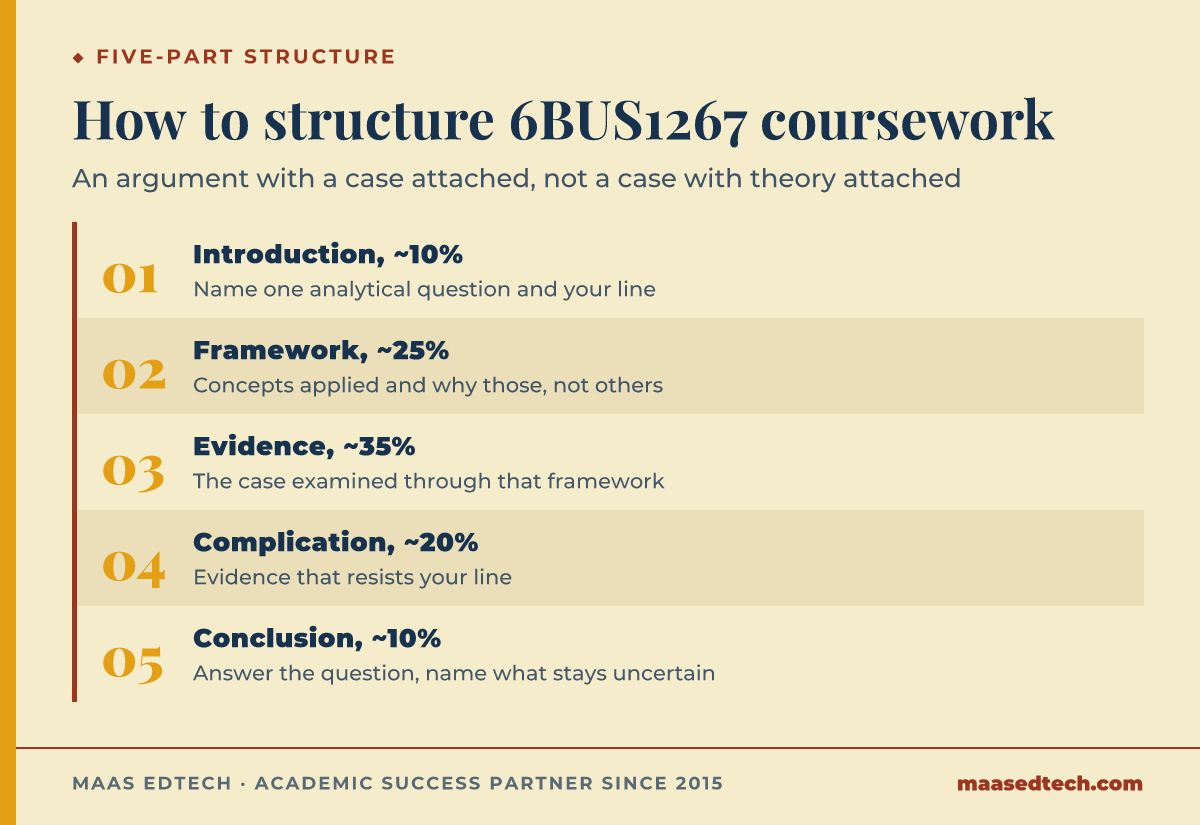
Evidence: Criterion-referenced marking at Level 6 distinguishes bands by evaluation and by handling of complexity. A submission with no section devoted to counter-evidence has structurally removed the criterion it most needs to satisfy, however strong the rest reads.
Example: A student argued that platform competition in Vietnam had settled into a duopoly, and wrote well to that claim. Her mentor asked what a sceptic would point at. She identified the persistence of informal, offline vendors serving the same demand. Rather than undermining her argument, the 600 words she spent on that exception let her narrow her claim to something she could actually defend.
What sources are acceptable, and which are a risk?
Direct answer: Anchor the analysis in peer-reviewed work and in institutional data from bodies such as the OECD, UNCTAD or national statistics offices, and use industry reporting only for current facts you attribute clearly. The specific risk in a digital-economy module is that the fast-moving subject matter tempts students toward consultancy blog posts and press coverage, which describe events well and explain mechanisms poorly. A submission built mainly on such material will read as journalism.
Evidence: UNCTAD's Digital Economy Report series is a standard institutional source for measurement and policy framing, and OECD digital-economy statistics offer comparable cross-country figures. Both are citable, dated and open, which matters because a claim about market shares is only as good as the year it refers to.
Example: A student cited a widely shared figure about global e-commerce growth without checking its origin. Tracing it back, his mentor found it came from a marketing agency's press release recycling an older forecast. Replacing it with a dated UNCTAD figure cost him 20 minutes and removed the weakest point in his evidence base.
What are the most common mistakes that lose marks?
Direct answer: Five patterns account for most of the lost marks MAAS mentors see in coursework of this kind.
- Describing a company instead of analysing a mechanism. The examiner does not need to be told how Grab works. They need to be shown what its structure demonstrates about digital markets.
- Naming a concept without applying it. "This illustrates network effects" is a label. The analysis is the sentence that follows it and explains how.
- Treating disruption as a synonym for change. Christensen's concept has specific conditions, and using it loosely is visible to any marker who knows the literature.
- Ignoring regulation. Competition policy, data protection and platform-work rules are part of the mechanism now, not context you can leave to a final paragraph.
- Presenting contested claims as settled. The economic effects of platforms on productivity, wages and welfare are genuinely disputed, and saying so is a marker of Level 6 judgement rather than a hedge.
Evidence: Christensen, Raynor and McDonald (2015) revisited disruptive innovation precisely because the term had been stretched to cover almost any successful new entrant, and set out what the theory does and does not claim. Brynjolfsson and McAfee (2014) document the productivity and distributional questions that remain open.
Example: A student described a super-app as "disruptive" four times in one section. Her mentor asked whether it had entered through a low-end or new-market foothold, as the theory requires. It had not; it had entered by outspending incumbents. Swapping the term for an accurate description of the entry strategy cost nothing and removed a visible weakness.
Frequently asked questions
Is 6BUS1267 a hard module?
The reading is not technically difficult, which is why students underestimate it. The difficulty is that the whole mark rests on coursework judged by final-year criteria, where accurate description alone lands in the lower bands.
Can I write about a Vietnamese or Southeast Asian company?
Yes, and regional cases often work better than the over-used global examples, because you can say something the marker has not read forty times. Make sure the evidence you rely on is verifiable and dated.
How many concepts should I apply?
Three or four, applied properly. Coursework that applies three concepts to one problem in depth consistently outperforms work that introduces eight and applies none.
Do I need economics knowledge from earlier modules?
You need the intuitions rather than the formalism. Understanding why fixed and marginal costs differ, and what a market failure is, will carry you further than any equation.
Can MAAS help me with 6BUS1267?
MAAS mentors work with you on framing, concept selection and developmental feedback across the Outline, Draft and Final stages. You remain the author of your coursework; the mentor's role is to test your reasoning and show you where an examiner would push back.
What are 6BUS1267's key numbers at a glance?
At the University of Hertfordshire, 6BUS1267 is a Level 6 module worth 15 credits, taught in Semester B and assessed 100% by coursework, with no examination component. It sits within Hertfordshire Business School's module tables, including the BA (Hons) Business and Marketing programme.
Where to start if the research is done but the argument is not
Reading widely is not what separates strong submissions in this module. What separates them is choosing one analytical question early and then spending the whole word count earning your answer against the evidence that resists it. If the research is done and the argument has not arrived yet, a MAAS mentor can work through the framing with you before you commit words to the page.
Talk to a MAAS mentor about your module
Related guides
References
- Brynjolfsson, E., & McAfee, A. (2014). The second machine age: Work, progress, and prosperity in a time of brilliant technologies. W. W. Norton.
- Christensen, C. M., Raynor, M. E., & McDonald, R. (2015). What is disruptive innovation? Harvard Business Review, 93(12), 44–53.
- Kenney, M., & Zysman, J. (2016). The rise of the platform economy. Issues in Science and Technology, 32(3), 61–69.
- Parker, G. G., Van Alstyne, M. W., & Choudary, S. P. (2016). Platform revolution: How networked markets are transforming the economy and how to make them work for you. W. W. Norton.
- Quality Assurance Agency for Higher Education [QAA]. (2024). The frameworks for higher education qualifications of UK degree-awarding bodies. Retrieved August 7, 2026, from https://www.qaa.ac.uk/quality-code/qualifications-and-credit-frameworks
- Rochet, J.-C., & Tirole, J. (2003). Platform competition in two-sided markets. Journal of the European Economic Association, 1(4), 990–1029. https://doi.org/10.1162/154247603322493212
- Shapiro, C., & Varian, H. R. (1999). Information rules: A strategic guide to the network economy. Harvard Business School Press.
- Srnicek, N. (2017). Platform capitalism. Polity Press.
- Teece, D. J. (2010). Business models, business strategy and innovation. Long Range Planning, 43(2–3), 172–194. https://doi.org/10.1016/j.lrp.2009.07.003
Tools & resources
- UNCTAD. (n.d.). Digital economy report. Retrieved August 7, 2026, from https://unctad.org/publications-search?f%5B0%5D=product%3A397
- OECD. (n.d.). Going digital: Digital economy statistics. Retrieved August 7, 2026, from https://www.oecd.org/digital/
This article is part of the MAAS Journal series for Vietnamese international students. MAAS Assignment & Essay Support is an academic support partner; we coach students through the Outline, Draft, Final delivery model with developmental feedback from discipline-matched experts. We do not write or submit work on a student's behalf.