
◆ Law
LAWS2706: the doctrinal course that asks you to justify the doctrine
Ninety percent of this course is examined, and the examination is not only about rules. Alongside four outcomes that ask you to identify, apply, analyse and research, there is a fifth that asks you to critically evaluate the justifications for property rights. That is a jurisprudential question sitting inside a doctrinal course, it usually appears as one question among problem questions, and the register it needs is not the register the rest of the semester trains.

◆ Section 1 / 6 · Which LAWS2706
First, confirm which LAWS2706 you are enrolled in
Direct answer: This guide describes the University of Queensland course LAWS2706 Foundations of Property Law, a 2-unit course taught in person at St Lucia by the TC Beirne School of Law. The prerequisites are LAWS1700 and LAWS1702, and it is incompatible with LAWS3009 and LAWS3112.
Evidence: The details here are drawn from the Semester 1, 2025 course profile, which is the most recent profile publicly reachable at the time of writing. Course profiles are reissued each offering, and assessment structures do change between them, so treat the specifics below as the shape of the course rather than as this semester's contract, and check your own profile before planning around any number.
Example: A student who built a revision timetable from a senior's notes discovered that the weighting split had moved between offerings. The doctrine had not changed at all. The plan for how many hours to spend where was built on the wrong arithmetic.
◆ Section 2 / 6 · The course
What is the course actually about, and in what order?
Direct answer: The conceptual building blocks of property, taught across both personal property and real property. The course description is explicit that the emphasis is on foundational rules and principles rather than on the mechanics of conveyancing, and it works through personal property foundations before turning to land.
Evidence: That ordering is worth pausing on. Most students arrive thinking property means land, because land is what property looks like in ordinary life. Starting with personal property strips away the registration systems and the statutory overlay, which is precisely why it comes first, the concepts are easier to see when there is no Torrens Title register in the way.
Example: A student found the early weeks unsatisfying because they seemed to be about goods rather than about anything important. The same student later described the fixtures material as the first moment the course clicked, since a fixture is exactly the point where a thing stops being personal property and becomes part of the land. The early weeks were not a preamble. They were the half of the distinction he needed.
| Course outcome | What it asks | Where students under-deliver |
|---|---|---|
| Identify and recall fundamental principles | Knowing the building blocks cold | Knowing cases rather than principles |
| Apply principles to factual situations | Using the block on facts you have not seen | Reciting the rule and stopping |
| Analyse relevant case law and statutes | Reading authority closely | Treating a case as a rule with a name attached |
| Demonstrate legal research and written communication | Finding and presenting authority | Leaving research skills to a later course |
| Reflect on social implications and critically evaluate justifications for property rights | Arguing about whether the law should be as it is | Skipping it, or answering with opinion |
◆ Section 3 / 6 · Assessment shape
Why does the assessment shape change how you revise?
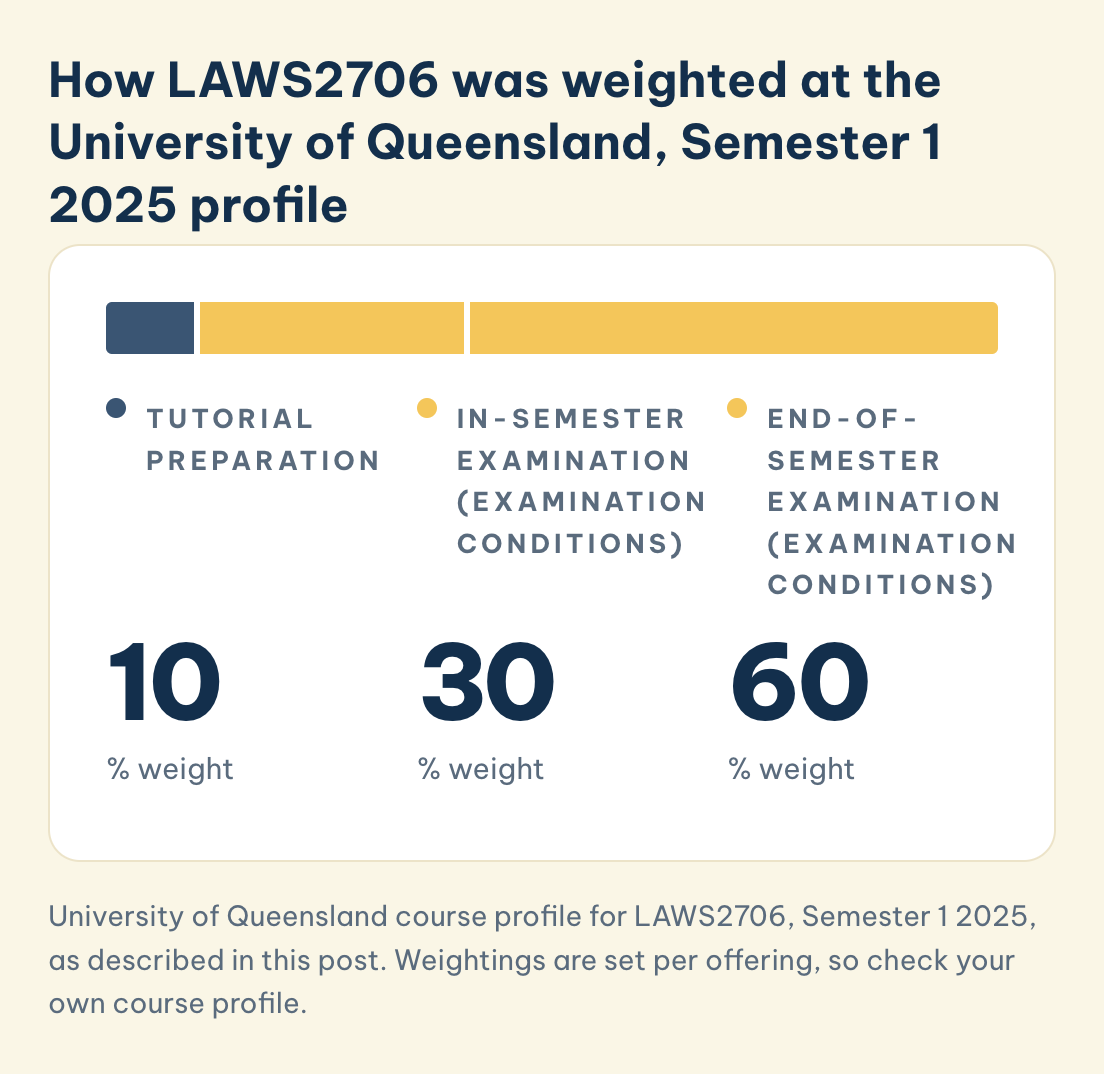
Direct answer: In the 2025 profile the marks were split between tutorial preparation at 10%, an in-semester examination at 30%, and an end-of-semester examination at 60%. Ninety percent under examination conditions means the version of your knowledge that counts is the version you can deploy without your notes in front of you.
How LAWS2706 was weighted at the University of Queensland, Semester 1 2025 profile
The yellow parts are the two examinations, which are sat under examination conditions.
Tutorial preparation
10
% weight
In-semester examination (examination conditions)
30
% weight
End-of-semester examination (examination conditions)
60
% weight
Save this figure
Evidence: Australian law schools, UQ included, reference in AGLC (the Australian Guide to Legal Citation), not APA, so footnote style and pinpoint citations matter as much as the argument itself. The tutorial preparation component ran continuously across the teaching period rather than falling due on one date. It is the smallest component by weight and the largest by function, because it is the only place where you practise the exact thing the examinations test, which is applying a principle to a set of facts while somebody checks your reasoning.
Example: A student treated tutorial preparation as a participation formality and prepared lightly for it. She then found the in-semester examination difficult in a way she had not predicted, because she had never before had to move from facts to principle at speed. The 10% was not the point. The rehearsal was.
◆ Section 4 / 6 · What the exams test
The skill the examinations are really testing
Direct answer: Applying a principle to facts you have never seen. A foundations course examines the blocks rather than the finished building, which means the fact patterns are usually unfamiliar by design, and revision that consists of memorising cases prepares you for a different examination.
Evidence: The outcome list separates identifying and recalling principles from applying them to factual situations, and separates both from analysing case law. Three distinct verbs, three distinct activities. A student who can recite the principle in a fixtures case has completed the first and none of the others.
Example: Given a problem about an item bolted to a wall in leased premises, a student wrote a careful account of the leading authority and concluded that the item was a fixture. The stronger answer worked through the degree and object of annexation on those specific facts, reached the same conclusion, and then noted what would change if the tenant had installed it for the purpose of its trade. Same authority, but used as a tool rather than quoted as a verdict.
◆ Section 5 / 6 · The avoided outcome
The outcome most students avoid
Direct answer: Reflecting on social implications and critically evaluating the justifications for property rights. It asks a different question from the rest of the course, because every other outcome takes the law as given and this one asks whether it is defensible.
Evidence: There is a serious literature here to draw on, and using it is what separates argument from opinion. Honoré (1961) catalogued the standard incidents of ownership, the bundle of rights and liabilities that together make up full ownership in a legal system, and that catalogue is still the starting point most property theory courses use. Waldron (1985) works through what we are actually claiming when we call a system one of private property, and shows that the term covers arrangements that differ from one another in important ways. Katz (2008) argues that the core of ownership is not excluding everyone from a thing but "the preservation of the owner's position as the exclusive agenda setter for the owned thing" (Katz, 2008, p. 275), which is a different foundation and yields different answers about what ownership requires.
Example: Asked whether the law should protect an owner who leaves land idle, a student answered that it seemed unfair and that land should be used productively. That is a position without a route to it. A stronger answer set out what the exclusion account would say, what an agenda-setting account would say, and where the two diverge on this exact case, before reaching a conclusion. It was no more radical. It was reasoned.
A note on register. This is still a law examination. The essay outcome does not license a change of voice into personal commentary. Make a claim, support it with authority or with theory attributed to its author, acknowledge the strongest version of the other position, and resolve it. In a timed answer this argument usually runs 400 to 600 words, roughly the length of one long paragraph developed properly rather than three short ones asserted. The structure is the same discipline as a problem answer, applied to a normative question.
Related reading
If you are studying property at another university, our guide to LAWS2012 Property and Commercial Law at Sydney covers the priority-of-interests side of property problems in more depth, which complements the foundations material here.
◆ Section 6 / 6 · Six things to do
Six things worth doing in this course
- Check your own course profile for the current assessment weightings before building a study plan. They move between offerings.
- Treat tutorial preparation as examination rehearsal rather than as a participation mark. It is the only continuous practice you get.
- Revise principles, not case names. Keep a list where each entry is a rule stated in your own words, with the authority cited in AGLC footnote form after it, never the other way round.
- For every principle, write one fact pattern where it applies and one where it nearly applies but does not. The boundary is where examination problems live.
- Do not leave the justification outcome to the last week. Read Waldron (1985) and Katz (2008) properly, alongside Honoré (1961) for the classical baseline, and know exactly where the accounts disagree.
- Keep the personal property material alive after the course moves to land. Fixtures, and the distinction generally, depend on both halves.
Frequently asked questions
What are the prerequisites for LAWS2706?
The course profile lists LAWS1700 and LAWS1702 as prerequisites, taught by the TC Beirne School of Law. It is also incompatible with LAWS3009 and LAWS3112, meaning the university treats those as covering equivalent ground.
How much of the course is examined?
In the Semester 1, 2025 profile, 90% sat in two examinations, an in-semester examination at 30% and an end-of-semester examination at 60%, with tutorial preparation making up the remaining 10%. Confirm the current split in your own profile, since assessment structures are reissued each offering.
Do I need to memorise cases?
You need the principles, and you need to be able to attribute them in AGLC form. A case is useful in an examination as authority for a proposition and as a source of reasoning you can apply, rather than as a name to drop.
How do I write the theory question without just giving my opinion?
Attribute the positions you are using to the scholars who argued them, such as Honoré (1961) on the incidents of ownership or Katz (2008) on agenda-setting, set out the strongest form of the view you disagree with, and show where the accounts actually diverge on the facts in front of you. Opinion is a conclusion without a route, and argument shows the route.
Why does the course start with personal property rather than land?
Because the underlying concepts are easier to see without the Torrens Title system and the statutory machinery that surrounds land. The ordering is pedagogical, and the personal property material stays relevant once the course moves on.
Where MAAS fits
MAAS mentors work alongside students in courses like this rather than in place of them. In a heavily examined foundations course, the two useful things a mentor does are to check that your principles are stated in your own words rather than borrowed from a case headnote, and to press on the theory answer until it argues rather than asserts. The work stays yours. If that is useful, our academic support service and our exam support service are the two places to start.
References
Honoré, A. M. (1961). Ownership. In A. G. Guest (Ed.), Oxford essays in jurisprudence (pp. 107-147). Oxford University Press.
Katz, L. (2008). Exclusion and exclusivity in property law. University of Toronto Law Journal, 58(3), 275–315. https://doi.org/10.3138/utlj.58.3.275
Waldron, J. (1985). What is private property? Oxford Journal of Legal Studies, 5(3), 313–349. https://doi.org/10.1093/ojls/5.3.313
Tools & resources
The University of Queensland. (2025). LAWS2706: Foundations of Property Law course profile. https://course-profiles.uq.edu.au/course-profiles/LAWS2706-20234-7520
A free 20-minute consultation is a conversation about where you are with LAWS2706.
Book a free consultation ▸