
◆ Writing Tips
How do you write a comparative essay, point by point or block?
To write a comparative essay, choose a basis for comparison, list the similarities and differences, write a thesis that says which of them matters more, then organise the body either point by point (alternating between your subjects on each criterion) or in blocks (all of A, then all of B). University of Toronto (n.d.) notes that professors often prefer the point-by-point pattern.
◆ Question 1 / 7 · What is a comparative essay
What is a comparative essay?
Direct answer: A comparative essay examines two or more texts, theories, events or objects side by side and argues what their similarities and differences show. Listing the overlaps is not enough. The University of Waterloo (n.d.) says you explain the insights a comparison gives, or judge whether one thing is better than another against established criteria.
The word "compare" in an assignment brief usually covers both similarities and differences. Western University (n.d.) separates the two terms: to compare is to analyse topics while focusing on both their similarities and differences, and to contrast is to emphasise only the differences. If your question says "compare and contrast", treat it as an instruction to cover both and to say which side weighs more.
The trap in this kind of essay is description. A paragraph that tells the reader what Text A does and then what Text B does, without saying what the difference means, reads like two summaries placed next to each other. The University of North Carolina at Chapel Hill (n.d.) warns that instructors generally want you to compare things very directly, rather than listing their traits and leaving the reader to work out why the similarities or differences matter. Every comparison you make should serve the thesis, and that is the single test you can apply to each paragraph as you draft it.
◆ Question 2 / 7 · Comparative essay structure
What does a comparative essay structure look like?
Direct answer: A comparative essay has an introduction with a thesis, a body organised in one of two patterns, and a conclusion that says what the comparison reveals. The two body patterns are point by point (alternating, ABAB) and block (subject by subject, AABB). BBC Learning English (2017) calls them the horizontal and vertical patterns.
The two patterns hold exactly the same material and differ only in its order. BBC Learning English (2017) describes them plainly: "In a 'vertical' pattern, we describe all the features of A, and then we describe all the features of B" (p. 3). In the horizontal pattern, one feature of A sits next to the same feature of B, and then the essay moves to the next feature. The table below lays out a six-paragraph body both ways, using the French and Russian revolutions example from University of Toronto (n.d.), which compares them on new technology, military strategy and the administrative system.
| Body paragraph | Point by point (alternating) | Block (subject by subject) |
|---|---|---|
| 1 | Technology: French Revolution | French Revolution: technology |
| 2 | Technology: Russian Revolution | French Revolution: military strategy |
| 3 | Military strategy: French Revolution | French Revolution: administration |
| 4 | Military strategy: Russian Revolution | Russian Revolution: technology, compared with the French |
| 5 | Administration: French Revolution | Russian Revolution: military strategy, compared with the French |
| 6 | Administration: Russian Revolution | Russian Revolution: administration, compared with the French |
The block column has comparison language in paragraphs 4 to 6 because University of Toronto (n.d.) says the second block should refer back to the first and make clear points of comparison, with phrases such as "Unlike A, B..." or "Like A, B...". Without that, the essay is two separate essays sharing an introduction. A third arrangement is also common: each paragraph covers one criterion and discusses both subjects inside the same paragraph. The University of North Carolina at Chapel Hill (n.d.) suggests this when you have only a little to say about each subject on a given point, and the full ABAB alternation when you have more.
◆ Question 3 / 7 · Point by point or block
When should you use point by point and when block?
Direct answer: Use point by point when you can find clearly related criteria that apply to every subject, because it puts the comparison in front of the reader in every paragraph. Use block when the subjects share few comparable points, when your ideas about B build on A, or when you compare three or more subjects (University of Toronto, n.d.).
University of Toronto (n.d.) says the alternating method generally does a better job of highlighting similarities and differences and tends to produce a more tightly integrated and analytical paper, which is why professors often like it. It also warns that forcing the alternating method onto subjects without clearly related points is likely to be counterproductive. The University of Waterloo (n.d.) gives block a specific use: it works well when you want readers to agree with the advantages of something new by showing how it compares with something more traditional, and it suits three or more major areas of comparison, such as a third or fourth subject.
Guides weigh different factors, so treat any "rule" you hear about length with care. Western University (n.d.) links block to shorter papers and point by point to longer, more complex papers with more points of comparison. The University of Waterloo (n.d.) recommends block on a different ground, when you have three or more major areas of comparison, such as a third or fourth subject. In our experience at MAAS, the deciding question is the brief, not the word count: if the marking criteria reward integrated analysis, point by point is the safer default.
| Situation | Better fit | Source |
|---|---|---|
| Same criteria apply clearly to both subjects | Point by point | University of Toronto (n.d.) |
| Few closely related points between A and B | Block | University of Toronto (n.d.) |
| Your ideas about B build on or extend A | Block | University of Toronto (n.d.); University of Waterloo (n.d.) |
| Three or more subjects | Block | University of Toronto (n.d.); University of Waterloo (n.d.) |
| Brief asks for direct comparison | Point by point | University of Toronto (n.d.); UNLV Writing Center (2026) |
Each pattern has a typical failure. Point by point can feel choppy if the transitions are weak, and Western University (n.d.) says the constant shifting can make a paper seem to jump around randomly unless you keep a fixed sequence. Block can drift into two disconnected summaries. Whichever you choose, keep the order of subjects the same in every section so the reader always knows where they are.
◆ Question 4 / 7 · Writing the introduction
How do you write a comparative essay introduction?
Direct answer: Introduce the subjects and the wider field, state the basis of your comparison, and end with a thesis that says whether the similarities or the differences matter more. The UNLV Writing Center (2026) says the introduction must establish clear grounds for comparison, explaining why these subjects are being examined together.
The basis of comparison is the idea, category or theme that applies to every subject you are comparing. The University of Waterloo (n.d.) gives the example of comparing neoclassical and gothic architecture through the influence of social context on each style. Without that frame, the reader cannot tell why you have chosen these subjects or which of their many features you will discuss.
Your thesis should weigh the comparison. University of Toronto (n.d.) suggests deciding whether the similarities on the whole outweigh the differences, or the reverse, and writing a thesis that reflects their relative weight, adding that a more complex thesis will usually include both. A workable template, adapted from the University of Waterloo (n.d.), is: "Although A and B share [similarity], they differ in [criteria], which shows [your claim]." Close the introduction with a one-sentence road map that names the criteria in the order your body paragraphs will take them, and say whether you are going point by point or subject by subject.
◆ Question 5 / 7 · University vs GCSE
How is a university comparative essay different from a GCSE one?
Direct answer: A university comparative essay usually asks you to build your own basis for comparison and argue a thesis about it, often using scholarly sources. A school task in English often supplies the texts and the focus, such as how two poems present a theme, and often asks you to compare methods.
At university, the criteria are usually yours to choose. The University of Waterloo (n.d.) says you may need preliminary reading of your course materials to decide what criteria to assess, if your instructor has not specified them. Political science guides make the same point: the University of Washington (n.d.) advises writing a short analytic summary of each author or concept first, because you must understand each one before you compare them, and it calls that selection step the hardest and most important part of the paper.
In English Literature, the subjects are texts and the criteria are usually themes, methods and contexts, and the same two patterns apply. Whatever the level, evidence still has to come from both texts in each section. If you are comparing poems or novels for a GCSE or A-level task, check your exam board's mark scheme for what it rewards, because school mark schemes set their own wording and we have not quoted any of them here.
◆ Question 6 / 7 · A worked example
Is there a comparative essay example you can follow?
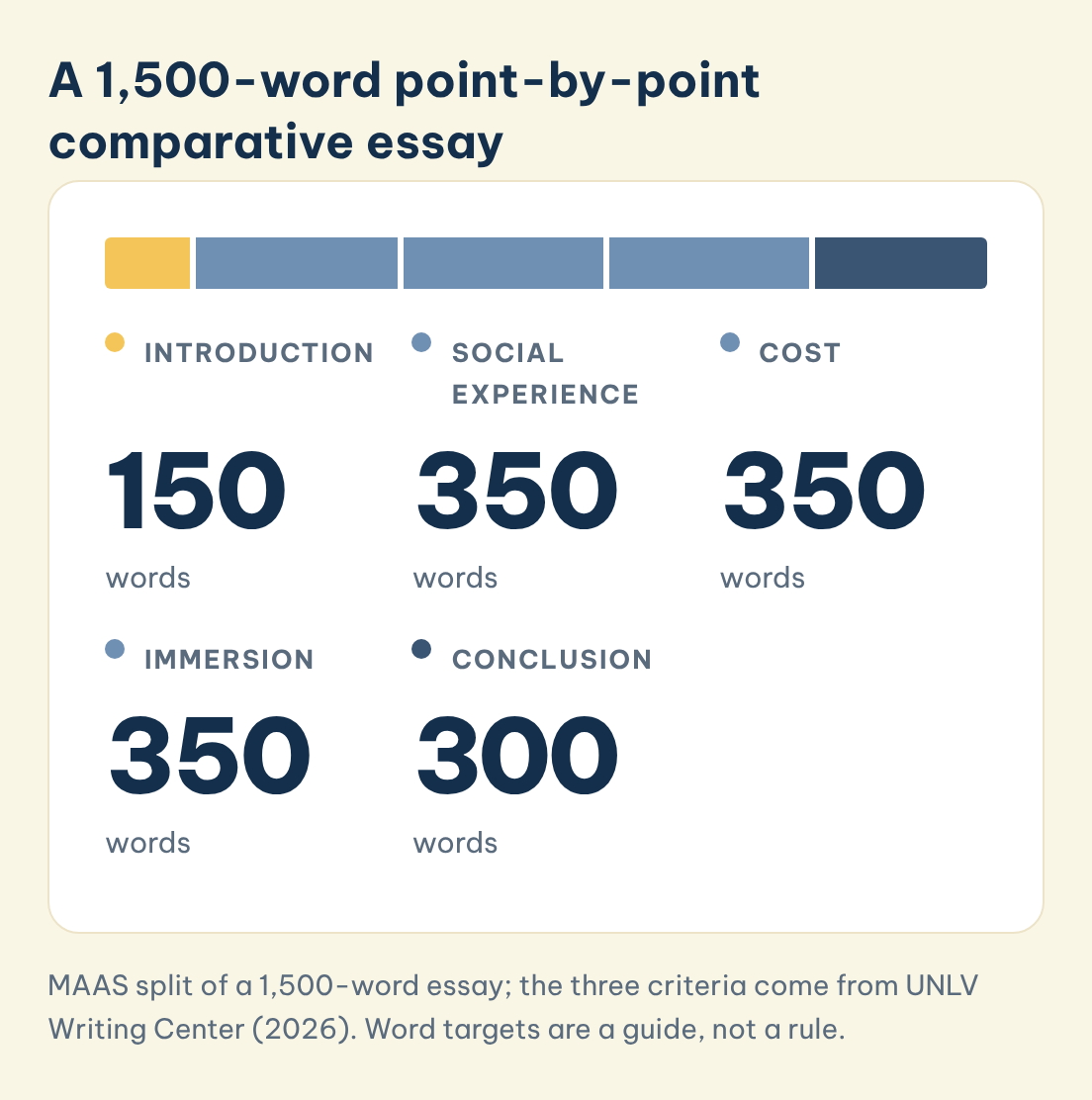
Direct answer: Yes. The plan below is a worked example of a 1,500-word point-by-point essay comparing cinemas and streaming, built on the three criteria in the UNLV Writing Center (2026) handout. Swap in your own subjects and criteria, and keep one criterion per section with both subjects inside it.
The UNLV Writing Center (2026) compares movie theaters with streaming on social experience, cost and immersion, and says point by point is best when your essay would benefit from direct comparison. The word targets in the plan are our own split of a 1,500-word essay, not figures from the handout.
A 1,500-word point-by-point comparative essay
The worked example in this guide, section targets in words.
Introduction
150
words
Social experience
350
words
Cost
350
words
Immersion
350
words
Conclusion
300
words
Save this figure
COMPARATIVE ESSAY PLAN (point by point, about 1,500 words)
Basis of comparison: which way of watching films suits students better

INTRODUCTION [about 150 words]
- Both let students watch new films; they differ in setting
- Thesis: Although streaming wins on cost, cinemas offer
  [claim about social experience and immersion]
- Road map: social experience, then cost, then immersion

SECTION 1: Social experience [about 350 words]
- Cinemas: evidence + what it means
- Streaming: evidence + direct comparison ("By contrast...")
- Mini-conclusion: which way this criterion points

SECTION 2: Cost [about 350 words]
- Cinemas / Streaming / mini-conclusion

SECTION 3: Immersion [about 350 words]
- Cinemas / Streaming / mini-conclusion

CONCLUSION [about 300 words]
- What the comparison shows overall
- Why it matters for the reader
Notice where the last section sits. The University of North Carolina at Chapel Hill (n.d.) points out that the last point you make is the one the reader leaves with, so if you argue that one subject is better, end on the contrast that supports it. If the differences are your main finding, end with a difference, and if the similarities are, end with a similarity.
◆ Question 7 / 7 · How MAAS can help
How can MAAS help with a comparative essay?
Direct answer: MAAS works as a tutor and advisor. You and a MAAS expert agree the basis of comparison and the structure, then move through the Outline, Draft and Final stages with the expert explaining what to change at each step, while the analysis and the submission stay yours.
If you are not sure whether your comparison answers the question, essay and assignment support from MAAS follows an Outline, Draft, Final sequence in which a mentor reviews your plan against the marking criteria and tells you where the comparison drifts into description. Before you start, our guide on how to make an essay plan covers word counts and paragraph planning in more depth. Most students begin by sending the brief and their plan, and the first conversation is free.
Frequently asked questions
Is point by point better than block?
Not always. University of Toronto (n.d.) says professors often like the alternating method because it integrates the analysis, but it also says block suits subjects with few related points, ideas that build on each other, or three or more subjects.
Can I mix the two patterns in one essay?
Some guides allow it. The University of North Carolina at Chapel Hill (n.d.) says there are no hard and fast rules about organising a comparison paper, as long as the reader can tell what is going on. Keep the order of subjects consistent within each section.
How many points of comparison do I need?
There is no fixed number. University of Toronto (n.d.) says you may include more than three pairs of alternating points and should let the subject matter decide how many you develop.
Should I write more about differences or similarities?
Write more about whichever carries your thesis. University of Toronto (n.d.) advises deciding whether similarities or differences weigh more and writing a thesis that reflects that balance.
How should I start the body of a block essay's second half?
Refer back to the first subject. University of Toronto (n.d.) suggests phrases such as "Unlike A, B..." or "Like A, B..." so the second block compares rather than describes.
Does a block essay need a paragraph that ties the subjects together?
Usually, yes. The University of North Carolina at Chapel Hill (n.d.) suggests a strong analytical thesis and at least one body paragraph that ties your points together when you go subject by subject.
References
BBC Learning English. (2017). Go the distance: Academic writing 6, essay structure. British Broadcasting Corporation. https://downloads.bbc.co.uk/learningenglish/gtd/academicwriting/GTD_academic_writing_06_essay_structure.pdf
University of North Carolina at Chapel Hill. (n.d.). Comparing and contrasting. The Writing Center. https://writingcenter.unc.edu/tips-and-tools/comparing-and-contrasting/
University of Toronto. (n.d.). The comparative essay. Writing Advice. https://advice.writing.utoronto.ca/types-of-writing/comparative-essay/
University of Washington. (n.d.). Writing compare/contrast papers. Political Science Writing Center. https://depts.washington.edu/pswrite/Handouts/CompareContrastPapers.pdf
University of Waterloo. (n.d.). Comparative essays. Writing and Communication Centre. https://uwaterloo.ca/writing-and-communication-centre/comparative-essays
UNLV Writing Center. (2026). Compare and contrast essays [Handout]. University of Nevada, Las Vegas. https://www.unlv.edu/sites/default/files/media/document/2026-04/Compare_and_Contrast_Essays.pdf
Western University. (n.d.). Compare and contrast essays. The Writing Support Centre. https://writing.uwo.ca/pdf/undergrads/compare-essay.pdf
Not sure how this guide applies to your own case? Talk it through with MAAS in a free 20-minute consultation.
Book a free consultation ▸