

Model 01
A flat mark penalty
A flat mark penalty subtracts the same number regardless of your score.
◆ Thesis and dissertation
A late UK dissertation loses 5 marks a day at Edinburgh and Queen Mary and a rising percentage every 24 hours at Manchester, before a hard zero cut-off. Missing a dissertation deadline by even a few hours can cost very different amounts of marks depending on where you study, because no single UK-wide rule governs late submission for a master's dissertation. Students often assume the penalty works the same way everywhere, then discover too late that their own institution runs a stricter schedule or a shorter grace window than the advice written for a different university's handbook describes.
The practical takeaway is that "the deadline" is really two questions: how fast marks fall once it passes, and the later date after which no submission is accepted at all. This guide reads the 2025/26 rules of four universities side by side so you can find your own regime; it pairs with the dissertation timeline guide, which is about planning so the penalty never applies.
◆ Part 1 / 7 · Two numbers
Direct answer: Late submission penalties for a UK master's dissertation are set by each university, not by one national rule, so the cost depends on which institution you attend. Most schools deduct either a fixed number of marks per day or a percentage of marks per 24 hours, then apply a hard cut-off after which the work scores zero.
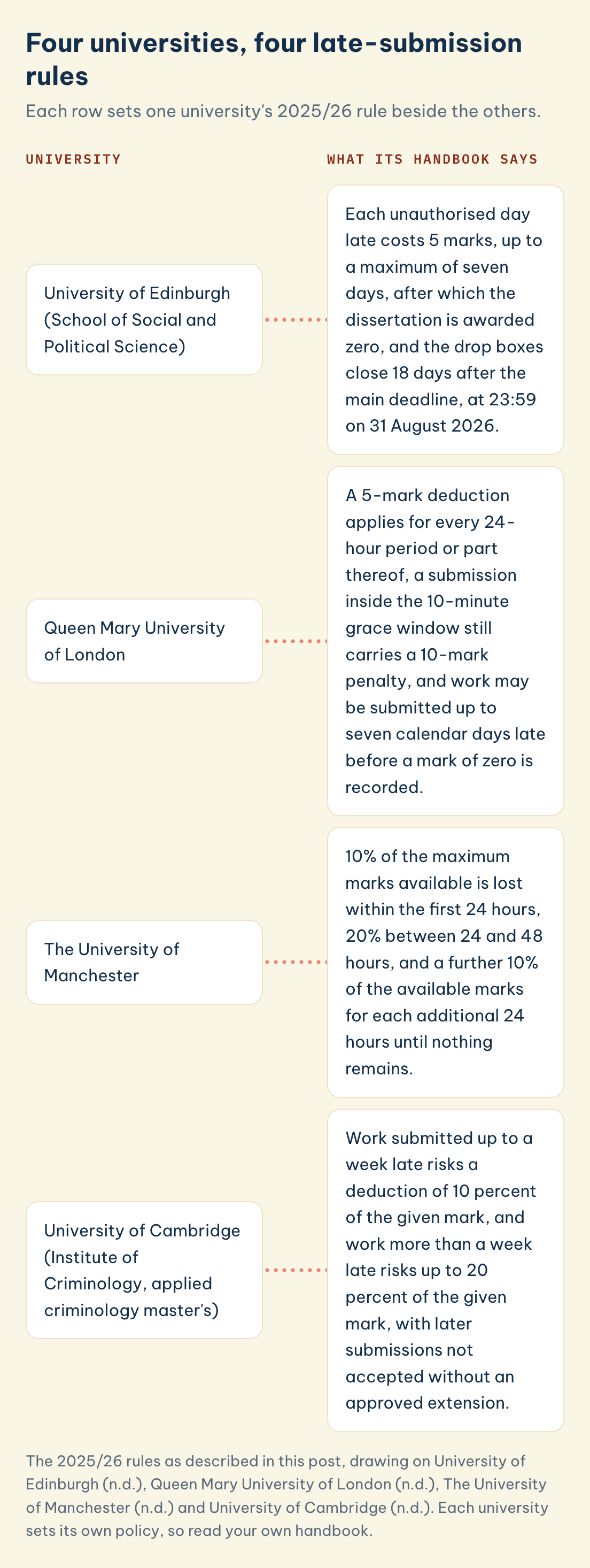
Four universities, four late-submission rules
Each row sets one university's 2025/26 rule beside the others.
University
What its handbook says
University of Edinburgh (School of Social and Political Science)
Each unauthorised day late costs 5 marks, up to a maximum of seven days, after which the dissertation is awarded zero, and the drop boxes close 18 days after the main deadline, at 23:59 on 31 August 2026.
Queen Mary University of London
A 5-mark deduction applies for every 24-hour period or part thereof, a submission inside the 10-minute grace window still carries a 10-mark penalty, and work may be submitted up to seven calendar days late before a mark of zero is recorded.
The University of Manchester
10% of the maximum marks available is lost within the first 24 hours, 20% between 24 and 48 hours, and a further 10% of the available marks for each additional 24 hours until nothing remains.
University of Cambridge (Institute of Criminology, applied criminology master's)
Work submitted up to a week late risks a deduction of 10 percent of the given mark, and work more than a week late risks up to 20 percent of the given mark, with later submissions not accepted without an approved extension.
Students tend to treat the submission deadline as a single wall: on time or late. The handbooks treat it as a schedule of escalating consequences with a second, quieter date built in, the point at which the submission portal closes and a late mark becomes a zero. Reading only the first date and ignoring the second is how a recoverable one-day slip turns into a non-submission. The sections below set out four regimes; find the one your school uses, because the differences change what a single late day actually costs.
◆ Part 2 / 7 · Edinburgh
Direct answer: At Edinburgh, each unauthorised day late costs 5 marks, capped at seven days before the dissertation drops to zero. After that comes a second wall: the drop boxes shut for good 18 days past the original deadline, with no dissertation accepted beyond it. Going over the word limit brings its own separate 5-mark deduction, regardless of overrun size.
The University of Edinburgh's School of Social and Political Science sets one dissertation deadline for all its taught MSc programmes: 13 August 2026 at 23:59 UK time. Work submitted after that without an approved extension loses 5 marks for each calendar day of lateness, up to a maximum of seven days, after which the dissertation is awarded zero (University of Edinburgh, n.d.). The handbook states this in plain terms: "Dissertations submitted late incur a lateness penalty of 5 marks for each calendar day of lateness up to a maximum of 7 calendar days, after which a mark of zero '0' will be given" (University of Edinburgh, n.d.).
The detail most students miss is the second date. The submission drop boxes close 18 days after the main deadline, at 23:59 on 31 August 2026, and the School will not accept a dissertation after that for any reason, including exceptional circumstances, so that marking can finish in time for the November Board of Examiners (University of Edinburgh, n.d.). Two further rules bite quietly: exceeding the word count carries its own flat 5-mark penalty regardless of how far over you are, and the handbook states plainly that IT failure and poor time management are not normally sufficient grounds for an extension (University of Edinburgh, n.d.).
◆ Part 3 / 7 · Queen Mary
Direct answer: Queen Mary deducts 5 marks for every 24-hour period a submission is late. A 10-minute grace window exists, but work submitted inside it still carries a 10-mark penalty, so it is not a safety margin. Work may be up to seven days late before it is recorded as a zero.
Queen Mary University of London applies a comparable rate, a 5-mark deduction for every 24-hour period or part thereof that an essay or dissertation is late, but the surrounding mechanics differ in ways that matter under pressure (Queen Mary University of London, n.d.).
First, there is a 10-minute grace period; a submission inside that window is accepted but still carries a 10-mark penalty, which means a portal that struggles to upload a large file at 23:55 is not the safety margin it looks like. Second, work may be submitted up to seven calendar days late, after which a mark of zero for non-submission is recorded. Third, and easiest to get wrong: a student may request a seven-day extension, but the request must be submitted before the original deadline, and a late-submission extenuating circumstances claim requires you to upload the work first and only then file the claim (Queen Mary University of London, n.d.). The rescue routes all assume you act before or at the wall, not after it.
◆ Part 4 / 7 · Manchester
Direct answer: Manchester deducts by percentage rather than a flat mark count: 10% of the available marks within the first 24 hours, 20% between 24 and 48 hours, then a further 10% for every additional 24 hours until nothing remains. The count runs on calendar days, so weekends are included.
Opening step
10%
of the maximum marks available is lost at Manchester within the first 24 hours
Weekend example
30%
is lost when a noon-Friday deadline is met just before noon on the following Monday
Manchester's escalating deduction
Share of the maximum marks lost, in percent.
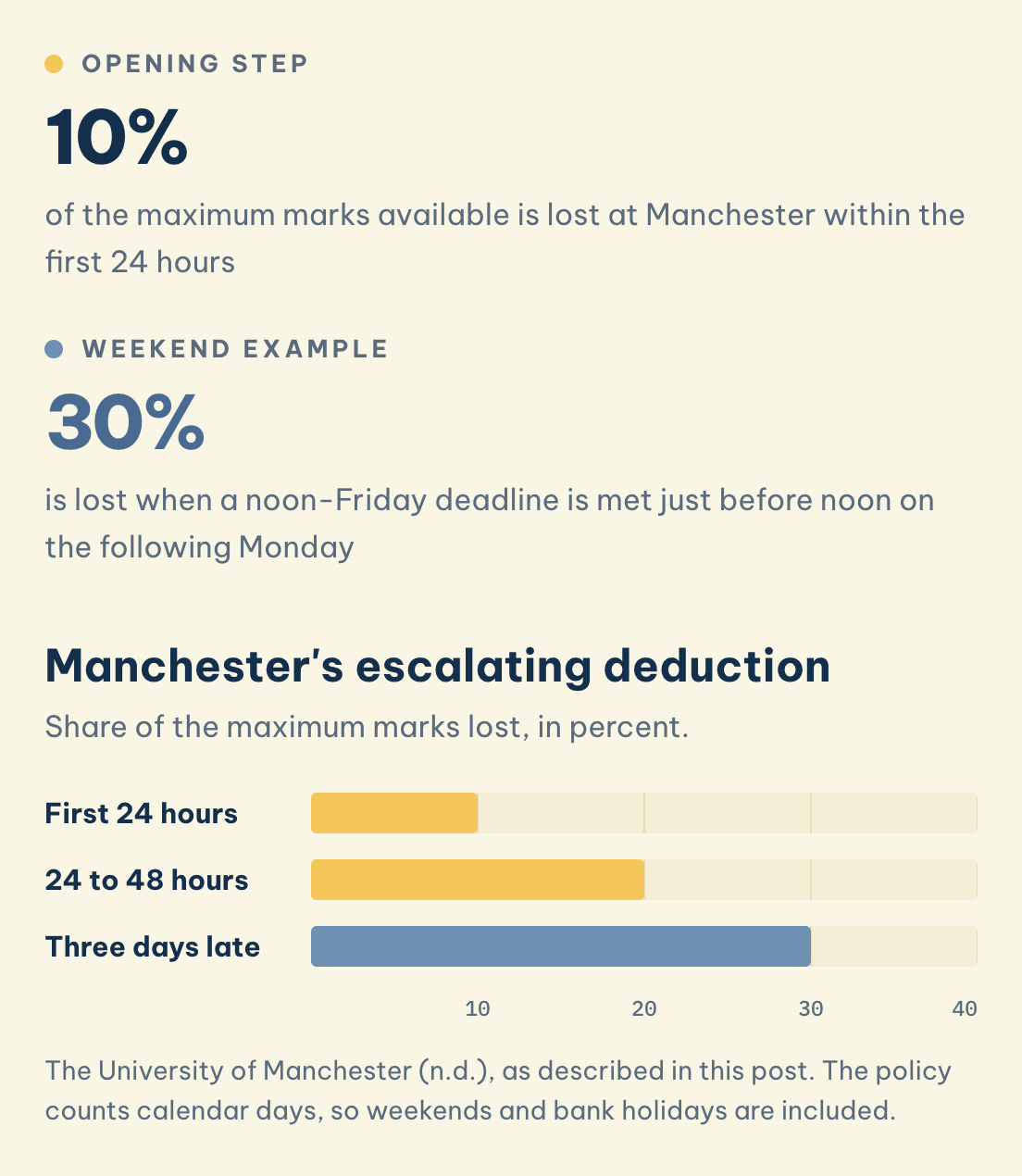
The University of Manchester's dissertation handbook for taught master's programmes uses a percentage model rather than a flat mark count. Work submitted within the first 24 hours after the deadline loses 10% of the maximum marks available; between 24 and 48 hours it loses 20%; and the deduction grows by a further 10% of the available marks for each additional 24 hours until nothing remains (The University of Manchester, n.d.).
Because the policy counts calendar days, weekends and bank holidays are included: a noon-Friday deadline submitted just before noon on the following Monday is three days late and loses 30% (The University of Manchester, n.d.). Alliance Manchester Business School sets its 2025/26 dissertation deadline at 2pm on 7 September 2026, and adds a penalty that has nothing to do with lateness: failing to complete the ethics process and forms beforehand can cost up to 10 marks, and collecting data without ethical approval can in severe cases result in a mark of zero (University of Manchester, Alliance Manchester Business School, n.d.).
◆ Part 5 / 7 · Cambridge
Direct answer: Cambridge deducts a percentage of the mark you were actually awarded, not of the maximum available, which changes the arithmetic. Work up to a week late risks losing 10 percent of that mark, and more than a week late risks up to 20 percent, with nothing accepted afterwards without an approved extension.
Marks lost from a 70
7
under a deduction of 10 percent of the given mark, which lands the dissertation at 63, against 5 marks under Edinburgh's flat rate
A flat mark penalty subtracts the same number regardless of your score.
A percentage of the given mark scales with your score.
A dissertation marked at 70 loses 5 under Edinburgh's flat rate but 7 under a deduction of "10 percent of the given mark", so the models are not interchangeable.
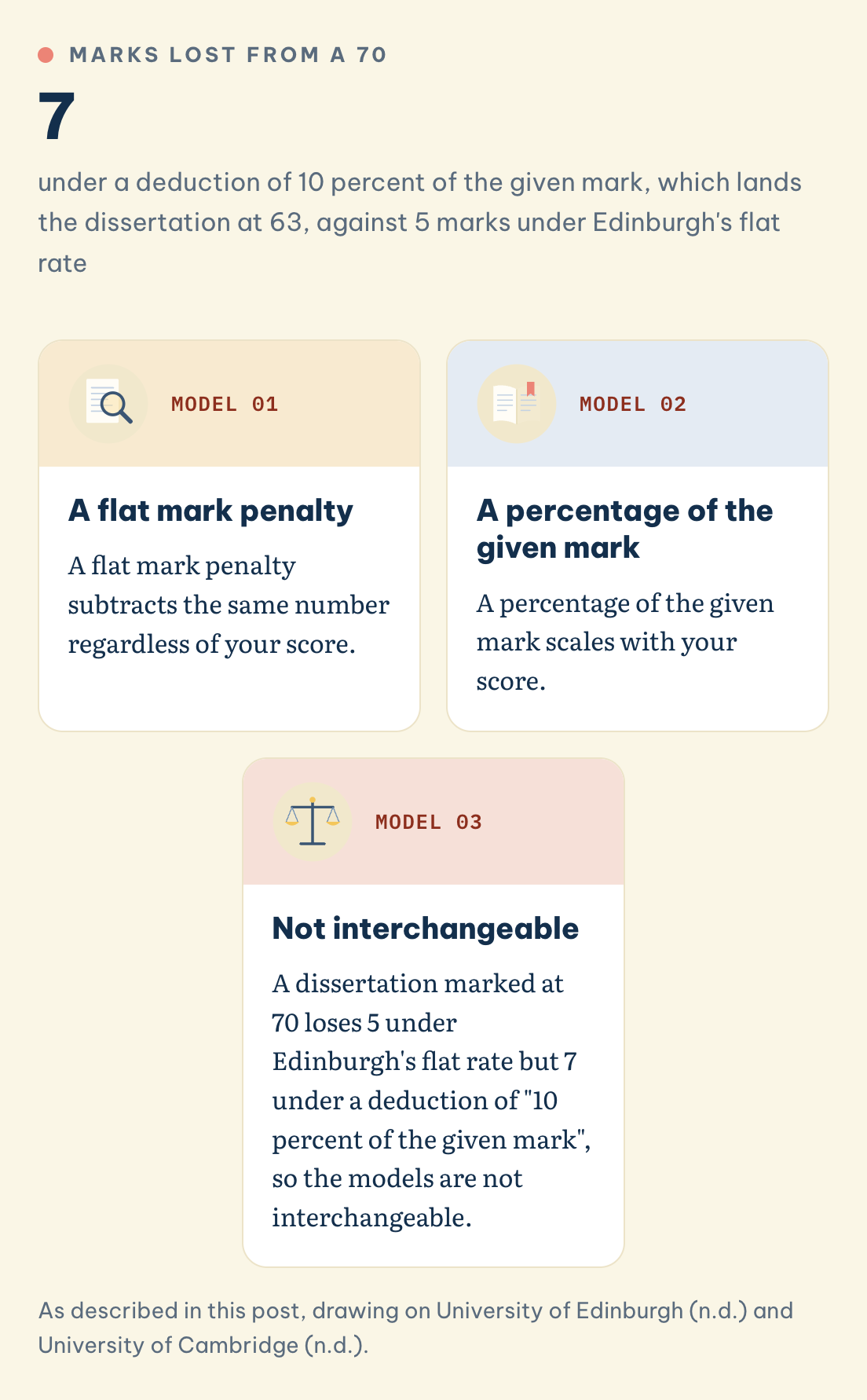
Some programmes deduct from the mark you earned rather than from the maximum available, a distinction that quietly changes the arithmetic. The University of Cambridge's Institute of Criminology handbook for its applied criminology master's states that work submitted up to a week late risks a deduction of 10 percent of the given mark, and work more than a week late risks up to 20 percent of the given mark, with submissions after that point not accepted without an approved extension (University of Cambridge, n.d.).
Ten percent of the given mark is not the same as ten marks. A dissertation marked at 70 that loses "10 percent of the given mark" loses seven marks and lands at 63; the same piece under Edinburgh's flat rate would lose five. Reading "10 percent" and assuming it means ten absolute marks, or reading a flat mark deduction and assuming it scales with your score, both lead to the wrong plan.
◆ Part 6 / 7 · Three differences
Direct answer: Three variables explain the gap between the four regimes: the unit, whether the deduction is a fixed number of marks per day, a percentage per day, or a percentage of the mark you were awarded; the cliff, the later date after which the mark becomes zero; and the base the penalty applies to.
Three variables behind every gap
Tap a variable to see what to ask your own school.
Variable 1 of 3
The unit
The unit is whether the deduction is a fixed number of marks per day, a percentage per day, or a percentage of the mark you were awarded.
Variable 2 of 3
The cliff
The cliff is the later date after which the mark becomes zero, and that date, not the headline deadline, is your true last resort.
Variable 3 of 3
The base
The base is what the penalty applies to, either the maximum marks or the mark you were awarded.
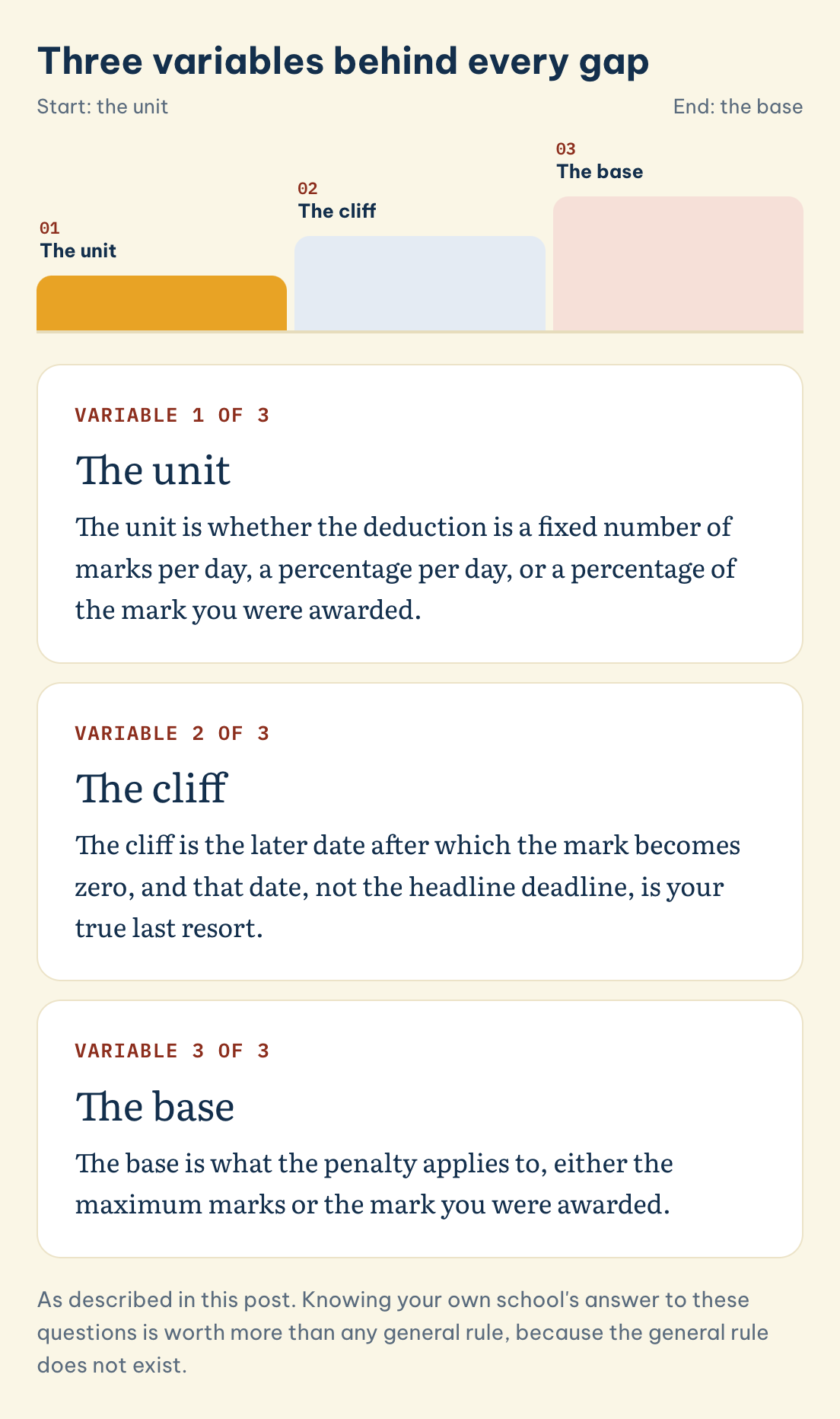
Set the four regimes beside each other and the same three variables explain every gap between them. First, the unit: a fixed number of marks per day (Edinburgh, Queen Mary) behaves very differently from a percentage per day (Manchester), and a percentage of the mark awarded (Cambridge) differs again. Second, the cliff: every school has a later date after which the mark is simply zero, and that date, not the headline deadline, is your true last resort. Third, the base the penalty applies to: the maximum marks, or the mark you were awarded.
There is also a rule that is not a penalty at all but functions like one: the extension must almost always be requested before the deadline, and grounds such as a slow internet connection or leaving things late are explicitly excluded. Knowing your own school's answer to these questions is worth more than any general rule, because the general rule does not exist.
◆ Part 7 / 7 · Planning
Direct answer: Treat the earliest binding time as your real deadline, not the grace window, which functions as a trap rather than a cushion, and treat the portal-closure date as the point past which no plan survives. If your circumstances warrant an extension, lodge the request early, while it can still be approved.
The safe reading of any handbook is the strict one: treat the earliest binding time, allowing for the grace window being a trap rather than a cushion, as your real deadline, and treat the portal-closure date as the line past which no plan survives. If your circumstances genuinely warrant an extension, the single most useful habit is to lodge the request early, while it can still be approved, rather than after the work is already late.
Where MAAS mentors help is upstream of all of this: reading your specific programme handbook with you, building a schedule that lands the final chapter before the binding date, and pacing supervisor feedback so the last week is for polishing rather than panicking. The work stays yours; the planning is what stops the penalty table from ever becoming relevant. If you want a second pair of eyes on your dissertation timeline, MAAS academic mentoring starts with your handbook and your dates. If the problem is the draft itself rather than the schedule, dissertation support is the other route.
No. Each university sets its own policy in its programme or dissertation handbook. Edinburgh and Queen Mary deduct 5 marks per day; Manchester deducts a percentage of the available marks that escalates every 24 hours; Cambridge's criminology programme deducts a percentage of the mark awarded (University of Edinburgh, n.d.; Queen Mary University of London, n.d.; The University of Manchester, n.d.; University of Cambridge, n.d.).
It varies. Queen Mary and Cambridge stop accepting work seven days after the deadline; Edinburgh closes its drop boxes 18 days after, at 23:59 on 31 August 2026, and accepts nothing afterwards even with exceptional circumstances (University of Edinburgh, n.d.; Queen Mary University of London, n.d.; University of Cambridge, n.d.).
No. Queen Mary allows a 10-minute window, but a submission inside it still carries a 10-mark penalty, so it protects against a portal glitch, not against planning to finish at the last minute (Queen Mary University of London, n.d.).
Usually not. Queen Mary requires an extension request to be submitted before the original deadline, and for a late-submission claim it requires you to upload the work first and then file the extenuating circumstances claim (Queen Mary University of London, n.d.).
Yes. Edinburgh deducts a flat 5 marks for exceeding the word count, and Manchester's business school can deduct up to 10 marks for not completing the ethics process and forms beforehand, independent of when you submit (University of Edinburgh, n.d.; University of Manchester, Alliance Manchester Business School, n.d.).
A flat mark penalty subtracts the same number regardless of your score, while a percentage of the given mark scales with it. A dissertation marked at 70 loses 5 under Edinburgh's flat rate but 7 under Cambridge's "10 percent of the given mark", so the models are not interchangeable (University of Edinburgh, n.d.; University of Cambridge, n.d.).
Talk to a MAAS academic mentor about your dissertation timeline, starting with your programme handbook and your dates.
Contact a MAAS mentor ▸