
◆ Business & Management
BUSM4561 Work in Global Society (RMIT): how do you approach the assignment?
BUSM4561 Work in Global Society is a first-year RMIT course that asks a deceptively big question: how is work itself changing, and why? Students often answer it with opinion, work is more flexible now, or gig jobs are exploitative, when the course wants something harder: an argument built from theory and evidence about a specific transformation of work. This guide answers the seven questions Vietnamese students at RMIT ask MAAS mentors most often before they start BUSM4561.

◆ Question 1 / 8 · The course
What is BUSM4561 Work in Global Society about?
Direct answer: BUSM4561 Work in Global Society is a first-year undergraduate core course in RMIT's Bachelor of Business, offered at RMIT Vietnam (also BUSM4558 in Melbourne and BUSM4559 at partner campuses). It examines the changing nature of work in a globalised economy and how employers now manage work and workers. It is a sociology-of-work course wearing a business-degree label.
Evidence: The RMIT course summary is explicit that the course "examines a range of perspectives and theories to explain the transformation of work". That phrase, "a range of perspectives", is the assignment instruction hiding in the description. The course does not want you to pick a side; it wants you to hold competing explanations of a change in work and weigh them against evidence.
Example: A Vietnamese student came to MAAS certain that the gig economy was simply bad. Her mentor asked her to argue the opposite for 5 minutes, then argue her own view. She could not evidence either strongly. Once she treated "is gig work good or bad?" as a question with a distribution of answers rather than a verdict, her essay stopped being an opinion piece and became analysis.
◆ Question 2 / 8 · Assessment
What assessment does the BUSM4561 assignment usually involve?
Direct answer: RMIT's Bachelor of Business uses no exams; assessment is through essays, reports, case analyses and presentations. BUSM4561 is typically assessed by an individual written piece, an essay or report analysing a specific transformation of work using course theory, often paired with a shorter reflective or group task. The written analysis is where the marks concentrate. Always confirm the exact tasks, topic and weighting in your own Canvas shell, because the assessment structure varies by semester and campus.
Evidence: Because the course is theory-driven and the degree relies on written and presented analysis rather than exams, the assessment rewards a sustained argument, not recall under time pressure. A written piece gives you room to define a change in work, apply two or three perspectives, and reach an evidenced conclusion, which is exactly the "range of perspectives" the course promises.
Example: A student wrote a lively essay full of personal views about remote work but cited no theory and no data. His MAAS mentor did not touch his opinions; she asked him to attach each claim to a concept from the course and a source. The essay's word count barely changed, but it moved from a blog post to an academic argument.
◆ Question 3 / 8 · Grading
How is BUSM4561 graded, what does the rubric actually reward?
Direct answer: BUSM4561 rewards four things, roughly in this order: (1) theoretical framing, whether you explain a change in work through recognised perspectives rather than personal opinion; (2) evidence, whether your claims rest on data and scholarship rather than assertion; (3) balance and critique, whether you weigh competing views instead of arguing one side; and (4) structure and referencing.
How BUSM4561 marking moves from opinion to analysis
Each row sets one rubric focus with its lower-band behaviour beside the higher-band behaviour, taken from the table in this post.
Rubric focus (opinion or description, lower band)
Analyse and evaluate (higher band)
The change in work (says work has "changed a lot")
Defines one specific transformation and its drivers
Theory (mentions a concept in passing)
Applies a named perspective to explain the change
Evidence (asserts what is true)
Supports claims with data and scholarship
Balance (argues one side)
Weighs competing perspectives and judges between them
Conclusion (restates the opening opinion)
Reaches a position that follows from the analysis
Save this figure
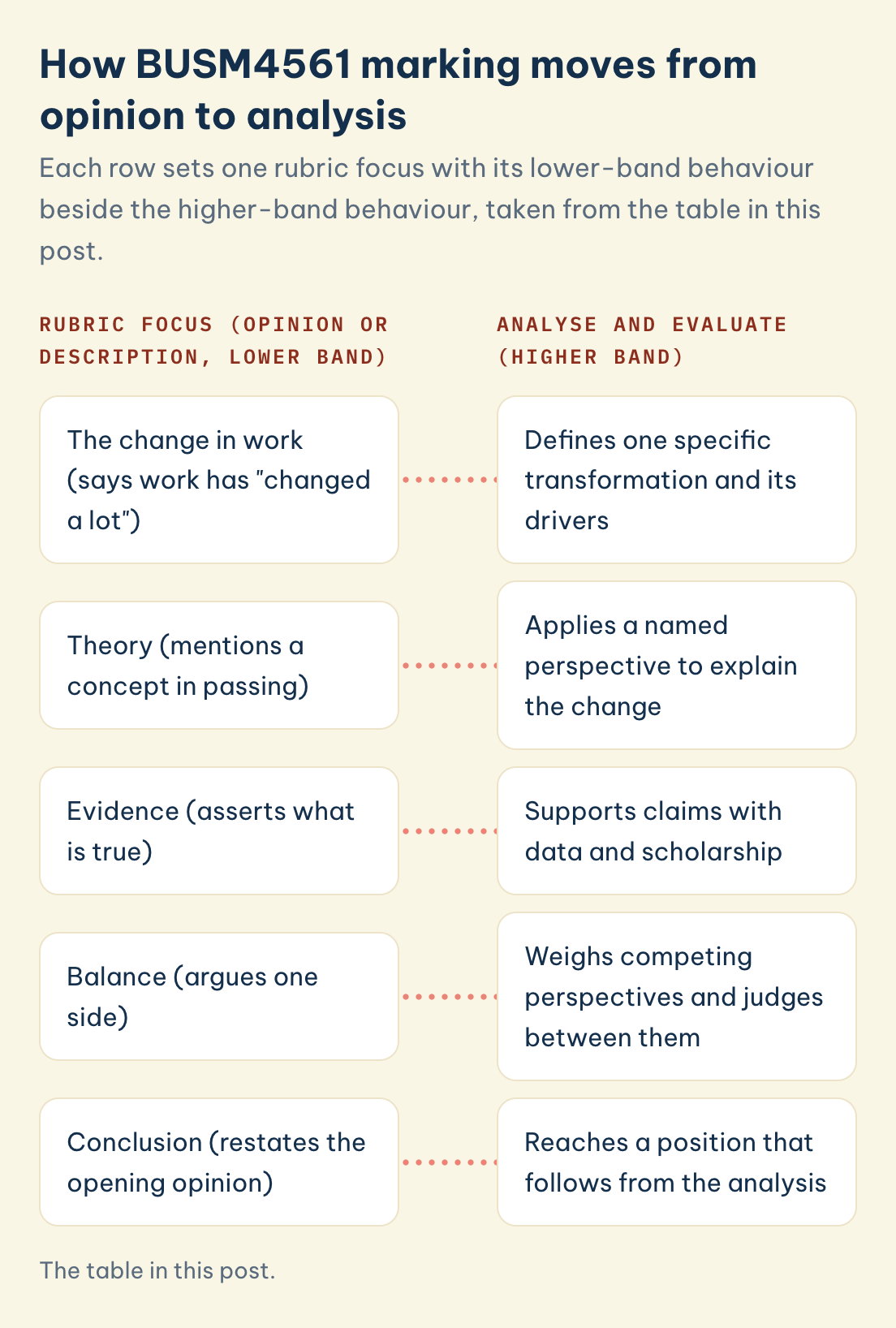
The move from a pass to a strong mark is almost always the shift from "here is what I think about work today" to "here is what these theories and this evidence reveal about a specific change in work".
Evidence: RMIT marking criteria reserve the higher bands for analysis and evaluation rather than description or opinion. Because the course explicitly examines "a range of perspectives", an essay that presents only one view has not met the criterion, however strongly it argues. The mark rewards holding two explanations in tension and judging between them on evidence.
| Rubric focus | Opinion or description (lower band) | Analyse and evaluate (higher band) |
|---|---|---|
| The change in work | Says work has "changed a lot" | Defines one specific transformation and its drivers |
| Theory | Mentions a concept in passing | Applies a named perspective to explain the change |
| Evidence | Asserts what is true | Supports claims with data and scholarship |
| Balance | Argues one side | Weighs competing perspectives and judges between them |
| Conclusion | Restates the opening opinion | Reaches a position that follows from the analysis |
Example: A MAAS mentor marked a student's draft against this table and found it sat entirely in the left column. The student kept his topic, remote work, but reframed it through two perspectives and added evidence for each. The essay moved two bands without a new argument, only a better-supported one.
◆ Question 4 / 8 · Theories
Which theories and concepts should you use in BUSM4561?
Direct answer: Anchor the work in a few recognised perspectives on work and apply them, rather than naming many. The most useful for BUSM4561 are: the standard employment relationship and its erosion; precarious work and job quality, set out in Kalleberg's (2011) Good Jobs, Bad Jobs; the gig and platform economy and algorithmic management (De Stefano, 2016); labour process theory (control and autonomy at work); globalisation and the international division of labour; and decent work as a normative standard (ILO, 2021). Pick the two or three that fit your chosen change in work and use them to explain it, not just to label it.
Evidence: These perspectives are examiner-recognised because they turn "work is changing" into a structured explanation with contested answers. The gig economy is the clearest place to show the balance the course rewards. Wood et al. (2019), publishing in Work, Employment and Society and studying 107 interviews and 679 survey responses across Southeast Asia and Sub-Saharan Africa, found that platform work delivers real autonomy, flexibility and task variety, but the same control system means "these mechanisms of control can also result in low pay, social isolation, working unsocial and irregular hours, overwork, sleep deprivation and exhaustion" (Wood et al., 2019, p. 56). That is not "gig work is good" or "gig work is bad"; it is a two-sided finding you can build a graded argument on.
Example: A Vietnamese student wrote that "the gig economy gives workers freedom". Her mentor pointed her to the evidence that the same flexibility often produces overwork and insecurity. Rewritten to hold both, autonomy and precarity as products of one control system, her essay demonstrated exactly the balanced critique the higher bands describe.
◆ Question 5 / 8 · Framing the topic
How do you choose and frame the transformation of work for your essay?
Direct answer: Choose one specific, well-documented change in work rather than "the future of work" in general. Strong choices include platform and gig work, remote and hybrid work, automation and job displacement, offshoring and global supply chains, or the casualisation of employment. Then frame it as a question the course can answer: what is driving this change, and what does it mean for workers and organisations? A narrow, evidenced topic beats a broad, opinion-led one every time.
Evidence: The course is about explaining transformation, which is impossible to do well across the whole of work in a single essay. Specificity is also what separates bands: "work is becoming more flexible" is a generalisation; "platform-based algorithmic management gives food-delivery riders formal flexibility while removing their real control over hours" is an analysable claim with a body of evidence behind it, and one Vietnamese students can observe directly in their own cities.
Example: A student chose "the future of work" and drowned in generalities. His mentor narrowed him to ride-hailing work in Vietnam, a change he could see, evidence and theorise. The essay sharpened immediately, because he was now explaining something specific rather than gesturing at everything.
◆ Question 6 / 8 · Generative AI
How should you handle generative AI and academic integrity in BUSM4561?
Direct answer: Check your course's Canvas statement on AI before using any tool, because coordinators set what is permitted per assessment, and follow RMIT's requirement to acknowledge and reference any permitted use. The safe approach is the one the research recommends: use tools for supportive work only if allowed, verify everything they produce, and declare the use plainly. A theory-and-evidence essay is exactly where an unverified AI summary of a concept or a fabricated citation will cost you marks.
Evidence: Non-disclosure is the documented failure mode, and it is usually driven by fear rather than intent to deceive. Gonsalves (2025), studying a King's Business School cohort, found that 74% of students did not declare their AI use on the mandatory coursework coversheet, with fear of penalties, ambiguous guidelines, inconsistent enforcement and peer influence all reported as barriers. For a course marked on theoretical framing and evidence, passing off an unverified AI account of a perspective as your own analysis fails on the exact criterion the essay is graded against.
Example: A student asked a MAAS mentor whether using a tool to explain labour process theory back to him counted against him. The mentor's answer was procedural: check the Canvas statement, and if supportive use is permitted, note it in one line, then verify the explanation against the actual reading. He did, and caught two points the tool had oversimplified, which made his essay more accurate, not less.
◆ Question 7 / 8 · Common mistakes
What are the most common mistakes Vietnamese students make in BUSM4561?
Direct answer: The recurring mistakes are: writing opinion instead of analysis; choosing a topic too broad to evidence; arguing one side when the course rewards balance; naming theories without applying them; relying on assertion rather than data; and confusing personal experience with evidence. Each loses marks even when the essay is well written and sincerely argued.
Evidence: Because the course is explicitly about weighing "a range of perspectives", a one-sided or opinion-led essay cannot reach the higher bands by design. Students often bring strong, well-informed views about work, they may be gig workers themselves, and the discipline to convert that experience into evidenced, balanced analysis is precisely the skill being assessed.
Example: A Vietnamese student who drove for a ride-hailing platform wrote a heartfelt essay about how hard the work was. His mentor did not dismiss the experience; she helped him turn it into evidence, connecting his hours and pay to the concepts of precarity and algorithmic control, and adding the counter-perspective on flexibility. The lived experience became the essay's strength once it was framed as analysis.
◆ Question 8 / 8 · MAAS mentor
How can a MAAS mentor help you approach BUSM4561 without crossing the line?
Direct answer: A MAAS mentor works alongside you, not instead of you. The mentor helps you decode the brief, narrow to one transformation of work you can evidence, choose the two or three perspectives that explain it, and test whether your essay weighs competing views rather than arguing one. You keep authorship of every word; the mentor raises the ceiling of what you can defend on your own.
Evidence: Because BUSM4561 is graded on theoretical analysis and balanced critique rather than opinion, the durable gain is the habit of explaining a real change through competing theories and evidence. That habit is the core of analytical work in any business or policy role, where you will be asked to interpret change, not just react to it. Coaching that builds that reasoning is what moves marks and, more importantly, what survives into your career.
Example: A Vietnamese RMIT student arrived with strong opinions about work and no way to argue them academically. Over a few sessions her MAAS mentor did nothing but ask "which theory explains that, and what evidence supports it" until the reflex became automatic. She wrote every word herself. The mark rose, and so did the way she reasons about the labour market she is about to enter.
Frequently asked questions
Is BUSM4561 hard for international students?
The reading is manageable; the difficulty is discipline of argument. The course punishes opinion and rewards balanced, evidenced analysis, so students with strong views about work often need to learn to argue against themselves before the essay feels academic.
What kind of topic works for the BUSM4561 essay?
One specific, well-documented change in work: platform and gig work, remote work, automation, offshoring, or casualisation. Narrow and evidenced beats broad and opinion-led.
Do I have to argue both sides?
Effectively, yes. The course examines "a range of perspectives", so the higher bands reward weighing competing explanations and judging between them on evidence rather than defending one position.
Does MAAS write the BUSM4561 assignment for me?
No. MAAS provides mentoring and review. A mentor helps you decode the brief, choose a topic, apply the theories, and test your balance, but you remain the author of every word you submit.
Can I use my own work experience as evidence?
Yes, if you frame it as analysis rather than anecdote. Connect what you experienced to a concept and, where possible, to wider data, so it functions as evidence within an argument rather than as a personal story.
Can I use AI tools in BUSM4561?
Only if your Canvas statement permits it, and only with acknowledgement per RMIT's guidance. Verify any explanation or citation a tool gives you, because an essay marked on theory and evidence is exactly what unverified AI output tends to fail.
How MAAS mentors support BUSM4561 students
If you are approaching the BUSM4561 Work in Global Society assignment and want a clearer path, MAAS offers a free 20-minute consultation to review your brief and map your approach. Bring your assignment brief and we will match you with a subject mentor within 48 hours when our network already covers that field. If it does not, MAAS opens a dedicated recruitment round for your case, which usually takes about 2 weeks. Around 23% of MAAS experts hold a PhD, and our management mentors are experienced practitioners who work with you to raise what you can defend on your own, never to write the work for you.
Related reading: see our guides to ECON1269 Business in the Globalised Economy and BUSM2575 Business in Society, and our academic support service for how mentoring works end to end.
References
De Stefano, V. (2016). The rise of the "just-in-time workforce": On-demand work, crowdwork, and labor protection in the "gig-economy". Comparative Labor Law & Policy Journal, 37(3), 471–504.
Gonsalves, C. (2025). Addressing student non-compliance in AI use declarations: Implications for academic integrity and assessment in higher education. Assessment & Evaluation in Higher Education, 50(4), 592–606. https://doi.org/10.1080/02602938.2024.2415654
International Labour Organization. (2021). World employment and social outlook 2021: The role of digital labour platforms in transforming the world of work. ILO.
Kalleberg, A. L. (2011). Good jobs, bad jobs: The rise of polarized and precarious employment systems in the United States, 1970s to 2000s. Russell Sage Foundation.
Wood, A. J., Graham, M., Lehdonvirta, V., & Hjorth, I. (2019). Good gig, bad gig: Autonomy and algorithmic control in the global gig economy. Work, Employment and Society, 33(1), 56–75. https://doi.org/10.1177/0950017018785616
Tools & resources
RMIT University. (2026). Work in Global Society (051472), course guide. RMIT Handbook. https://www.rmit.edu.au/study-with-us/levels-of-study/course-guides/051/051472
A free 20-minute consultation is a conversation about where you are with BUSM4561.
Book a free consultation ▸