
Most students walk into Accounting Information Systems with two and a half years of double-entry behind them, and that training quietly works against them. The subject looks like accounting, with examples drawn from revenue cycles and purchase ledgers. But the marker is not checking whether entries balance. They are checking whether a student can look at a business process, say where it can go wrong, and name the control that would catch it.
Author: MAAS Editorial Team
Last updated: 2026-08-12
Category: accounting-finance
First, check which ACC203 you are enrolled in
Direct answer: This code is crowded, so confirm the institution first. At King's Own Institute in Sydney and Newcastle, ACC203 is Accounting Information Systems, following ACC100, ACC101 and ACC201. The same five characters denote Managerial Accounting at the University of Tampa, Federal Income Taxation at Mercer County Community College, and Introduction to Financial Accounting I at the National Open University of Nigeria.
Evidence: Each institution publishes its own description openly, and course codes are internal to the university that issues them. Collisions like this are ordinary, the same code sitting across King's Own Institute, the University of Tampa, Mercer County Community College and the National Open University of Nigeria with no shared numbering authority behind any of them. Search engines have no reason to separate them, so a query on the bare code returns four unrelated syllabi mixed together.
Example: A student spent an evening working through depreciation and accruals exercises found under a Federal Income Taxation subject code before noticing her outline never mentioned preparing financial statements at all. The material was perfectly good. It belonged to a different country's degree.
This guide describes the KOI subject. If your outline is about tax returns or about preparing a balance sheet, you are reading the wrong page.
What is this subject actually asking of you?
Direct answer: It asks you to understand an accounting system as a system, not as a ledger. The published description runs in three parts: the basic concepts of AIS including its objectives, components and subsystems; emerging issues in computer crime, computer ethics and internal control within an organisation; and the common features of transaction processing systems such as purchases and accounts payable, revenue and accounts receivable, human resources, production, and general ledger and reporting. Practice with accounting software is integrated into the subject, and there is a specific focus on e-business and data security.
Evidence: Read that structure again and notice what it does not say. It does not ask you to prepare statements, and it does not ask you to compute anything difficult. Every one of the three sections is about how information moves, who touches it, and what stops it being wrong, the territory the Association of Certified Fraud Examiners covers on the crime side and the Institute of Internal Auditors covers on the control side. The prerequisites do the accounting work, this subject sits on top of them.
Example: Given a case on a company's ordering process, one student described each step accurately, citing COSO by name, and concluded that the process was well documented. A stronger answer described the same steps, then noted that the person who raised the purchase order also approved the invoice for payment, and identified that single fact as the weakness worth writing about.
Why does describing the process score so poorly?
Direct answer: Because description is the first half of the task, and markers in this subject read for the second half. A submission that walks through a cycle step by step has demonstrated comprehension. Marks separate when you turn each step into a question: what could go wrong here, how likely is it, what would it cost, and which control addresses it.
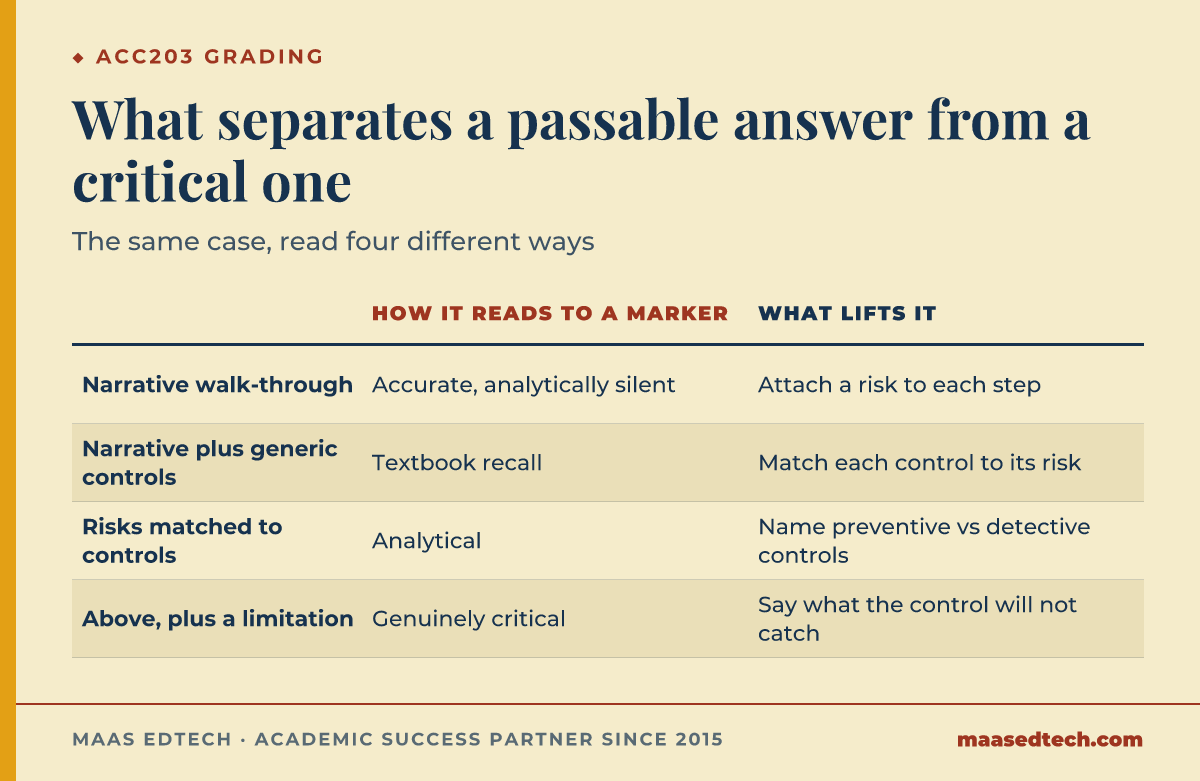
| What the submission contains | How it typically reads to a marker | What lifts it |
|---|---|---|
| A narrative walk-through of the cycle | Accurate, analytically silent | Attach a specific risk to each step, not a general one |
| Narrative plus a list of generic controls | Textbook recall | Say which control addresses which risk, and why that one |
| Risks, matched controls, and a stated rationale | Analytical | Distinguish preventive from detective controls and say which the client needs here |
| All of the above, plus a limitation | Genuinely critical | Name what the control will not catch, and what would |
Evidence: The subject's own middle section pairs computer crime and computer ethics with internal control, which is a deliberate ordering. Controls exist because of specific threats. A control listed without the threat it answers is an unattached fact, and unattached facts read as memorisation, the same failure mode that shows up when a submission names all 5 COSO components but never says which one the case actually breaks.
Example: Two students both recommended segregation of duties, the classic COSO control activity. The first stated it as a principle. The second said which two duties were currently combined in the case, named the specific fraud that combination permits, and added that a small firm may be unable to separate them, so a compensating control such as independent review of the payment run may be the realistic answer. The second student wrote three more sentences and moved up a band.
How do you write about internal control without sounding like a textbook?
Direct answer: By keeping the control tied to a consequence somebody can measure. The weakest submissions treat internal control as vocabulary to be reproduced, listing COSO Internal Control Framework categories without connecting any of them to the case in front of them. The strongest treat it as an argument about what a failure would cost.
Evidence: There is real research to draw on here, and it is more concrete than students expect. Mojtahedi and Zhou (2024) categorise information technology internal control material weaknesses and examine how their trends, associations and industry effects differ across sectors. Haislip et al. (2015) study the external reputational penalties that CEOs and CFOs face once their firm reports an IT-related material weakness. Neither finding is decoration. Both let you say that control failure has a measurable cost, rather than asserting that controls matter.
Example: A submission arguing for stronger access controls closed by saying controls protect the integrity of financial information. That sentence is true of every control ever written. Replacing it with a reference to how IT-related weaknesses get categorised and tracked across industries, and to the reputational consequences that follow disclosure, converted a platitude into a claim with evidence behind it.
What is the software component really testing?
Direct answer: Not whether you can operate the package. It is testing whether you can see the control implications of what the package does automatically and what it leaves to a human.
Evidence: This test of control implications is the subject's quiet link to the wider literature. Reviewing research on enterprise systems, Grabski, Leech and Schmidt write that "ERP and related integrated technologies are a transformative force on the accounting profession" (Grabski et al., 2011), and note that accounting expertise is increasingly called on to audit information systems and to implement management controls within them, the same territory that COBIT, the IT governance framework published by ISACA, was built to cover. They also observe that such systems support internal controls and audit trails to a greater extent than earlier departmental systems, while simultaneously enforcing business processes and restricting employee tasks. Both halves of that sentence are examinable. A system that enforces a process removes some risks and creates others, and the new risks tend to concentrate in who holds administrator rights.
Example: Asked to comment on a firm moving from spreadsheets to an ERP package, a weaker answer listed the benefits. A stronger one accepted the benefits, then pointed out that the audit trail is only as trustworthy as the access controls around it, and asked who in this small company would be able to edit configuration without review.
What does the e-business and data security focus expect?
Direct answer: It expects you to treat the boundary of the organisation as the risky part. Internal control over financial reporting, the standard that Sarbanes-Oxley Section 404 requires public companies to assess, was written for internal processes, and an e-business channel pushes the risk outside that boundary. Once transactions arrive from outside, controls that assumed an internal, trusted user stop being sufficient, and your answer should say so explicitly rather than importing internal-control language unchanged.
Evidence: The subject description names e-business and data security as a special focus alongside the transaction cycles, which signals that the cycles are expected to be discussed in a networked setting rather than an isolated one, close to what the Payment Card Industry Data Security Standard exists to police at the transaction level. In practical terms this means authentication, transmission integrity, and the question of what happens when a counterparty's system, not yours, is the one that fails.
Example: Discussing an online sales channel, one student applied the standard COSO revenue-cycle controls and stopped. Another applied them, then noted that customer credit assessment cannot rely on the personal knowledge a counter salesperson would have had, and proposed what would replace it.
A practical order of work
There is no single correct method, but this sequence tends to keep students out of the description trap:
- Identify the cycle and its subsystem boundaries before writing anything. Know where the process starts and where it hands over.
- Map who does what. Most assignment weaknesses are visible in the allocation of duties alone.
- For each step, write the risk before you write the control. Reversing this order is what produces generic control lists.
- Classify each control as preventive, detective or corrective, map it to a COSO component, and say why that mix suits this organisation's size.
- State one thing your recommendation will not fix. Markers read this as confidence, not weakness.
- Check your documentation conventions against your subject outline, not against an internet example, because notation standards differ between institutions.
Frequently asked questions
Do I need programming skills to pass ACC203?
No. The subject uses accounting software as a context for control questions, not as a development exercise. What you need is the discipline to ask, of every automated step, what it now guarantees and what it now assumes.
How much detail should a risk-and-control table contain?
Enough that each row is specific to the case in front of you, and named against a COSO component. A row that could be copied into any assignment about any company is a row that earns little. Tie the risk to a named step and the control to a named person or system.
Is it acceptable to cite a textbook rather than journal articles?
Follow your subject outline. Textbooks are appropriate for definitions and frameworks such as COSO, but a claim about how often control failures occur or what they cost is a claim about evidence, and it should be supported by a source that actually measured something, such as Mojtahedi and Zhou (2024) or Haislip et al. (2015).
My case study is a small business that cannot segregate duties. What do I write?
Say that directly, then propose compensating controls, such as independent owner review of the payment run. Recognising a constraint and working within it demonstrates judgement, whereas recommending an impossible structure suggests you have not read the case.
Does this subject overlap with auditing?
It borders on it. Auditing asks whether controls operated effectively over a period, this subject asks whether the right controls exist and make sense for the process, close to the categories Mojtahedi and Zhou (2024) work with when they classify IT-related material weaknesses. Keeping that distinction visible in your writing helps, because it stops you drifting into audit procedures that were not asked for.
Where MAAS fits
MAAS mentors work alongside students on subjects like this rather than in place of them. A typical session on an AIS assignment involves reading the case together, testing whether the risks you have identified are specific enough to defend, and pressure-testing the control recommendations against the constraints in the scenario. The writing stays yours. What changes is that somebody who has read a few hundred of these tells you which paragraph a marker will stop at. If that is useful, our academic support service and our tutoring service are the two places to start.
References
Grabski, S. V., Leech, S. A., & Schmidt, P. J. (2011). A review of ERP research: A future agenda for accounting information systems. Journal of Information Systems, 25(1), 37–78. https://doi.org/10.2308/jis.2011.25.1.37
Haislip, J. Z., Masli, A., Richardson, V. J., & Watson, M. W. (2015). External reputational penalties for CEOs and CFOs following information technology material weaknesses. International Journal of Accounting Information Systems, 17, 1–15. https://doi.org/10.1016/j.accinf.2015.01.002
Mojtahedi, A., & Zhou, L. (2024). Information technology internal control material weaknesses in financial reporting: Categories, trends, associations, and industry effects. International Journal of Accounting Information Systems, 53, 100679. https://doi.org/10.1016/j.accinf.2024.100679
Tools & resources
King's Own Institute. (n.d.). ACC203 Accounting Information Systems subject description. https://koi.edu.au/subject_descriptions/acc203-accounting-information-systems/