
Ask a marker on this module what separates the top band from the middle, and the answer will not be about networking knowledge. It will be about the difference between explaining how a technology works and judging whether it was the right one. A coursework submission that walks through Wi-Fi generations, cellular releases and video codecs in turn is readable, accurate, and capped, because engineering judgement under constraint is what the module actually assesses.
Author: MAAS Editorial Team
Last updated: 2026-08-10
Category: it-data

What is 7COM1076 and who takes it?
Direct answer: 7COM1076 Wireless Mobile and Multimedia Networking is a Level 7 module at the University of Hertfordshire worth 30 credits, taught in Semester A. It is an optional module on MSc Advanced Computer Science, sitting alongside 30-credit options such as Artificial Life with Robotics and, in Semester B, Neural Networks and Machine Learning.
Evidence: The programme specification the university publishes openly alongside its course pages tabulates every module by code, title, credit value, semester and optional-or-core status, and lists this one for the 2025-26 delivery. A UK master's runs to 180 credits under the national qualifications framework, split on this programme into 120 credits of taught modules across two semesters and a 60-credit project, so this single module already carries one sixth of the whole degree. Under the same national convention, 1 credit represents 10 notional hours of study, so 30 credits equates to roughly 300 hours of timetabled teaching, reading and coursework across a single semester of 15 weeks. The optional status has a consequence worth planning around. Because students assemble their own combination of 30-credit options, the cohort is small and mixed, and nobody can assume the marker will grade generously because networking is not their specialism. The programme outcome the module feeds is explicitly about covering at least two specialist topics of computer science to advanced depth. You chose this as one of your two. Depth is the expectation, not a bonus.
Example: One student picked the module because it looked like the most practical option on the list, then discovered in week three that "practical" at Level 7 meant reading standards documents and measurement studies rather than configuring equipment. The workload was not larger than she expected. It was a different shape.
A note on sources before you begin. Hertfordshire keeps its Definitive Module Documents behind a student login, so most of what circulates publicly under this code has been reposted by sites that sell coursework, frequently for a previous academic year. Your Canvas handbook is the only authority on this year's task, weighting and word count.
Why does a technology survey hit a ceiling?
Direct answer: Because a survey answers a question the module did not ask. Describing how OFDMA allocates subcarriers demonstrates that you read the material. Level 7 credit accrues when you show which constraint the design was solving, what it cost elsewhere, and how you would know whether the trade was worth making in a given deployment.
Evidence: The programme learning outcome mapped to this module asks students to use and critically evaluate a range of methods and tools employed in specialist topics of computer science to advanced depth. "Critically evaluate" is the operative phrase, and it is not satisfied by comparison tables of headline figures. The Quality Assurance Agency's Framework for Higher Education Qualifications, abbreviated FHEQ, describes master's-level attainment in the same terms, expecting a critical awareness of current problems at the forefront of a discipline and originality in applying knowledge (QAA, 2024). Describing how OFDMA allocates subcarriers among users, the scheduling method IEEE 802.11ax introduced when it was ratified in 2021, demonstrates that you read the standard. It does not yet show which deployment problem OFDMA was chosen to solve.
Example: A submission compared Wi-Fi and cellular for a campus deployment using peak throughput and nominal range, and concluded that one was superior. The claim collapsed on a single question about how the two behave when four hundred devices contend for the medium in one lecture hall, which is the condition the deployment actually faces. Contention behaviour, not peak rate, was the deciding variable, and the peak-rate table had been decorative all along.
What does a genuine evaluation look like here?
Direct answer: It names the constraint, states the metric that reveals it, gives evidence from measurement or standards, and admits where the evidence is thin. Wireless and multimedia networking is unusually well suited to this because its trade-offs are explicit rather than hidden.
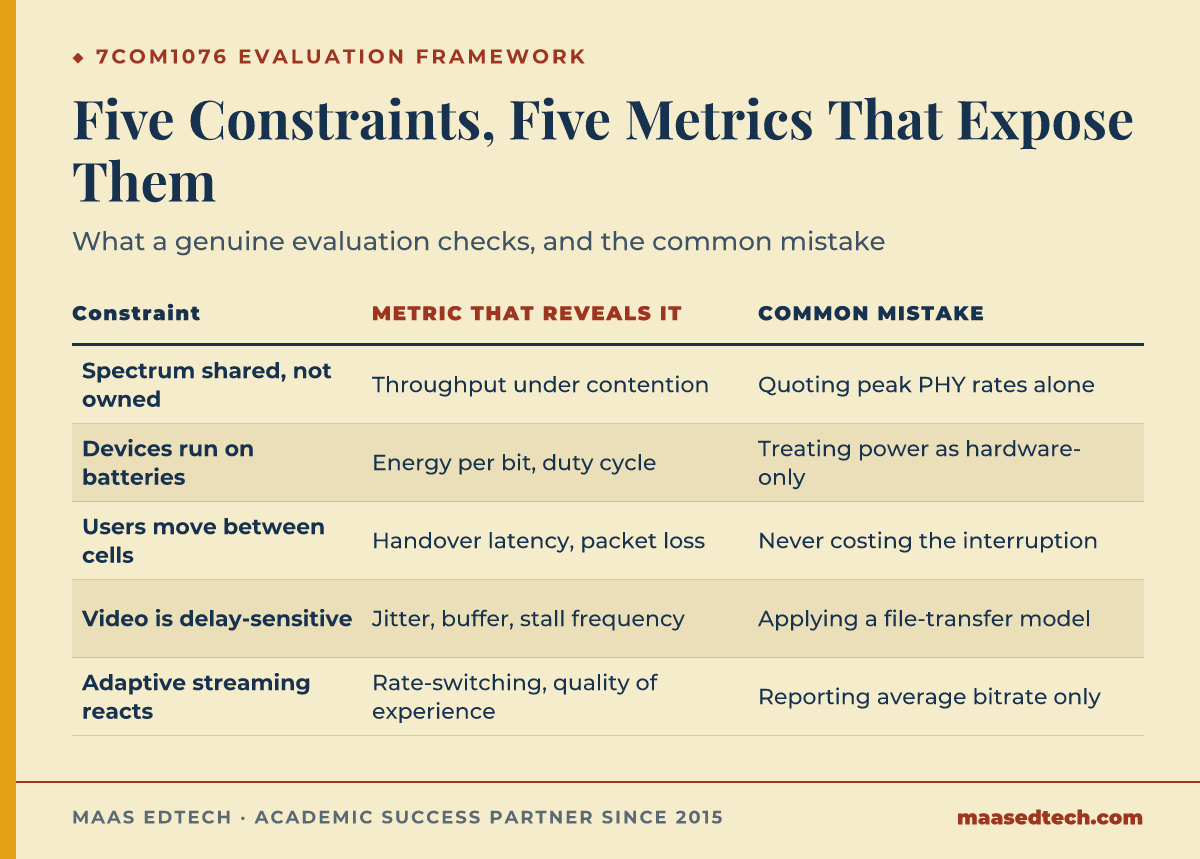
| Constraint in play | The metric that exposes it | Where submissions go wrong |
|---|---|---|
| Spectrum is shared, not owned | Throughput under contention and channel utilisation | Quoting peak PHY rates as if a single device had the medium to itself |
| Devices run on batteries | Energy per delivered bit, duty cycle | Treating power as a hardware problem rather than a protocol design variable |
| Users move between cells | Handover latency and packet loss during transition | Describing mobility management without ever costing the interruption |
| Video is delay-sensitive, not loss-intolerant | Jitter, buffer occupancy, stall frequency | Applying a file-transfer mental model, where any loss is a failure |
| Adaptive streaming reacts to what it measures | Rate-switching behaviour, quality of experience | Reporting average bitrate, which conceals the stalls users actually notice |
Evidence: The distinction in the last two rows carries more weight than students expect. Research on adaptive streaming has consistently found that user-perceived quality is dominated by stalls and by the frequency of quality switches rather than by mean bitrate (Seufert et al., 2015), which is why an evaluation built on averages can be numerically correct and practically misleading. On the wireless side, Gast (2013) sets out why contention-based access degrades in ways that headline figures never show, and Bianchi (2000) gives the analytical model that explains the degradation rather than merely reporting it, defining the mechanism at the centre of it plainly: "DCF is a carrier sense multiple access with collision avoidance (CSMA/CA) scheme with binary slotted exponential backoff" (Bianchi, 2000, p. 535). The spectrum-sharing, mobility and layered-protocol concepts behind every row in the table above are standard postgraduate subject matter, set out in Stallings (2016) for the wireless-specific mechanics and in Tanenbaum and Wetherall (2011) for the general network-layer reasoning that sits underneath them, so a submission that has not engaged with that baseline has skipped the foundation the comparison rests on.
Example: A student evaluating a video delivery design reported a comfortable mean bitrate and rated the system good. Prompted to look at the distribution instead of the mean, she found two stalls concentrated at the moment a large group joined. The mean had not moved. The user experience had, and so had the analysis, from description to argument.
How current do the sources have to be?
Direct answer: Current enough that your claims are still true, which in this field is a shorter window than in most modules you have taken. Wireless standards revise on a cycle of a few years, so a statement about "the latest" anything ages faster than the textbook it came from.
Evidence: Two source disciplines matter here and they are different. Primary standards documentation from bodies such as IEEE and 3GPP defines what a technology specifies; peer-reviewed measurement studies establish what it achieves in deployment. Confusing the two is a common and costly error, because a specification describes a ceiling under favourable assumptions, not an expectation. Where you cite a specified figure, say so, and separate it from measured performance rather than reporting both as the same kind of fact.
The revision cycle is a fact you can check rather than guess at. IEEE ratified 802.11n in 2009, 802.11ac in 2013, and 802.11ax, marketed by the Wi-Fi Alliance as Wi-Fi 6, in 2021. On the cellular side, 3GPP finalised Release 15, the first 5G New Radio specification, in 2018, with Release 16 following in 2020. The Federal Communications Commission opened the 6 GHz band for unlicensed use in April 2020, which is the regulatory step that made Wi-Fi 6E possible in the United States. A claim written against the 2013 generation and left uncorrected in 2026 coursework is not wrong because it was once true. It is wrong because it is no longer the current specification, and a marker checking the date will see the gap immediately.
The history behind the current generation is worth knowing precisely, because it explains why some claims that look outdated are still the correct citation. IEEE 802.11 was first published in 1997; 802.11a and 802.11b, both finalised in 1999, split the standard into a 5 GHz variant and a 2.4 GHz variant; and 802.11g, in 2003, brought higher throughput back to the 2.4 GHz band. On the cellular side, the Third Generation Partnership Project, known as 3GPP, was established in December 1998 as a partnership of regional standards bodies, and it is still the organisation that publishes every release cited above.
Example: A draft asserted a data rate for a wireless generation and cited a vendor product page. Two problems surfaced at once. The figure was the theoretical maximum under a channel width the deployment in question would never use, and the page had no author, no date and a commercial interest in the number. Replacing it with a measurement study lowered the number and raised the mark.
How should the coursework be structured?
Direct answer: Organise by decision, not by technology. A submission with one section per technology forces you into description, because each section has nothing to argue against. A submission organised around the questions the scenario poses forces comparison, because each section must resolve something.
Proportions that hold at Level 7: scenario and requirements, including the constraints you will hold the design to, roughly 15%; the evaluation framework, meaning which metrics you chose and why those reveal the constraints, roughly 20%; the comparative analysis itself, roughly 35%; the proposed design or recommendation with its justification, roughly 15%; and limitations, including the conditions under which your recommendation stops being right, roughly 15%.
Evidence: The assessment strategy published for the programme states that intellectual and practical skills are assessed through in-course assignments and the project, and that knowledge must be evidenced as applied within substantial independent work. A structure organised by technology invites you to recall; a structure organised by decision requires you to apply.
Example: One report devoted a section each to Wi-Fi, cellular, and a short-range standard, then closed with a paragraph recommending a hybrid. The three sections never referred to one another, so the recommendation arrived unsupported. Reorganising the same material under three deployment questions, covering dense indoor use, mobility across the site, and latency for a real-time stream, changed almost none of the content and produced a report that argued rather than recited.
Where do international students lose marks unnecessarily?
Direct answer: In hedging and attribution rather than in technical understanding. Students arriving from Vietnamese computing programmes are often precise about protocol mechanics and imprecise about how strongly a claim may be stated, which reads to a UK marker as a lapse in critical judgement rather than a language issue.
Evidence: The programme's transferable skill outcomes include evaluating and making critical use of relevant academic and technical literature, and explaining, justifying and defending your work in its specific details and within a broader context. Both are assessed. A confident sentence with no boundary on it fails the first; an unattributed figure fails the second.
Example: A sentence claiming that a protocol "always outperforms" its predecessor was revised, after some pushing, to say that it outperformed the predecessor in the dense-deployment scenario under discussion, that the advantage narrowed sharply at low device counts, and that the comparison rested on simulation rather than field measurement. The revision is longer, more cautious, and worth more marks, because a marker can now see exactly how far the writer is prepared to go.
What do MAAS mentors actually do on this module?
MAAS works as an academic advisor. On this module the most useful early conversation is usually about your evaluation framework, because a poorly chosen metric locks a submission into description before a word of analysis is written. After that, a mentor reads your draft against the module's learning outcomes, tests whether your sources support the strength of your claims, and points out where a section describes when it should be deciding. You write and submit your own work. Referencing and academic-integrity questions are handled inside that read rather than sold separately.
Frequently asked questions
Is 7COM1076 compulsory?
No. The published programme specification lists it as an optional Semester A module on MSc Advanced Computer Science. Check your own programme and year, since option lists are revised.
How many credits is it worth?
30 credits at Level 7, the same weight as the other large options on the programme and a quarter of the 120 credits of taught modules that make up a standard year.
Do I need a strong maths background?
You need to be comfortable reading and interpreting quantitative results, which is not the same as deriving them. Understanding why a measured throughput curve bends where it does matters more than reproducing the analysis that predicts the bend.
Can I use simulation results in my coursework?
Usually yes, and simulation is standard practice in this field. What matters is that you state your assumptions, note that simulated results are not field measurements, and avoid presenting a simulated figure with the confidence of an observed one.
How many references should I use?
Counting is the wrong measure. A submission that engages closely with 6 to 10 measurement studies and the relevant standards outperforms one that lists 30 sources in passing, and in this field currency matters as much as quantity: a study from the last 3 to 5 years carries more weight than an older one on a standard that has since been revised.
Is it acceptable to cite vendor documentation?
For what a product specifies, yes, with clear attribution. For what a technology achieves, no. Vendor material reports favourable conditions and rarely reports the conditions under which performance collapses, which is exactly the evidence a critical evaluation needs.
Related reading
- How to write a university report
- 7COM1025: why does working code still get a low mark?
- Data and coding project support from MAAS
Talk to a MAAS mentor about your module
References
Bianchi, G. (2000). Performance analysis of the IEEE 802.11 distributed coordination function. IEEE Journal on Selected Areas in Communications, 18(3), 535–547. https://doi.org/10.1109/49.840210
Gast, M. S. (2013). 802.11ac: A survival guide. O'Reilly Media.
Quality Assurance Agency for Higher Education. (2024). The frameworks for higher education qualifications of UK degree-awarding bodies. QAA. https://www.qaa.ac.uk/docs/qaa/quality-code/the-frameworks-for-higher-education-qualifications-of-uk-degree-awarding-bodies-2024.pdf
Seufert, M., Egger, S., Slanina, M., Zinner, T., Hossfeld, T., & Tran-Gia, P. (2015). A survey on quality of experience of HTTP adaptive streaming. IEEE Communications Surveys & Tutorials, 17(1), 469–492. https://doi.org/10.1109/COMST.2014.2360940
Stallings, W. (2016). Wireless communications and networks (2nd ed.). Pearson.
Tanenbaum, A. S., & Wetherall, D. J. (2011). Computer networks (5th ed.). Pearson.