
◆ IT & Data
INFO123: what do you do in a unit where using AI is a graded skill?
Across most of a business degree, generative AI sits in the space marked "be careful." In this course it appears in the learning outcomes as a skill you must master, alongside spreadsheets and databases. Two outcomes later you are asked to evaluate the ethics, privacy and governance problems the same technologies create. Holding both of those at once is the actual skill this course teaches, and it is not the one students expect to be assessed on.

◆ Section 1 / 7 · Your course
First, confirm which INFO123 you are enrolled in
Direct answer: This guide describes the University of Canterbury course INFO123 Business Information Systems and Technology, a 15-point course taught by the Department of Accounting and Information Systems. Semester One 2026 runs from 16 February to 21 June 2026, and the course is restricted against ACIS123, AFIS123 and AFIS124.
Evidence: The course page lists two lecture streams plus a computer-lab drop-in class, with online delivery options for both lectures. The lab sessions are described as drop-in rather than compulsory tutorials, which matters, because two of the assessed items are tool-based and the lab is where support for them lives.
Example: A student who read the drop-in label as optional did the Excel and database assignments alone at home, then spent longer on them than classmates who had brought half-finished work to the lab. Nothing was lost academically, but the time cost was real and avoidable.
◆ Section 2 / 7 · Course content
What is the course actually about?
Direct answer: Information systems examined through four components: people, process, technology and data. The course moves from what an information system is, through the specific systems that support business processes, to the harder questions about selecting, governing and living with them.
Evidence: The description names enterprise systems through to artificial intelligence, and explicitly includes security and ethical considerations alongside the technical material. Learning outcome 2 lists the systems by name, including collaboration systems, ERP, CRM, business analytics and AI. Outcome 4 asks you to evaluate critical issues in managing information systems, including the development process, information security, privacy, ethics and governance.
Example: Asked to discuss a CRM implementation, a student described the software's functions in detail and stopped. The stronger answer noted that most CRM failures are not software failures, and traced how a system that requires sales staff to log activity competes with the incentive structure those staff are actually paid against. Same system, examined through people and process rather than technology alone.
| Assessment | Weight | What it tests | Where students lose marks |
|---|---|---|---|
| Excel assignment | 7.5% | Working competence with spreadsheets | Leaving it late because the weight looks small |
| Database assignment | 7.5% | Designing and querying a data structure | Building tables without a model behind them |
| Project and video presentation | 25% | Communicating an IS argument to a business audience | Presenting the technology rather than the decision |
| Mid-semester test | 30% | Concepts and systems, without the tools | Revising by redoing lab work |
| Final exam | 30% | The whole course, connected | Studying outcomes separately |
◆ Section 3 / 7 · Weighting
Why the weighting misleads people
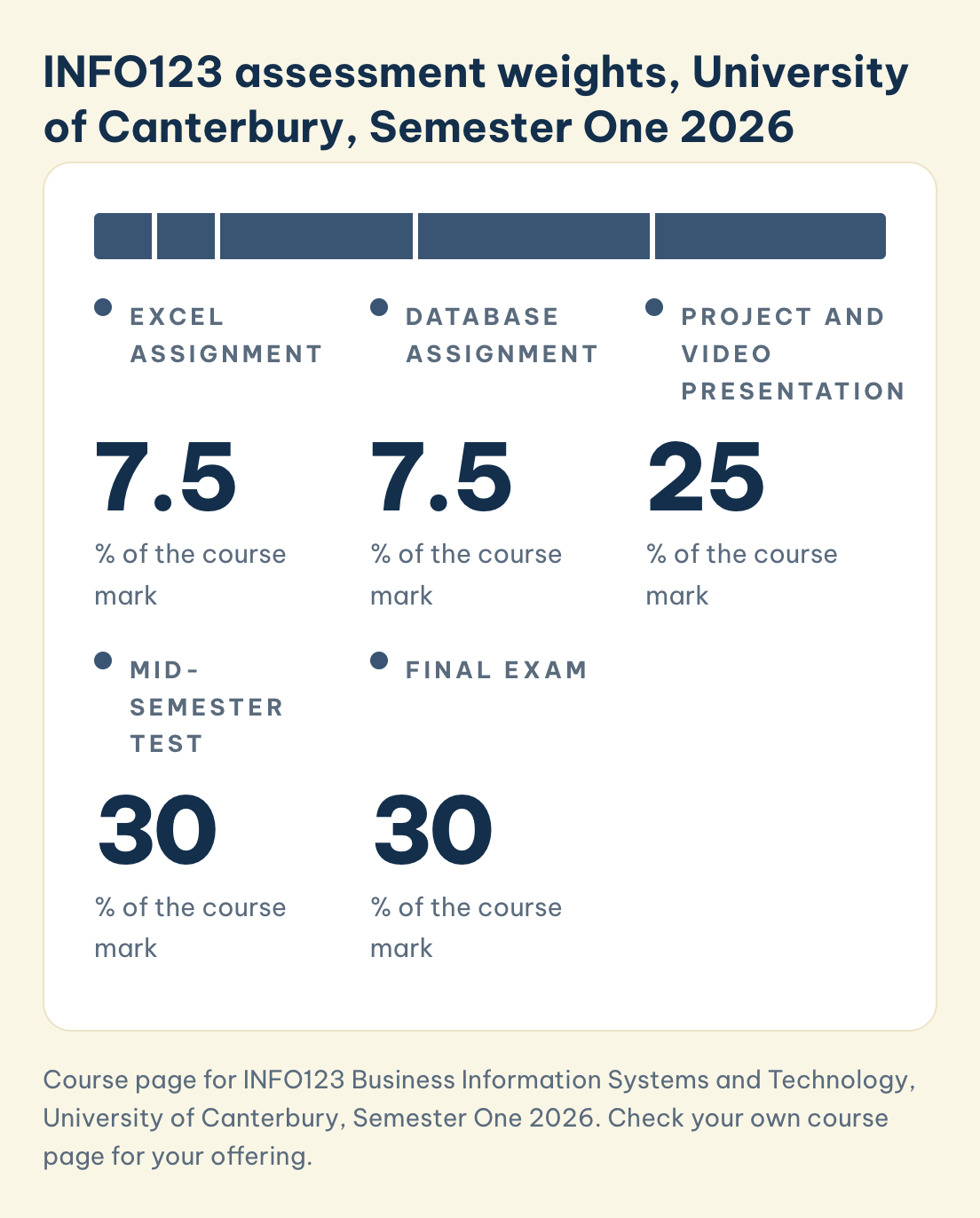
Direct answer: The two hands-on assignments are worth 15% between them, while the mid-semester test and final exam are worth 60% together. The course teaches through practical activity and assesses mainly through closed written work, so hours spent in the software are not proportional to marks available for it.
INFO123 assessment weights, University of Canterbury, Semester One 2026
Each part is one assessed item, and the five parts add up to 100%.
Excel assignment
7.5
% of the course mark
Database assignment
7.5
% of the course mark
Project and video presentation
25
% of the course mark
Mid-semester test
30
% of the course mark
Final exam
30
% of the course mark
Save this figure
Evidence: The stated outcomes make this coherent rather than unfair. Only outcomes 6 and 7 are about operating tools. Outcomes 1 to 5 are about explaining, analysing, identifying, evaluating and assessing, all of which are written verbs. The examinable version of this course is the reasoning, and the tools are how you build an intuition for it.
Example: A student who could produce a competent pivot table found the test question about when analytics changes a business decision much harder, because she had practised the operation without ever articulating its purpose. The fix was small: after each lab, write two sentences on what the technique would let a manager decide.
◆ Section 4 / 7 · Generative AI
The part students are least prepared for
Direct answer: Learning outcome 7 asks you to develop proficiency in business productivity tools "such as presentation software, spreadsheets, data analytics tools, database applications, and generative AI assistants". In this course, using generative AI is a listed competency rather than a risk to be managed.
Evidence: Outcome 4 sits in the same list and asks you to evaluate critical issues including information security, privacy, ethics and governance. The course is therefore asking for fluency and scepticism together. Dwivedi et al. (2023), writing in the information systems literature itself, set out exactly this double position: generative AI offers substantial capability while raising ethical and legal problems that the same professionals have to reason about. In the paper's own abstract, the authors write that “nevertheless, they also consider its limitations, disruptions to practices, threats to privacy and security, and consequences of biases, misuse, and misinformation” (Dwivedi et al., 2023, p. 3).
Example: In a project on a customer analytics platform, a student used an AI assistant to draft her explanation of how the platform's recommendations were produced. The explanation was fluent and slightly wrong, and she did not catch it because she had used the tool at the point where her own understanding was thinnest. That is the failure mode worth naming in the course's own vocabulary.
How to hold both at once. Bearman and Ajjawi (2023) argue that working with artificial intelligence means learning to act sensibly around systems whose inner workings you cannot inspect, which requires knowing what the system is likely to be good and bad at rather than trusting or refusing it wholesale. Applied here: use the assistant where you can check the output, and not where you cannot.
A caution that costs nothing to observe. This course treating AI use as a taught competency does not mean every other course in your degree does. Assessment rules are set per course, so read each one's own statement rather than generalising from this one.
◆ Section 5 / 7 · Easy to skip
The outcome that is easiest to skip
Direct answer: Outcome 3 asks you to identify how digital innovation and the business models associated with emerging technologies, ecosystems and platforms transform and create value in organisations and society. It is the only outcome that looks outward past the single firm, and it is the one students most often leave until the night before a test.
Evidence: The other outcomes can be revised from a system description. This one cannot, because a platform business model is not a system you can draw. It is an arrangement in which value comes from connecting parties rather than from producing something, and the analysis has to account for who joins first and why anyone stays.
Example: Asked why a marketplace beat a competitor with better software, a student pointed to features. The stronger answer observed that the marketplace had solved the problem of getting the first sellers on board before buyers existed, which is a business model question rather than a technology one, and no amount of feature comparison reaches it.
Keep two or three real examples of platform or ecosystem businesses ready, with one sentence each on where their value actually comes from. That is usually enough to convert a vague answer into a specific one.
◆ Section 6 / 7 · The project
The project and video presentation
Direct answer: At 25% this is the largest single non-examined component, and outcome 8 defines it precisely: creating and delivering a professional presentation tailored to information systems and business audiences, using digital presentation tools.
Evidence: The phrase "tailored to IS and business audiences" is doing real work. A business audience does not want the architecture. It wants to know what changes, what it costs, and what could go wrong. The outcome is about the fit between the message and the listener, not about the depth of the technical content.
Example: Two video presentations covered the same ERP case. The weaker one walked through modules and integration points for most of its length. The stronger one opened with the process that was breaking, showed what the system would change about it, and named the two risks that would decide whether the implementation succeeded. The second contained less information and communicated more.
Because it is a video rather than a live talk, the temptation is to script it densely and read. Recording lets you edit, so use that to cut rather than to add.
◆ Section 7 / 7 · Six habits
Six things worth doing in this course
- Read the restriction line before enrolling. ACIS123, AFIS123 and AFIS124 are restricted against this course.
- Take the tool assignments to the drop-in labs, even though they are only 7.5% each. The support is free and the time saving is large.
- After every lab, write two sentences on what the technique would let a manager decide. That is the tested version of the skill.
- Use an AI assistant where you can verify the output and avoid it where you cannot. Fluency and scepticism are both assessed here.
- For the video, decide who the audience is before deciding what to include, then cut everything that does not serve them.
- Revise outcomes 1 to 5 as one connected argument rather than five separate topics. Sixty percent of the mark sits in written reasoning across them.
Frequently asked questions
Does INFO123 have an exam?
Yes. The Semester One 2026 breakdown is an Excel assignment at 7.5%, a database assignment at 7.5%, a project and video presentation at 25%, a mid-semester test at 30% and a final exam at 30%.
Am I really allowed to use generative AI in this course?
The learning outcomes list generative AI assistants among the productivity tools you should become proficient with. That said, the rules that apply to any specific assessment are set in that assessment's own instructions, so read them rather than assuming a blanket permission.
Do I need a technical background?
No. This is a 100-level course introducing information systems to business students, and the tool work is taught rather than assumed. The computer lab drop-in sessions exist to support exactly that.
What are ACIS123, AFIS123 and AFIS124?
They are listed as restrictions, meaning the university treats them as covering equivalent material and you cannot count them together with INFO123.
How should I prepare for a test on practical material?
By explaining the practical material in writing. The examined outcomes are about explaining, analysing and evaluating, so revision that only repeats the lab exercises prepares you for the smaller part of the assessment.
Where MAAS fits
MAAS mentors work alongside students in courses like this rather than in place of them. Where a course asks you to be capable with a technology and critical about it in the same semester, the useful thing a mentor does is press on the second half: asking how you know an output is right, until checking becomes a habit rather than an afterthought. The work stays yours. If that is useful, our academic support service and our tutoring service are the two places to start.
References
Bearman, M., & Ajjawi, R. (2023). Learning to work with the black box: Pedagogy for a world with artificial intelligence. British Journal of Educational Technology, 54(5), 1160–1173. https://doi.org/10.1111/bjet.13337
Dwivedi, Y. K., Kshetri, N., Hughes, L., Slade, E. L., Jeyaraj, A., Kar, A. K., Baabdullah, A. M., Koohang, A., Raghavan, V., Ahuja, M., & Albanna, H. (2023). Opinion paper: "So what if ChatGPT wrote it?" Multidisciplinary perspectives on opportunities, challenges and implications of generative conversational AI for research, practice and policy. International Journal of Information Management, 71, 102642. https://doi.org/10.1016/j.ijinfomgt.2023.102642
Tools & resources
University of Canterbury. (2026). INFO123 Business Information Systems and Technology. https://courseinfo.canterbury.ac.nz/GetCourseDetails.aspx?course=INFO123
A free 20-minute consultation is a conversation about where you are with INFO123.
Book a free consultation ▸