
◆ Economics
ECON3440: what happens when the yardstick itself is disputed?
Most third-year economics courses ask you to apply a model correctly. Competition policy asks something harder: before you can say whether a merger or a pricing practice was harmful, you have to say what "harmful" means, and the profession has not settled that question. The course sits on a live disagreement about what competition law is for, and students who do best usually notice this early rather than memorising the most cases.

◆ Section 1 / 7 · Which course
First, confirm which ECON3440 you are enrolled in
Direct answer: This guide describes the University of Queensland unit, ECON3440 Competition Policy and Regulation, a 2-unit course taught in person at St Lucia by the School of Economics. The same code exists at Georgia College and at Graceland University in the United States, where it is an international economics course, which is an entirely different subject.
Evidence: The UQ course profile states the prerequisite as ECON2010 or ECON2011 or ECON2410, recommends ECON2030, and marks the course incompatible with ECON7430, the postgraduate version. None of that structure carries over to the American courses sharing the code.
Example: A student revising from material found by searching the bare code worked through several chapters on trade theory before realising his own course had never mentioned comparative advantage. The material was sound. It belonged to a different curriculum.
◆ Section 2 / 7 · What is assessed
What is the course actually assessing?
Direct answer: Three online take-home tests worth 25% each, and one individual essay of 1000 words worth the remaining 25%. That distribution matters more than it looks, because it means three quarters of your mark comes from timed recall and application, while the entire writing component is compressed into a single short piece.
Evidence: The Semester 1 profile schedules the tests across the teaching period and places the essay near the end, after the case material has been covered. The late submission penalty is 10% of the maximum possible mark per 24 hours, for up to 7 days.
Example: A student who treated the essay as the small component, because it was only a quarter and only a thousand words, submitted a piece that spent 400 words summarising a case before it reached its first argument. The summary was accurate and it cost him the top band, because at that length a description-heavy opening leaves no room for the analysis the criterion rewards.
| Assessment | Weight | What it really tests | Where students lose marks |
|---|---|---|---|
| Take Home Test 1 | 25% | Whether the theory is fluent enough to use under time pressure | Recognising the model but not the market condition that triggers it |
| Take Home Test 2 | 25% | Applying regulatory theory to a described industry | Naming a remedy before diagnosing the problem |
| Take Home Test 3 | 25% | Integrating policy and theory across the semester | Treating each topic as a separate box |
| Essay, 1000 words | 25% | Sustained argument on a real case | Description crowding out evaluation |
◆ Section 3 / 7 · Short word count
Why is 1000 words harder than 3000?
Direct answer: Because a short word count removes your ability to be comprehensive, and forces you to choose. At 3000 words you can describe the market, set out the law, summarise the decision and then evaluate it. At 1000 you cannot, so the essay becomes a test of judgement about what to leave out, and most students leave out the wrong thing.
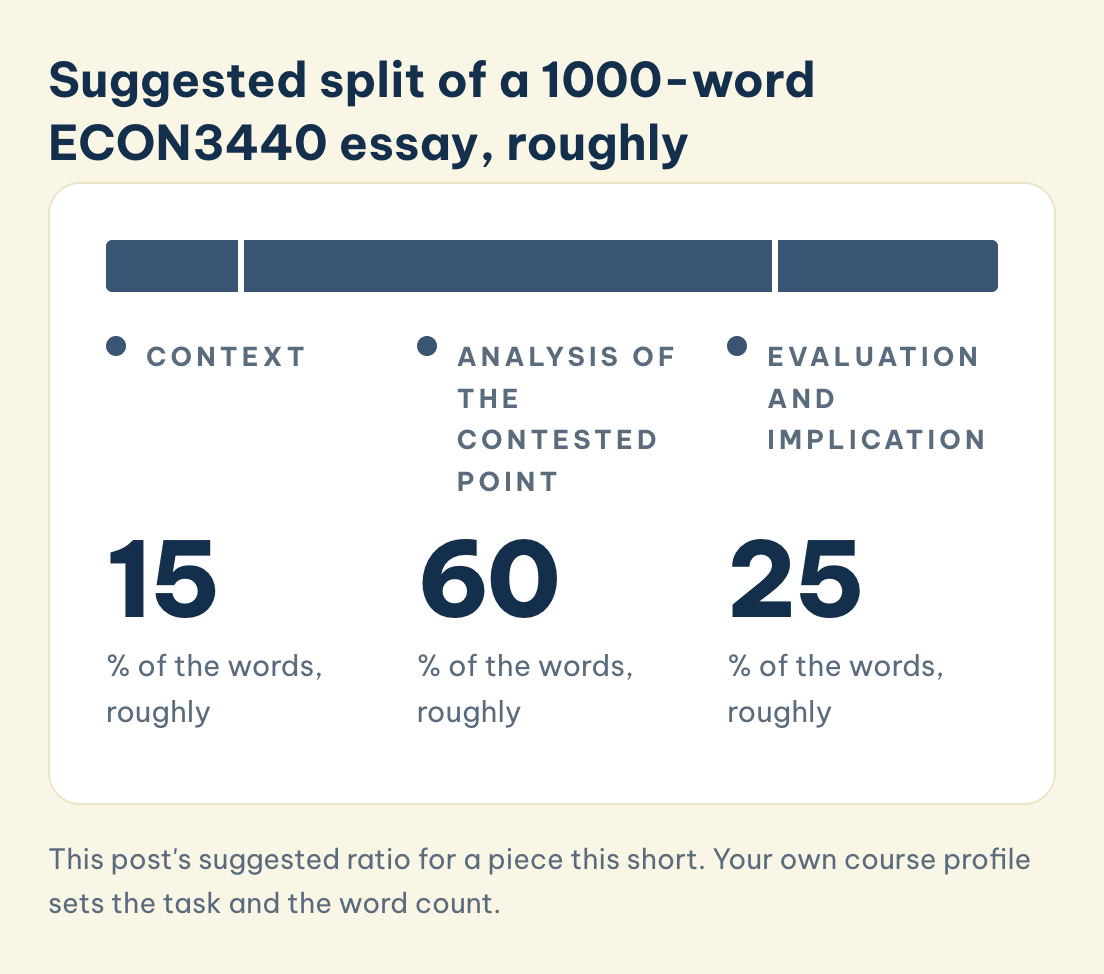
Suggested split of a 1000-word ECON3440 essay, roughly
These shares are a practical ratio suggested in this post, not a requirement from the university.
Context
15
% of the words, roughly
Analysis of the contested point
60
% of the words, roughly
Evaluation and implication
25
% of the words, roughly
Save this figure
Evidence: The learning outcomes ask you to describe and critically examine policy issues, and to summarise and critically evaluate real-world cases. Notice that in both, the summarising verb is paired with a critical one. The pairing is the instruction: the summary exists to make the evaluation possible, not to stand on its own.
Example: Two essays on the same ACCC matter were compared in a mentoring session. The weaker one gave a fair, complete account of the facts and then asserted in its final paragraph that the decision was correct. The stronger one gave three sentences of facts, identified the single contested question the decision turned on, and spent the remaining space arguing about that question. The second student knew less about the case and wrote a better essay.
A practical ratio for a piece this short is roughly 15% context, 60% analysis of the contested point, 25% evaluation and implication. If your context section is longer than 200 words, something is being described that could be assumed.
◆ Section 4 / 7 · The disagreement
The disagreement you are expected to notice
Direct answer: Competition policy has no single agreed objective. The dominant framework is the consumer welfare standard, which asks whether conduct harms consumers, but it is contested from several directions at once, and the course expects you to be aware that your evaluation rests on a choice of standard rather than on a neutral fact.
Evidence: Vickers (2025) defends the consumer welfare standard against recent criticism, distinguishing it from a total welfare standard that would include producer profits, and arguing that consumer welfare works better as a regulatory objective precisely because firms are not themselves pursuing total welfare. The image Vickers borrows to make the point is not his own. It comes from Farrell and Katz: "If you want to travel north-east and firms always push eastwards, there is something to be said for someone adding a northerly force" (Farrell & Katz, 2006, as cited in Vickers, 2025). That defence is only necessary because the standard is under sustained attack, including from those who would have competition law pursue labour market outcomes, environmental goals or distributive aims. The modern version of that attack echoes an older one. Bork (1978) argued in The Antitrust Paradox that US antitrust enforcement had drifted from consumer welfare toward protecting competitors, and the consumer welfare standard the course now asks you to apply was itself a response to that critique, not a starting assumption nobody has ever questioned.
Example: A student asked to evaluate a merger clearance argued that the merger was harmful because a competitor exited and concentration rose. A marker's response was to ask which standard that argument assumed, since under a consumer welfare standard the exit of a rival is not harm at all unless prices, quality, choice or innovation worsen. The student had assumed a competitive-process standard without knowing there was another one.
How to use this in an answer. Name the standard you are applying in a single clause, apply it consistently, and then, if you have room, note what the answer would look like under the alternative. That last move is what separates a critical answer from a competent one, because it shows the conclusion was reached rather than assumed.
◆ Section 5 / 7 · Regulation
Regulation is the other half, and it has its own unsettled question
Direct answer: The second strand of the course concerns regulation in infrastructure and network industries, where the underlying question is not whether to regulate but whether and how to introduce competition into an industry that was regulated because competition was thought impossible.
Evidence: Armstrong and Sappington (2006) survey exactly this problem, and their central distinction is between procompetitive and anticompetitive liberalisation, which is a warning that introducing competition is not automatically beneficial. Access pricing, vertical separation and the treatment of legacy assets are the places where a liberalisation programme succeeds or fails.
Example: In a question on electricity network access, a student proposed marginal cost access pricing because it was efficient. The proposal ignored that the network then fails to recover its fixed costs, which is the whole reason access pricing is difficult. Efficiency was the right criterion and the wrong single criterion.
◆ Section 6 / 7 · Australian law
Australia's own moving target
Direct answer: The Australian legal framework has shifted within recent memory, and a case decided before the shift may not tell you what the law now requires. Section 46 of the Competition and Consumer Act 2010 was amended with effect from 6 November 2017, following the Harper review, so that a firm with a substantial degree of market power is prohibited from conduct having the purpose, effect or likely effect of substantially lessening competition.
Evidence: The amendment removed the previous requirement to show that the firm had taken advantage of its market power, and introduced an effects test, so that anticompetitive purpose no longer has to be proved. The older jurisprudence turned on the take-advantage limb, which the current provision does not contain. The Act itself carries an older name in most of that jurisprudence: it operated as the Trade Practices Act 1974 for 36 years before being renamed the Competition and Consumer Act 2010, effective from 1 January 2011, and the regulator enforcing it, the ACCC, was itself only formed in 1995 from the merger of two earlier bodies. A case citing the Trade Practices Act by name is not necessarily wrong, but it is citing the Act under its old title.
Example: An essay that leaned on a well-known pre-2017 decision to argue what section 46 requires was accurate about the case and wrong about the law. Where you use older authority, say what it was decided under and why it still illuminates the point, or choose different authority.
This account of section 46 is a description of how the provision is framed for the purpose of economic analysis, not legal advice. Where a question turns on legal interpretation, work from your course materials and the ACCC's own guidance.
◆ Section 7 / 7 · Six things
Six things worth doing in this unit
- Read the course profile's incompatibility line before you enrol. ECON7430 covers the same ground at postgraduate level and you cannot count both.
- Refresh calculus and algebra before week one rather than during it. The course profile says explicitly that it makes extensive use of mathematical models and expects you to be comfortable using or learning calculus.
- Keep a one-page log of every case covered, recording only the contested question each turned on. Facts you can look up; the contested question is the reusable part.
- Practise writing the same argument at 1000 words and at 400. The compression teaches you what your argument actually needs.
- In every regulatory answer, state the market failure before the remedy. Reversing the order produces recommendations with no diagnosis behind them.
- Before submitting the essay, mark every sentence as description, analysis or evaluation. If description exceeds a fifth of the piece, cut it.
Frequently asked questions
How much mathematics does ECON3440 assume?
The course profile states that it makes extensive use of mathematical models and expects students to be comfortable using or learning calculus and algebra. It also expects second-year economics to be complete, with ECON2010, ECON2011 or ECON2410 as the formal prerequisite.
Can I take ECON3440 and ECON7430?
No. The course profile lists ECON7430 as incompatible, which means the university treats the two as covering equivalent ground at different levels.
What makes a competition policy essay critical rather than descriptive?
Naming the standard your evaluation applies, and showing what would change under a different one. An essay that reaches a verdict without saying what the verdict was measured against has described a case rather than assessed it.
Should I cite academic literature in a 1000-word essay?
Check the assessment instructions in your course profile, since expectations differ by task. Where secondary literature is permitted, 1 or 2 sources used to frame the contested question do more work than 5 sources cited in passing.
Are older Australian cases still useful after the 2017 amendment?
They can be, provided you say what provision they were decided under. Section 46 changed on 6 November 2017, and an argument that treats pre-amendment reasoning as current law will be marked down on accuracy rather than on style.
Where MAAS fits
MAAS mentors work alongside students in units like this rather than in place of them. In a course where three quarters of the mark comes from timed tests and the writing is compressed into a thousand words, the two most useful things a mentor does are to check that your theory is fluent enough to survive time pressure, and to push on your essay until it names the standard it is arguing from. The work stays yours. If that is useful, our academic support service and our tutoring service are the two places to start.
References
Bork, R. H. (1978). The antitrust paradox: A policy at war with itself. Basic Books.
Armstrong, M., & Sappington, D. E. M. (2006). Regulation, competition, and liberalization. Journal of Economic Literature, 44(2), 325–366. https://doi.org/10.1257/jel.44.2.325
Vickers, J. (2025). Competition policy and the consumer welfare standard. Journal of Antitrust Enforcement, 13(1), 6–16. https://doi.org/10.1093/jaenfo/jnae038
Tools & resources
Australian Competition and Consumer Commission. (n.d.). Guidelines on misuse of market power. https://www.accc.gov.au/about-us/publications/guidelines-on-misuse-of-market-power
The University of Queensland. (n.d.). ECON3440: Competition Policy and Regulation course profile. https://course-profiles.uq.edu.au/course-profiles/ECON3440-20894-7520
A free 20-minute consultation is a conversation about where you are with ECON3440.
Book a free consultation ▸