
BBL2033 Operations Management asks you to analyse how an organisation turns inputs into products and services, and the rubric rewards the reasoning behind your calculations, not the calculations alone. Most students who lose marks here can compute a capacity figure or an economic order quantity, but they never connect that number to a strategic decision or a performance trade-off. This guide answers the seven questions Vietnamese students ask MAAS mentors most often before they start a BBL2033 assignment.
Author: MAAS Editorial Team
Last updated: 2026-07-23
Category: business-management

What is BBL2033 Operations Management about?
Direct answer: BBL2033 is an operations management course that examines how organisations design, plan, and control the processes that transform inputs, materials, labour, information, into finished goods and services. Dominant topics are operations strategy, process and layout design, capacity planning, inventory management, quality management, and supply chain coordination. It wants you to think like an operations manager who makes trade-offs.
Evidence: Courses of this type map closely onto the canon set out by Slack, Brandon-Jones and Johnston (2019), Heizer, Render and Munson (2020), and Stevenson (2021): the transformation model, the four Vs of operations (volume, variety, variation, visibility), and the five performance objectives (quality, speed, dependability, flexibility, cost). These are the examinable spine, and the marking criteria reward the ability to apply them to a real operation far more than they reward recall.
Example: A Vietnamese student came to MAAS convinced BBL2033 was "just formulas and diagrams". Her mentor reframed it: every operations decision buys one performance objective at the expense of another, and the assignment is about arguing that trade-off. Once she began writing one sentence about the trade-off beside each calculation, her analysis marks moved from a Pass level to a Distinction, because the marker could finally see the managerial judgement behind the numbers.
What assessment does the BBL2033 assignment usually involve?
Direct answer: Operations management courses at this level are typically assessed through a case-based report or analytical assignment, often supported by a set of quantitative problems (capacity, inventory, forecasting, process analysis). You are usually asked to analyse a real or given organisation's operations, diagnose an inefficiency or a performance gap, and recommend evidence-based improvements. Always confirm the exact brief, weighting, and reference style in your own course shell, because structure changes by campus and semester.
Evidence: Business-school operations assessments are criterion-referenced (Heizer, Render and Munson, 2020), meaning your work is marked against published rubric criteria rather than ranked against classmates. This is why a correct EOQ or capacity calculation with no interpretation still stalls in the middle bands: the criteria reward the analysis and recommendation that the number supports, not the arithmetic on its own.
Example: A student submitted a set of perfectly solved inventory problems and expected a High Distinction. He earned a Credit. His MAAS mentor showed him the rubric line that awarded marks for "application to the organisation and justified recommendations", a line he had left almost blank. The calculations were never the problem; the missing interpretation was.
How is the BBL2033 assignment graded, what does the rubric actually reward?
Direct answer: BBL2033 rubrics at this level reward four things, in roughly this order: (1) correct and explicit use of operations concepts and frameworks, (2) depth of critical analysis linking the concept to the organisation, (3) practical, justified recommendations with their trade-offs acknowledged, and (4) clear academic writing and referencing. Description of what an operation does earns almost no marks on its own; marks live in why it works that way and whether it should. The jump from Credit to Distinction is almost always the word "critical", not more content.
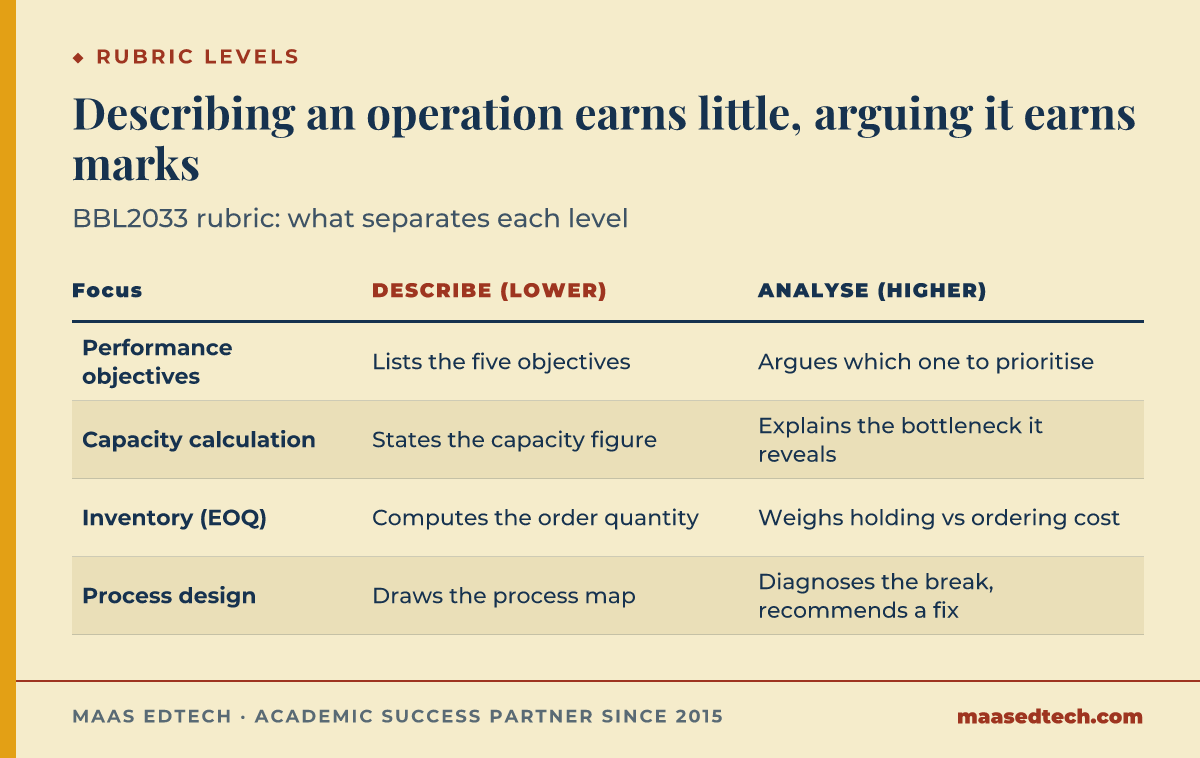
Evidence: Business rubrics use criterion bands (Pass / Credit / Distinction / High Distinction), consistent with the analytical emphasis Slack, Brandon-Jones and Johnston (2019) place on operations decision-making, and the higher bands are defined by evaluative language, "critically evaluates", "justifies with reference to theory", "analyses trade-offs". A student who only describes a process, or who calculates without interpreting, cannot reach those bands however tidy the work.
| Rubric focus | Describe (lower band) | Analyse and justify (higher band) |
|---|---|---|
| Performance objectives | Lists the five objectives | Argues which objective the operation should prioritise and why |
| Capacity calculation | States the capacity figure | Explains what the figure means for the bottleneck and the decision |
| Inventory (EOQ) | Computes the order quantity | Evaluates the trade-off between holding and ordering cost |
| Process design | Draws the process map | Diagnoses where flow breaks and recommends a justified fix |
The logic behind that trade-off goes back to the paper that first derived the EOQ formula: "Carrying a large stock means a lot of money tied up and a heavy depreciation." (Harris, 1913/1990, p. 947)
Example: A MAAS mentor colour-coded a student's draft, green for a sentence that interpreted a result, red for a bare calculation or description. The draft was mostly red. After one pass that added a single interpreting clause to each result, "which means the packing station is the bottleneck limiting throughput", the same work moved up two full bands.
Which operations frameworks should you use in BBL2033?
Direct answer: Anchor your analysis in two or three established frameworks rather than name-dropping many. The most useful for BBL2033 are: the transformation (input-process-output) model to describe the operation, the five performance objectives to evaluate it, the four Vs to explain why it is designed the way it is, and, for improvement, a lens such as lean thinking (Womack & Jones, 2003), which traces back to the Toyota Production System, Total Quality Management, or the theory of constraints (Goldratt & Cox, 2016). Pick the frameworks that fit your case operation's actual situation; do not force all of them in.
Evidence: These frameworks are examiner-recognised, drawn from Slack, Brandon-Jones and Johnston (2019) and Stevenson (2021), because they are analytical, not merely descriptive. The five performance objectives, for instance, are only useful when you argue a priority among them, an operation cannot maximise speed, flexibility, and cost simultaneously, so the interesting work is defending which objective the operation should lead on.
Example: A Vietnamese student analysing a coffee chain's operations tried to apply six frameworks and explained each shallowly. Her MAAS mentor cut it to two, the four Vs to explain why the chain runs a high-volume, low-variety model, and the performance objectives to argue that speed and dependability should lead. Fewer frameworks, deeper application, higher mark.
How should you structure the BBL2033 report?
Direct answer: Use an analysis-led structure: (1) brief introduction and operation context (keep it under 10% of the word count, typically 150 to 250 words in a 2,000-word report), (2) diagnosis of the specific operations problem or performance gap, (3) analysis of that problem using your chosen frameworks and any supporting calculations, (4) justified recommendations with their trade-offs, (5) conclusion. The single biggest structural fix is shrinking the description and expanding the analysis and recommendation sections, where the marks concentrate.
Evidence: The higher rubric bands reward "logical, well-supported reasoning", which is exactly what a diagnosis-analysis-recommendation structure produces. It also protects you against the most common failure in operations assignments: a correct calculation sitting in isolation, with no argument telling the marker what it means for the operation.
Example: A student's operations report was a sequence of solved problems with no narrative. His mentor kept the numbers untouched but added a short interpretation before each, what the problem was and what the result implied for the operation. The content did not change; the readability and the mark both jumped, because the marker could finally follow the argument.
What are the most common mistakes Vietnamese students make in BBL2033?
Direct answer: The recurring mistakes are: calculating without interpreting (a correct EOQ or capacity figure with no managerial meaning); describing a process instead of diagnosing where it fails; listing all five performance objectives without arguing a priority; recommending "improvements" with no acknowledgement of their trade-offs; and drawing a process map that is decorative rather than analytical. Each of these is a marks-loser even when the technical work is correct.
Evidence: Because the subject is criterion-referenced and analytical (Slack, Brandon-Jones and Johnston, 2019), the marker penalises unlinked calculation and undefended recommendation, and rewards the reasoning that connects a number to a decision. A student who computes a bottleneck's capacity but never says what to do about it has done the mechanics without earning the analysis marks.
Example: A Vietnamese student calculated the correct cycle time for every workstation but never identified the bottleneck or its consequence for throughput. His MAAS mentor did not do the analysis for him; he asked one question, "which station sets the pace of the whole line, and what does that cost you?", and let the student reason to the answer himself. The insight stuck because he arrived at it.
How can a MAAS mentor help you approach BBL2033 without crossing the line?
Direct answer: A MAAS mentor works alongside you, not instead of you. The mentor helps you decode the brief and rubric, walks you through a framework until you can apply it to your own case, reviews a draft and points to where interpretation is thin, and models how an operations manager argues a trade-off. You keep authorship of every calculation and every sentence; the mentor raises the ceiling of what you can defend on your own.
Evidence: Because BBL2033 is graded on justified analysis rather than answer-matching, the durable gain comes from understanding the transformation model, the performance objectives (Stevenson, 2021), and the improvement logic well enough to reapply them in an exam or a job. Coaching that builds that reasoning is what moves marks and, more importantly, what survives the semester.
Example: A Vietnamese student arrived able to solve operations problems but unable to explain what any of them meant. Over a few sessions his MAAS mentor had him narrate each result aloud, what it implied for the operation and what he would decide, until the interpretation became automatic. He wrote and submitted the assignment himself. The mark rose, and so did his confidence walking into the final exam.
Frequently asked questions
Is BBL2033 Operations Management hard for international students?
The calculations are manageable; the difficulty is interpretation. Many international students solve the quantitative problems but lose marks because they never link a result to a managerial decision. Building the habit of writing one interpreting sentence per result closes most of that gap.
Which frameworks matter most in BBL2033?
The core set is usually the transformation model, the four Vs, the five performance objectives, and one improvement lens, lean thinking (Womack & Jones, 2003), Six Sigma, or the theory of constraints (Goldratt & Cox, 2016). Confirm the emphasis in your own course outline.
What is the difference between describing and analysing an operation?
Describing states what the operation does; analysing explains why it is designed that way, what trade-off it makes, and whether it should. The higher rubric bands are reached only through analysis, so replace a descriptive sentence with an analytical one wherever you can.
Does MAAS write the BBL2033 assignment for me?
No. MAAS provides mentoring and review. A mentor helps you decode the rubric, understand the frameworks, and strengthen your own draft, but you remain the author of every calculation and explanation you submit.
How long should the report be?
Follow your own brief. Operations reports reward tight, well-argued analysis over length. If you are padding operation description to hit a word count, you are spending words where marks are thin.
Can I use MAAS if I only need help with the calculations?
Yes. Many students book a short session to work through capacity, inventory, or process analysis until they can interpret the results independently, then complete the assignment on their own.
How MAAS mentors support BBL2033 students
If you are approaching a BBL2033 Operations Management assignment and want a clearer path, MAAS offers a free 20-minute consultation to review your brief and map your approach. Bring your assignment brief and we will match you with a subject mentor within 48 hours when our network already covers that field. If it does not, MAAS opens a dedicated recruitment round for your case, which usually takes about 2 weeks. Around 23% of MAAS experts hold a PhD, and our operations mentors are experienced practitioners who work with you to raise what you can defend on your own, never to write the work for you.
Related reading: see our guide to how assignment rubrics reward analysis over description and our academic support service for how mentoring works end to end.
References
Slack, N., Brandon-Jones, A., & Johnston, R. (2019). Operations management (9th ed.). Pearson.
Heizer, J., Render, B., & Munson, C. (2020). Operations management: Sustainability and supply chain management (13th ed.). Pearson.
Stevenson, W. J. (2021). Operations management (14th ed.). McGraw-Hill.
Goldratt, E. M., & Cox, J. (2016). The goal: A process of ongoing improvement (4th ed.). North River Press.
Harris, F. W. (1990). How many parts to make at once. Operations Research, 38(6), 947–950. https://doi.org/10.1287/opre.38.6.947 (Original work published 1913)
Womack, J. P., & Jones, D. T. (2003). Lean thinking: Banish waste and create wealth in your corporation (Rev. ed.). Free Press.